TrimRx vs Ro: Which GLP-1 Weight Loss Program Is Better in 2026?
Bottom line: If you’re comparing TrimRx vs Ro, the decision comes down to one question — are you paying cash, or do you have insurance that might cover a GLP-1?
TrimRx bundles everything (consultation, compounded medication, shipping, and follow-ups) into one monthly price starting at $199/mo on promotional plans. There’s no separate membership fee. You know your total before you enter a credit card.
Ro charges a $149/mo membership fee — and medication is billed on top of that. If your commercial insurance covers Wegovy or Zepbound, Ro’s insurance concierge can fight for coverage and potentially bring your total below what TrimRx charges. But if insurance denies you (and coverage for weight-loss GLP-1s is inconsistent — only about 19% of large employers covered these drugs for weight loss in 2024, per KFF), you’ll end up paying that membership plus cash-pay medication prices — totaling $294–$594/mo depending on the drug and dose.
That’s the tradeoff. Flat-rate compounded path vs. insurance-assisted brand-name path. Everything else on this page helps you figure out which side you fall on.
Choose TrimRx if
you’re paying cash, want predictable all-in pricing, and are comfortable with compounded GLP-1 medication.
Choose Ro if
you have strong commercial insurance, want FDA-approved brand-name weight-loss medication (Wegovy or Zepbound), or want the new Wegovy pill — the first oral GLP-1 approved for weight loss.
Skip both if you have a complex medical history that needs in-person evaluation, or if your doctor has already written you a prescription you can fill at a retail pharmacy.
For informational purposes only—not medical advice.
This page contains affiliate links. We earn commissions when you sign up through our links — this never affects our recommendations or the accuracy of our content. Full disclosure →
TrimRx vs Ro at a Glance: The Real Comparison
Pricing pulled directly from trimrx.com and ro.co/weight-loss/pricing/ — verified March 11, 2026. Prices change. Check both sites for current rates.
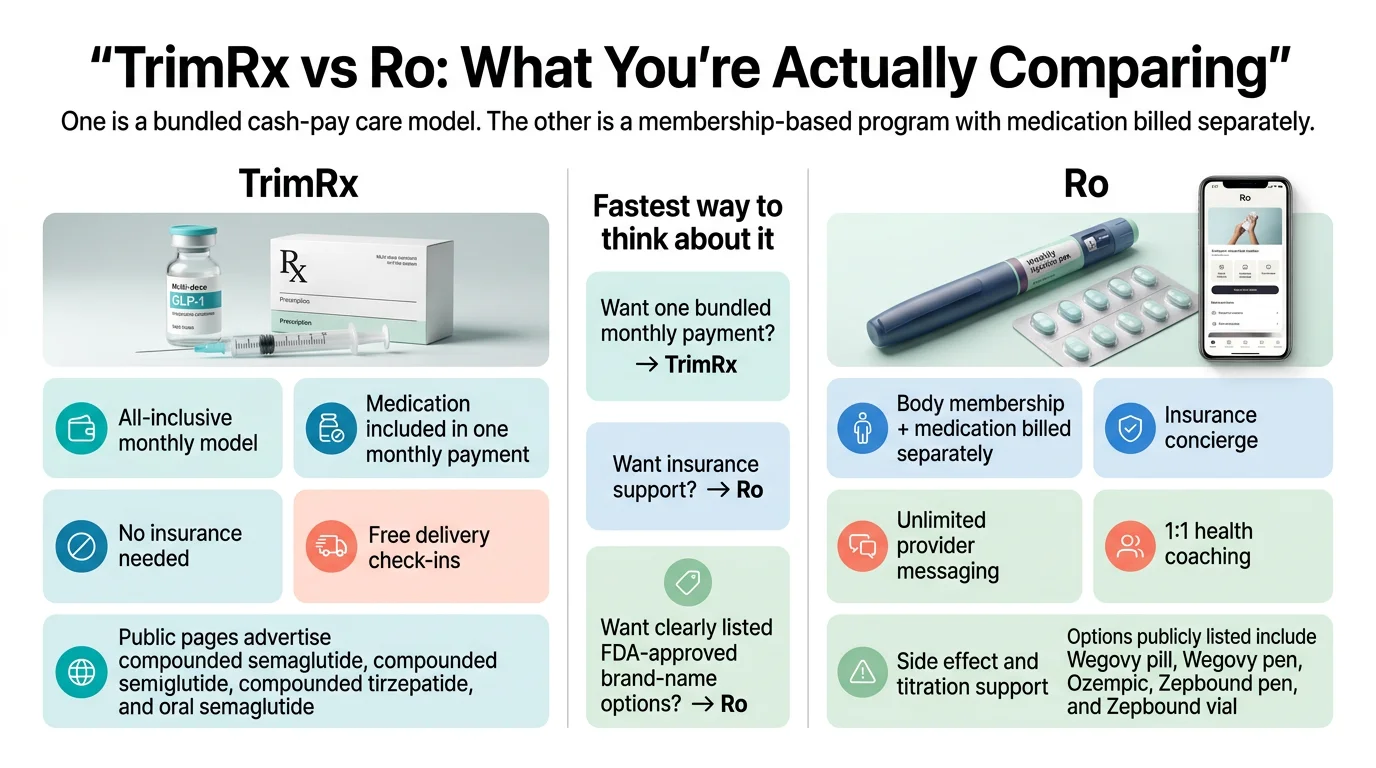
| TrimRx | Ro (Body Program) | |
|---|---|---|
| Best for | Cash-pay patients who want simple pricing | Patients with insurance or who want brand-name meds |
| Medication type | Compounded semaglutide & tirzepatide (not FDA-approved as finished products) | FDA-approved: Wegovy (pen + pill), Foundayo pill, Zepbound KwikPen, Zepbound vials. Ozempic (off-label). |
| Monthly membership fee | None — all-inclusive | $149/mo ($39 first month). Medication is separate. |
| Semaglutide, cash-pay total | From ~$199/mo (varies by plan length) | $149 membership + $149–$349 medication = $294–$494/mo |
| Tirzepatide, cash-pay total | From ~$349/mo (varies by plan length) | $149 membership + $299–$449 medication = $444–$594/mo |
| Oral (pill) option? | TrimRx advertises an oral semaglutide path — verify exact product and regulatory status at checkout | Yes — FDA-approved Wegovy pill (daily oral semaglutide) |
| Insurance accepted? | No — cash-pay only | Yes — concierge handles prior authorizations |
| Lab work required? | Not typically | Often yes (Quest or $75 at-home kit) |
| Price increases with higher doses? | No — flat rate at all dose levels | Yes — medication cost rises with dose |
| Coaching / app | Provider messaging, check-ins | Full app, weight tracker, nurse coaching, curriculum |
| Guarantee | Verify current refund/guarantee language at checkout before relying on it | No money-back guarantee |
| Cancellation | Month-to-month. Previously processed charges are non-refundable per TrimRx terms. Cancel via chat or phone. | Month-to-month. Cancel via account or email (48 hrs before billing). |
| HSA / FSA | Reported eligible — verify with your plan | Reported eligible — verify with your plan |
| Availability | 50 US states per TrimRx terms (exact medication availability may vary by state) | All 50 states + DC |
| Time to first dose | ~1 week | <1 week cash-pay · 2+ weeks insurance track |
A quick note on that table: TrimRx’s pricing varies by plan length and promotional windows. Their public pages currently market compounded semaglutide from $199/mo and compounded tirzepatide from $349/mo, with longer commitments typically offering lower per-month rates. Always confirm current pricing directly on trimrx.com.
Why This Comparison Is Harder Than It Looks
Most comparison pages give you a tidy “Provider A costs X, Provider B costs Y.” That’s not how either of these platforms actually works in 2026, and it’s exactly why so many people feel confused.
Ro isn’t one price. It’s a membership ($149/mo) plus your choice of medication, and those medication costs vary wildly depending on which drug, which dose, and whether insurance covers any of it. The Wegovy pill at the lowest dose starts at $149/mo cash-pay. Zepbound vials range from $299 to $449/mo depending on dose. Wegovy pens jump from $199/mo (promotional, first two months, lowest doses only) to $349/mo at higher doses. Add the $149 membership on top of every one of those numbers.
TrimRx isn’t one offer page either. Different landing pages on their site show different pricing depending on plan length and promotional windows. The standard listed price for compounded semaglutide is $349/mo, with promotions reducing it to approximately $199/mo. Standard compounded tirzepatide is listed at $449/mo, with promotions bringing it to approximately $349/mo. Which number you see depends on when you visit and what plan you choose.
And the FDA landscape shifted. In February 2025, the FDA determined the semaglutide injection shortage was resolved and subsequently announced plans to tighten restrictions on compounded GLP-1 products. The agency has logged hundreds of adverse-event reports tied to compounded semaglutide. This doesn’t mean compounded medication is inherently dangerous — but it does mean the regulatory ground is moving, and any honest comparison needs to acknowledge it.
And Ro just added the Wegovy pill. Oral semaglutide for weight loss is a game-changer for people who hate needles. But it’s only available through the cash-pay track, it has dose-dependent pricing that increases over time, and it changes who Ro makes sense for. Older comparison pages don’t mention it because it didn’t exist when they were written.
All of this means a straight “TrimRx costs X, Ro costs Y” comparison is misleading at best. Your real cost depends on your insurance status, your preferred medication, your dose trajectory, and how long you plan to stay on treatment. That’s why we built this page around scenario math instead of a single “starting at” number. We’re going to walk through each one — because the only comparison that matters is the one that matches your situation.
What Will You Actually Pay? Month-1 to Year-1 Math
This is the section most comparison pages skip. We won’t.
Here’s the reality: GLP-1 treatment is a long-term commitment. Clinical trials that demonstrated significant weight loss ran for 68 to 72 weeks. Most providers recommend at least 12 months. That means your annual cost matters far more than the first-month teaser.
Scenario 1: Cash-Pay Semaglutide
You’re paying out of pocket. No insurance help. You want semaglutide.
| TrimRx | Ro (Wegovy pill, lowest dose) | Ro (Wegovy pen, after promo) | |
|---|---|---|---|
| Month 1 | From ~$199 | $39 + $149 = $194 | $39 + $199 = $244 |
| Months 2–12 | From ~$199/mo | $149 + $149–$299 = $294–$444/mo | $149 + $349 = $494/mo |
| Year-1 total | From ~$2,388 | ~$3,428–$5,078 | ~$5,678 |
What this tells you: At TrimRx’s marketed pricing, you’d save roughly $1,000 to $3,200 over a year compared to Ro’s cash-pay paths. (TrimRx pricing may vary by plan length — confirm your exact rate before committing.)
The catch: TrimRx gives you compounded semaglutide. Ro gives you FDA-approved Wegovy. These are not the same product (more on that below). If you’re comfortable with compounded medication and want the lowest annual cost, TrimRx wins on price. If you specifically want FDA-approved medication without insurance, Ro’s Wegovy pill at the lowest dose is the least expensive brand-name option — but your cost rises as your dose increases, and you’re still paying the membership on top.
Scenario 2: Cash-Pay Tirzepatide
You want the dual-action GLP-1/GIP medication. No insurance.
| TrimRx | Ro (Zepbound vials, cash-pay) | |
|---|---|---|
| Month 1 | From ~$349 | $39 + $299 = $344 |
| Months 2+ | From ~$349/mo | $149 + $299–$449 = $444–$594/mo |
| Year-1 total | From ~$4,188 | ~$5,228–$6,878 |
TrimRx’s flat-rate pricing matters most with tirzepatide. Ro’s Zepbound vial pricing increases with dose — the starter (2.5 mg) is $299/mo, but higher doses jump to $399–$449/mo. TrimRx stays flat regardless of dose level. Over a year, that difference adds up.
Scenario 3: Insurance Through Ro (The Best-Case)
You have commercial insurance. You’re hoping it covers a GLP-1 for weight loss.
| Ro (best case) | TrimRx | |
|---|---|---|
| Membership | $149/mo | N/A |
| Medication (with insurance + savings card) | As low as $25/mo copay | No insurance option |
| Monthly total | ~$170/mo | From $199/mo |
| Year-1 total | ~$2,040 | From ~$2,388 |
When insurance works, Ro wins. Period. The $149 membership plus a $25 copay is cheaper than any TrimRx plan.
But here’s the reality. Coverage for weight-loss GLP-1s is inconsistent and often restrictive. KFF found only 19% of large employers covered GLP-1s for weight loss in 2024. Ro says about 43% of users who check insurance through their platform have some form of GLP-1 coverage. Ro’s insurance concierge will fight for you — but they can’t guarantee approval.
Scenario 4: The Insurance-Denied Reality (This Happens a Lot)
Walk with us through a common scenario we see in public reviews and forums:
- You sign up for Ro. Pay $39 first month.
- Complete the intake. Provider reviews your history. Labs may be ordered.
- Provider prescribes Wegovy or Zepbound.
- Insurance concierge submits prior authorization. You wait.
- Insurance denies coverage. (A common outcome for weight-loss GLP-1s.)
- Ro offers cash-pay alternatives: Zepbound vials ($299–$449/mo), Wegovy pill ($149–$299/mo), or other options your provider recommends.
- You’re now paying $149 membership + cash-pay medication. Total: $294–$594/mo.
- You’ve invested 2–3 weeks in the process.
If you’d started with TrimRx: $199–$449/mo, medication in hand within about a week.
We’re not saying Ro’s insurance path is bad. It’s the only path that could get you brand-name medication at a copay price. But if your plan doesn’t cover it, you’ve paid a membership fee and waited weeks for the same financial outcome as going cash-pay from the start.
Our suggestion: Before committing to Ro, call your insurance company and ask one question: “Does my plan cover Wegovy or Zepbound for weight loss?” If the answer is yes or likely, Ro’s insurance concierge can take it from there. If the answer is no or unknown, weigh whether the membership fee and wait time are worth the attempt.
What Happens When Your Dose Goes Up?
This catches people off guard — especially on Ro. GLP-1 treatment starts at a low dose and increases gradually over several months. With semaglutide, you typically start at 0.25 mg and titrate up to 2.4 mg. With tirzepatide, you start at 2.5 mg and may go up to 15 mg. Higher doses produce more weight loss in clinical trials, and most providers will increase your dose over the first 4–5 months.
TrimRx: Flat-rate pricing at all dose levels. Whether you’re on the starting dose or the maximum dose, your monthly cost stays the same. This is a meaningful advantage for a treatment that requires consistent dose increases.
Ro: Medication cost increases with dose for most options.
- Wegovy pill: $149/mo (1.5 mg) → $199/mo (4 mg, after promo expires April 2026) → $299/mo (9 mg and 25 mg)
- Wegovy pen: $199/mo (promo, first 2 months, lowest doses) → $349/mo (higher doses)
- Zepbound vials: $299/mo (2.5 mg) → $399/mo (5 mg) → $449/mo (7.5–15 mg)
This means your Ro cost in month 5 will likely be higher than your Ro cost in month 1 — sometimes significantly. On TrimRx, month 5 costs the same as month 1.
Hidden-Cost Checklist: What to Verify Before You Buy
Before you enter a credit card on either platform, confirm these:
For TrimRx:
- Which plan are you signing up for? Monthly, quarterly, annual? The marketed price may only apply to longer commitments.
- What is the rate if you choose a shorter plan or if a promotion expires?
- What happens if you cancel after submitting your medical intake? (TrimRx’s terms say previously processed charges are non-refundable.)
- Does your state allow compounded GLP-1 medications? Some have restrictions.
For Ro:
- The $39 first-month fee is the membership only. Medication is separate. What’s the total for both?
- Which medication will you likely be prescribed, and what’s the cash-pay cost at your expected dose?
- If insurance denies coverage, what are your alternatives and their costs?
- The membership auto-renews monthly. How quickly can you cancel if you need to?
- Is metabolic lab testing required? If using the at-home kit, that’s an additional $75.
What Medication Are You Actually Getting?
This is the part most comparison pages handle badly. They either dismiss compounded medication or dismiss brand-name medication, depending on who’s paying them. We’ll do neither.
What TrimRx Prescribes
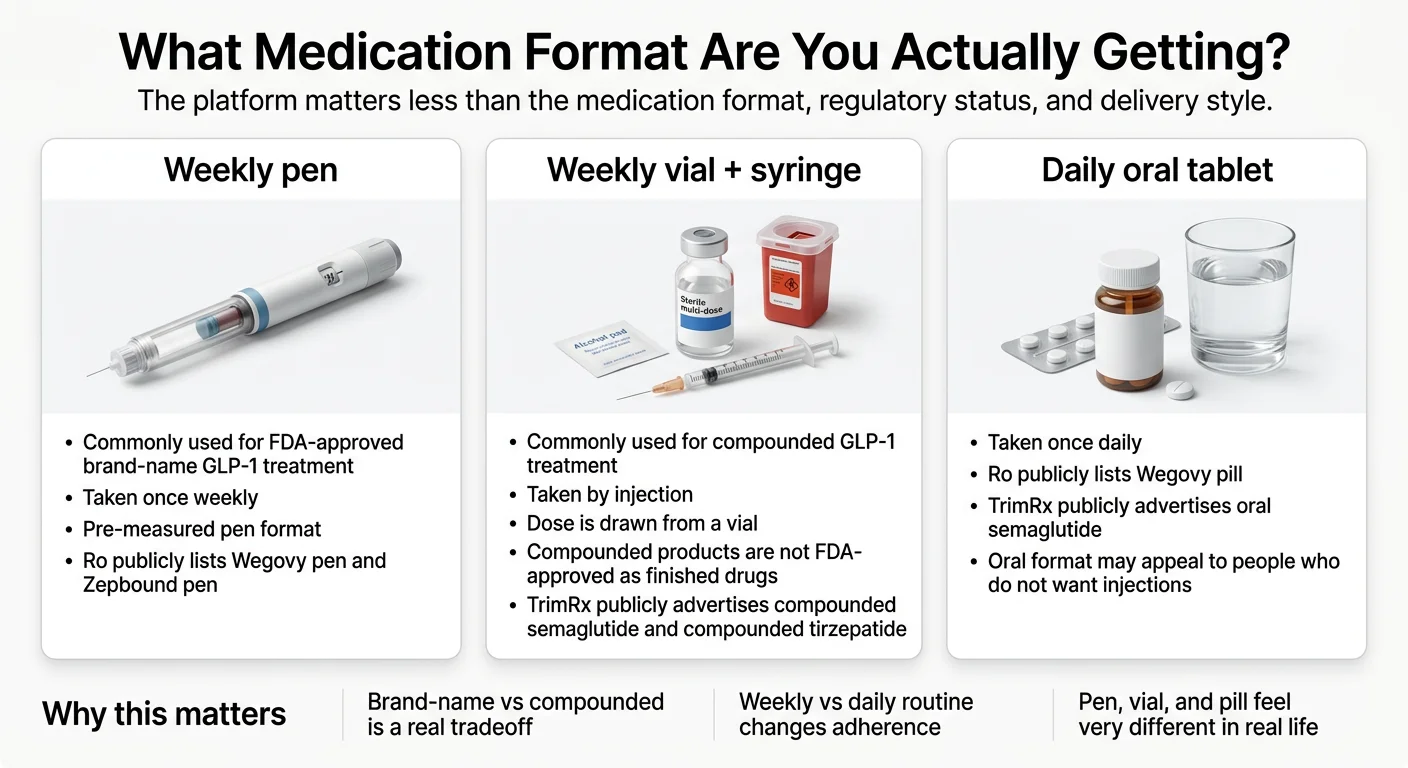
TrimRx primarily prescribes compounded semaglutide and compounded tirzepatide. Their public pages also advertise an oral semaglutide option — if an oral path matters to you, verify the exact product, formulation type, and regulatory status with TrimRx before purchasing. TrimRx states they partner with FDA-registered compounding pharmacies (their public pages reference both 503A and 503B facilities — verify the specific pharmacy filling your prescription and whether it operates as a 503B outsourcing facility, which is the higher regulatory tier).
TrimRx also lists FDA-approved branded medications (Wegovy, Ozempic, Zepbound) at significantly higher price points ($1,299+/mo), but their core value proposition and most-marketed programs center on compounded medications.
What Ro Prescribes
Ro’s primary approach is FDA-approved, brand-name medication. Their pricing page prominently lists Wegovy (pen and the newer daily pill), Zepbound (pen and vial), and Ozempic (FDA-approved for type 2 diabetes, but may be prescribed off-label for weight loss). Ro’s current public pricing page does not prominently feature compounded medication as a standard listed option — it leads with FDA-approved brand-name paths.
Ro also now offers the Wegovy pill — a daily oral form of semaglutide approved specifically for weight loss. This is a significant differentiator for anyone who doesn’t want to self-inject.
Compounded vs. FDA-Approved: What You Need to Understand
This matters. A lot. And it’s nuanced enough to deserve a clear explanation rather than a marketing spin.
FDA-approved medications (Wegovy and Zepbound for weight loss; Ozempic for type 2 diabetes, sometimes prescribed off-label for weight loss) have been through rigorous clinical trials involving thousands of patients. The FDA reviewed their safety, efficacy, and manufacturing processes before approving them. When you take Wegovy, you’re getting a product whose exact formulation was studied, tested, and monitored through the full regulatory pipeline.
Compounded medications are prepared by licensed pharmacies using pharmaceutical-grade ingredients. They are prescribed by licensed providers and filled by pharmacies that operate under state and federal regulation. However — and this is important — compounded medications are not FDA-approved as finished products. The FDA does not review compounded drugs for safety, effectiveness, or manufacturing quality the way it does brand-name drugs. Compounded formulations have not gone through the clinical trial process.
That doesn’t automatically make them unsafe. Compounding has a long, legitimate history in medicine. But it does mean the level of regulatory oversight is different. The risk profile is different. And the quality depends heavily on the specific pharmacy doing the compounding.
Some additional context: In February 2025, the FDA determined that the semaglutide injection shortage was resolved. Following that, the agency announced plans to tighten restrictions on mass-marketed compounded GLP-1 products and has reported hundreds of adverse events linked to compounded semaglutide formulations. This regulatory environment is evolving.
What this means for you: If you choose TrimRx’s compounded path, you’re choosing lower cost in exchange for a different regulatory standard. Ask which pharmacy compounds your medication. Verify whether it operates as a 503A or 503B facility (503B outsourcing facilities face more FDA oversight). Discuss with your provider whether compounded medication is appropriate for your situation.
If you choose Ro’s brand-name path, you’re choosing the full FDA-approval pipeline in exchange for higher cost. The medication has been through clinical trials. The manufacturing is directly overseen by the FDA.
Neither choice is universally “better.” It depends on your budget, your risk comfort, and what your healthcare provider recommends. We’re not doctors — we can’t tell you which to take. We can tell you the factual differences so you can have that conversation with someone who knows your health history.
Pill vs. Injection: Does It Matter?
More than you might think.
Injectable GLP-1s (which both TrimRx and Ro offer in various forms) are administered once weekly via subcutaneous injection — typically in the stomach, thigh, or upper arm. Brand-name injectables come in pre-filled pens that are relatively easy to use. Compounded injectables come in multi-dose vials that require you to draw the dose yourself with a syringe. This isn’t complicated, but it does require more care to get the dosing right.
The Wegovy pill (available through Ro) is a daily oral tablet and the first FDA-approved oral GLP-1 specifically for weight loss. You take it first thing in the morning on an empty stomach with no more than 4 ounces of water, then wait at least 30 minutes before eating, drinking, or taking other medications. TrimRx also advertises an oral semaglutide path on its website — if you’re considering that route, confirm the specific product, its regulatory status, and how it compares to the FDA-approved Wegovy pill.
The Wegovy pill is a real option if needles are a dealbreaker for you. But there are tradeoffs. It’s a daily medication (vs. weekly for injectables). It has specific fasting requirements that some people find inconvenient. And the currently available doses may not reach the highest therapeutic levels available in the injectable form. Your provider can help you decide if the pill is appropriate for your weight loss goals.
Semaglutide vs. Tirzepatide: A Quick Orientation
Both TrimRx and Ro offer access to semaglutide and tirzepatide medications, so the provider choice doesn’t lock you into one drug.
Semaglutide (the active ingredient in Wegovy and Ozempic) is a GLP-1 receptor agonist. In the STEP 1 clinical trial of the FDA-approved version, participants lost an average of ~15% of body weight over 68 weeks.
Tirzepatide (the active ingredient in Zepbound and Mounjaro) is a dual GLP-1 and GIP receptor agonist. In the SURMOUNT-1 clinical trial of the FDA-approved version, participants lost an average of ~20.9% of body weight over 72 weeks.
Tirzepatide showed greater average weight loss in trials, but it’s also more expensive across the board — brand-name or compounded. Some people start with semaglutide to test their tolerance and switch to tirzepatide if they plateau. Others start with tirzepatide from day one because they have more weight to lose and want the strongest option.
Both platforms let you discuss these options with your provider. On TrimRx, the choice between compounded semaglutide and compounded tirzepatide is made in consultation with your provider. On Ro, the choice between Wegovy, Zepbound, Ozempic, or another option depends on your insurance coverage, clinical profile, and provider recommendation.
Which Is Better for Your Situation?
Here’s where we stop talking in generalities and get specific. Find your situation.
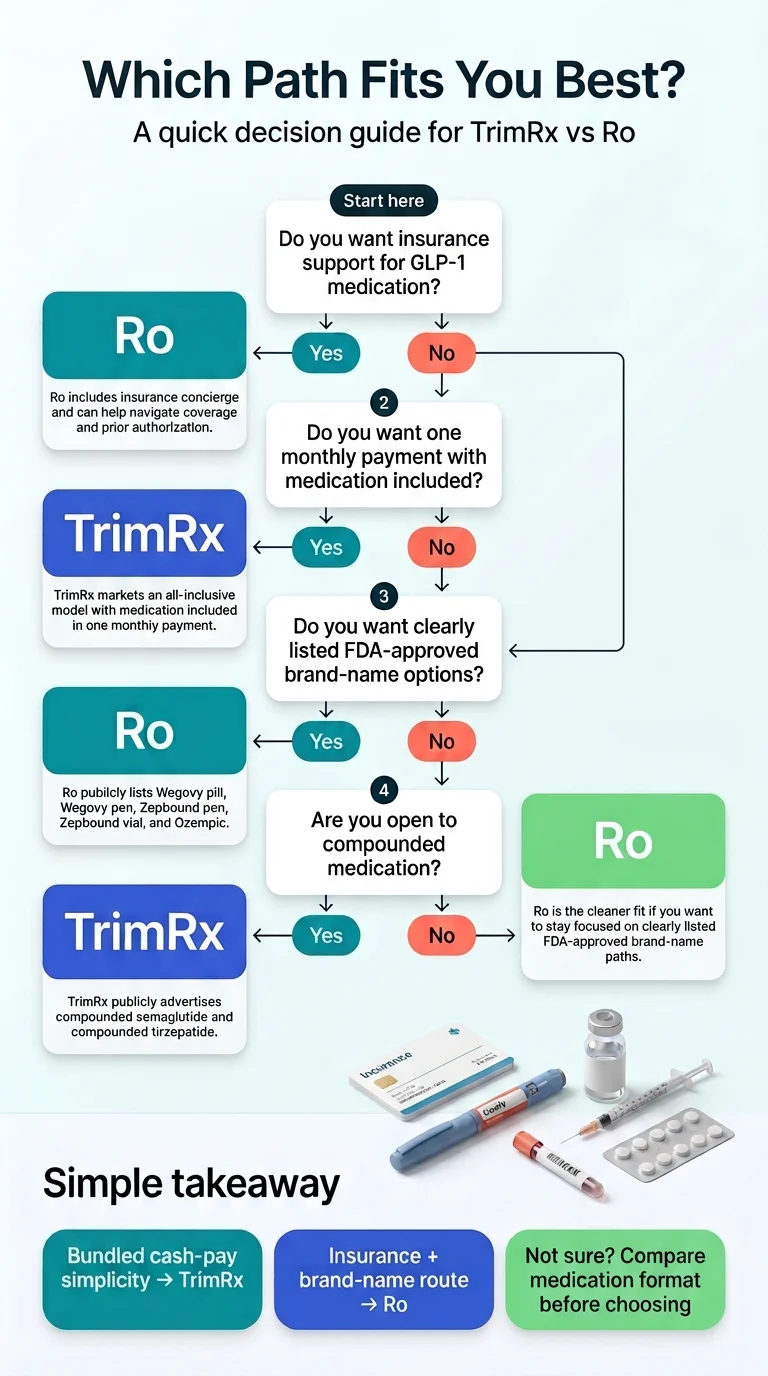
Paying cash, no insurance help
→ TrimRx is usually the simpler, cheaper option. You get one bill. Medication included. No membership fee stacked on top. If you’re comfortable with compounded medication and you want to minimize total spend, TrimRx’s model is built for you.
Commercial insurance that covers GLP-1s
→ Ro is usually worth the membership fee. If your insurance covers Wegovy or Zepbound, Ro’s concierge handles the prior authorization headache. Your total cost could drop to $170/mo (membership + copay). That’s potentially cheaper than TrimRx, and you’d be getting FDA-approved medication.
Insurance status unknown or unlikely
→ Start by calling your insurer. If they won’t cover it, TrimRx saves you from paying a $149/mo membership on top of cash-pay meds. If there’s a reasonable chance they’ll cover it, Ro’s concierge might be worth the gamble.
Want FDA-approved medication, no exceptions
→ Ro. TrimRx’s core offering is compounded. If brand-name matters to you or your doctor requires it, Ro is the only option between these two.
Afraid of needles
→ Ro has the clearest oral path. The FDA-approved Wegovy pill is a daily oral semaglutide tablet — no injection required. TrimRx also advertises an oral semaglutide option, but verify the specific product and its regulatory status before committing. Note: the Wegovy pill through Ro is cash-pay only, starting at $149/mo plus the $149 membership.
Want the simplest billing with no surprises
→ TrimRx. One number. One bill. No second charge for medication. No separate lab fee. No membership that runs whether or not you’re receiving medication that month.
Want tirzepatide at the lowest possible cost
→ TrimRx. Compounded tirzepatide through TrimRx is ~$349/mo (promo) with flat-rate dosing. Ro’s Zepbound vials start at $299/mo (2.5 mg) but increase to $449/mo at higher doses, plus the $149 membership. Over a year, TrimRx can save $1,000–$2,700 depending on dose.
Want structured coaching and an app
→ Ro. Ro includes a full mobile app with weight tracking, a Body Curriculum, weekly nurse coaching, and provider messaging. TrimRx offers provider messaging and check-ins but doesn’t have the app infrastructure or coaching depth that Ro provides.
How Each Provider Works After You Sign Up
You’ve picked a provider. Now what? Here’s the step-by-step, side by side, so you know exactly what to expect.
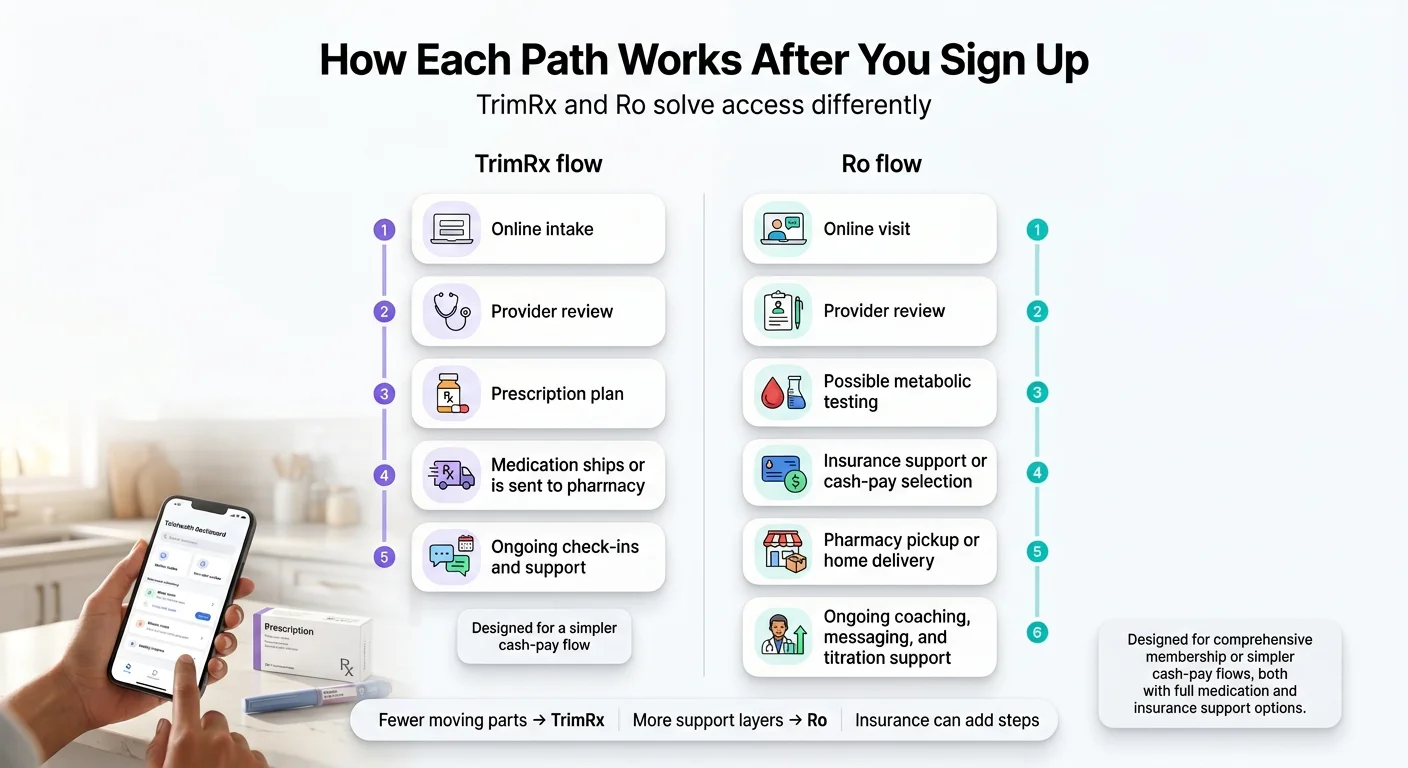
TrimRx Process
- Step 1 — Health questionnaire. Complete an online intake covering your health history, current medications, BMI, and weight loss goals. Takes 5–10 minutes.
- Step 2 — Provider review. A licensed healthcare provider reviews your submission. TrimRx states they use board-certified providers, though the specific credential level may vary.
- Step 3 — Prescription. If approved, your provider prescribes compounded semaglutide or tirzepatide based on your health profile and goals.
- Step 4 — Medication ships. Compounded medication is shipped from a partner pharmacy directly to your door. TrimRx reports most patients receive medication within approximately one week.
- Step 5 — Ongoing care. Provider check-ins, dose adjustments (included at no extra cost), and messaging support throughout treatment.
Ro Process
- Step 1 — Online intake. Answer questions about health history, goals, and insurance status. Pay the $39 first-month membership fee.
- Step 2 — Provider evaluation. A licensed provider reviews your information. They may order metabolic lab testing (Quest Diagnostics in-network, or $75 at-home kit).
- Step 3 — Insurance check. If you’re using insurance, Ro’s concierge contacts your insurer, submits prior authorization if needed, and fights for coverage. This can take 1–2+ weeks.
- Step 4 — Prescription. Based on insurance outcome and clinical judgment, your provider prescribes a GLP-1 — typically Wegovy, Zepbound, or Ozempic (off-label for weight loss).
- Step 5 — Medication delivery. Brand-name medications may be shipped directly or sent to your pharmacy depending on the drug. Cash-pay options (Zepbound vials, Wegovy pill) ship directly via manufacturer partnerships (LillyDirect, NovoCare). Timing: under a week for cash-pay, 2+ weeks for insurance track.
- Step 6 — Ongoing care. Monthly check-ins, unlimited provider messaging, weekly nurse coaching, Body Curriculum content, and app-based tracking. Insurance concierge continues working if your coverage situation changes.
The honest takeaway: Ro’s process is more thorough but slower, especially if you’re going through insurance. TrimRx is faster but lighter-touch. Neither is objectively better — it depends on whether you value speed and simplicity or comprehensiveness and insurance support.
Refill Process: How Does Ongoing Treatment Work?
TrimRx: Monthly shipments. Your provider manages dose adjustments as part of your ongoing plan. Refill reminders are handled through their platform. Dose increases don’t change your price.
Ro: Monthly refills coordinated through the membership. For brand-name medications, refills go through your pharmacy or manufacturer partner (LillyDirect for Zepbound, NovoCare for Wegovy). For Ro’s cash-pay options, medication ships directly. Ro requires regular check-ins to maintain your prescription — for Zepbound vials specifically, if you miss a 45-day refill check-in window, you may lose your discounted manufacturer pricing on higher doses and get charged the full price.
That Zepbound refill detail is worth highlighting. If you’re on Ro’s Zepbound vials at 7.5 mg or above with the manufacturer discount ($449/mo), you need to complete your refill check-in within 45 days of your last delivery. Miss it, and the price jumps. Ro sends reminders, but this is a billing trap worth knowing about.
Safety, Side Effects, and Who Should Think Twice
GLP-1 medications — whether brand-name or compounded — carry the same general class of side effects because they work on the same biological pathways. Here’s what you should know.
Common Side Effects
Nausea is the big one, especially in the first few weeks and whenever your dose increases. Vomiting, diarrhea, constipation, and stomach pain are also common. These typically improve over time as your body adjusts. Starting at a low dose and increasing gradually (which both TrimRx and Ro providers should do) reduces the severity.
For our full breakdown of GLP-1 side effects, see our complete Mounjaro side effects guide.
Serious Risks
All GLP-1 medications carry an FDA boxed warning about thyroid C-cell tumors observed in animal studies. The clinical significance in humans hasn’t been established, but these medications are contraindicated if you have a personal or family history of medullary thyroid carcinoma (MTC) or Multiple Endocrine Neoplasia syndrome type 2 (MEN 2).
Other serious but less common risks include pancreatitis, gallbladder problems, kidney issues, and severe allergic reactions. (Source: FDA prescribing information for Wegovy and Zepbound.)
Why Compounded Safety Questions Are Different
With FDA-approved medications, the manufacturing process is directly inspected and regulated by the FDA. Potency, purity, and sterility are verified before the product reaches you.
With compounded medications, the oversight structure is different. 503B outsourcing facilities (the higher regulatory tier) must register with the FDA and follow current good manufacturing practices, but they are not subject to the same pre-market review process. 503A pharmacies operate under state oversight. The quality of a compounded product depends on the specific pharmacy.
The FDA has reported adverse events linked to compounded semaglutide, including dosing errors from multi-dose vials (which require patients to draw their own doses, unlike pre-filled pens). This is a real risk factor worth discussing with your provider.
If you have a complex medical history, multiple medications, or health conditions beyond obesity, talking to your own doctor — not just a telehealth provider — is strongly recommended before starting any GLP-1 program.
What to Realistically Expect in Your First Month
We want to set honest expectations, because unrealistic ones lead to people quitting too early.
Weeks 1–2: You’ll start on the lowest dose. Most people don’t see dramatic weight loss yet — the starting dose is about letting your body adjust. Nausea is most likely during this period. Eat smaller meals. Stay hydrated. Avoid greasy or heavy foods. This is normal.
Weeks 3–4: Your appetite will likely start to decrease noticeably. You may find yourself thinking about food less often. Some people lose 2–5 pounds in the first month; others lose less. This is not the “before and after” phase yet.
Why this matters for the TrimRx vs Ro decision: If you start a program and feel disappointed after two weeks because you haven’t dropped 15 pounds, that’s not a platform problem — it’s an expectations problem. Clinical trials measured results over 68–72 weeks, not 4 weeks. Commit to the process for at least 3 months before evaluating whether it’s “working.”
This is also why cancellation policies matter. If you sign up, try it for two weeks, feel nauseous, and want to quit — understand the financial implications of early cancellation on either platform before that situation arises.
This content is educational and not medical advice. Always consult a licensed healthcare provider before starting any medication.
Cancellation, Refunds, and Billing Surprises
This section exists because of real complaints from real people. Pricing confusion and cancellation friction are the two biggest grievances we found in public reviews for both providers. If you read one section carefully before entering a credit card, make it this one.
How to Cancel TrimRx
TrimRx advertises month-to-month billing with no long-term contracts. Their FAQ states you can cancel via chat or phone. However, there are important details:
Watch for this: TrimRx’s terms state that previously processed charges are non-refundable. Their public pages also say there are “no hidden initiation fees or cancellation penalties” — but multiple public reviews on Trustpilot and BBB mention difficulty getting refunds after intake submission. The practical reality may differ from the marketing language. Verify the exact refund policy in your checkout flow before submitting payment.
Before you sign up: Understand that submitting the intake form may trigger charges that are difficult or impossible to reverse. If you’re still comparing options, do your research before entering payment information.
How to Cancel Ro
Ro’s membership is month-to-month. You can cancel through your account (Plan → Cancel Plan) or by emailing support. Cancel at least 48 hours before your next billing date to avoid the next month’s charge.
Watch for this: The $149 monthly membership fee is non-refundable for the current billing cycle once charged. This means if you cancel on day 3 of your billing cycle, you won’t get a prorated refund for the remaining days. The membership also continues billing whether or not you’re actively receiving medication — if you’re waiting for insurance approval, switching meds, or taking a break, the membership still charges unless you explicitly cancel.
The most common complaint pattern we found across BBB, Trustpilot, and PissedConsumer reviews for Ro: people sign up thinking the $39 (or $149) is the total cost, then discover medication is billed separately. To be fair, Ro does disclose this on their pricing page. But the advertising emphasis on “$39 first month” without equally prominent disclosure of the separate medication cost catches people off guard.
Before You Enter a Credit Card Anywhere
Regardless of which provider you choose, do these three things:
- Screenshot the pricing page with the date visible. Pricing changes. Having a record of what was advertised when you signed up protects you.
- Read the cancellation and refund policy — not the FAQ summary, the actual terms. Look for phrases like “non-refundable,” “processing fee,” and “auto-renewal.”
- Ask support one question before paying: “If I’m not approved, or if I change my mind after intake, what exactly is refundable?” Get it in writing.
Is TrimRx Legit? Is Ro Worth It?
Both are real, licensed telehealth companies. But “legit” and “worth it” are different questions.
TrimRx
TrimRx is a telehealth platform focused primarily on compounded GLP-1 medications. Their Trustpilot profile is generally positive. Positive reviews highlight fast approval, clear pricing, and effective medication. Negative reviews — more concentrated on BBB, Reddit, and review-aggregation sites — focus on billing disputes, difficulty getting refunds after intake submission, and occasional customer support delays.
One pattern worth noting: TrimRx’s Trustpilot profile is significantly more positive than its BBB and Reddit presence. This split is common in the telehealth space and may reflect different reviewer demographics, but it’s worth keeping in mind.
Ro
Ro (formerly Roman) has been operating since 2017 and has served millions of patients across weight loss, sexual health, hair loss, and other categories. Their Trustpilot profile is mixed, and scores vary widely across review platforms. On ConsumerAffairs, Ro generally scores better than on complaint-focused sites.
The dominant complaint theme for Ro is pricing confusion — specifically, people not realizing the membership and medication are separate costs. Secondary complaints include prescription delivery delays and difficulty reaching support. Positive review themes include quality of care, helpful insurance concierge, and effective medication.
Our Trust Assessment
Both providers operate within the law, employ licensed providers, and deliver real medication. Both also have real customer service gaps that show up in public reviews. The trust question is really about transparency and expectations:
- TrimRx is transparent on total price but less transparent on refund/cancellation friction. Know the intake-submission policy before you pay.
- Ro is transparent in its terms but the marketing emphasis on low intro pricing creates mismatched expectations. Know that medication is always a separate cost.
Go in with clear expectations and you’ll avoid the most common frustrations.
Complaint Themes Worth Knowing
We categorized public complaints by theme to give you a clearer picture than star ratings alone.
TrimRx — most common complaint themes:
- Billing/refund friction: Charges after intake submission with limited refund options.
- Customer support delays: Slow response times, especially for billing questions.
- Shipping delays: Occasional reports of medication arriving later than expected.
- Expectation mismatch: Some users expected brand-name medication and received compounded.
Ro — most common complaint themes:
- Pricing confusion: Far and away the #1 complaint. People think $39 or $149 covers everything. It doesn’t.
- Insurance denial frustration: Waited weeks for approval, got denied, now stuck choosing cash-pay options.
- Prescription/refill delays: Some users report gaps between refills.
- Cancellation difficulty: Some reviews mention trouble finding the cancel button or being charged after attempting to cancel.
These are patterns from publicly posted reviews, not isolated incidents. We didn’t verify each individual claim — but when the same theme appears across multiple platforms (Trustpilot, BBB, PissedConsumer), it’s worth paying attention to.
Insurance, HSA, FSA, and Government Plans
Does Ro Accept Insurance?
Yes — for medication. Ro’s insurance concierge will contact your insurer, submit prior authorizations, and fight for coverage of your prescribed GLP-1. If your plan covers Wegovy or Zepbound, this service is genuinely valuable and can dramatically reduce your medication cost.
However: the $149/mo membership itself is cash-pay only. Insurance does not cover it.
Does TrimRx Accept Insurance?
No. TrimRx is a cash-pay platform. They do not submit claims to insurance or coordinate coverage. Their model is built around avoiding insurance complexity entirely.
What If Your Insurance Covers Wegovy or Zepbound?
Then Ro is almost certainly the better financial choice. With a manufacturer savings card (available for commercially insured patients), your medication copay could drop to $25/mo. Total: $149 membership + $25 copay = $170/mo. That’s hard to beat.
Medicare, Medicaid, or TRICARE?
This landscape is changing. CMS announced the BALANCE Model in December 2025 — a voluntary program that will negotiate GLP-1 pricing with manufacturers for Medicare Part D and Medicaid. Medicaid access under BALANCE can begin as early as May 2026 for participating states. For Medicare Part D beneficiaries, a separate short-term program called the Medicare GLP-1 Bridge will begin in July 2026, providing eligible beneficiaries access to Wegovy and Zepbound at a $50/month copay. Broader Part D access under BALANCE is delayed — check cms.gov for the current launch date.
However, this coverage depends on manufacturer participation, state/plan sponsor opt-in, and individual qualification criteria. It is not guaranteed for any individual. Neither TrimRx nor Ro currently coordinates coverage for government insurance plans (Ro makes an exception for FEHB). If you’re on Medicare or Medicaid and the BALANCE/Bridge programs aren’t yet available in your area, talk to your prescribing doctor about brand-name medications through your regular pharmacy.
Can You Use HSA or FSA?
Both TrimRx and Ro report that their services may be HSA/FSA eligible. However, eligibility varies by plan. Check with your specific plan administrator before assuming coverage. GLP-1 medications prescribed for weight loss have historically qualified, but administrators interpret the rules differently.
State Availability and Shipping
Ro operates in all 50 states and Washington, D.C. Brand-name medications are available nationwide, though some compounded formulations have state-specific restrictions.
TrimRx states in its terms that products are available to customers in the 50 US states, though exact medication and pathway availability may vary depending on state compounding regulations.
Shipping speed: TrimRx reports approximately one week to first delivery. Ro’s cash-pay medications ship in under a week. Ro’s insurance-track medications may take 2+ weeks depending on the prior authorization process and pharmacy coordination. Both providers ship to your door. Ro’s brand-name pens may also be sent to your local pharmacy depending on insurance requirements.
The Long-Term View: What This Costs Over 18 Months
GLP-1 treatment isn’t a quick fix. The clinical trials that showed 15–20% weight loss ran for 68 to 72 weeks. Most obesity medicine specialists recommend a minimum of 12 months, with many patients staying on medication for 18+ months or transitioning to a lower maintenance dose indefinitely.
Here’s why that matters for this decision:
18 months on TrimRx compounded semaglutide (marketed rate): From ~$199 × 18 = from ~$3,582
18 months on Ro, Wegovy pill (assuming dose increases): ($39 + $149) + ($149 + $149) × 3 + ($149 + $199) × 6 + ($149 + $299) × 8 = roughly $6,000–$7,200 depending on dose timing
18 months on Ro with insurance covering medication: ($39 + $25) + ($149 + $25) × 17 = roughly $3,022
The insurance-covered Ro path remains the cheapest option long-term — if your insurance actually covers it. The cash-pay gap between TrimRx and Ro widens significantly over time because Ro’s dose-dependent pricing and membership fee compound every single month.
This is the math that should drive your decision. Not the first-month price. The 12- to 18-month total.
What If Neither TrimRx nor Ro Fits You?
Not everyone lands neatly in one of these two camps. A few alternatives worth knowing about:
If you want a different compounded provider: Platforms like Hims/Hers, SkinnyRx, and MEDVi also offer compounded GLP-1 programs at competitive price points. Each has a different pricing model, different pharmacy partnerships, and different levels of support. We compare all major GLP-1 providers in our complete provider comparison.
If you want a physician-led obesity medicine clinic: Some patients benefit from in-person care with a board-certified obesity medicine specialist — particularly if you have comorbidities like type 2 diabetes, cardiovascular disease, sleep apnea, or PCOS. The Obesity Medicine Association has a provider directory at obesitymedicine.org.
If your PCP already prescribed a GLP-1: You may not need a telehealth platform at all. Fill the prescription at your retail pharmacy, use manufacturer savings programs (NovoCare for Wegovy/Ozempic, LillyDirect for Zepbound), and skip the middleman.
If you’ve already tried a GLP-1 and it didn’t work: Talk to a provider about switching between semaglutide and tirzepatide. Some patients who plateau on one respond well to the other. Both TrimRx and Ro offer both medication types, so you don’t necessarily need to switch platforms to switch drugs.
Not sure which GLP-1 provider fits you?
Take our free 60-second matching quiz. We’ll map your health profile, budget, and insurance to the options that actually fit.
Take the Free GLP-1 QuizHow We Evaluated TrimRx vs Ro
Transparency matters, especially on a page like this. Here’s exactly what we checked and when.
Pricing verification: We pulled pricing directly from trimrx.com and ro.co/weight-loss/pricing/ on March 11, 2026. We cross-referenced against third-party reports published in the same time frame.
Policy verification: We reviewed Ro’s terms of service (ro.co/terms-of-use/) and pricing disclosures. We reviewed TrimRx’s published pricing, refund language, and FAQ sections across multiple pages on trimrx.com.
Public review analysis: We read through Trustpilot, BBB complaints, PissedConsumer, ConsumerAffairs, and Reddit discussions for both providers. We categorized complaints by theme rather than cherry-picking individual reviews.
Regulatory sources: We referenced FDA prescribing information for Wegovy (semaglutide) and Zepbound (tirzepatide), FDA communications regarding compounded GLP-1 products, and publicly available clinical trial data (STEP program for semaglutide, SURMOUNT program for tirzepatide).
What we didn’t do: We did not personally enroll in both services for this specific comparison. We did not independently test medication from either provider. We are not healthcare providers and this content is not medical advice.
Affiliate relationship: We may earn commissions from links on this page. This does not influence our analysis — we recommend Ro as the better choice in several scenarios above. Our business model depends on giving you the right recommendation for your situation, not the most profitable one for us.
Update schedule: We re-verify pricing at least monthly. If you notice outdated information, email us at corrections@weightlossproviderguide.com and we’ll update within 48 hours.
Claim verification log: We maintain timestamped screenshots of all pricing pages and terms referenced in this article. A detailed verification log — including the specific claim, source URL, date checked, and screenshot — is available in our editorial archive. This is how we hold ourselves accountable to accuracy.
TrimRx vs Ro FAQ
Is TrimRx cheaper than Ro?
For cash-pay patients, generally yes. TrimRx's all-inclusive compounded semaglutide pricing starts from ~$199/mo vs. Ro's $294/mo minimum (membership + cheapest medication). If you have insurance that covers GLP-1s, Ro could end up cheaper.
Does Ro's $149/month include medication?
No. The $149/mo Ro Body membership covers provider consultations, coaching, the insurance concierge, and app access. Medication is always a separate charge — from $149/mo (Wegovy pill, lowest dose) up to $449+/mo depending on the drug and dose.
Is TrimRx compounded semaglutide FDA-approved?
No. Compounded medications are not FDA-approved as finished products. They are prepared by licensed compounding pharmacies using pharmaceutical-grade ingredients, but they have not gone through the FDA's clinical trial and approval process. The FDA does not evaluate compounded drugs for safety, effectiveness, or quality before they are dispensed.
Does Ro offer a pill instead of injections?
Yes. Ro now offers the Wegovy pill — a daily oral semaglutide tablet. It's the first FDA-approved oral GLP-1 for weight loss. Available as a cash-pay option through Ro, starting at $149/mo for the lowest dose (plus the $149/mo membership).
Can I get the Wegovy pill through TrimRx?
TrimRx does not offer the FDA-approved Wegovy pill. However, TrimRx advertises an oral semaglutide option on its website — verify the specific product and its regulatory status directly with TrimRx. For the FDA-approved Wegovy pill specifically, Ro is the clearer current option.
Does TrimRx offer Wegovy or Zepbound?
Not through their standard compounded program. TrimRx's core offering is compounded semaglutide and compounded tirzepatide. They do list branded medications on their site at significantly higher price points ($1,299+/mo), but their value proposition centers on the compounded path.
How fast can I start medication?
TrimRx: approximately 1 week from signup to medication delivery. Ro: under a week for cash-pay options, 2+ weeks if going through the insurance track (prior authorization can add significant time).
Can I cancel TrimRx anytime?
TrimRx advertises month-to-month billing with cancellation available via chat or phone. However, their terms state that previously processed charges are non-refundable. Verify the exact refund policy in your checkout flow before submitting payment.
Can I cancel Ro anytime?
Yes. Cancel through your account dashboard or by emailing support at least 48 hours before your next billing date. The current month's membership fee is non-refundable.
What if insurance denies my GLP-1 through Ro?
Your provider will suggest cash-pay alternatives — Zepbound vials, Wegovy pill, or other options based on your clinical profile. The $149/mo membership continues regardless. At that point, compare TrimRx's all-in pricing against Ro's membership + cash-pay medication cost.
Which provider has better customer support?
Ro has more infrastructure — a full app, nurse coaching, insurance concierge. TrimRx offers provider messaging, check-ins, and states that cancellation can be handled via chat or phone. Ro relies primarily on in-app messaging and email. Both have received customer service complaints in public reviews.
Can I use my HSA or FSA?
Both providers report HSA/FSA eligibility, but coverage varies by plan. Verify with your plan administrator before relying on this.
Are the side effects different between TrimRx and Ro?
Side effects are related to the medication class (GLP-1 receptor agonists), not the platform. Nausea, vomiting, diarrhea, and constipation are the most common. These typically improve with time. The boxed warning about thyroid tumors applies to all GLP-1 medications. Discuss risks with your provider regardless of which platform you use.
Is one more effective for weight loss than the other?
Effectiveness depends on the medication and your body's response, not the platform. FDA-approved semaglutide (Wegovy) showed average weight loss of ~15% in clinical trials. FDA-approved tirzepatide (Zepbound) showed ~20.9%. Compounded formulations have not undergone their own clinical trials, so there is no equivalent trial data specifically for compounded versions.
Which is better if semaglutide stops working for me?
Both platforms offer a tirzepatide option. TrimRx offers compounded tirzepatide at ~$349/mo. Ro offers Zepbound (FDA-approved tirzepatide) at $299–$449/mo plus the membership fee. Having a fallback option matters because some patients plateau on semaglutide and benefit from switching.
Should I just go to my regular doctor instead?
If you have a good relationship with your PCP and they're willing to prescribe a GLP-1, that can work well — especially if your insurance covers office visits and medication. You'd skip the platform fees entirely. The main reasons people use telehealth platforms are convenience, speed, and access to compounded options that aren't available through traditional pharmacies.
What if I want to switch from Ro to TrimRx?
Cancel your Ro membership (through your account or email). Sign up with TrimRx. Your new provider will evaluate your history and determine the appropriate starting dose or continuation dose. Time it so you don't have a gap between your last Ro refill and your first TrimRx shipment.
Which should I pick if I'm still unsure?
Ask yourself one question: Do I have insurance that's likely to cover a GLP-1 for weight loss? If yes, start with Ro — the potential savings from insurance coverage are significant. If no, TrimRx's simpler pricing model is hard to beat for cash-pay patients.
Final Verdict: TrimRx vs Ro
After breaking down the real cost, the medication differences, the insurance math, and the cancellation fine print, here’s where we land:
TrimRx is the better path
for cash-pay patients who want simple, bundled pricing and are comfortable with compounded GLP-1 medication. You’ll know your total before you pay. Your price won’t jump when your dose increases. And you won’t pay a membership fee that runs independently of your medication. For someone paying $199/mo for 12 months of compounded semaglutide, TrimRx delivers a straightforward, budget-friendly experience — as long as you understand that compounded medications have a different regulatory status than brand-name products.
Ro is the better path
for patients with strong commercial insurance, anyone who specifically wants FDA-approved brand-name medication, and anyone who wants the Wegovy pill (oral semaglutide). If your insurance covers it, Ro’s total cost can be lower than any compounded alternative. The insurance concierge alone is worth the membership if your plan has a reasonable chance of approval. And for patients who don’t want to self-inject, the Wegovy pill is a genuine differentiator that no compounded-only platform can match right now.
The most expensive mistake is not choosing the wrong provider — it’s not understanding the pricing model before you commit. Ro’s layered billing confuses a lot of people. TrimRx’s cancellation terms catch others off guard. The second most expensive mistake is comparing first-month teaser pricing instead of your realistic 12-month total. This is long-term treatment, and the annual math is what should guide your choice.
We built this page because most exact-match comparisons we found were either provider-owned or light on current pricing detail. Every existing comparison was either written by one of the providers themselves (obvious bias) or was a thin overview that told you to “contact providers for pricing” instead of giving you the actual numbers. That’s not helpful. You deserve the real math, the real tradeoffs, and an honest recommendation based on your situation — not ours.
Still not sure which GLP-1 program is right for you?
Take the Free 60-Second Matching QuizSources
Provider pricing and terms:
- Ro weight loss pricing page — ro.co/weight-loss/pricing/ (verified March 11, 2026)
- TrimRx website — trimrx.com (verified March 11, 2026)
- Ro terms of service — ro.co/terms-of-use/ (reviewed March 2026)
FDA and regulatory:
- FDA: Wegovy (semaglutide) prescribing information — accessdata.fda.gov
- FDA: Zepbound (tirzepatide) prescribing information — accessdata.fda.gov
- FDA: Compounding and the FDA — fda.gov/drugs/human-drug-compounding
- FDA: Safety information on compounded semaglutide products — fda.gov
Clinical trial data:
- STEP 1 trial (semaglutide/Wegovy): Wilding et al., New England Journal of Medicine, 2021
- SURMOUNT-1 trial (tirzepatide/Zepbound): Jastreboff et al., New England Journal of Medicine, 2022
Third-party reviews analyzed:
- Trustpilot — trustpilot.com/review/trimrx.com
- Trustpilot — trustpilot.com/review/ro.co
- Better Business Bureau — bbb.org (Ro complaint filings)
- ConsumerAffairs — consumeraffairs.com/health/ro.html
- PissedConsumer — ro.pissedconsumer.com
Pricing last verified: March 11, 2026
Medical Disclaimer: This content is for informational purposes only and does not constitute medical advice. GLP-1 medications are prescription treatments that require evaluation by a licensed healthcare provider. Compounded medications are not FDA-approved finished products. Always consult your doctor before starting, stopping, or changing any medication. Individual results vary. Weight loss outcomes depend on medication adherence, lifestyle modifications, and individual health factors.
Affiliate Disclosure: WeightLossProviderGuide.com is an affiliate site. We earn commissions when readers sign up with providers through our links. This never changes what we recommend or how we present the evidence. See our advertising disclosure for details.
Related Articles
TrimRx vs WeightWatchers Clinic 2026 [Cost + FDA Status]
TrimRx from ~$149/mo (meds included) vs WeightWatchers Clinic ($74/mo + meds). Real 2026 cost math, FDA-approved vs compounded, and who each one fits.
TrimRx vs Yucca Health: Cost, Reviews & Verdict
TrimRx vs Yucca Health: verified live pricing, refund terms, real Trustpilot data, and FDA status. See who fits cash-pay GLP-1 shoppers in 2026.
MEDVi Tirzepatide vs Semaglutide: Which Fits You?
MEDVi tirzepatide vs semaglutide (2026): SURMOUNT-5 trial showed 20.2% vs 13.7% weight loss. Verified starting prices, side effects, dosing +
MEDVi vs Found 2026: Real Cost, Tradeoffs & Best Fit
MEDVi vs Found compared. May 2026 pricing, 12-month cost math, insurance rules, cancellation gotchas, FDA context, and the right pick for you.
MEDVi vs Gala GLP-1: Pricing & Best Fit
MEDVi vs Gala GLP-1 compared: verified pricing, FDA warning letter context, BBB & Trustpilot data, cancellation rules, and who should choose each in 2026.
MEDVi vs Hims: Pricing, Plans & Which Is Better
MEDVi: $179/mo, no contract, cancel anytime. Hims: $199/mo but $1,194 upfront. One lets you walk away — the other doesn't. Full 2026 breakdown.