SkinnyRx vs MEDVi: Which GLP-1 Program Fits You Best in 2026?
If you've been going back and forth between SkinnyRx vs MEDVi, you're probably two browser tabs deep and more confused than when you started. Every site says something slightly different about pricing. Nobody mentions the FDA warning letters from last month. And you still can't figure out which one is actually better for you.
We spent the past several weeks pulling apart both programs — their real pricing, their official refund policies, their medication options, their regulatory history, and what actual customers are saying on platforms we trust. Here's what we found.
Disclosure: Some links on this site are affiliate links. If you purchase through these links, we may earn a commission at no extra cost to you. Thank you for supporting our site.·For informational purposes only—not medical advice.
Important 2026 Update
On February 20, 2026, FDA posted warning letters to both SkinnyRx and MEDVi for misleading compounded-drug claims. Most comparison pages online were written before these letters existed. This guide explains what changed, what it means for you, and which provider still fits your situation. Read the FDA update below.
Sources include FDA warning letters, official provider websites, published terms and refund policies, Trustpilot, and ConsumerAffairs.
Best if needle-free options matter: SkinnyRx
Oral tablets, sublingual drops, and injectables across both semaglutide and tirzepatide — one of the widest format selections available. Free overnight shipping on every order. All 50 states.
Best if you want bundled clinical support: MEDVi
Semaglutide injections start at $179 for the first month (before rising to $299/mo), with 24/7 messaging, optional video consultations, and ongoing clinician guidance.
Skip both if you want FDA-approved medication only: Neither
Neither is the right choice if you only want FDA-approved medication, if your insurance already covers Wegovy or Zepbound at a manageable copay, or if the recent FDA warning letters are a dealbreaker. Talk to your doctor about brand-name options or NovoCare.
SkinnyRx vs MEDVi at a Glance
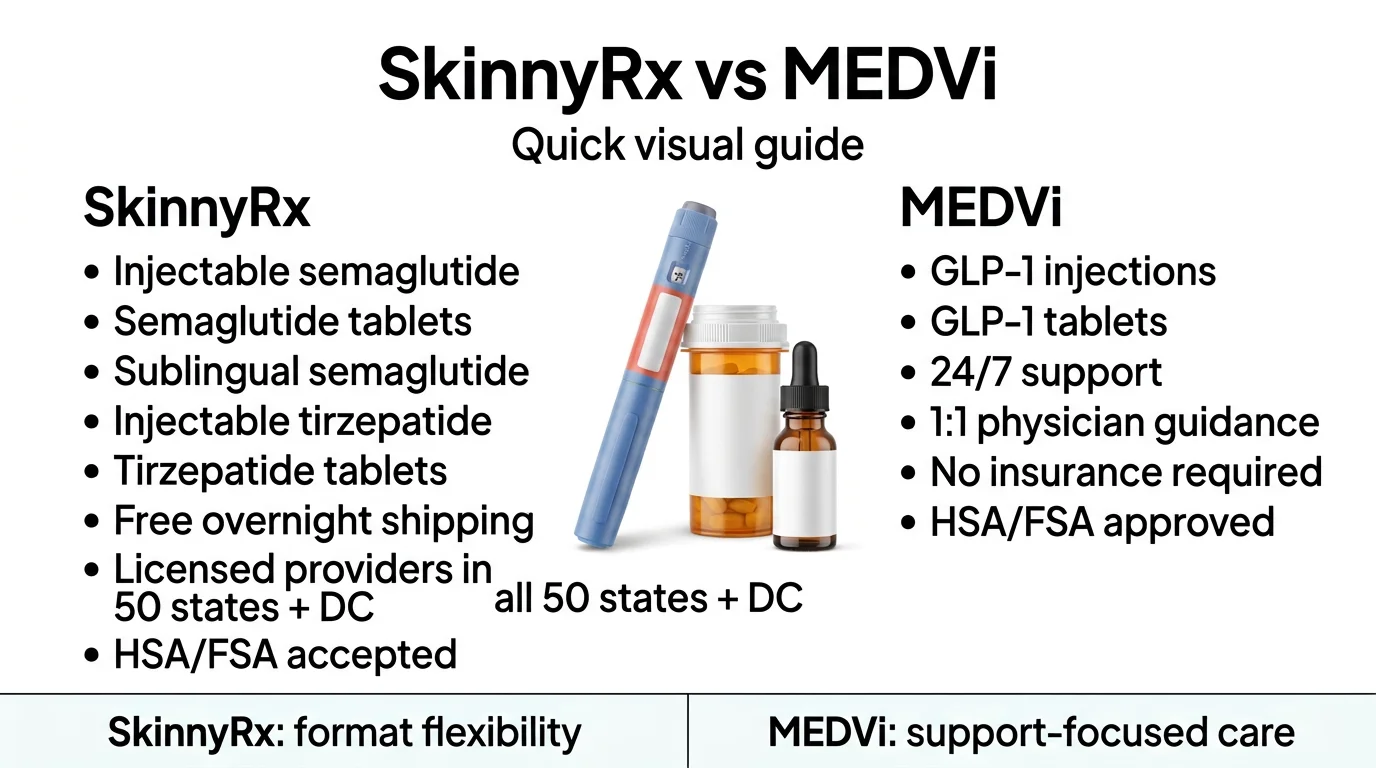
| Category | SkinnyRx | MEDVi |
|---|---|---|
| Best for | Needle-free options, fast shipping, format flexibility | Lower starting injectable price, bundled clinical support |
| Semaglutide injectable | From $199/mo | $179 first month → $299/mo |
| Semaglutide tablets | From $249/mo | $249 first month → $349/mo |
| Tirzepatide injectable | From $299/mo | $349/mo (provider-stated) |
| Tirzepatide tablets | From $299/mo | $279/mo (provider-stated) |
| Oral / sublingual / tablet? | Yes — tablets + sublingual for semaglutide; tablets for tirzepatide | Yes — tablets for semaglutide and tirzepatide |
| What's included in price? | Medication, consultation, free overnight shipping | Medication, consultation, shipping, 24/7 support (confirm lab/testing inclusions directly) |
| Membership fee? | No | No |
| Shipping speed | Free overnight (all orders) | Free — typically 2–5 business days |
| Support model | Licensed providers via app; customer service team | 24/7 messaging, optional video consult, care coaching |
| Cancellation policy | Full refund before Rx is written; cancel 5+ days before renewal | 72 hours before billing date; limited refund once meds are ordered |
| Money-back guarantee | 10% body weight loss guarantee (terms apply) | Lose weight or money back after 5 months adherence (minus 25% consult fee) |
| HSA / FSA accepted? | Yes (confirm with plan administrator) | Yes (confirm with plan administrator) |
| State availability | All 50 states + DC | Not clearly listed — verify before checkout |
| Trustpilot rating | 4.8/5 — ~4,700 reviews | 4.5/5 — ~10,000 reviews |
| LegitScript certified? | Not confirmed | Site displays LegitScript badge |
| FDA warning letter (Feb 2026)? | Yes | Yes |
| Pricing last verified | March 6, 2026 | March 6, 2026 |
Prices are provider-stated and may vary by dosage, plan length, and clinical evaluation. Always confirm current pricing directly before enrolling.
Decision-Risk Snapshot
This is the part most comparison pages leave out. Features are one thing. But what could actually go wrong with each choice?
| Risk Factor | SkinnyRx | MEDVi |
|---|---|---|
| Month-2 price surprise | Lower risk — pricing is more consistent | Higher risk — $179 → $299 after month 1 |
| Cancellation friction | Lower risk — refund before Rx; cancel before renewal | Moderate risk — 72-hour notice; limited refund post-pharmacy |
| Needle-free fit | Strong — sublingual + tablet options | Moderate — tablets available, no sublingual |
| Clinical support depth | Basic — app-based support | Deeper — 24/7 messaging, video consults |
| Regulatory context | FDA warning letter (Feb 2026) | FDA warning letter (Feb 2026) |
“Lost 16 lbs in 10 weeks — no side effects. Down two sizes. I wish I’d started sooner.”
— Verified MEDVi patient on ConsumerAffairs ★★★★★
Did FDA Warn SkinnyRx and MEDVi in 2026?
Yes. This matters, and you deserve to know about it before you decide.
What Happened
On February 20, 2026, the FDA posted warning letters to both SkinnyRx (operated by Lean Rx, Inc.) and MEDVi, LLC. These were part of a broader enforcement wave — on March 3, 2026, FDA announced a second group of 30 warning letters to telehealth companies over unlawful or misleading marketing of compounded GLP-1 drugs.
The SkinnyRx letter is publicly available on the FDA website under MARCS-CMS 717989 (FDA.gov — SkinnyRx Warning Letter), and the MEDVi letter under MARCS-CMS 721455 (FDA.gov — MEDVi Warning Letter).
What FDA Objected To
Both letters raised two main concerns:
1. Labeling that implied the platform was the compounder
FDA noted that the product labels displayed on each provider's website identified the platform name (SkinnyRx or MEDVi) on the pictured label, suggesting the platform itself compounded the drugs — when in fact separate compounding pharmacies prepare the medications. FDA called this false or misleading under sections 502(a) and 502(bb) of the Federal Food, Drug, and Cosmetic Act.
2. Marketing claims implying equivalence to FDA-approved drugs
FDA's letter to SkinnyRx cited claims like "Get access to the same active ingredient as name-brand GLP-1 medications." FDA's letter to MEDVi cited claims like "Same active ingredient as Wegovy® and Ozempic®." FDA was clear: compounded drug products are not FDA-approved, and claims implying equivalence are false or misleading.
What This Does and Does Not Mean
This was not a recall. Neither letter ordered products off the market, shut down the companies, or found contamination in the medication itself. The letters were about misleading marketing and labeling — not about the safety of the compounded medications being shipped.
It is still a serious trust signal. A warning letter from FDA's Center for Drug Evaluation and Research is not a slap on the wrist. Both companies were given 15 working days to respond with corrective actions. If they don't adequately address the violations, FDA stated it may pursue legal action including seizure and injunction.
Both companies received essentially identical letters. The structure, legal citations, and objections were the same for both. This was not a case of one provider being singled out while the other got a pass.
As of March 6, 2026, both letters are active on FDA's warning letter index. If either company submits a satisfactory response, FDA may post a close-out letter. We will update this page when that happens.
Why This Matters for You
Most comparison pages you'll find online were written before these letters were posted. That means they may still contain the exact type of language FDA flagged — claims implying that compounded products are equivalent to FDA-approved brands.
We have intentionally avoided that language throughout this guide. You deserve accurate information, especially when you're spending $200–$400 a month on medication.
If the warning letters are a dealbreaker for you, that's a completely reasonable position. We cover paths forward in the "Who Should Skip Both" section below. If you're comfortable proceeding — and many people are, since these letters were about marketing, not product safety — the rest of this guide will help you decide which one fits your situation.
Which One Should You Choose Based on Your Situation?
You don't need a universal winner. You need the right answer for your specific setup.
Choose SkinnyRx When…
You don't want injections. SkinnyRx offers semaglutide as an injectable, a sublingual (under-the-tongue liquid), and a tablet. They also offer tirzepatide tablets. If the idea of a weekly needle makes you hesitate, SkinnyRx has more paths around it.
You need your medication fast. Free overnight shipping on every order is a genuine differentiator. If waiting 3–5 days feels like too long — especially for a first order when you're motivated — this matters.
You want to use your HSA or FSA. Both providers say they accept these payment methods, but SkinnyRx makes it more prominent in their messaging and checkout flow. Confirm with your plan administrator that your specific GLP-1 expense qualifies before relying on pre-tax funds.
You want brand-name options available. SkinnyRx lists Ozempic, Wegovy, and Zepbound at market rates for patients who prefer FDA-approved medication and are willing to pay the premium.
Choose MEDVi When…
Lower starting price is the priority. MEDVi's semaglutide injectable starts at $179 for the first month — $20 less than SkinnyRx. If every dollar counts in month one, that's real.
You want more clinical hand-holding. MEDVi bundles 24/7 messaging support, optional video consultations with licensed providers, and emphasizes ongoing clinician guidance. If you're new to GLP-1 treatment and want more support as you start, this is meaningful. (If diagnostic testing matters to you, confirm exactly what testing is included and whether there is any added cost before you pay.)
You value a LegitScript-certified provider. MEDVi's official site currently displays a LegitScript Certified badge, indicating the platform is monitored for compliance. SkinnyRx's certification status was not confirmed from current public materials.
You're comfortable with the month-2 price jump. The $179 intro price rises to $299/month for ongoing semaglutide injections. If you've budgeted for the ongoing cost and you value the bundled support, MEDVi can be a strong fit over time.
Choose Neither When…
You only want FDA-approved medication. Neither SkinnyRx nor MEDVi primarily sells FDA-approved finished products. Their core offering is compounded GLP-1 medication. Talk to your doctor about brand-name Wegovy or Zepbound.
Your insurance covers brand-name GLP-1s. If you can get Wegovy or Zepbound through your plan with a manageable copay, that's likely your best path.
The February 2026 warning letters change your risk tolerance. Reasonable people can disagree about how much weight to give an FDA warning letter about marketing claims. If it bothers you, honor that instinct.
You need in-person medical care. Telehealth is convenient, but it's not a substitute for a face-to-face relationship with an obesity medicine specialist, especially if you have complex health conditions.
Is SkinnyRx or MEDVi Cheaper After the First Month?
This is where most people get surprised. The advertised price and the price you'll actually pay in month 3, 6, or 12 are not always the same number.
SkinnyRx Pricing (Verified March 6, 2026)
SkinnyRx pricing is relatively straightforward. Provider-stated starting prices from skinnyrx.com:
- Semaglutide injectable: From $199/month
- Semaglutide sublingual: From $199/month
- Semaglutide tablets: From $249/month
- Tirzepatide injectable: From $299/month
- Tirzepatide tablets: From $299/month
- Brand-name options: Ozempic, Wegovy, Zepbound at market rate (significantly higher)
SkinnyRx does not prominently advertise a different "introductory" versus "ongoing" price for compounded options. Multi-month plan commitments may reduce per-month pricing. Price includes medication, consultation, and free overnight shipping. Lab work is not included.
MEDVi Pricing (Verified March 6, 2026)
MEDVi uses a first-month discount model. Provider-stated prices from home.medvi.org:
- Semaglutide injectable: $179 first month → $299/month ongoing
- Semaglutide tablets: $249 first month → $349/month ongoing
- Tirzepatide injectable: $349/month (provider-stated)
- Tirzepatide tablets: $279/month (provider-stated)
- Ozempic (brand-name): ~$1,999/month
The month-2 price increase for semaglutide injectables is significant: $179 → $299 is a 67% jump. This is the single most important number to plan for if you're considering MEDVi. The bundled 24/7 support helps justify the ongoing price, but you need to budget for $299/month — not $179.
Real Cost Over Time: Semaglutide Injectable Example
Let's do the math so you can see what this actually looks like over a treatment period.
SkinnyRx saves $480 over 6 months
SkinnyRx saves ~$1,080 over 12 months
However — and this is important — MEDVi's price includes 24/7 clinical support and a more bundled care model that SkinnyRx doesn't offer. If you value deeper clinician access, the cost gap may feel more justified.
Tirzepatide Cost Comparison
Tirzepatide (the dual GLP-1/GIP compound found in brand-name Mounjaro and Zepbound) is generally more expensive than semaglutide across both providers.
For tirzepatide tablets specifically, MEDVi is actually the more affordable option. For tirzepatide injectables, SkinnyRx wins. The "cheaper" provider changes depending on which medication and format you choose — which is exactly why a blanket answer is misleading.
Budget Planning: What to Actually Expect
Plan your GLP-1 budget around 6–12 months, not 1 month. Most published data on GLP-1 treatment shows meaningful weight loss at 3–6 months, with continued progress through 12+ months. If you're budgeting for one month as a "test," you may not see enough results to judge fairly — and you'll feel frustrated rather than empowered.
A realistic 6-month budget for semaglutide injectables: $1,194–$1,674 depending on provider. That's roughly $199–$279 per month. Both providers say they accept HSA and FSA cards, but whether a GLP-1 expense is reimbursable can depend on your specific plan, diagnosis, and documentation requirements.
The True-Cost Checklist (Before You Pay)
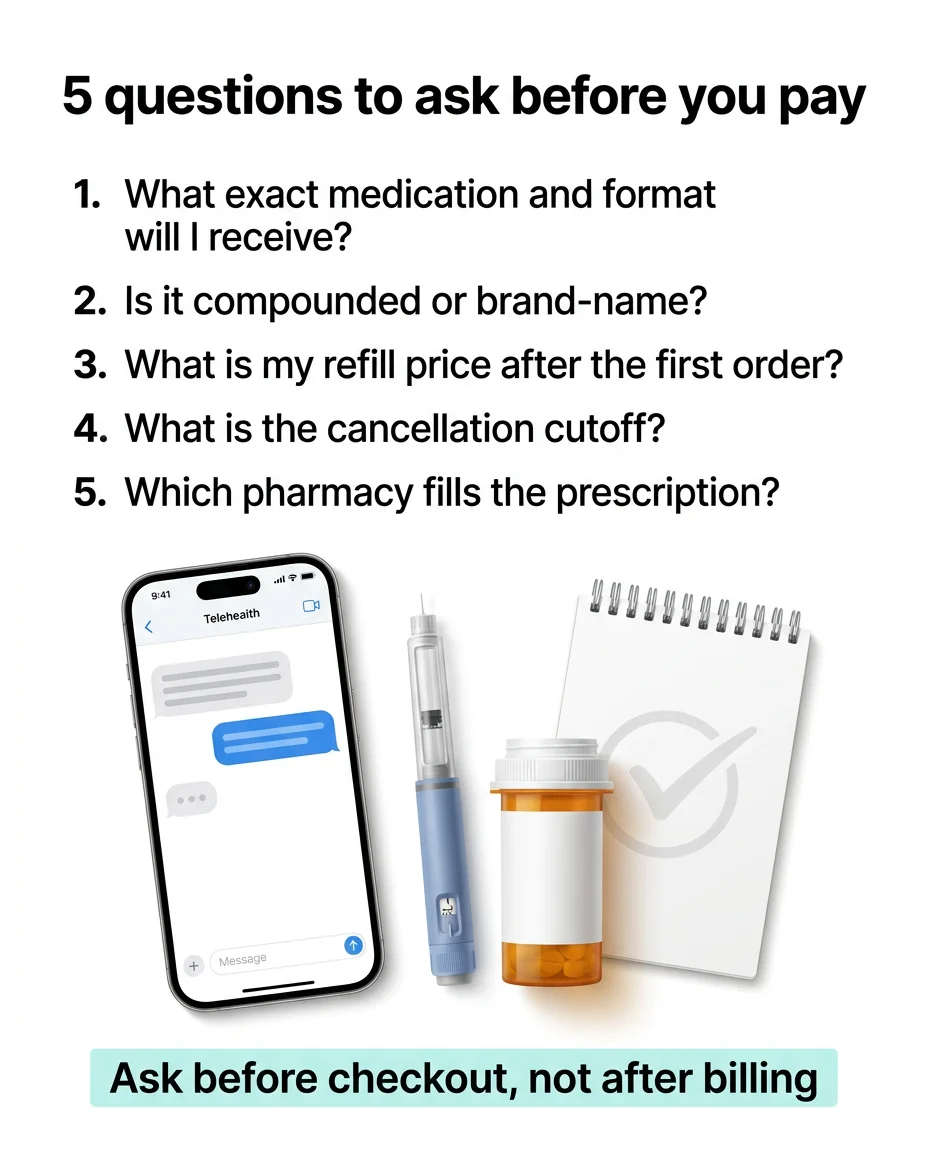
Before you enter your credit card number with either provider, confirm these five things:
- What is my price in month 2? (Not month 1.)
- What happens when my dose increases? (Higher doses can mean higher prices.)
- What is included in my monthly cost? (Medication? Shipping? Labs? Support?)
- What is the exact cancellation cutoff date? (More on this below.)
- Does my HSA/FSA card work at checkout?
What Medications and Formats Can You Actually Get?
If you care about how you take your medication — not just what it costs — this section matters a lot.
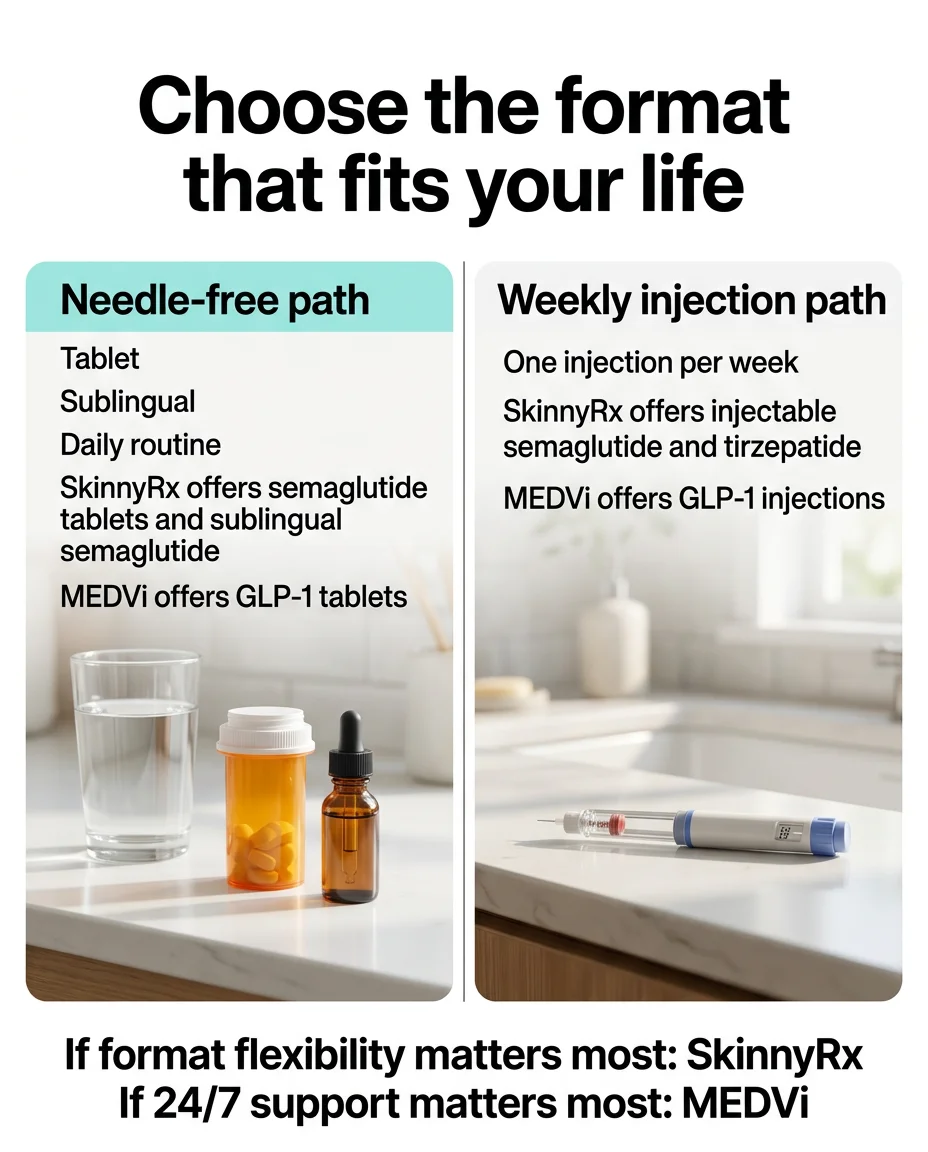
SkinnyRx Medication Options
SkinnyRx offers one of the widest format selections we found in this comparison set:
- Semaglutide: injectable, sublingual (under-the-tongue liquid), and tablets
- Tirzepatide: injectable and tablets
- Brand-name: Ozempic, Wegovy, and Zepbound at market rates
The sublingual semaglutide option is a genuine differentiator. Very few telehealth providers offer it, and for people who dislike both needles and swallowing large pills, it fills a real gap.
MEDVi Medication Options
MEDVi's lineup is focused but solid:
- Semaglutide: injectable and tablets
- Tirzepatide: injectable and tablets
- Brand-name: Ozempic at ~$1,999/month
MEDVi does not currently offer a sublingual option. If you're deciding between injection and tablet, they have you covered. If you want the sublingual path specifically, SkinnyRx is your option.
Quick Decision Guide: Formats
Best path if you want to avoid needles entirely: SkinnyRx — sublingual or tablet options for semaglutide, tablets for tirzepatide
Best path if you prefer the established weekly injection: Either — both offer semaglutide and tirzepatide injectables
Best path if you're likely to forget a daily pill: Injectable (once-weekly) through either provider
Your prescribing clinician will ultimately determine which format is appropriate based on your health history and goals. But knowing your preference before you start the intake process saves time and helps you ask the right questions.
Injectable vs. Oral: What the Trade-offs Actually Feel Like
Injectables are a once-weekly subcutaneous injection — a small needle into the belly fat or thigh. Most users describe it as a brief pinch, not real pain. The advantage is consistent absorption and a well-established dosing track record. The disadvantage is that some people genuinely can't get past the needle, and that's okay.
Tablets are taken daily (not weekly), which means you need to remember a daily routine. Oral GLP-1 absorption can be affected by food and timing — typically you take it on an empty stomach with a small amount of water. Some users report that oral semaglutide takes slightly longer to show full effects compared to injectables, though individual experiences vary widely.
Sublingual drops (SkinnyRx only) dissolve under the tongue. This avoids both needles and the digestive absorption variability of tablets. It's a daily administration. If you're needle-averse and find large pills difficult, the sublingual route is worth asking about.
None of these formats is inherently "better." They're different tools for different people. Your clinician will help you choose, but walking in knowing your preference makes the process faster.
Are the Medications FDA-Approved or Compounded?
This is where trust is won or lost, and we're going to be precise.
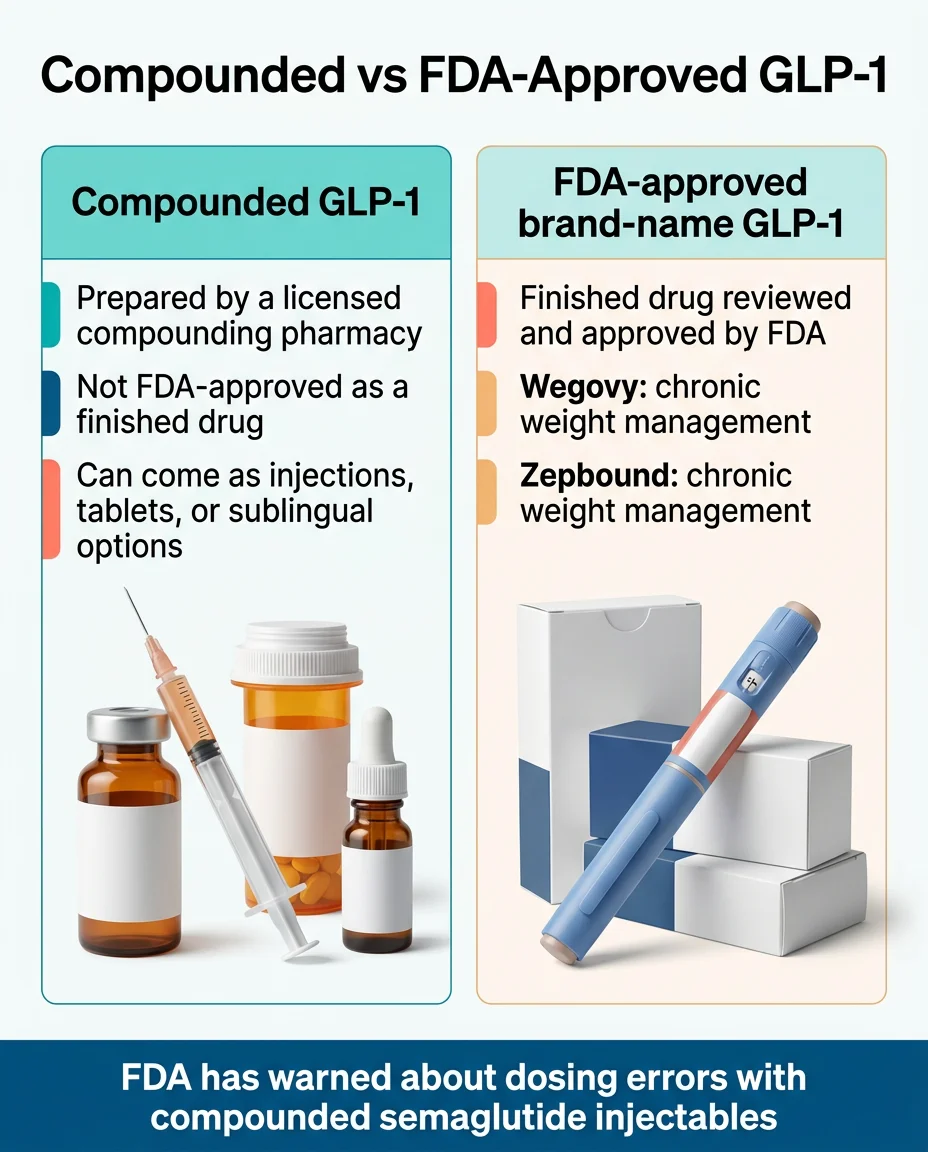
The Core Distinction
FDA-approved brand-name GLP-1 medications have gone through the full FDA approval process — clinical trials, manufacturing review, and ongoing post-market surveillance. These include:
- Wegovy (semaglutide): FDA-approved for chronic weight management in adults with obesity or overweight with at least one weight-related condition. Also approved to reduce the risk of major adverse cardiovascular events in certain adults.
- Ozempic (semaglutide): FDA-approved for type 2 diabetes and certain cardiovascular outcomes. Sometimes prescribed off-label for weight loss.
- Zepbound (tirzepatide): FDA-approved for chronic weight management.
- Mounjaro (tirzepatide): FDA-approved for type 2 diabetes.
Compounded GLP-1 medications are prepared by licensed compounding pharmacies. They are not FDA-approved finished products and have not been independently evaluated by FDA for safety, efficacy, or manufacturing quality in their compounded form.
Both SkinnyRx and MEDVi primarily sell compounded GLP-1 products. That is how they offer prices of $179–$299/month compared to the $1,000+/month retail cost of brand-name versions.
What You Should Know About Compounding in 2026
The semaglutide shortage is over. FDA resolved the semaglutide drug shortage in February 2025. Tirzepatide was removed from the shortage list even earlier. Many telehealth providers originally justified compounding under shortage-era exemptions. Those exemptions have narrowed.
FDA is actively enforcing. In addition to the February 2026 warning letters to SkinnyRx and MEDVi, FDA announced a second group of 30 warning letters on March 3, 2026. The agency has stated it intends to restrict GLP-1 APIs used in mass-marketed compounded products.
Patient-specific compounding remains legal. Under Section 503A of the Federal Food, Drug, and Cosmetic Act, compounding pharmacies may still prepare medications for individual patients based on a valid patient-specific prescription. The legal pathway is narrower than it was during the shortage, but it exists.
FDA has warned about dosing errors. The agency has documented adverse events, including hospitalizations, linked to dosing errors with compounded semaglutide products (FDA Alert). This underscores the importance of working with a reputable provider that uses licensed, regulated pharmacies.
What This Means in Plain English
Compounded GLP-1 medication is not the same product as brand-name Wegovy, Ozempic, Zepbound, or Mounjaro. It has not gone through FDA's approval process for the finished product. The regulatory environment around compounding is tightening, and the long-term availability of these programs is not guaranteed.
For most people without insurance coverage for brand-name GLP-1s — and that's the majority — compounded programs like SkinnyRx and MEDVi represent the most financially accessible path to clinician-supervised GLP-1 treatment. But you should make that choice with your eyes open.
“Lost 16 lbs in 10 weeks — no side effects. Down two sizes. I wish I’d started sooner.”
— Verified MEDVi patient on ConsumerAffairs ★★★★★
Which Provider Feels More Legit and Better Supported?
Clinical Support
MEDVi advertises 1:1 physician guidance, 24/7 messaging support with real medical staff (not chatbots), and a care coaching team. MEDVi emphasizes ongoing clinician guidance and optional video consultations. If diagnostic testing matters to you, confirm what testing is included and whether there is any added cost. MEDVi partners with OpenLoop Health for its licensed clinician network and names Belmar Pharma Solutions and Beluga Health as compounding pharmacy partners.
SkinnyRx uses licensed, board-certified providers across all 50 states and DC. Support is available through the SkinnyRx app and phone/email customer service. There is no bundled lab work, and the support model leans more toward efficient processing. For experienced GLP-1 users who know what they need and don't want a lot of back-and-forth, this is actually a plus.
Edge: MEDVi for clinical depth. SkinnyRx for speed and simplicity.
Legitimacy Signals
| Signal | SkinnyRx | MEDVi |
|---|---|---|
| Licensed clinician involvement | Yes | Yes |
| Visible terms and refund pages | Yes | Yes |
| Trustpilot review volume | ~4,700 reviews, 4.8/5 | ~10,000 reviews, 4.5/5 |
| LegitScript certified | Not confirmed | Site displays badge |
| FDA warning letter (Feb 2026) | Yes | Yes |
| Named pharmacy partners | Not prominently disclosed | Belmar Pharma Solutions, Beluga Health |
Both providers describe licensed clinician involvement and have public-facing terms and refund pages. MEDVi has a slight edge on third-party credibility markers (LegitScript badge, higher review volume, named pharmacy partners), while SkinnyRx has a higher average Trustpilot rating.
Questions to Ask Support Before You Pay
Whichever provider you're leaning toward, send these five questions to their support team before entering your credit card:
- What exact medication and format will I receive? (Compounded or brand-name? Injectable, tablet, or sublingual?)
- What is my refill price at my expected next dose level?
- What is my exact cancellation cutoff date?
- If I'm not approved by the clinician, do I get a full refund?
- Which compounding pharmacy will prepare my medication?
If they answer clearly and promptly, that tells you something. If they dodge or delay, that tells you something too.
Which One Is Easier to Cancel or Get a Refund From?
This is one of the highest-value sections on this page, because cancellation friction is one of the most common complaints we found across both providers.
SkinnyRx Cancellation and Refund Terms
Based on SkinnyRx's published FAQ and terms (skinnyrx.com/faq):
- Full refund available before a licensed provider completes the prescription review
- Cancellation must be submitted at least five days before the applicable renewal processing date
- Once your prescription is written and medication is shipped, standard refund eligibility is limited
- SkinnyRx responds to 99% of negative Trustpilot reviews, suggesting active customer service engagement
Cancellation friction: Low to moderate. The key moment is before the prescription is finalized. After that, your leverage decreases. Set a calendar reminder at least 5 days before your renewal processing date.
MEDVi Cancellation and Refund Terms
Based on MEDVi's published cancellation policy and medical consent (cancellation policy, medical consent):
- Cancellation requests must be received at least 72 hours before your billing date
- If that 72-hour window is missed, your subscription charges on the next billing date, and cancellation takes effect the following cycle
- Programs auto-renew; the medical consent form states "there are no refunds or exchanges" once medication is ordered
- The money-back guarantee requires at least 5 months of program adherence, documentation of compliance, and is subject to a 25% consultation fee deduction
- Some customers on Reddit and ConsumerAffairs have reported difficulty obtaining refunds, particularly around the guarantee terms
Cancellation friction: Moderate to high. The 72-hour advance notice is strict, and the "no refunds once medication is ordered" policy means your window to change your mind is narrow. The money-back guarantee sounds generous in marketing but has meaningful fine print.
Our Advice
For either provider: Set a phone reminder 5 days before your billing date. If you're even considering canceling or pausing, contact support before that window closes. Don't wait until billing day.
How Fast Can You Start, and How Fast Does It Ship?
- Online health quiz: ~2–5 minutes
- Provider review: Typically 1–2 business days (some same-day)
- Rx sent to pharmacy: Within 2 business days after Rx
- Free overnight on all orders
- Online health assessment: ~10–15 minutes (more detailed)
- Provider review: Most within 24–48 hours
- Rx to pharmacy: Within 24 hours after approval
- Free — typically 2–5 business days
SkinnyRx's speed advantage is real and consistent. Multiple Trustpilot reviewers mention receiving medication the next business day after approval.
MEDVi's process is more thorough upfront, which is a tradeoff. The longer assessment and optional video consult mean your clinician has more context about your health before prescribing.
A note on expectations: First orders are almost always slower than refills. Don't judge either provider's long-term shipping speed by order #1.
What Do Real Customers Say About SkinnyRx and MEDVi?
We looked at published reviews on Trustpilot, ConsumerAffairs, and public Reddit threads. Here's what we found, organized by theme — not cherry-picked praise.
SkinnyRx Customer Themes
What customers like: Fast response times, smooth onboarding, helpful reps who walk you through format changes (tablets to injectables), and easy-to-understand pricing. One Trustpilot reviewer said they were nervous about starting but the onboarding team "made me feel very comfortable about my decision." Another noted their experience was "smooth sailing compared to the others I've looked into."
What customers complain about: Some ConsumerAffairs reviews mention dose mismatches when transferring from another provider (being sent a starter dose instead of their current dose). A handful of reviewers reported slow responses from the medical team, with one noting a 12-day wait. Some users of oral semaglutide reported less noticeable results in the first weeks compared to injectables.
Overall pattern: SkinnyRx's strongest signal is its 4.8/5 Trustpilot rating with 91% of reviews at 5 stars. The company responds to 99% of negative reviews, suggesting active engagement rather than ignoring problems.
MEDVi Customer Themes
What customers like: Supportive, knowledgeable providers who listen rather than rushing. Several reviewers praised the clinical staff's attentiveness. One ConsumerAffairs user shared that MEDVi was "not my first choice but is my last" after being rejected by two other programs — and went on to lose 31 pounds. Another called their tirzepatide results "a mindblower" and said they paid with their HSA card.
What customers complain about: Cancellation and refund friction is the most common negative theme. Multiple Reddit users report difficulty reaching responsive support about refunds. Some users say the money-back guarantee terms changed from 3 months to 5 months after they enrolled. A few reviewers reported unwanted follow-up calls. At least one user described their experience as "bait and switch" regarding pricing.
Overall pattern: MEDVi has more total reviews (10,000+) but a slightly lower average rating (4.5/5). The depth of positive reviews is genuinely impressive — people share detailed weight-loss timelines. But the negative reviews cluster specifically around billing and refund issues.
A Note on Reviews
Individual reviews are not clinical evidence. People who have strong feelings — very positive or very negative — are more likely to leave reviews. The truth for most customers is probably somewhere in the middle. Use reviews as one input, not the only input.
The Review Landscape in Numbers
Here's what the aggregate data looks like as of March 2026:
SkinnyRx on Trustpilot
4.8/5 from ~4,700 published reviews. 91% five-star. Only 4% one-star. Responds to 99% of negative reviews within about a week.
SkinnyRx on ConsumerAffairs
Small review sample (2 editorial reviews). Mixed — one good overall experience, one dosage mismatch issue.
MEDVi on Trustpilot
4.5/5 from ~10,000 published reviews. "Excellent" rating with a wider range of experiences in the comments.
MEDVi on ConsumerAffairs
More extensive coverage. Editorial review highlights transparent pricing. Customer reviews include both enthusiastic weight-loss stories and refund complaints.
The takeaway: both providers have overwhelmingly positive third-party ratings. The difference is in the type of complaints — SkinnyRx's tend to be about medication experience (dosing, oral effectiveness), while MEDVi's tend to be about the business side (billing, refunds, guarantee terms). Know your sensitivity and weigh accordingly.
Who Should Skip SkinnyRx and MEDVi Entirely?
This section is here because we'd rather lose an affiliate commission than mislead you.
Skip both if:
Your insurance covers brand-name Wegovy or Zepbound with a manageable copay. If you can get FDA-approved medication through your plan for $25–$50/month, that's better than any compounded option at any price.
You only want FDA-approved products. Compounded medication has legitimate clinical use, but it is not the same as a product that has gone through FDA's full approval process. Talk to your doctor about brand-name options, or look into manufacturer savings programs.
The February 2026 FDA warning letters change your risk calculation. If using a provider that received a warning letter sits wrong with you — even though the letter was about marketing, not product safety — listen to that instinct. Your comfort matters.
You need in-person care. If you have complex medical conditions, a history of eating disorders, or need hands-on clinical monitoring, a telehealth platform is not a substitute for a local obesity medicine specialist or endocrinologist.
You're outside their service areas. SkinnyRx covers all 50 states and DC. MEDVi's state availability is not clearly listed — verify eligibility directly before checkout.
You have contraindications. GLP-1 medications carry a boxed warning about the risk of thyroid C-cell tumors based on animal studies. They are contraindicated in patients with a personal or family history of medullary thyroid carcinoma (MTC) or Multiple Endocrine Neoplasia syndrome type 2 (MEN2).
Paths Worth Exploring
Brand-name through your doctor: Ask your primary care physician about Wegovy or Zepbound. Your out-of-pocket cost could be as low as $25–$50/month with manufacturer savings cards.
Eli Lilly's LillyDirect: Offers Zepbound single-dose vials through a self-pay program at $349–$499/month — still expensive, but FDA-approved and shipped directly.
Ro Body Program: Uses both brand-name and compounded options with an insurance-concierge model. Monthly membership is ~$149/month plus medication costs.
Local obesity medicine specialist: The Obesity Medicine Association (obesitymedicine.org) has a provider directory. In-person care gives you monitoring that no telehealth platform can match.
Lifestyle-first programs: If you're not ready for medication, programs like Noom, Found (for coaching + medication), or working with a registered dietitian can provide meaningful support.
What Side Effects and Safety Questions Matter Before Choosing Either?
Side effects are medication-related, not provider-related. Whether you get your GLP-1 medication from SkinnyRx, MEDVi, or a local pharmacy, the side-effect profile is similar because the active medication in the compounded formulation is what drives the therapeutic effect.
Common GLP-1 Side Effects
- Gastrointestinal: Nausea (especially during the first 2–4 weeks), vomiting, diarrhea, constipation, abdominal pain
- Other: Headache, fatigue, dizziness, injection-site reactions (for injectables)
These are well-documented across published clinical data. Most people find that GI side effects are worst in the first few weeks and improve as the body adjusts. Both SkinnyRx and MEDVi use dose titration — starting at a lower dose and gradually increasing — to minimize early side effects.
Safety Considerations Specific to Compounded Products
Dosing accuracy matters. FDA has documented adverse events, including hospitalizations, linked to dosing errors with compounded semaglutide products. Make sure your provider and their partner pharmacy have a clear dosing protocol.
Storage and shipping. Injectable GLP-1 medications require refrigeration. FDA has received reports of compounded GLP-1s arriving warm or with insufficient ice packs. If your medication arrives at room temperature, contact your provider before using it.
No FDA post-market surveillance. Unlike brand-name drugs, compounded products are not subject to FDA's post-market safety monitoring system. Side effects or quality issues may be less likely to be caught at scale.
Boxed Warning Context
Both semaglutide and tirzepatide carry a boxed warning (the most serious type of FDA warning) about the risk of thyroid C-cell tumors in animal studies. This warning appears on all FDA-approved GLP-1 medications including Wegovy, Ozempic, Zepbound, and Mounjaro.
If you have a personal or family history of medullary thyroid carcinoma or MEN2, GLP-1 medications are contraindicated — regardless of provider.
Questions to Ask Your Prescriber Before Starting
- Based on my health history, am I a good candidate for GLP-1 treatment?
- What dose will I start at, and what is the titration schedule?
- What side effects should I watch for, and when should I contact you?
- Should I get any lab work before starting?
- What should I do if my medication arrives damaged or improperly stored?
How We Evaluated SkinnyRx and MEDVi
We believe you should know exactly how we arrived at our recommendations.
Affiliate disclosure: We may earn a commission if you sign up through links on this page. This does not influence our analysis or rankings. We recommend both providers for different situations because that is what our research supports. We also recommend skipping both providers when that's the better choice.
Update schedule: We will update this page when either provider changes pricing, when FDA posts close-out letters or takes additional action, or when significant new customer experience patterns emerge.
Final Verdict: SkinnyRx vs MEDVi
There is no universal winner here. There shouldn't be. These are different programs that serve different people.
Pick SkinnyRx if you want needle-free flexibility, free overnight shipping, and predictable pricing
SkinnyRx is the better fit for people who know what they want, prefer a simpler process, and don't need heavy clinical hand-holding. The sublingual option is a genuine differentiator that very few providers offer.
Pick MEDVi if you want the lowest entry point, bundled clinical support, and LegitScript certification
MEDVi is the better fit for people who are new to GLP-1 treatment and want more guidance as they get started — as long as they're prepared for the month-2 price increase and have read the cancellation terms carefully.
Pick neither if FDA-approved medication is non-negotiable
If your insurance covers brand-name GLP-1s or if the February 2026 warning letters change your comfort level, talk to your doctor about Wegovy, Zepbound, or other clinician-supervised options.
The biggest mistake in this decision isn't picking the wrong provider. It's spending another month comparing tabs instead of starting. The best provider is the one you actually begin with.
SkinnyRx vs MEDVi: Frequently Asked Questions
Medical disclaimer: This content is for informational purposes only and is not medical advice. GLP-1 medications are prescription drugs requiring evaluation by a licensed clinician. Compounded medications are not FDA-approved finished products. Always consult a qualified healthcare professional before starting any weight-loss medication. Individual results vary based on adherence, medical history, and other factors.
Last updated: March 6, 2026. Pricing and policies verified from official provider websites. FDA warning letter status verified from FDA.gov. This page will be updated when material changes occur.
Related Articles
DudeMeds GLP-1 Reviews
DudeMeds GLP-1 review covering pricing, compounding details, pharmacy transparency, public reviews, and honest verdict.
Henry Meds Review
Henry Meds GLP-1 telehealth review covering pricing, prescribing process, and patient outcomes.
Semaglutide Providers in Texas
Best semaglutide providers and telehealth options available specifically for Texas residents.
Best GLP-1 for Seniors
Safest GLP-1 options, real costs, Medicare coverage rules, and top programs compared for adults 60+.
GLP-1 Providers That Prescribe Wegovy and Zepbound
Verified 2026 matrix of GLP-1 telehealth providers carrying both brand-name Wegovy and Zepbound — Ro, Sesame, Walgreens, Hims & Hers, WW Med+, and more. Real prices, insurance/PA support, and the right route for your situation.
Wegovy HD vs Wegovy Pill
Wegovy HD averaged 18.8% weight loss vs 13.6% for the pill — but HD costs $100/mo more and you cannot start on it. Full 2026 comparison with verified prices, switching rules, and who each form actually fits.