Best GLP-1 Providers While Waiting for Prior Authorization (2026 Bridge Guide)
Weight Loss Provider Guide is an independent comparison resource for GLP-1 telehealth providers. Some links on this page may earn us a commission. It doesn’t change what you pay or what we verify. This guide is not medical advice — always talk to a licensed clinician about your treatment.
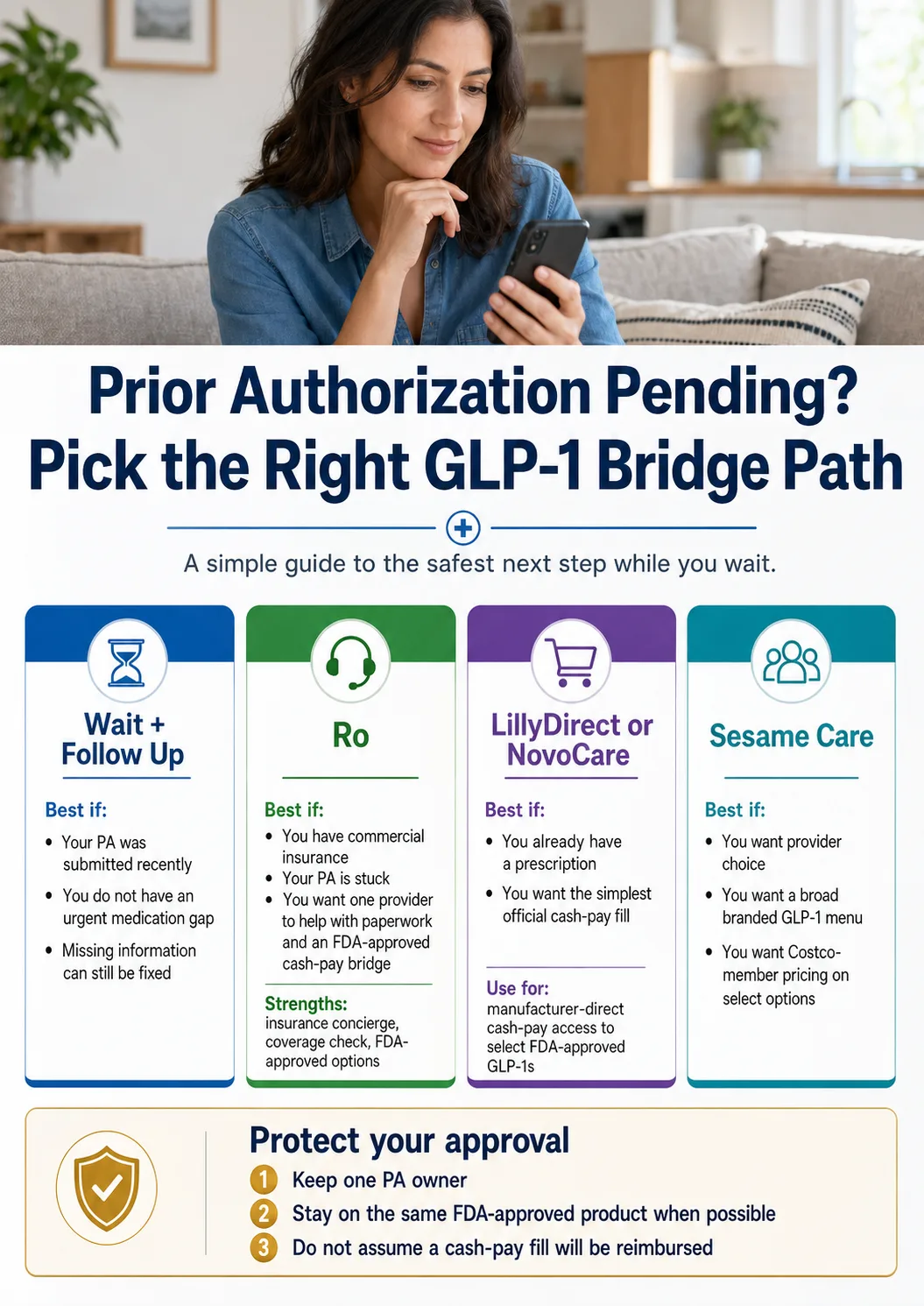
If your Wegovy, Zepbound, Ozempic, Mounjaro, or Foundayo prescription is stuck in prior authorization, the best GLP-1 providers while waiting for prior authorization fall into three honest paths. For most commercially insured people, Ro is the strongest first move — its free GLP-1 Insurance Coverage Checker tells you what your plan covers before you spend a dollar, and Ro’s insurance concierge then handles the PA paperwork. Sesame Care is the better pick if you’d rather see a real live video provider on your schedule. NovoCare or LillyDirect are the right call if you already have a prescription and just want the same FDA-approved medication at the lowest cash-pay price until insurance kicks in.
Looking for a pure ranking of providers that handle PA paperwork? That’s our prior authorization provider guide. This page is the one to read if your PA is already pending and you don’t know whether to wait, push, switch, or pay cash.
Disclosure: We may earn a commission if you start a subscription through links on this page. That doesn’t change our rankings or the limitations we disclose about each provider.
Your situation right now → your best first move
| Where you are right now | Best first move | Why it fits |
|---|---|---|
| Commercial insurance, PA pending, want help | Ro | Free coverage checker + insurance concierge + FDA-approved cash-pay backup in one place |
| Want a live video provider, not async messaging | Sesame Care | Pick your own video provider; provider can help with PA paperwork |
| You already have a Wegovy or Zepbound prescription | NovoCare or LillyDirect | Manufacturer-direct cash-pay; no membership; same medication |
| PA was denied — appeal window open | Call PBM today + Ro insurance concierge | Resubmit with better documentation while you bridge |
| Medicare Part D (after July 1, 2026) | Medicare GLP-1 Bridge | $50 copay for eligible drugs and eligible beneficiaries |
| Renewal PA is about to lapse | Call PBM + prescriber today | Don't lose continuity — see the renewal section below |
| Plan completely excludes weight-loss drugs | Quiz → cash-pay path | Different fight; PA appeals usually don't fix exclusions |
Most people stuck on this page are in row one or row three. Read the next section before you call anyone.
Run Ro’s Free GLP-1 Coverage CheckWhat to do in the first 24 hours (before you switch providers)
Your first move while waiting for GLP-1 prior authorization is to confirm the PA was actually submitted to the correct pharmacy benefit manager — not just to your medical insurer. The repeated failure pattern isn’t medical. It’s a submission issue: the PBM never received the PA, received incomplete documentation, or the patient was calling the medical insurer instead of the pharmacy side.
Quick definition: what’s a PBM?
A pharmacy benefit manager (PBM) is the company that handles prescription benefits for your insurance plan. The big ones are CVS Caremark, Express Scripts, Optum Rx, and Humana Pharmacy Solutions. Your medical insurance card may say “UnitedHealthcare” or “Anthem” — but your PBM is often a different name printed in smaller text. PAs for prescription drugs go to the PBM, not the medical plan.
The 15-minute PA status checklist
Get these answers before you do anything else.
Medication and dose your doctor prescribed
Date your prescriber's office submitted the PA
PA case or reference number
Pharmacy benefit manager name (look on the back of your insurance card, smaller text)
Current status: pending, denied, incomplete, or "we never received it"
Missing documentation, if any
Expected decision date
Whether step therapy applies (your plan wants you to fail a cheaper drug first)
If denied — the exact denial reason and your appeal deadline
The PBM phone script (copy-paste this)
Call the number on the back of your insurance card. Ask for the pharmacy or prescription benefits team. Then say, word for word:
“Hi, I’m calling about a GLP-1 prescription prior authorization. Can you confirm whether the PA was received, the date it was submitted, the case number, the expected decision date, and whether any information is missing from my prescriber?”
If they tell you the PA wasn’t received, your prescriber’s office made a mistake — call them next. If it’s pending, get the case number and expected decision date in writing. If it’s incomplete, ask exactly which fields are missing, then forward that to your prescriber.
What not to do while you wait
Don't assume "pending" means "submitted." Confirm with the PBM directly.
Don't pay for a new provider before you know the obstacle. If your plan excludes weight-loss drugs entirely, switching telehealth platforms won't fix that.
Don't switch to compounded GLP-1 just because it's faster. Compounded medications are not FDA-approved, and the FDA has cautioned against marketing them as generic, the same as, or clinically equivalent to brand drugs.
Don't change your dose, skip a dose, or restart based on internet advice. If you've already been taking a GLP-1 and your renewal is stuck, talk to your prescriber the same day.
How long does GLP-1 prior authorization take in 2026?
Clean prior authorization requests for Wegovy, Zepbound, or Foundayo often take several business days, but the timeline varies by plan, PBM, state rules, submission channel, and whether documentation is complete. Cigna’s consumer page states insurers typically respond within 5–10 business days after receiving a PA request. Ro’s insurance page says its full insurance process usually takes about 2–3 weeks, and longer after a denial.
Your day-by-day waiting plan
Day 0 — Submission day
Confirm with your prescriber's office that the PA went out. Get the date, the PBM name, and the case number in writing.
Day 3 — First check-in
Call the PBM. Confirm they received it. Ask for the expected decision date.
Day 7 — Documentation check
Call the PBM again. Ask, "Is there any missing documentation?" The most common gaps: BMI not recorded in the last six months, no diagnosis code matching plan criteria, no documented prior weight-management attempts, no comorbidity documentation (hypertension, sleep apnea, prediabetes), or a step-therapy requirement that wasn't addressed.
Day 14 — The pivot question
Ask the PBM directly: "Is this still moving, or is it effectively stalled?" If they can't give you a clear answer, that's your signal to either escalate (let Ro's insurance concierge take over) or start a cash-pay bridge with the same FDA-approved medication.
Day 21 — Decision time
If you're still waiting at three weeks with no movement, you need a fallback plan. The options: file an appeal if denied, switch to a covered medication on your plan's formulary, use a provider with stronger PA support, pay cash for the same FDA-approved drug, or stop fighting if it's a hard plan exclusion.
Can you start a GLP-1 while waiting for prior authorization?
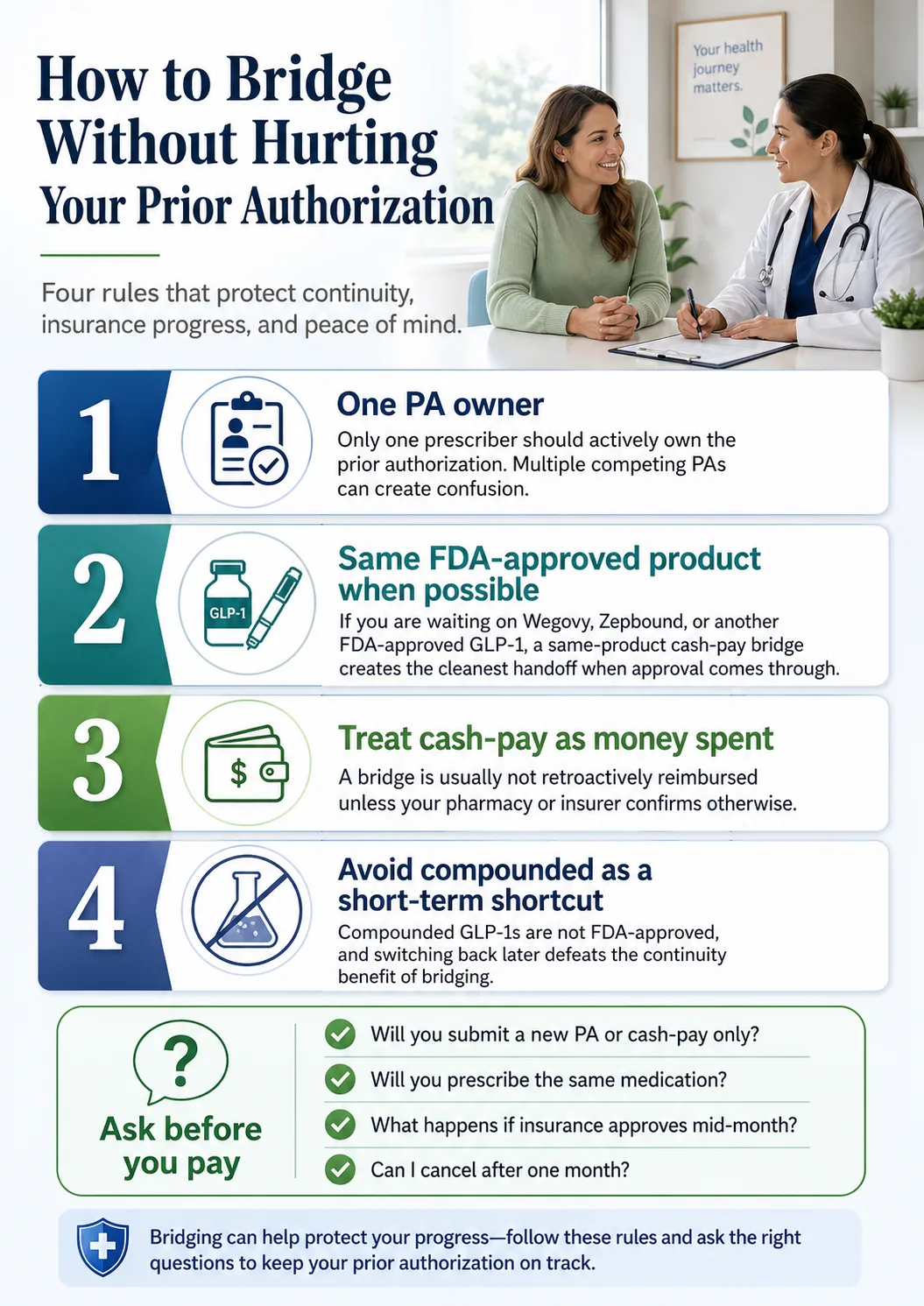
Yes — and starting a cash-pay bridge doesn’t automatically replace or cancel your pending PA. The public PA criteria we reviewed focus on clinical fit (BMI, comorbidities, documented weight-management attempts) and plan rules — not your payment history during the wait. The paperwork question and the medical question are separate: your PBM decides coverage under plan rules, and your clinician decides whether starting, pausing, restarting, switching, or bridging is medically appropriate.
Before you spend a dollar on a bridge, call your PBM and ask specifically about:
Duplicate-therapy edits
Some automated systems flag a duplicate when a brand GLP-1 hits the claims data while a PA is pending for the same drug class. Usually resolvable with a note from your prescriber.
Step therapy
If your plan requires you to fail Wegovy before approving Zepbound, cash-pay Zepbound months don't satisfy the requirement. Doesn't hurt your future approval — but doesn't help it either.
Deductible and out-of-pocket credit
Cash-pay months don't count toward your insurance deductible or out-of-pocket maximum.
Compounded prescription on file
Whether a compounded prescription affects how your prescriber documents continuity when you transition to the brand drug.
Does paying cash for a GLP-1 affect your prior authorization, deductible, or future coverage?
| Concern | The honest answer |
|---|---|
| Prior authorization | A cash-pay fill doesn't cancel a pending PA on its own. Confirm with your PBM — some plans have duplicate-therapy or step-therapy edits, and your prescriber may need to note continuity. |
| Deductible | Cash-pay months don't count. If you have a $2,000 prescription deductible and you pay $349/month cash for Wegovy through NovoCare for three months, you've spent $1,047 — and your deductible is still at zero. |
| Future coverage | Generally unaffected. A cash-pay prescription on your record doesn't tell future insurers anything about you. Your future PA is judged on your future clinical record — not your past payment method. |
| HSA/FSA credit | An HSA or FSA can reimburse cash-pay GLP-1 medication pre-tax when the medication treats a specific disease diagnosed by a physician — obesity, diabetes, hypertension, or cardiovascular disease. Save an itemized receipt and ask your prescriber for a letter of medical necessity. |
The 5 bridge paths compared (the only table you’ll need)
A side-by-side of every legitimate bridge path on the six dimensions that actually decide which one fits your situation. Pricing verified May 24, 2026 from each provider’s official page. Eligibility and end-dates apply.
| Bridge path | What you get | First month | Ongoing cost | Who handles your PA | When PA approves |
|---|---|---|---|---|---|
| 1. Ro (full-service bridge) | FDA-approved Zepbound, Wegovy pen, Wegovy pill, or Foundayo — cash-pay, with Ro’s concierge submitting and following up on your PA in the background | $39 membership + medication (e.g., $149 Wegovy pill 1.5 mg; $199 Wegovy pen intro; $299 Zepbound vial 2.5 mg) | $149/mo membership (or as low as $74/mo annual prepay) + medication | Ro’s insurance concierge | Stays within FDA-approved brand products; you switch to insurance pricing (often $0–$50 copay) |
| 2. NovoCare or LillyDirect (manufacturer-direct) | Same FDA-approved brand you’re awaiting PA for, shipped from Novo Nordisk or Eli Lilly | $199 NovoCare intro (Wegovy pen 0.25/0.5 mg, first two fills through December 31, 2026); $149 Wegovy pill 1.5 mg / 4 mg; $299 LillyDirect Zepbound vial 2.5 mg; $149 Foundayo 0.8 mg | $349 Wegovy pen; $149–$299 Wegovy pill by dose; $299–$449 Zepbound vial by dose; $149–$299 Foundayo by dose | Your existing prescribing doctor | Same brand; transitions to insurance pricing or savings-card copay |
| 3. Sesame Care (live video, cash-pay branded) | Live video provider of your choice; cash-pay options including Wegovy pill, Wegovy pen, Zepbound KwikPen, Zepbound vial, Foundayo, and Ozempic | Care subscription as low as $59/mo annual; medication from $149/mo | $59+/mo care + medication | Your Sesame video provider | Same brand; transitions to insurance billing if covered |
| 4. Compounded bridge (Embody, Yucca Health) | Compounded semaglutide or tirzepatide from a 503A pharmacy network — a different product than FDA-approved brand | $99 Embody / $175 Yucca semaglutide; $149 Embody / $258 Yucca tirzepatide | $299 Embody / $206–$275 Yucca semaglutide; $399 Embody / $325–$385 Yucca tirzepatide | Compounded provider does NOT handle your brand-drug PA | Your prescriber decides the transition timing and dose; compounded products may differ in concentration from FDA-approved versions |
| 5. Just wait | Nothing | $0 | $0 | Your existing doctor | You start at dose 1 — you’ve lost the bridge weeks |
What this table tells you that nobody else’s does
The “bridge risk” isn’t really about price. It’s about what happens to your treatment when your PA finally lands. Paths 1, 2, and 3 keep you on the same FDA-approved brand and transition cleanly. Path 4 saves you the most money but requires switching products and a prescriber-managed dose transition. Path 5 costs $0 — and costs you 1–6 weeks of progress.
What are the best GLP-1 providers while waiting for prior authorization?
The best GLP-1 providers while waiting for prior authorization are the ones that solve the waiting-period problem — not the ones with the lowest headline price or the loudest marketing. We rank providers on this page by how well they confirm coverage, keep the PA moving, and offer an FDA-approved cash-pay bridge that transitions cleanly.
Ro — Best Overall While Waiting for Prior Authorization
The punchline: Ro is the most complete bridge product on the market because it bundles FDA-approved brand-name medication, a free coverage checker, and an active insurance concierge into one membership. You start cash-pay; Ro’s concierge submits and follows up on your PA in the background. When the PA approves, you stay on the same FDA-approved brand and switch to insurance pricing.
Current pricing, verified May 24, 2026
| Item | Price |
|---|---|
| Ro Body membership | $39 first month, then $149/month — or as low as $74/month annual prepay |
| Wegovy pen (intro doses 0.25/0.5 mg) | $199/month intro, then $349/month for higher doses |
| Wegovy pill (1.5 mg) | $149/month |
| Zepbound vial (2.5 mg) | $299/month starting dose (verify current at checkout) |
| Foundayo (orforglipron) | Available through Ro at LillyDirect-matched pricing — verify by dose at signup |
| Ozempic (cash-pay) | Available — off-label use for weight loss; clinically appropriate when ordered |
| Lab work at Quest Diagnostics | Included with membership when ordered by Ro provider |
What’s actually included that nobody else offers
Free GLP-1 Insurance Coverage Checker
Ro contacts your insurance and sends a personalized report telling you what your plan covers before you commit. You don't have to sign up to use it.
Insurance concierge team
Ro's concierge checks coverage, handles paperwork and coordination, submits PA requests, and continues working with the insurer when additional information is needed or another clinically appropriate GLP-1 can be submitted.
Same FDA-approved brand on either side of your approval
If you start Ro Wegovy cash-pay and your insurance approves Wegovy, you don't change drugs, doses, or providers — Ro just switches you to the insurance price.
The damaging admission
Ro is not the cheapest path. The membership is a real $149/month on top of medication ($74/month if you prepay annually). If you already have a primary care doctor actively chasing your PA, you can get the exact same Wegovy through NovoCare or the same Zepbound through LillyDirect at the same cash price — no membership required. Ro does not beat NovoCare or LillyDirect on raw medication price. The membership buys you the insurance concierge — the team that does the calling, the resubmitting, the follow-up.
Best for
- Anyone with commercial insurance
- Anyone whose existing doctor isn't actively chasing the PA
- Anyone who's been waiting more than 10 business days with no movement
- Anyone facing a denial who needs to keep pressure on while bridging
- FEHB members
Not for
- Medicaid and other government-funded plans (Ro says these cannot join or pay out of pocket)
- TRICARE medication coordination (Ro doesn't coordinate with TRICARE)
- VA coverage (ask your VA primary care provider directly)
Sesame Care — Best Live Video Provider Path
The punchline: Sesame Care is the better fit if you want a real live video visit with a provider of your choice, on your schedule, with a lower care subscription than Ro’s concierge model. Sesame’s program includes ongoing video visits, dedicated provider care, labs, messaging, and cash-pay GLP-1 medications — and Sesame says its providers can assist with insurance pre-authorization paperwork as part of your visits.
Current details, verified May 24, 2026
| Item | Detail |
|---|---|
| Success by Sesame care subscription | As low as $59/month with annual subscription |
| Cash-pay GLP-1 medications | Starting at $149/month |
| Branded formulary shown on Sesame | Wegovy pill, Wegovy pen, Zepbound KwikPen, Zepbound vial, Foundayo, Ozempic |
| Labs at Quest Diagnostics | Included except in AZ, HI, ND, NJ, NY, OK, RI, SD, and WY where fees may apply |
| Costco-member pricing | Sesame's partnership with Costco offers Ozempic and Wegovy at reduced pricing for Costco members; verify current offer at signup |
Where Sesame beats Ro for this use case
- Live video care, not async messaging
- Provider choice — pick from Sesame's network
- Lower care fee: $59/month annual vs. $74–$149 for Ro
Where Ro beats Sesame for this use case
- Concierge that owns the PA workflow end-to-end — Sesame's providers can help; Ro's concierge actively chases it
- More integrated bridge if cash-pay turns into insurance approval
NovoCare Pharmacy — Cheapest Manufacturer-Direct Wegovy
The punchline: NovoCare is Novo Nordisk’s direct-to-patient pharmacy for Wegovy. If you already have a prescription and just want the lowest cash-pay price on the same FDA-approved Wegovy you’re being approved for, NovoCare beats every telehealth membership on raw medication cost.
Current pricing, verified May 24, 2026
| Medication | Price |
|---|---|
| Wegovy pen 0.25 mg / 0.5 mg | $199/month for the first two monthly fills through December 31, 2026, then $349/month |
| Wegovy pen higher doses (1 mg, 1.7 mg, 2.4 mg) | $349/month for self-pay |
| Wegovy HD 7.2 mg pen | $399/month |
| Wegovy pill 1.5 mg and 4 mg | $149/month (4 mg offer runs through August 31, 2026) |
| Wegovy pill higher doses (9 mg, 25 mg) | $299/month where listed |
| Membership fee | None |
Best for
You already have a Wegovy prescription. Your doctor is actively chasing the PA. You don’t need a concierge — you just need the medication at the lowest cash-pay price until insurance kicks in.
Not for
Anyone without an active prescription or active prescriber. NovoCare is a pharmacy, not a care platform — it doesn’t write you a new prescription, it doesn’t handle PA, and it doesn’t replace a clinician relationship. If you don’t already have someone prescribing, go to Ro or Sesame.
LillyDirect — Cheapest Manufacturer-Direct Zepbound and Foundayo
The punchline: LillyDirect is Eli Lilly’s equivalent of NovoCare for Zepbound and Foundayo. The vial format is significantly cheaper than the pen.
Current pricing, verified May 24, 2026
| Medication | Price |
|---|---|
| Zepbound vial 2.5 mg | $299/month |
| Zepbound vial 5 mg | $399/month |
| Zepbound vial 7.5 mg through 15 mg | $449/month (with program refill-timing terms) |
| Foundayo 0.8 mg | $149/month |
| Foundayo 2.5 mg | $199/month |
| Foundayo 5.5 mg and 9 mg | $299/month (with program refill-timing terms) |
| Membership fee | None |
Same use case as NovoCare — you have an active prescription, your prescriber is chasing the PA, and you want the cheapest cash-pay tirzepatide or orforglipron until insurance approval lands.
See LillyDirect’s current Zepbound and Foundayo pricingThe compounded bridge option (Embody, Yucca Health)
For most people on this page, compounded is not the right reflex. Your PA is for an FDA-approved brand-name drug — Wegovy, Zepbound, Foundayo — and the cleanest bridge stays on that same brand. But if your monthly budget can’t stretch to $200+ for brand cash-pay and you’re willing to switch products when your PA lands, compounded is a legitimate cheaper option to consider.
Quick definition: a 503A pharmacy is a state-licensed pharmacy that prepares medications for individual patients based on a prescriber’s order. Compounded GLP-1 medications are not FDA-approved as finished products — they’re prepared by 503A pharmacies for patient-specific use under federal compounding rules. The FDA has said semaglutide and tirzepatide do not currently appear on the agency’s drug shortage list, and has proposed excluding semaglutide, tirzepatide, and liraglutide from the 503B bulks list.
Note on MEDVi
Earlier versions of our compounded ranking included MEDVi. The FDA issued MEDVi a warning letter dated February 20, 2026 over false or misleading claims about compounded semaglutide and tirzepatide products on its website, including “same active ingredient” claims. We’ve removed MEDVi from our recommended bridge providers on this page until that’s resolved and verified.
Two compounded bridge providers worth considering (verified May 24, 2026)
Embody
- Semaglutide injection: $99 first month, then $299/month ongoing
- Tirzepatide injection: $149 first month, then $399/month ongoing
- Needle-free GLP-1 gum option for needle-averse patients
- Cash-pay, no insurance required; HSA/FSA accepted
- Fast online intake with clinician oversight
- 24/7 care-team support; ships to your door if a provider approves
Yucca Health
- Semaglutide: $175 first month, $206–$275/month on 6-month plan
- Tirzepatide: $258 first month, $325–$385/month ongoing
- BNPL: Klarna, Affirm, Afterpay available
- Lowest entry point on a 6-month plan
- Best beginner-friendly pick with BNPL flexibility
What you need to know before starting compounded as a PA bridge
It's a different product. Compounded semaglutide and brand-name Wegovy are not the same product. We are not saying they're equivalent, identical, or clinically interchangeable.
Your prescriber decides the transition. When your PA approves and you fill the brand drug, your prescriber decides the transition timing and dose. Compounded products may differ in concentration from FDA-approved versions, so don't assume direct dose equivalence.
Your insurance PA decision doesn't reference your compounded prescription. Starting compounded doesn't help or hurt your brand-drug PA on its own. Confirm with your PBM whether your specific plan has any edits that interact with a compounded fill.
Verify your pharmacy. Ask for the pharmacy name and license type. Confirm it's a US-licensed 503A pharmacy that follows USP <797> standards for sterile compounding.
What happens when your prior authorization actually approves
This is the section nobody else writes — and it’s the single biggest reason to pick your bridge path carefully.
| You started on… | PA gets approved for… | What you do |
|---|---|---|
| Ro Wegovy pen cash-pay | Wegovy pen | Ro's concierge moves you to insurance pricing automatically. Copay is often $0–$50 with manufacturer savings card. |
| Ro Zepbound vial cash-pay | Zepbound pen (most plans cover the pen, not the vial) | Ro re-prescribes the pen. You transition formats with a prescriber-managed dose adjustment. |
| NovoCare Wegovy cash-pay | Wegovy via insurance | Your doctor transfers your prescription from NovoCare to an in-network retail pharmacy. Use the Wegovy savings card if you're commercially insured. |
| LillyDirect Zepbound vial cash-pay | Zepbound pen | Your doctor re-prescribes the pen. The Zepbound savings card can reduce copay to as low as $25/month on eligible commercial plans. |
| Sesame video visit + cash-pay brand | Same brand via insurance | Your Sesame provider re-prescribes through your in-network pharmacy. Sesame continues your care subscription if you want ongoing visits. |
| Compounded semaglutide (Embody / Yucca) | Brand Wegovy | Your prescriber decides the transition timing and dose. Don't assume direct dose equivalence between compounded and FDA-approved products. |
| Compounded tirzepatide | Zepbound | Same logic — your prescriber manages the transition. |
| Did nothing | Wegovy / Zepbound / Foundayo | Start at the lowest titration dose. You've lost the bridge weeks. |
The transitions that go smoothest: Ro → Ro insurance pricing, NovoCare → insurance retail pharmacy, LillyDirect → insurance retail pharmacy. The transitions that require the most prescriber coordination: compounded → brand, and Zepbound vial → Zepbound pen format change.
Start the cleanest transition path on RoWhat if your prior authorization is denied?
A denial isn’t the end — but your next move depends on why the denial happened. Missing documentation, step therapy, or wrong-formulary medication may be fixable. A hard plan exclusion (your plan doesn’t cover weight-loss drugs at all) usually requires a different strategy. Read the exact denial reason before you do anything else. By law, your denial letter has to state the reason; if it didn’t, call your PBM today and ask.

Denial reason → what to do next
| Denial reason | What it actually means | Your next move |
|---|---|---|
| Missing information | The PBM didn't get enough documentation from your prescriber | Have your prescriber resubmit with the missing chart notes (BMI, comorbidities, prior attempts) |
| Step therapy required | The plan wants you to try a cheaper drug first | Ask exactly which drug/program counts; ask if there's an exception path for medical contraindication |
| Not on formulary | The medication isn't on your plan's preferred list | Ask what GLP-1 or anti-obesity medication IS preferred; resubmit for that |
| Diagnosis doesn't match coverage | The drug is covered for diabetes, not weight loss (or vice versa) | Talk to your clinician about whether the prescribed drug matches the FDA indication and your plan's criteria |
| Plan exclusion | Your benefit plan doesn't cover weight-loss drugs at all | File a formulary exception request OR pivot to a cash-pay path; PA appeals usually don't fix exclusions |
| Renewal denied | Plan wants proof of weight-loss response or continued eligibility | Submit current weight trend, adherence, side-effect history, and prescriber's letter of medical necessity |
The appeal packet checklist
If you appeal, your prescriber will need:
The original denial letter
Your PA case number
Medication and dose requested
Current BMI and weight history (last 6 months)
Diagnosis and any comorbidities
Documentation of prior lifestyle program attempts (programs like WW, structured diet/exercise plans)
Previous medication attempts and outcomes (if step therapy applies)
Lab documentation where relevant (A1c, lipid panel for cardiometabolic risk)
A letter of medical necessity from your prescriber
A screenshot of your plan's published criteria so you can directly address each
Your appeal deadline (most commercial appeals: 60–180 days from denial)
You can bridge AND appeal at the same time.
They don’t conflict on their own — confirm with your PBM that your specific plan doesn’t have edits that interact with the bridge during an appeal. Most people who win appeals win them by submitting a complete packet within the first 30 days — and the bridge keeps them on medication during that window.
What if you have Medicare, Medicaid, or other government insurance?
Commercial telehealth advice doesn’t apply cleanly to government insurance. Ro says it cannot help coordinate GLP-1 medication coverage for most government plans. Medicare, Medicare Supplement, and TRICARE patients may join Ro Body and pay out of pocket; Medicaid and other government-funded plans cannot join or pay out of pocket through Ro; FEHB members can join Ro Body and access the insurance concierge.
Medicare Part D (the big change for 2026)
The Centers for Medicare & Medicaid Services (CMS) is launching the Medicare GLP-1 Bridge program on July 1, 2026. Here’s what CMS has published:
| Detail | What CMS has published |
|---|---|
| Start date | July 1, 2026 |
| End date | December 31, 2027 |
| Drugs covered | Foundayo (orforglipron), all Wegovy formulations (injection and tablet), and Zepbound KwikPen |
| Drugs NOT covered | Zepbound single-dose vial and Zepbound single-dose pen |
| Central processor | Humana |
| Copay | $50 per month, collected by the pharmacy |
| Copay counts toward TrOOP? | No — does NOT count toward Part D true out-of-pocket totals |
| PA still required? | Yes — provider must submit prior authorization through the Bridge program |
| Eligibility | Only eligible beneficiaries qualify under CMS criteria |
Medicaid
Medicaid coverage of GLP-1s for weight loss varies dramatically by state. Some states have eliminated or restricted coverage for weight-loss indications; others still cover Wegovy or Zepbound for weight loss with PA. There’s no universal Medicaid answer — call your state’s Medicaid pharmacy program directly, or ask your prescriber’s office to verify your state’s current criteria.
FEHB
Federal Employees Health Benefits members can join Ro Body and use Ro’s insurance concierge. Ro is one of the few telehealth platforms that explicitly coordinates with FEHB plans.
TRICARE / VA
TRICARE patients may join Ro Body as out-of-pocket members but Ro doesn’t coordinate medication coverage with TRICARE. VA coverage rules are separate from commercial telehealth workflows. If you have VA coverage, ask your VA primary care provider about coverage and PA — don’t try to use a commercial telehealth concierge.
Have a government plan? Take the matching quiz — it routes you to the right pathWhat if it’s a renewal PA that’s stuck?
Renewal delays are scarier than new-start delays because you may be facing an interruption in active treatment. Don’t wait. Call your prescriber, your pharmacy, and your PBM the same day you find out the renewal is delayed. Confirm the renewal was submitted before your current PA expired. Ask what documentation the insurer needs. And do not change your dose, skip a dose, or restart your dose ladder based on internet advice — talk to your prescriber.
Renewal PA checklist
When does your current PA expire?
Did your prescriber submit the renewal before expiration?
Does your insurer require proof of weight-loss response (typically ≥5% body weight loss)?
Does the insurer want updated weight and BMI?
Does the insurer want continued lifestyle program documentation?
Has your dose changed since the last PA?
Is the medication still on the same formulary?
Has your employer or plan year changed?
How to avoid the next renewal gap
- Ask your prescriber's office to submit the renewal 45–60 days before expiration
- Save your weight trend data (most plans want documented response)
- Keep a record of your visits and labs
- Ask your insurer up front how long renewals typically take
- Ask whether dose changes trigger a new PA
Should you use compounded GLP-1s while waiting for prior authorization?
Not as your first reflex. Your PA is for an FDA-approved brand-name medication — Wegovy, Zepbound, Foundayo, Ozempic, Mounjaro, or Saxenda. The cleanest bridge stays on that same brand through Ro, NovoCare, LillyDirect, or Sesame. Compounded medications have a legitimate role for some patients, but they’re not FDA-approved as finished products, and the FDA has explicitly warned against marketing compounded GLP-1s as generic, the same as, or clinically equivalent to brand drugs.
What the FDA has said
The FDA’s April 1, 2026 policy clarification on compounders reiterated that 503A pharmacies continue to operate under long-standing rules permitting patient-specific compounding in narrow conditions. The agency has also issued alerts about dosing errors with compounded injectable semaglutide, noting that compounded products may vary in concentration and container format. The FDA does not review compounded drugs for safety, effectiveness, or quality. The FDA has also proposed excluding semaglutide, tirzepatide, and liraglutide from the 503B bulks list.
What we don’t say about compounded
We don’t say “same active ingredient” as Wegovy or Zepbound. We don’t say “clinically proven.” We don’t say “FDA-approved compounded semaglutide” — that phrase is a contradiction in terms. We don’t call compounded a “generic version” of any brand. If anyone tells you otherwise, that’s a red flag about the source.
When compounded might still be the right call
- Your monthly budget can't stretch past $250 for medication
- You're prepared to switch products when your PA approves
- You're working with a 503A pharmacy that publishes its license info, follows USP standards, and uses US-licensed prescribers
- Your prescriber has confirmed you're a clinical fit for the formulation being prescribed
Five questions to ask your insurer before paying anyone
Before you spend a dollar on a bridge, call your PBM (the number on the back of your insurance card) and ask these five questions:
"Was the PA actually received?"
If they can't find it, the clock hasn't started.
"What is the PA case number, and what's the expected decision date?"
Get both in writing.
"Is anything missing from the submission?"
Most multi-week delays trace to a single missing field.
"Is this drug covered with PA, non-formulary, or excluded entirely from the plan?"
A non-formulary drug has a path. A plan exclusion usually doesn't.
"If I pay cash for one fill at NovoCare or LillyDirect while this PA is pending, does that affect the PA, duplicate-therapy edits, step therapy, deductible credit, or my future coverage?"
Get the answer in writing — it's plan-specific.
How we ranked these providers (and what we actually verified)
Our scoring framework, weighted for this exact search intent
| Factor | Weight |
|---|---|
| PA support and insurance navigation | 30% |
| FDA-approved cash-pay bridge availability | 25% |
| Speed and clarity during the wait | 15% |
| Pricing transparency and current accuracy | 10% |
| Fit across commercial, Medicare, and cash-pay edge cases | 10% |
| Honest handling of limitations and regulatory clarity | 10% |
What we actually verified (May 24, 2026)
- Each provider's official pricing page
- Each manufacturer's direct-to-patient pharmacy page (NovoCare, LillyDirect)
- FDA policy statements on compounding and GLP-1 marketing
- CMS guidance on the Medicare GLP-1 Bridge program
- Publicly published PA criteria from Cigna's national formulary and four state Medicaid programs
- FDA warning letters for every compounded provider considered
What we did NOT verify
- We did not secret-shop every checkout flow
- We did not submit test prior authorizations
- We did not call every PBM for plan-specific timing — anything that depends on your specific plan needs to be confirmed by your PBM directly
What real searchers are saying about the wait
The language people use when they describe this exact problem on Reddit and GLP-1 community forums shows a consistent emotional pattern: anxiety, confusion about who actually handles PA paperwork, fear of losing momentum, and a hunger for a clear next step. A common theme is people not knowing whether to call their medical insurer or their PBM, and not knowing whether starting something else will sabotage their pending approval. Discussion examples on the WegovyWeightLoss subreddit capture this pattern.
This is voice-of-customer language, not testimonials, and not medical evidence. The point is simple: if you’re feeling stuck right now, you’re not the only one — and there’s a clear next step.
Frequently Asked Questions
What is the best GLP-1 provider while waiting for prior authorization?
For most commercially insured people, Ro is the strongest first move because it bundles a free coverage checker, an insurance concierge that handles PA paperwork, and FDA-approved cash-pay options like Wegovy, Zepbound, and Foundayo in one place. Sesame Care is the better choice if you want a live video provider and lower care subscription cost.
Can I pay cash for Wegovy or Zepbound while my prior authorization is pending?
Yes. Paying cash for a self-pay prescription doesn't require waiting for PA, because PA applies to insurance billing. The cash-pay months won't count toward your insurance deductible or out-of-pocket maximum, and you should confirm with your PBM whether a cash-pay fill interacts with duplicate-therapy edits or step-therapy progress on your specific plan.
Does starting a cash-pay bridge hurt my insurance approval?
A cash-pay fill doesn't automatically cancel a pending PA. The PA criteria we reviewed across major commercial and state Medicaid plans focus on clinical fit (BMI, comorbidities, documented attempts) and plan rules. Confirm with your PBM whether your specific plan has any duplicate-therapy or step-therapy edits that could complicate things.
How long does Wegovy prior authorization take in 2026?
Cigna's consumer guidance says insurers typically respond within 5–10 business days of receiving a PA request. Ro reports its full insurance process usually takes about 2–3 weeks, longer after a denial. Incomplete submissions stretch the wait to several weeks.
How long does Zepbound prior authorization take in 2026?
Similar — most commercial PBMs respond within 5–10 business days when documentation is complete. Self-funded employer plans and some Medicaid plans take 2–4 weeks. CVS Caremark removed Zepbound from its preferred formulary in July 2025, which can slow approval on CVS Caremark plans.
Does Ro handle prior authorization?
Yes. Ro's insurance concierge checks coverage, handles paperwork and coordination, submits PA requests, and continues working with the insurer when additional information is needed or another clinically appropriate GLP-1 can be submitted.
Does Sesame help with prior authorization?
Sesame states that its providers can assist with insurance pre-authorization paperwork as part of your visits. It's a lighter-touch model than Ro's dedicated concierge — your video provider helps with the paperwork rather than a separate team owning the workflow.
What's the cheapest FDA-approved GLP-1 cash-pay option in 2026?
As of May 24, 2026, Wegovy pill at $149/month (1.5 mg or 4 mg dose) through NovoCare or Ro is the cheapest FDA-approved branded cash-pay semaglutide. Foundayo at $149/month (0.8 mg) through LillyDirect is the cheapest FDA-approved orforglipron pill. LillyDirect Zepbound vial at $299/month (2.5 mg) is the cheapest cash-pay tirzepatide.
Can my HSA or FSA pay for a bridge GLP-1?
HSA/FSA reimbursement may be available when the medication treats a specific disease diagnosed by a physician — obesity, diabetes, hypertension, or cardiovascular disease. The IRS does not consider weight-loss programs medical expenses when they're for general health or cosmetic weight loss. Confirm with your plan administrator and save an itemized receipt or letter of medical necessity if needed.
What if I have Medicare? Can I still get GLP-1 coverage?
Starting July 1, 2026, the Medicare GLP-1 Bridge program covers eligible Foundayo, all Wegovy formulations (injection and tablet), and Zepbound KwikPen at a $50/month copay for qualified Part D beneficiaries through December 31, 2027. Zepbound single-dose vial and single-dose pen are not included. PA is still required and submitted through Humana. The $50 copay does not count toward Part D true out-of-pocket totals.
Will insurance reimburse me for medication I paid cash for while waiting?
In almost all cases, no. Insurance PA approvals are effective from the approval date forward, not retroactively. A few commercial plans offer continuity-of-care provisions for documented gap-in-care risk, but these are rare. HSA/FSA accounts will reimburse you pre-tax for cash-pay GLP-1 medication when the treatment qualifies under IRS rules.
My PA was denied. Can I appeal AND bridge at the same time?
Yes. The appeal goes through your plan's appeal process in the background while the bridge gets you on medication immediately. Confirm with your PBM that your specific plan doesn't have edits that interact with the bridge during an appeal. Ro's insurance concierge can keep pressure on the insurer while you bridge.
Are compounded GLP-1s a substitute for FDA-approved Wegovy or Zepbound?
No. Compounded medications are not FDA-approved as finished products, and the FDA has specifically warned against marketing compounded GLP-1s as generic, the same as, or clinically equivalent to brand drugs. Compounded has a legitimate role for some patients in specific clinical situations — but it's a different product, not a substitute.
Still not sure which path is right for you?
Take our free 60-second GLP-1 matching quiz. We’ll route you to the provider that best fits your prescribed medication, your insurance situation, your budget, and your timeline — including the path that has nothing to do with affiliates if that’s what your situation calls for.
Take the free 60-second matching quizThe bottom line
If your GLP-1 prior authorization is stuck and you’ve been waiting more than a week, you don’t have to keep losing time. The honest hierarchy:
Commercial insurance, want help with the paperwork: Ro. Free coverage check first, then let the concierge own the chase.
Want a live video provider: Sesame Care. Lower care fee, broad formulary, provider choice.
Already have a prescription and an engaged doctor: NovoCare for Wegovy, LillyDirect for Zepbound and Foundayo. Cheapest cash-pay paths.
Medicare-eligible after July 1, 2026: Medicare GLP-1 Bridge through your prescriber.
Tight budget and OK with switching products later: Embody or Yucca Health for compounded bridge, with eyes open.
Plan excludes weight-loss drugs entirely: Take the quiz; the answer isn't a telehealth concierge.
Whatever path you pick, the most important move is the call to your PBM today. Use the script. Get the case number. Find out exactly what’s missing. That one phone call is what separates the people who get approved in 7 days from the people still waiting at week six.
Last verified: . We re-verify pricing, PA coverage policies, and regulatory status on a monthly and quarterly cadence, or sooner when providers or the FDA publish material changes.
Affiliate disclosure: Weight Loss Provider Guide is an independent comparison resource for GLP-1 telehealth providers. This page contains affiliate links — if you start treatment through one of our links, we may earn a commission. It doesn’t change your price.
Medical disclaimer: This page is for informational purposes only and is not medical advice. Always consult a licensed healthcare provider before starting any GLP-1 medication. Compounded medications are not FDA-approved. Compounded GLP-1s are not the same product as FDA-approved Wegovy, Zepbound, Ozempic, Mounjaro, or Foundayo.
Trademarks: Wegovy®, Ozempic®, Saxenda®, and Victoza® are trademarks of Novo Nordisk. Zepbound®, Mounjaro®, and Foundayo® are trademarks of Eli Lilly and Company.