GLP-1 Market Size and Reported Drug Sales: $89.9B Adjusted in 12 Months
By the WPG Research Team · Weight Loss Provider Guide Research · Updated September 2026
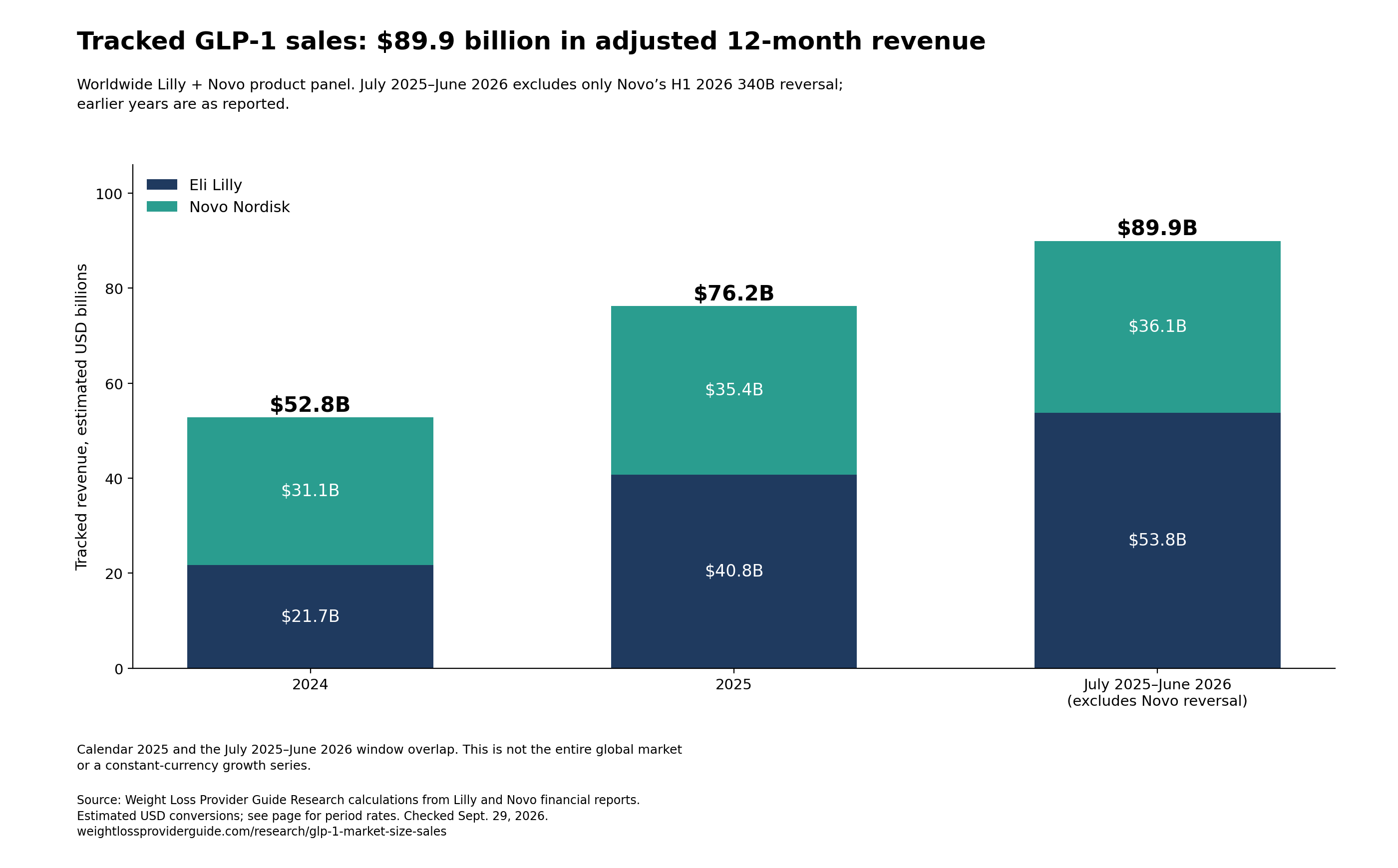
GLP-1 sales from Eli Lilly and Novo Nordisk totaled about $89.9 billion across the tracked products in the 12 months ending June 2026, excluding Novo's one-time 340B rebate reversal. Weight Loss Provider Guide's September 2026 analysis puts the as-reported total at $92.8 billion. Lilly's share of the adjusted total was 60%, up from 41% in 2024. Sales and sources.
Below: each drug's sales, and why GLP-1 market size estimates disagree. Dollar conversions are estimates; 'adjusted' here removes only Novo's first-half 2026 reversal, not every accounting adjustment.
Key GLP-1 market size and sales statistics
- About $89.9 billion: the tracked Lilly and Novo products' worldwide revenue in July 2025–June 2026, excluding Novo's first-half 2026 340B reversal; about $92.8 billion as reported. Weight Loss Provider Guide's September 2026 calculation uses company reports and period-average currency conversions (Table 1; Novo reconciliation).
- About $76.2 billion: worldwide revenue across the same eight tracked brands in 2025, up 44.3% from about $52.8 billion in 2024. Weight Loss Provider Guide calculated the totals in translated U.S. dollars (Table 2; Lilly; Novo).
- 96.5%: the ratio of our $76.2 billion selected-brand total to Morgan Stanley's $79 billion 2025 figure—not a verified global market share. The scopes cannot be fully reconciled from the public sources (Weight Loss Provider Guide calculation; Morgan Stanley, April 22, 2026).
- 60%: Lilly's rounded share of the selected two-company total in July 2025–June 2026, excluding Novo's first-half 2026 340B reversal, versus 41% of the as-reported panel in 2024 (Weight Loss Provider Guide calculation; Table 1).
- 85.7%: Mounjaro and Zepbound's share of the eight-brand panel's $23.4 billion revenue increase from 2024 to 2025, calculated by Weight Loss Provider Guide in translated U.S. dollars (Table 2; Lilly; Novo).
- $22.97 billion: Mounjaro's worldwide revenue in 2025, the most of the eight tracked brands. Zepbound added $13.54 billion (Eli Lilly, Q4 2025 results).
- $36.5 billion vs. about $34.5 billion: 2025 worldwide sales of Mounjaro and Zepbound (tirzepatide) versus Ozempic, Wegovy and Rybelsus (semaglutide), calculated by Weight Loss Provider Guide using Novo's period-average exchange rate (Table 2).
- DKK 127.1 billion (about $19.2 billion): Ozempic's worldwide sales in 2025 (Novo Nordisk 2025 financial report; dollar figure uses Novo's 2025 average exchange rate).
- DKK 79.1 billion (about $11.95 billion): Wegovy's worldwide sales in 2025, up 41% at constant exchange rates (Novo Nordisk 2025 financial report).
- 5.2%: pills' share of the tracked Lilly and Novo revenue in January–June 2026: about $2.5 billion of $47.7 billion, excluding Novo's first-half 2026 340B reversal (Weight Loss Provider Guide calculation; Table 4).
- $98 million: worldwide sales of Lilly's new GLP-1 pill, Foundayo, in April–June 2026, the first quarter Lilly reported sales for it (Eli Lilly, Q2 2026 results).
- DKK 18.4 billion (about $2.9 billion): the 340B rebate-provision reversal included in Novo's six tracked product lines for January–June 2026 (Novo Nordisk H1 2026 report; dollar conversion by Weight Loss Provider Guide).
- $62.8 billion to $79 billion: the range of the four published 2025 GLP-1 market figures reviewed here: Fortune Business Insights, Grand View Research, Roots Analysis and Morgan Stanley. Their definitions differ (sources and figures; checked September 29, 2026).
- $114 billion by 2030: Goldman Sachs' obesity-drug forecast published July 10, 2026. This is a forecast, not sales; its May 2025 figure was $95 billion (Goldman Sachs Research; forecast history).
- $27.5 billion: Medicare Part D gross spending on GLP-1s in 2024, before rebates, about five times the 2019 level (KFF’s January 30, 2026 analysis of CMS data).
On this page: How big · Sales by drug · Lilly vs. Novo · Growth · Pills · Why estimates disagree · The "$100 billion" forecast · The accounting catch · Sales vs. what patients pay · How we built this · Limits · Cite · Download · FAQ · Sources
How big is the GLP-1 market?
The tracked Lilly and Novo products generated about $89.9 billion in worldwide revenue in the 12 months ending June 30, 2026, excluding Novo's first-half 2026 340B reversal. The as-reported total was about $92.8 billion. In calendar 2025, the eight tracked brands brought in about $76.2 billion. Morgan Stanley's separate 2025 market figure is $79 billion; the ratio is not a verified market share. Figures and sources.
Spread evenly over that 365-day window, the adjusted total works out to roughly $246 million a day. Or about $2,850 every second, while you read this line. That's an average, not a live count of sales or cash.
Here's the full count, period by period. Lilly reports in U.S. dollars. Novo reports in Danish kroner (DKK), so we converted its numbers using Novo's own average exchange rate for each period.
| Period | Eli Lilly | Novo Nordisk | Combined | Lilly share |
|---|---|---|---|---|
| 2024 (full year) | 21,719 | 31,099 | 52,818 | 41.1% |
| 2025 (full year) | 40,783 | 35,430 | 76,213 | 53.5% |
| January–June 2025 | 16,921 | 17,067 | 33,988 | 49.8% |
| July–December 2025 | 23,862 | 18,364 | 42,226 | 56.5% |
| January–June 2026, excluding Novo 340B reversal | 29,929 | 17,747 | 47,676 | 62.8% |
| 12 months ending June 30, 2026, excluding Novo H1 2026 340B reversal | 53,791 | 36,110 | 89,901 | 59.8% |
| January–June 2026, as Novo reported it* | 29,929 | 20,618 | 50,547 | 59.2% |
| 12 months ending June 30, 2026, as Novo reported it* | 53,791 | 38,982 | 92,773 | 58.0% |
*Includes Novo's early-2026 rebate-provision reversal (explained below). Lilly's numbers are the same in both versions. These are selected-product totals, not the entire global market. Historical rows retain other reported rebate adjustments. July–December 2025 is calculated by subtracting the separately translated first half from the separately translated full year; it has no single exchange rate. Source: Weight Loss Provider Guide Research analysis of Eli Lilly and Novo Nordisk financial reports; Novo converted at 6.89 (2024), 6.84 (January–June 2025), 6.62 (2025) and 6.40 (January–June 2026) DKK per dollar. Checked September 29, 2026. Rows may not add exactly because of rounding.

Tracked GLP-1 sales: $89.9 billion in adjusted 12-month revenue
Source: Weight Loss Provider Guide Research calculations from Lilly and Novo financial reports.
What counts as a GLP-1 drug here
GLP-1 drugs mimic a gut hormone, glucagon-like peptide-1, that helps control blood sugar and appetite. (Here's how they work.) Tirzepatide, the medicine in Mounjaro and Zepbound, acts on GLP-1 and a second hormone, GIP. We include tirzepatide's dual action in this GLP-1 sales panel, alongside the single-target drugs.
This ledger covers the following stand-alone GLP-1 product lines: Mounjaro, Zepbound, Trulicity and Foundayo from Lilly, and Ozempic, Wegovy (shot and pill), Rybelsus/Ozempic pill, Saxenda and Victoza from Novo.
Is this the whole market?
No. Morgan Stanley wrote in April 2026 that $79 billion in total GLP-1 sales was recorded in 2025. Our 2025 total from company reports is about $76.2 billion. Dividing the two gives 96.5%, but that does not prove a global market share: the public sources do not give enough detail to match their coverage.
Other drugmakers, generic versions and compounded products are outside this ledger. The gap between our total and Morgan Stanley's is not a measured total for those products. We did not find a complete, comparable primary-source sales total for them.
How much does each GLP-1 drug sell?
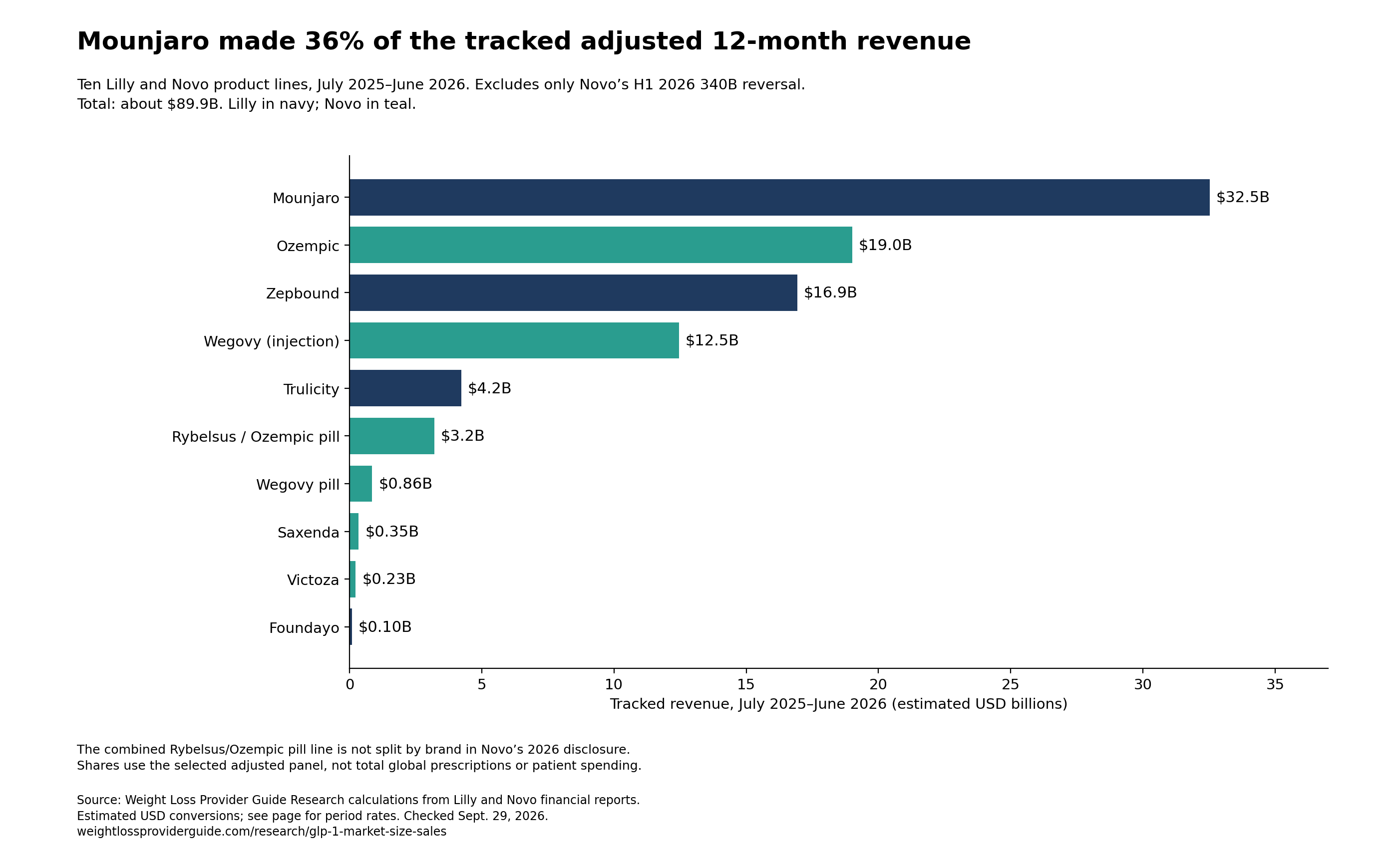
Mounjaro leads the tracked product lines. It brought in $32.5 billion in the 12 months ending June 2026, which is 36% of this ledger's total after excluding Novo's first-half 2026 340B reversal. Ozempic was second at about $19.0 billion. Source rows.
Put another way: out of every $100 of manufacturer revenue in this adjusted panel, about $36 came from Mounjaro. That's not a split of what patients paid.
| Drug | Maker | Active ingredient | 2024 | 2025 | 2025, as the company reported it | 12 months ending June 30, 2026 | Share of 12-month total |
|---|---|---|---|---|---|---|---|
| Mounjaro | Eli Lilly | tirzepatide | 11,540 | 22,965 | $22,965 million | 32,529 | 36.2% |
| Ozempic | Novo Nordisk | semaglutide | 17,466 | 19,198 | DKK 127,089 million | 19,015 | 21.2% |
| Zepbound | Eli Lilly | tirzepatide | 4,926 | 13,542 | $13,542 million | 16,937 | 18.8% |
| Wegovy (injection) | Novo Nordisk | semaglutide | 8,448 | 11,950 | DKK 79,106 million | 12,450 | 13.8% |
| Trulicity | Eli Lilly | dulaglutide | 5,254 | 4,276 | $4,276 million | 4,227 | 4.7% |
| Rybelsus / Ozempic pill | Novo Nordisk | semaglutide | 3,382 | 3,337 | DKK 22,093 million | 3,209 | 3.6% |
| Wegovy pill | Novo Nordisk | semaglutide | — | — | launched January 2026 | 855 | 1.0% |
| Saxenda | Novo Nordisk | liraglutide | 1,007 | 490 | DKK 3,241 million | 347 | 0.4% |
| Victoza | Novo Nordisk | liraglutide | 796 | 456 | DKK 3,020 million | 234 | 0.3% |
| Foundayo | Eli Lilly | orforglipron | — | — | first sales April–June 2026 | 98 | 0.1% |
| Total | 52,818 | 76,213 | 89,901 | 100% |
— marks a product line first reported in 2026, not a missing value treated as zero. Novo amounts use the stated period-average currency conversions; the 12-month column excludes only its first-half 2026 340B reversal. Trulicity's 2025 amount is the sum of two rounded regional figures, not an exact unrounded worldwide disclosure. The Rybelsus/Ozempic pill line contains Rybelsus alone before 2026; Novo reports the two together in 2026. Source: Weight Loss Provider Guide Research analysis of Lilly Q4 2025 results, Lilly 2025 Form 10-K, Lilly Q2 2026 Form 10-Q, Novo 2025 report, Novo H1 2025 report and Novo H1 2026 report. Checked September 29, 2026. Columns may not add exactly because of rounding.

Mounjaro made 36% of the tracked adjusted 12-month revenue
Source: Weight Loss Provider Guide Research calculations from Lilly and Novo financial reports.
Mounjaro and Zepbound are the same medicine
Both are tirzepatide. In the U.S., Mounjaro is the diabetes brand and Zepbound is the weight-loss brand; Lilly sells Zepbound in the U.S., Canada and Japan. In many other countries, Mounjaro itself is sold for weight loss too. Same ingredient, different labels. Together they brought in $36.5 billion in 2025. Lilly product and sales disclosures.
Ozempic, Wegovy and Rybelsus are all semaglutide
Ozempic and Rybelsus are Novo's diabetes brands. Wegovy is its weight-loss brand, now as a shot and a pill. Together they brought in about $34.5 billion in 2025. That puts the tracked tirzepatide brands ahead of the tracked semaglutide brands in 2025, $36.5 billion to $34.5 billion. In 2024, semaglutide had led by about $13 billion. Source rows and calculation.
If you're weighing the two medicines for yourself rather than for a spreadsheet, our side-by-side guide to how semaglutide and tirzepatide compare covers dosing, results and cost.
The latest quarter: April–June 2026
| Drug | Maker | April–June 2026 | Same quarter in 2025 |
|---|---|---|---|
| Mounjaro | Eli Lilly | $9,943 | $5,199 |
| Zepbound | Eli Lilly | $4,928 | $3,381 |
| Trulicity | Eli Lilly | $1,219 | $1,092 |
| Foundayo | Eli Lilly | $98 | — |
| Lilly total | $16,188 | $9,672 | |
| Ozempic | Novo Nordisk | DKK 31,375 | DKK 31,799 |
| Wegovy (injection) | Novo Nordisk | DKK 19,484 | DKK 19,528 |
| Rybelsus / Ozempic pill | Novo Nordisk | DKK 5,228 | DKK 5,653 |
| Wegovy pill | Novo Nordisk | DKK 3,218 | — |
| Saxenda | Novo Nordisk | DKK 450 | DKK 844 |
| Victoza | Novo Nordisk | DKK 181 | DKK 914 |
| Novo total | DKK 59,936 | DKK 58,738 |
Novo's quarter stays in kroner because this ledger does not use a matched quarter-only exchange rate. The 2025 comparison is as originally reported, including applicable rebate revisions, not Novo's adjusted comparative. Don't add this quarter to the January–June figures above; it's already inside them. Source: Eli Lilly Q2 2026 results and Form 10-Q; Novo Nordisk H1 2026 report, Appendix 6, and Novo H1 2025 report for the originally reported comparison. Checked September 29, 2026.
Is Eli Lilly or Novo Nordisk bigger in GLP-1 drugs?
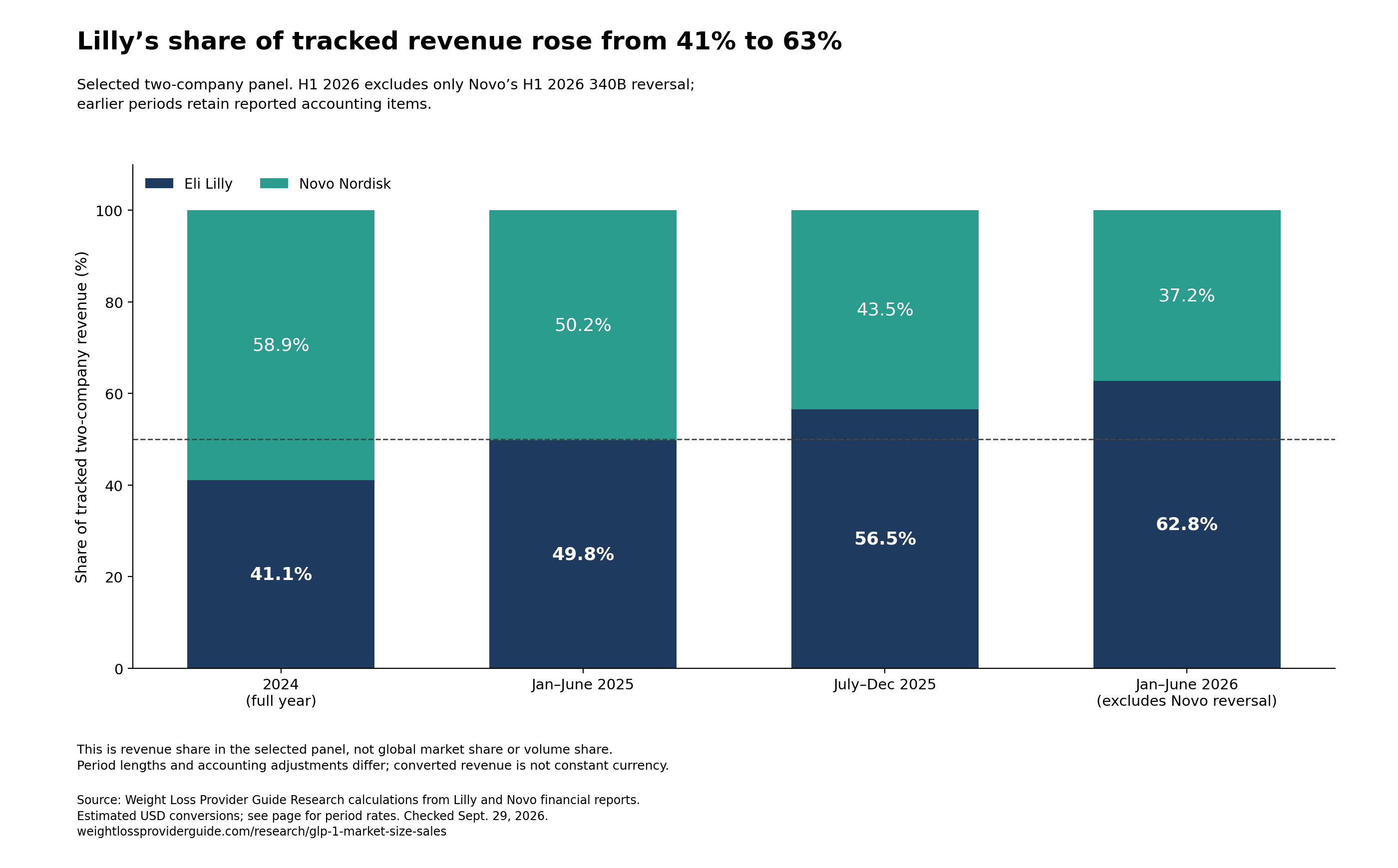
By revenue in this ledger, Eli Lilly. Lilly made 60% of the selected two-company total in the 12 months ending June 2026 after excluding Novo's first-half 2026 340B reversal, up from 41% of the reported panel in 2024. Table 1 also gives the as-reported comparison.
Think of two bakeries. One sells more loaves. The other rings up more at the register. Volume share and revenue share answer different questions.
Novo's 2025 financial release gives a 54.6% global GLP-1 volume share across diabetes and obesity in its November 2025 market-data discussion. Its 2025 annual-report commercial page instead says close to 43% of global volumes, without enough matching detail to reconcile the two. We do not use either figure to name a current volume leader.
In the half-year periods compared here, Lilly moved ahead in the second half of 2025. In January–June 2025 the two were almost tied, 49.8% to 50.2%. By January–June 2026, Lilly's share was 62.8% after excluding Novo's first-half 2026 reversal (Table 1). This series does not remove all historical accounting items.

Lilly’s share of tracked revenue rose from 41% to 63%
Source: Weight Loss Provider Guide Research calculations from Lilly and Novo financial reports.
How fast are GLP-1 sales growing?
Combined revenue across the same eight tracked brands grew 44.3% in 2025, from $52.8 billion to $76.2 billion. Mounjaro and Zepbound supplied $20.0 billion of that $23.4 billion increase, or 85.7%. Growth kept going in 2026: Lilly's GLP-1 sales in April–June 2026 were $16.2 billion, up 67% from a year earlier.
Novo's picture is split. From January to June 2026, its obesity sales grew 19% and its diabetes GLP-1 sales fell 5%, both on Novo's adjusted basis at constant exchange rates (holding currencies steady), according to its H1 2026 report.
Here's the 2025 growth in plain terms. For every new dollar the eight brands added, about 86 cents came from Lilly's two tirzepatide brands. The other six brands added the remaining 14 cents, and four of them (Trulicity, Rybelsus, Saxenda and Victoza) actually shrank. Rows and sources.
More doses, lower prices
Sales dollars and patient numbers don't move together. In April–June 2026, Lilly's total company revenue rose 48%. The amount of medicine it sold rose 60%, and the price it actually collected fell 13%, according to its Q2 2026 results. Lilly said Mounjaro and Zepbound drove both moves.
So dollar growth can understate how much more medicine is being used.
Growth is moving overseas
In April–June 2026, Mounjaro sold $5.2 billion outside the U.S. and $4.8 billion inside it. Novo's obesity sales outside the U.S. grew 40% at constant exchange rates in January–June 2026. Its report also says semaglutide lost market exclusivity in Canada, which lowered the prices Novo collects there. Lilly Q2 results; Novo H1 report.
What's changing the numbers in 2026
Four dated changes affect product access and pricing; the last one is still ahead:
- January 5, 2026: Novo launched the Wegovy pill in the U.S. In its August 4 report, Novo said it had passed 5 million prescriptions since launch and listed self-pay prices of $149 to $299 a month by dose (Novo Nordisk H1 2026 report).
- April–June 2026: Lilly booked its first Foundayo sales, $98 million (Lilly Q2 2026 results).
- July 1, 2026: the Medicare GLP-1 Bridge began giving eligible Part D enrollees access to certain GLP-1 drugs. CMS says it operates outside the Part D benefit, with a $50 copay (CMS).
- January 1, 2027: Novo says it will cut U.S. list prices for Wegovy (shot and pill), Ozempic and the Ozempic pill to $675 (same report).
For the full list-price story behind Ozempic, see our Ozempic price history.
How much of GLP-1 sales come from pills?
About 5%. Pills brought in about $2.5 billion of the $47.7 billion in tracked Lilly and Novo revenue in January–June 2026, excluding Novo's first-half 2026 340B reversal. The two new weight-loss pills, the Wegovy pill and Foundayo, made up 2% of that same total.
So for all the headlines about pills, shots still bring in about 95 of every 100 dollars in this adjusted panel.
| Pill | Maker | Main U.S. use shown here | Sales basis: Novo adjusted, Lilly reported | Estimated millions of U.S. dollars |
|---|---|---|---|---|
| Rybelsus / Ozempic pill | Novo Nordisk | type 2 diabetes | DKK 9,800 million | 1,531 |
| Wegovy pill | Novo Nordisk | weight management | DKK 5,474 million | 855 |
| Foundayo | Eli Lilly | weight management | $98 million | 98 |
| Tracked GLP-1 pills | 2,485 | |||
| Share of the tracked total excluding Novo reversal ($47,676 million) | 5.2% |
Foundayo's $98 million is from April–June only; it had no sales in January–March. Novo figures are its adjusted sales, converted at 6.40 DKK per dollar. The total uses unrounded amounts, so the displayed rows may not add exactly. Source: Novo Nordisk H1 2026 report, Appendix 6; Eli Lilly Q2 2026 results. Checked September 29, 2026.
The combined Rybelsus/Ozempic pill line is the biggest seller of the three; Novo does not split the two brands in this table. Our guide to Rybelsus for weight loss explains why it isn't the same as the Wegovy pill.
Why do GLP-1 market size estimates disagree?
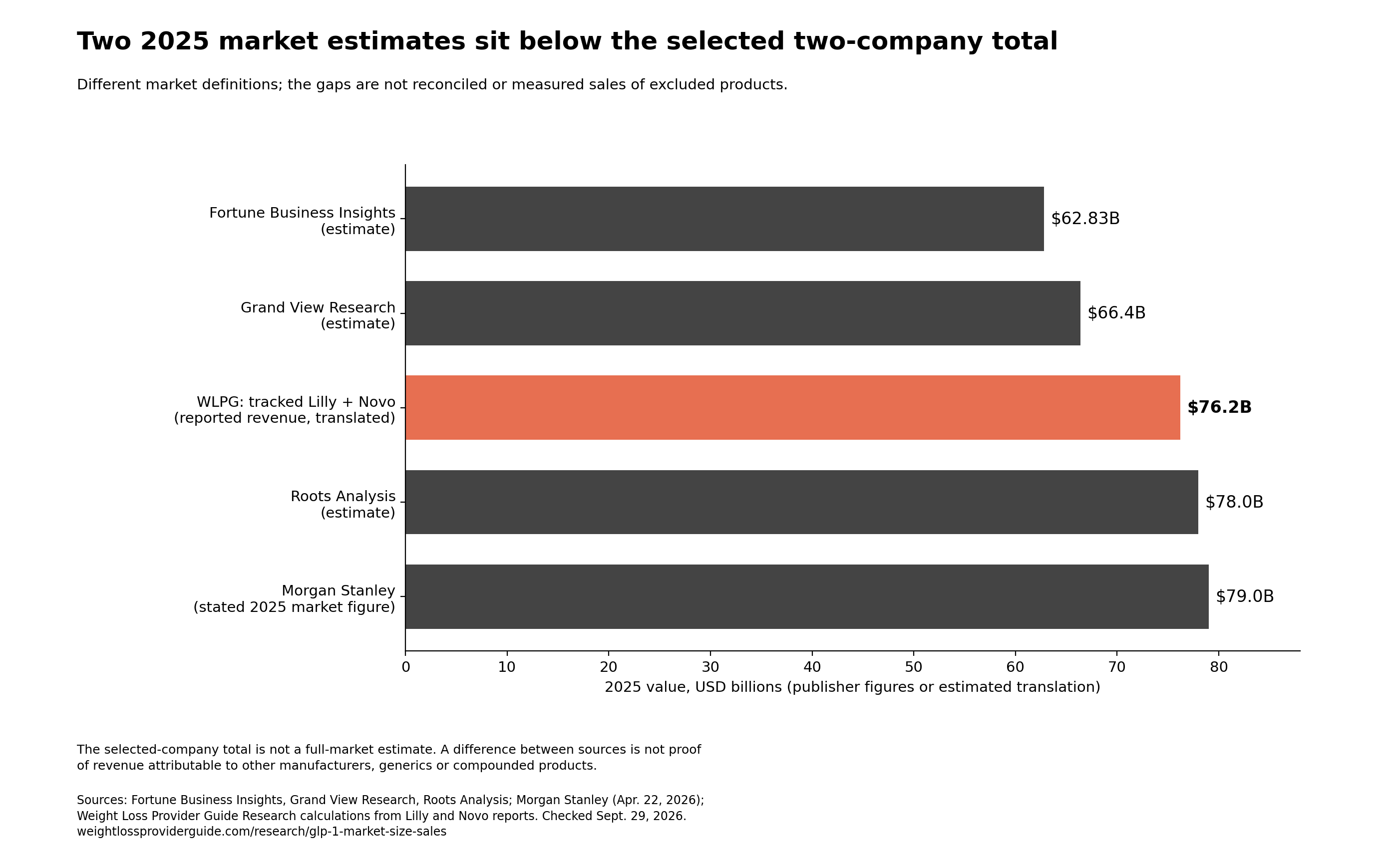
Their scope and methods differ, and the public summaries do not fully explain the gaps. The four published 2025 figures reviewed here run from $62.8 billion to $79 billion. Two of them are lower than the $76.2 billion that Lilly and Novo alone reported selling.
If they all measured the same thing accurately, a whole-market number could never be smaller than two companies' sales. This flags a mismatch or an estimate error; it does not tell us which. The free summaries do not give enough detail to settle it.
| Source | What it measures | 2025 figure | Type |
|---|---|---|---|
| Fortune Business Insights | GLP-1 receptor agonist market | 62.83 | estimate |
| Grand View Research | GLP-1 receptor agonist market | 66.4 | estimate |
| Weight Loss Provider Guide (this page) | Lilly + Novo GLP-1 sales, 8 brands | 76.2 | reported sales, our tally |
| Roots Analysis | GLP-1 receptor agonist market | 78.0 | estimate |
| Morgan Stanley Research | total GLP-1 sales recorded in 2025 | 79.0 | bank's tally of past sales |
Source: publishers' free summary pages and Morgan Stanley's April 22, 2026 article, all checked September 29, 2026; Weight Loss Provider Guide Research analysis of company reports.

Two 2025 market estimates sit below the selected two-company total
Sources: Fortune Business Insights, Grand View Research, Roots Analysis, Morgan Stanley (April 22, 2026), and Weight Loss Provider Guide Research analysis of company reports.
One clue from inside an estimate
Grand View's summary says semaglutide was 52.8% of its $66.4 billion. That's about $35.1 billion, close to the roughly $34.5 billion Novo actually reported for Ozempic, Wegovy and Rybelsus. The trouble is what's left: $31.3 billion for every other GLP-1. Lilly alone reported $40.8 billion from Mounjaro, Zepbound and Trulicity in 2025.
We can't see the paid report's full method, so we won't guess the reason. This comparison points to a larger mismatch outside semaglutide, but it does not reconcile the full report.
Grand View's estimate for all of 2026 is $82.0 billion. Our selected-product first-half 2026 total is about $47.7 billion excluding Novo's reversal, or $50.5 billion as reported. Neither half-year figure is a full-year forecast.
Three numbers that sound alike
Writers mix these up all the time:
- Net sales are recorded revenue after rebates, discounts and other sales deductions. They are not profit or cash receipts. Our tables distinguish reported revenue from the stated 340B adjustment.
- Gross spending is drug spending before rebates, often including amounts paid by plans and patients. It is not the same as manufacturer revenue.
- Market size estimates are models built by research firms. Some add up sales; others project from patient counts and prices.
For a simple example, suppose a payer and patient together spend $1,000, $500 comes back in rebates, and there are no other fees or deductions. Gross spending is $1,000 and spending after rebates is $500. Both can be true at once; list price alone cannot tell you either amount.
Where does "$100 billion by 2030" come from?
It's a Goldman Sachs forecast from October 30, 2023, and it covered obesity drugs. Goldman later raised it to $130 billion, then cut it to $95 billion in May 2025. Its July 10, 2026 article gives $114 billion for 2030. Other bank forecasts use broader categories: J.P. Morgan projects $200 billion for incretin drugs by 2030, and Morgan Stanley projects $190 billion for GLP-1s by 2035. Dated sources.
Forecasts are educated guesses about the future. The company-sales tables use recorded revenue, not cash that changed hands. The market-research figures above are estimates, not company filings.
| Publisher | Published | What it covers | Target year | Forecast |
|---|---|---|---|---|
| Goldman Sachs Research | October 30, 2023 | anti-obesity drugs | 2030 | $100 billion |
| Goldman Sachs Research | Earlier forecast, cited May 22, 2025* | anti-obesity drugs (raised) | 2030 | $130 billion |
| Goldman Sachs Research | May 22, 2025 | anti-obesity drugs (cut; historical) | 2030 | $95 billion |
| Goldman Sachs Research | July 10, 2026 | global obesity-drug sales | 2030 | $114 billion |
| J.P. Morgan Global Research | February 27, 2026 | incretin drugs, which include GLP-1s | 2030 | $200 billion |
| Morgan Stanley Research | April 22, 2026 | GLP-1 drugs for type 2 diabetes and obesity | 2035 | $190 billion (range $170 billion to $240 billion) |
| Grand View Research | June 2026 | GLP-1 receptor agonists | 2033 | $185.3 billion |
*The May 2025 Goldman article documents the earlier $130 billion forecast. We have not established that forecast's original publication date. Source: publishers' pages linked above, checked September 29, 2026. Forecasts use different definitions and target years, so they can't be lined up into one trend.
When you quote one, name the publisher, the year it was made, what it covers and the target year. "$100 billion by 2030" without those four things could point to an outdated Goldman number.
Why do reported and adjusted 2026 GLP-1 sales differ by $2.9 billion?
Novo Nordisk booked a one-time accounting gain in early 2026. It reduced a liability for estimated rebates under a U.S. drug-discount program called 340B. In Novo's GLP-1 brands, that added DKK 18.4 billion (about $2.9 billion) to reported sales for January–June 2026.
The reversal does not represent extra pens or pills sold, and Novo says it has no cash impact. It's like lowering an estimate for a bill you expected to owe. It changes recorded revenue, not the number of sales transactions. That's why our headline totals use Novo's own "adjusted" sales, which leave it out. Novo uses adjusted sales for its own 2026 outlook. Novo H1 2026 report.
| Product | Reported sales | One-time 340B gain | Adjusted sales |
|---|---|---|---|
| Ozempic | 71,855 | 12,655 | 59,200 |
| Wegovy (injection) | 39,997 | 2,278 | 37,719 |
| Rybelsus / Ozempic pill | 10,343 | 543 | 9,800 |
| Wegovy pill | 5,474 | 0 | 5,474 |
| Victoza | 3,261 | 2,746 | 515 |
| Saxenda | 1,024 | 153 | 871 |
| Six tracked product lines | 131,954 | 18,375 | 113,579 |
| In U.S. dollars (at 6.40 DKK per dollar) | $20,618 | $2,871 | $17,747 |
Source: Novo Nordisk H1 2026 report, Appendix 6 (sales IFRS reconciliation). Dollar row by Weight Loss Provider Guide Research. Checked September 29, 2026. Novo's company-wide one-time gain was larger (DKK 26.8 billion) because it also touched insulin and rare-disease products.
Victoza shows the trap best. Its reported sales were 6.3 times its adjusted sales. Comparing reported 2026 sales with 2025 without this bridge would mix sales changes with a large accounting change. The reported revenue is valid; it is not a measure of new prescriptions. Our adjustment removes this item only, not every rebate change in either company's history.
Do GLP-1 drug sales tell you what patients pay?
No. Drug sales are recorded revenue after rebates and discounts, not take-home profit or cash. What one person pays depends on their insurance, pharmacy and program, and gross government spending is a third, separate number.
Here's that third number. Gross Medicare Part D spending on GLP-1s was $27.5 billion in 2024 before rebates, about five times the 2019 level, according to a KFF analysis of CMS data. KFF notes that if rebates averaged 50%, Medicare's net cost would be around $14 billion. KFF’s January 16, 2026 analysis put Medicaid gross spending at $8.6 billion across 8.4 million GLP-1 prescriptions in 2024 (original analysis; Figure 2 spending data). These are KFF’s published analyses of CMS data, not totals we independently rebuilt from raw CMS records.
Don't add those to the sales tables. Part of that spending is already inside Lilly's and Novo's sales, counted a different way. For a state-by-state view, see our Medicare GLP-1 spending by prescriber state.
If you're trying to work out your own monthly cost rather than the market's, our guide to GLP-1 cost with and without insurance walks through each route. Online programs post their own prices too: see the GLP-1 telehealth pricing index and our comparison of licensed GLP-1 providers.
How we built this
We built the GLP-1 Sales Ledger from the companies' own financial reports. Here's exactly what we did:
- Collected the named GLP-1 product lines from Eli Lilly's quarterly results, Form 10-Q and Form 10-K filings, and from Novo Nordisk's quarterly and annual financial reports filed with the U.S. Securities and Exchange Commission. The ledger has ten product/formulation lines, including Wegovy shot and pill separately and the combined Rybelsus/Ozempic pill line, across selected periods from 2024 through June 30, 2026.
- Copied each company's own number for each selected period, in its own currency. For Trulicity's 2025 total, we added Lilly's rounded U.S. $2,914 million and outside-U.S. $1,362 million amounts. For Lilly's 2024 rows, we used the original filing's more precise $11,540.1 million Mounjaro, $4,925.7 million Zepbound and $5,253.5 million Trulicity amounts. The ledger contains 82 rows, including second-quarter 2025 comparisons and both reported and adjusted 12-month totals.
- Calculated July–December 2025 by subtraction. We took the full-year product figure and subtracted January–June, using the two source periods rather than claiming a directly reported half-year number.
- Converted Novo's kroner to dollars using the average U.S. dollar rate Novo publishes for each period: 6.89 DKK per dollar for 2024, 6.84 for January–June 2025, 6.62 for 2025 and 6.40 for January–June 2026. For July–December 2025, we subtracted the dollar value of the first half from the dollar value of the full year.
- Left out Novo's one-time 340B gain from the headline totals by using Novo's adjusted sales for January–June 2026. The as-reported versions are in Table 1 and the download.
- Added up and divided. Totals and shares come straight from the selected rows. We kept calculation precision until display rounding, with nine decimal places retained for converted values in the CSV. Those decimals aid reproduction; they do not make the source measurements more precise. Formulas and component row IDs are in the downloads. Select one period and one basis, and never sum reported and adjusted versions together.
All sources were checked on September 29, 2026. To reproduce any number, open the CSV: each row lists its source link, the table it came from and the math.
Two small judgment calls, stated so you can change them: Novo's original January–June 2025 report gives 6.85 DKK per dollar; its January–June 2026 comparison gives 6.84. The reports do not explain that difference. We used the later comparison, without calling it a formal restatement. Using 6.85 raises the 12-month total by about $25 million, and it still rounds to $89.9 billion. Lilly calls its figures revenue, while Novo calls its figures net sales; both reflect sales deductions. Subtracting separately translated years and half-years gives an approximate dollar total, not a constant-currency growth measure. Other reported rebate-estimate changes remain in the historical data.
What this data does and doesn't show
It shows:
- What Eli Lilly and Novo Nordisk sold, drug by drug, from 2024 through June 2026, after rebates and discounts.
- How their share of combined GLP-1 sales has shifted.
- How much comes from pills vs. shots.
- Where one-time accounting items change the totals.
It doesn't show:
- Every GLP-1 dollar in the world. Other drugmakers, generic versions sold in some countries, and compounded GLP-1s are not included. We did not establish a complete, comparable primary-source sales total for them.
- Patients or prescriptions. Dollars rise and fall with price, not just with people treated.
- A clean obesity vs. diabetes split. Mounjaro is sold for weight loss in many countries outside the U.S., so brand names don't sort the money by use.
- What any one person pays, or what insurers spend before rebates.
- Profit. These are sales, not earnings.
- Novo's quarter-only figures in dollars. We did not apply a matched quarter-only average exchange rate, so its April–June 2025 and April–June 2026 numbers stay in kroner.
Missing isn't zero. If a number isn't in the ledger, we don't have a sourced figure for it.
How to cite this page
Credit Weight Loss Provider Guide for the combined totals, shares and calculations. When you quote a single company's number, keep that company and period in the sentence too.
WPG Research Team. "GLP-1 Market Size and Reported Drug Sales: $89.9B Adjusted in 12 Months." Weight Loss Provider Guide Research. Updated September 2026. https://weightlossproviderguide.com/research/glp-1-market-size-sales
One-sentence version:
Tracked Lilly and Novo GLP-1 products generated about $89.9 billion in worldwide revenue in July 2025–June 2026, excluding Novo's first-half 2026 340B reversal, according to Weight Loss Provider Guide Research's September 2026 analysis; the as-reported total was about $92.8 billion.
Reuse: our original tables, charts, calculations and ledger arrangement are available under CC BY 4.0 with credit by name to Weight Loss Provider Guide Research; no link to us is required. Keep the company and research-firm source credits and their terms. This permission does not license third-party reports, artwork or other material we do not own.
Download the GLP-1 Sales Ledger
Four free CSV files, no sign-up:
- glp-1-sales-ledger.csv: 82 rows across the ten tracked product lines and selected periods, with original currency, exchange rate, U.S. dollars where calculated, basis, formula, component row IDs, source links and check date.
- glp-1-sales-totals.csv: the eight Table 1 totals, plus two quarter-only records with separate USD and DKK company subtotals.
- glp-1-market-estimates-and-forecasts.csv: 15 estimate and forecast records, including the dated history and scenarios in Tables 5 and 6.
- glp-1-derived-findings.csv: 22 calculations behind the growth, shares, ratios and examples, with formulas and sources.
Dataset version 2026.06 (data through June 30, 2026; checked September 29, 2026).
Find one number fast
Pick a drug, a period and a basis, and the finder shows the amount, where it came from and a sentence you can copy. It only reads the ledger above, so it can't show a number we don't have.
Find reported GLP-1 sales
Explore reported worldwide product revenue from the published sales ledger and totals.
Loading the sales ledger and totals…
Frequently asked questions
How big is the GLP-1 market?
The tracked Lilly and Novo products generated about $89.9 billion in worldwide revenue in July 2025–June 2026 excluding Novo's first-half 2026 340B reversal, or $92.8 billion as reported. Their eight tracked brands brought in about $76.2 billion in 2025. Morgan Stanley's separate $79 billion 2025 figure uses a scope we cannot fully reconcile, so it is not our market-share denominator. Table 1 and sources.
Who sells the most GLP-1 drugs?
By revenue in this ledger, Eli Lilly: 60% of the selected total in July 2025–June 2026 excluding Novo's first-half 2026 reversal, and 53.5% of the as-reported 2025 panel. Volume is a separate measure: Novo's 2025 release gives 54.6%, while its 2025 annual-report commercial page says close to 43%. Those source figures are not reconciled here and do not establish a current volume leader. Source comparison.
How much did Ozempic sell in 2025?
Novo Nordisk reported Ozempic sales of DKK 127.1 billion in 2025. That's about $19.2 billion at Novo's 2025 average exchange rate. Ozempic ranked second among the tracked 2025 brands, after Mounjaro. Table 2 and sources.
How much did Wegovy sell in 2025?
Novo reported Wegovy sales of DKK 79.1 billion in 2025, about $11.95 billion, up 41% at constant exchange rates. The Wegovy pill launched in January 2026 and added DKK 5.5 billion (about $855 million) in its first six months. Novo H1 2026 report.
How much did Mounjaro and Zepbound sell in 2025?
Lilly reported $22.97 billion for Mounjaro and $13.54 billion for Zepbound, a combined $36.5 billion. Both are tirzepatide. Together they supplied 85.7% of the eight-brand panel’s revenue increase between 2024 and 2025, calculated in translated U.S. dollars. Table 2 and sources.
Is the GLP-1 market still growing?
The tracked eight-brand panel grew 44.3% in 2025. Lilly's tracked GLP-1 revenue was up 67% in April–June 2026 from a year earlier; Novo reported 19% obesity-sales growth and a 5% fall in diabetes GLP-1 sales for January–June 2026 on its adjusted, constant-currency basis. These measure different periods and methods, not one global growth rate. Growth and sources.
What will the GLP-1 market be worth in 2030?
Nobody knows yet. Goldman Sachs’ July 10, 2026 article forecasts $114 billion for obesity drugs by 2030, and J.P. Morgan forecasts $200 billion for the broader incretin market by 2030. Morgan Stanley forecasts $190 billion for GLP-1s by 2035. These are forecasts, not sales. Publication dates and sources.
Do these numbers include compounded semaglutide or tirzepatide?
No. This ledger covers only the named Lilly and Novo product lines. We did not establish a complete, comparable primary-source sales total for compounded products, and we do not treat that gap as zero.
Why are there two numbers for Novo's 2026 sales?
Novo booked a one-time accounting gain in early 2026 tied to the U.S. 340B discount program. It added DKK 18.4 billion (about $2.9 billion) to reported GLP-1 sales for January–June 2026. Novo's adjusted figures leave it out, and so do our headline totals. Novo reconciliation.
Sources
-
Eli Lilly and Company. "Lilly reports second-quarter 2026 financial results…" Form 8-K exhibit, August 5, 2026. Selected Revenue Highlights; product commentary. https://www.sec.gov/Archives/edgar/data/59478/000005947826000077/q226lillysalesandearningsp.htm (checked September 29, 2026)
-
Eli Lilly and Company. Form 10-Q for the quarter ended June 30, 2026. Revenue by product, three and six months. https://www.sec.gov/Archives/edgar/data/59478/000005947826000081/lly-20260630.htm (checked September 29, 2026)
-
Eli Lilly and Company. "Lilly reports fourth-quarter 2025 financial results and provides 2026 guidance," February 4, 2026. Selected Revenue Highlights. https://investor.lilly.com/news-releases/news-release-details/lilly-reports-fourth-quarter-2025-financial-results-and-provides (checked September 29, 2026)
-
Eli Lilly and Company. Form 10-K for 2025. Revenue by product, U.S. and outside U.S. https://www.sec.gov/Archives/edgar/data/59478/000005947826000013/lly-20251231.htm (checked September 29, 2026)
-
Eli Lilly and Company. Form 10-K for 2024. Revenue by product. https://www.sec.gov/Archives/edgar/data/59478/000005947825000067/lly-20241231.htm (checked September 29, 2026)
-
Eli Lilly and Company. Form 10-Q for the quarter ended September 30, 2025. Revenue by product, nine months (used to cross-check). https://www.sec.gov/Archives/edgar/data/59478/000005947825000254/lly-20250930.htm (checked September 29, 2026)
-
Novo Nordisk A/S. Financial report for January 1–June 30, 2026 (Form 6-K), August 4, 2026. Adjusted sales split per therapy; Appendix 5; Appendix 6 sales IFRS reconciliation; FX table; commercial update. https://www.sec.gov/Archives/edgar/data/353278/000035327826000023/caq22026.htm (checked September 29, 2026)
-
Novo Nordisk A/S. Financial report for January 1–December 31, 2025 (Form 6-K), February 3, 2026. Sales split per therapy; FX table; market share. https://www.sec.gov/Archives/edgar/data/353278/000035327826000006/caq42025.htm (checked September 29, 2026)
-
Novo Nordisk A/S. Financial report for January 1–June 30, 2025 (Form 6-K), August 6, 2025. Sales split per therapy. https://www.sec.gov/Archives/edgar/data/353278/000162828025038087/caq22025.htm (checked September 29, 2026)
-
Morgan Stanley Research. "GLP-1 Market Expected to More Than Double to $190B by 2035," April 22, 2026. https://www.morganstanley.com/insights/articles/glp1-weight-loss-market-may-double-190-billion-2035 (checked September 29, 2026)
-
J.P. Morgan Global Research. "How Supply and Demand for Weight Loss Drugs is Playing Out in 2026," February 27, 2026. https://www.jpmorgan.com/insights/global-research/current-events/obesity-drugs (checked September 29, 2026)
-
Goldman Sachs Research. "The anti-obesity drug market may prove smaller than expected," May 22, 2025. https://www.goldmansachs.com/insights/articles/the-anti-obesity-drug-market-may-prove-smaller-than-expected (checked September 29, 2026)
-
Goldman Sachs Research. "Why the anti-obesity drug market could grow to $100 billion by 2030," October 30, 2023. https://www.goldmansachs.com/insights/articles/anti-obesity-drug-market (checked September 29, 2026)
-
Grand View Research. GLP-1 Receptor Agonist Market Size report summary. https://www.grandviewresearch.com/industry-analysis/glp-1-receptor-agonist-market (checked September 29, 2026)
-
Fortune Business Insights. GLP-1 Receptor Agonist Market report summary. https://www.fortunebusinessinsights.com/glp-1-receptor-agonist-market-112827 (checked September 29, 2026)
-
Roots Analysis. GLP-1 Receptor Agonist Market report summary. https://www.rootsanalysis.com/reports/glp-1-market.html (checked September 29, 2026)
-
KFF. "Recent Trends in GLP-1 Use and Spending in Medicare," January 30, 2026. https://www.kff.org/medicare/recent-trends-in-glp-1-use-and-spending-in-medicare/ (checked September 29, 2026)
-
KFF. "Medicaid Coverage of and Spending on GLP-1s," January 16, 2026. Figure 2 (prescriptions and gross spending). https://www.kff.org/medicaid/medicaid-coverage-of-and-spending-on-glp-1s/ (checked September 29, 2026)
-
Goldman Sachs Research. "Biotech Stocks Are Projected to Extend Rally amid Innovation and M&A," July 10, 2026. Obesity-market forecast. https://www.goldmansachs.com/insights/articles/biotech-stocks-are-projected-to-extend-rally-amid-innovation (checked September 29, 2026)
-
Centers for Medicare & Medicaid Services. "Medicare GLP-1 Bridge." Program scope, start date and copay; page modified July 13, 2026. https://www.cms.gov/medicare/coverage/prescription-drug-coverage/medicare-glp-1-bridge (checked September 29, 2026)
-
Novo Nordisk. Annual Report 2025, "Commercial execution." Conflicting global volume-share wording and product descriptions. https://annualreport.novonordisk.com/2025/strategic-aspirations/commercial-execution.html (checked September 29, 2026)
-
U.S. Food and Drug Administration. "FDA Approves First New Molecular Entity Under National Priority Voucher Program," April 1, 2026. Foundayo approval and product identity. https://www.fda.gov/news-events/press-announcements/fda-approves-first-new-molecular-entity-under-national-priority-voucher-program (checked September 29, 2026)
-
KFF. Figure 2, Medicaid gross GLP-1 spending, 2019–2024, accompanying its January 16, 2026 analysis. https://datawrapper.dwcdn.net/63R44/ (checked September 29, 2026)
Weight Loss Provider Guide Research is an independent research and reference resource covering access, coverage, and policy for medical weight-management care.