GLP-1 Usage Statistics and Demographics: 1 in 8 Adults, by Age and Sex
By the WPG Research Team · Updated September 2026
About 1 in 8 U.S. adults (12%) were taking a GLP-1 in KFF's October–November 2025 poll, and 18% had tried one. Four published survey results near 12% use three different labels, according to Weight Loss Provider Guide's September 2026 source review: ever-use, current use, and reported weight-loss use. Gallup's older weight-loss figure conflicts with its newer trend.
Below are the GLP-1 usage statistics that matter, each one next to what it actually counts. Then we sort users by age, sex, race, insurance and health, and show which "12%" you should actually quote.
For company-reported product revenue, see GLP-1 market size and drug sales. For a selected-program snapshot, see obesity drugs in late-stage development.
Key GLP-1 usage statistics
- 12% of U.S. adults were currently taking a GLP-1 drug to lose weight or treat a chronic condition, and 18% had ever taken one (KFF Health Tracking Poll, Oct. 27–Nov. 2, 2025).
- Four "about 12%" figures, three labels: published reports gave 12% (KFF 2024, ever taken), 11.8% (RAND 2025, ever taken), 12.4% (Gallup 2025, reported weight-loss use) and 12% (KFF 2025, current use). Gallup's older figure conflicts with its newer trend. Weight Loss Provider Guide source comparison, September 2026.
- About 32 million is Weight Loss Provider Guide's estimate of U.S. adult GLP-1 users in late 2025, applying KFF's 12% to the Census Bureau's July 1, 2025 adult-population estimate of 269,763,509. This is an extrapolation, not a survey headcount.
- 11% of U.S. adults were currently taking a GLP-1 weight-loss medication, and 15% had ever taken one (Gallup, May 28–June 5, 2026; report updated Sept. 8, 2026).
- 22% of adults ages 50–64 were currently taking a GLP-1, vs. 4% of adults 18–29 and 9% of adults 65 and older (KFF, Oct.–Nov. 2025). Ages 50–64 had the highest point estimate in all four sources in our age comparison; this does not mean every age-group difference was statistically significant (Weight Loss Provider Guide analysis).
- 15% of women vs. 9% of men were currently taking a GLP-1 (KFF, Oct.–Nov. 2025). Among adults with diagnosed diabetes, CDC found no significant sex difference in injectable use (27.2% vs. 25.9%, 2024).
- 26.5% of U.S. adults with diagnosed diabetes, about 6.9 million people, were using a GLP-1 injectable in 2024 (CDC National Center for Health Statistics).
- 35% of adults who had ever taken a GLP-1 were not taking one at the time; 14% of those ever-users had stopped because of cost and 13% because of side effects (KFF, Oct.–Nov. 2025).
- 70% of adults who had ever taken a GLP-1 took it at least partly for a chronic condition such as diabetes or heart disease; 30% took it mainly to lose weight (KFF, Oct.–Nov. 2025).
- 17% of adults who had ever taken a GLP-1 obtained the drug or a prescription from an online provider or website in late 2025, up from 11% in spring 2024; 76% named their doctor (KFF). More than one source could be selected.
- 27% of insured adults who had taken a GLP-1 paid the full cost themselves in late 2025, up from 19% in spring 2024 (KFF).
- 8,819 per 100,000 eligible adult patients were prescribed, dispensed or recorded as starting a GLP-1 in the first quarter of 2026, 4.7 times the rate of 1,884 in the second quarter of 2021 (Epic Research).
On this page: How many · Which number to use · By age · By sex · By race · Diabetes · Insurance · Why people take them · Growth · Stopping · Access and cost · Compounded · States and Ozempic · Source check · Method · Cite · Data · FAQ
How many Americans take GLP-1 drugs?
About 12% of U.S. adults, roughly 1 in 8, were taking a GLP-1 drug in late 2025, according to KFF. That is about 32 million people when we apply the rate to the Census adult-population estimate. Another 6% had taken one before but weren't taking one then, so 18% had ever used one. Gallup's mid-2026 survey, which asks about weight-loss medications, found 11% taking one.
Picture a school bus with 40 adults on board. At KFF's late-2025 rates, about five would be taking a GLP-1 and about seven would have tried one. That illustrates the percentages; it is not a prediction about any actual group of passengers.
GLP-1 drugs mimic a hormone that helps lower blood sugar and supports weight loss (CDC). Examples are semaglutide (Ozempic, Wegovy) and tirzepatide (Mounjaro, Zepbound). For the basics, here's what GLP-1 drugs are and how they work, and how semaglutide and tirzepatide differ.
Here are the selected national estimates, side by side. This is a source comparison, not an exhaustive list of every published estimate.
| Source | When asked | Who was asked | What counts as "use" | Result |
|---|---|---|---|---|
| KFF Health Tracking Poll | Apr. 23–May 1, 2024 | 1,479 U.S. adults | Ever taken or taking now, for weight loss or a chronic condition | 12% ever; 6% now |
| Gallup, as first published | Mar. 4–9, 2024 | 5,577 U.S. adults | Taking one for weight loss | 5.8% |
| RAND American Life Panel | 2025 (the report gives conflicting field dates) | 8,793 English-speaking adults | Ever taken, for weight loss or a chronic condition | 11.8% |
| Gallup, as first published | May 27–June 4 and Aug. 26–Sept. 3, 2025 | U.S. adults | Taking one for weight loss | 12.4% |
| KFF Health Tracking Poll | Oct. 27–Nov. 2, 2025 | 1,350 U.S. adults | Ever taken or taking now, for weight loss or a chronic condition | 18% ever; 12% now |
| PRC National Health Survey | Field dates not public; summary published Mar. 5, 2026 | U.S. adults | Taking one now for diabetes, heart disease, sleep apnea and/or weight loss | 13.2% now |
| Gallup | May 28–June 5, 2026 | 5,065 U.S. adults | Ever taken or taking now, asked as "weight loss medications" | 15% ever; 11% now. Same report lists 2025 as 12% ever, 8% now, and 2024 as 6% ever, 3% now |
| Epic Research | Jan.–Mar. 2026 | Adult patients at Epic health systems with a BMI or medication record in that quarter | Prescribed, dispensed or recorded as starting a GLP-1 during the quarter | 8,819 per 100,000 eligible patients |
Source: each organization's original report or data table, linked in the first column; checked Sept. 29, 2026. Compiled by Weight Loss Provider Guide Research. PRC's full methods are behind a sign-up form and were not checked.
| Estimate | Rate | U.S. adults (approx.) |
|---|---|---|
| Taking a GLP-1 now (KFF, Oct.–Nov. 2025) | 12% | 32.4 million |
| Ever taken a GLP-1 (KFF, Oct.–Nov. 2025) | 18% | 48.6 million |
| Taking a GLP-1 weight-loss medication now (Gallup, May–June 2026) | 11% | 29.7 million |
Source: rates from KFF and Gallup. Adult-population estimate: 269,763,509, directly published in the Census Bureau's July 1, 2025 table, released January 2026. Calculation: rate ÷ 100 × 269,763,509, rounded to one decimal place in millions. Calculation by Weight Loss Provider Guide Research. The same 2025 population benchmark is used for the 2026 Gallup extrapolation; these are not survey-published headcounts.
Treat these as ballpark numbers. Each survey rate is rounded and has sampling error. Applying KFF's full-sample margin of plus or minus 3 points to 12% gives an illustrative range of 9%–15%, or about 24.3 million–40.5 million using the same population benchmark. Those are not hard limits or a new survey confidence interval. The survey and Census populations also need not cover exactly the same people.
Why "about 12%" can mean three different things
Four selected survey results published since 2024 landed near 12%. Two were labeled ever-use, one was labeled weight-loss use, and one was labeled current use for weight loss or a chronic condition. These labels overlap; they are not three separate groups of people. Gallup's older weight-loss figure remains a reporting conflict, not a settled estimate to mix into a current-use average.
| Figure | Source | When asked | Published label | Later comparison shown in Chart 1 |
|---|---|---|---|---|
| 12% | KFF | Apr. 23–May 1, 2024 | Ever taken, weight loss or chronic condition | — |
| 11.8% | RAND | 2025; field dates conflict | Ever taken, weight loss or chronic condition; English-speaking adults | — |
| 12.4% | Gallup, October 2025 report | May 27–June 4 and Aug. 26–Sept. 3, 2025 | Reported as taking one for weight loss; conflicts with newer report | 8% current use for 2025 in the 2026 report's trend chart |
| 12% | KFF | Oct. 27–Nov. 2, 2025 | Taking one now, weight loss or chronic condition | — |
Source: KFF 2024, RAND 2025, Gallup 2025, KFF 2025; checked Sept. 29, 2026. Analysis by Weight Loss Provider Guide Research.
Four published GLP-1 estimates near 12% use different labels; Gallup's historical 12.4% differs from the 8% current-use figure for 2025 in its 2026 trend. The conflict is unresolved.
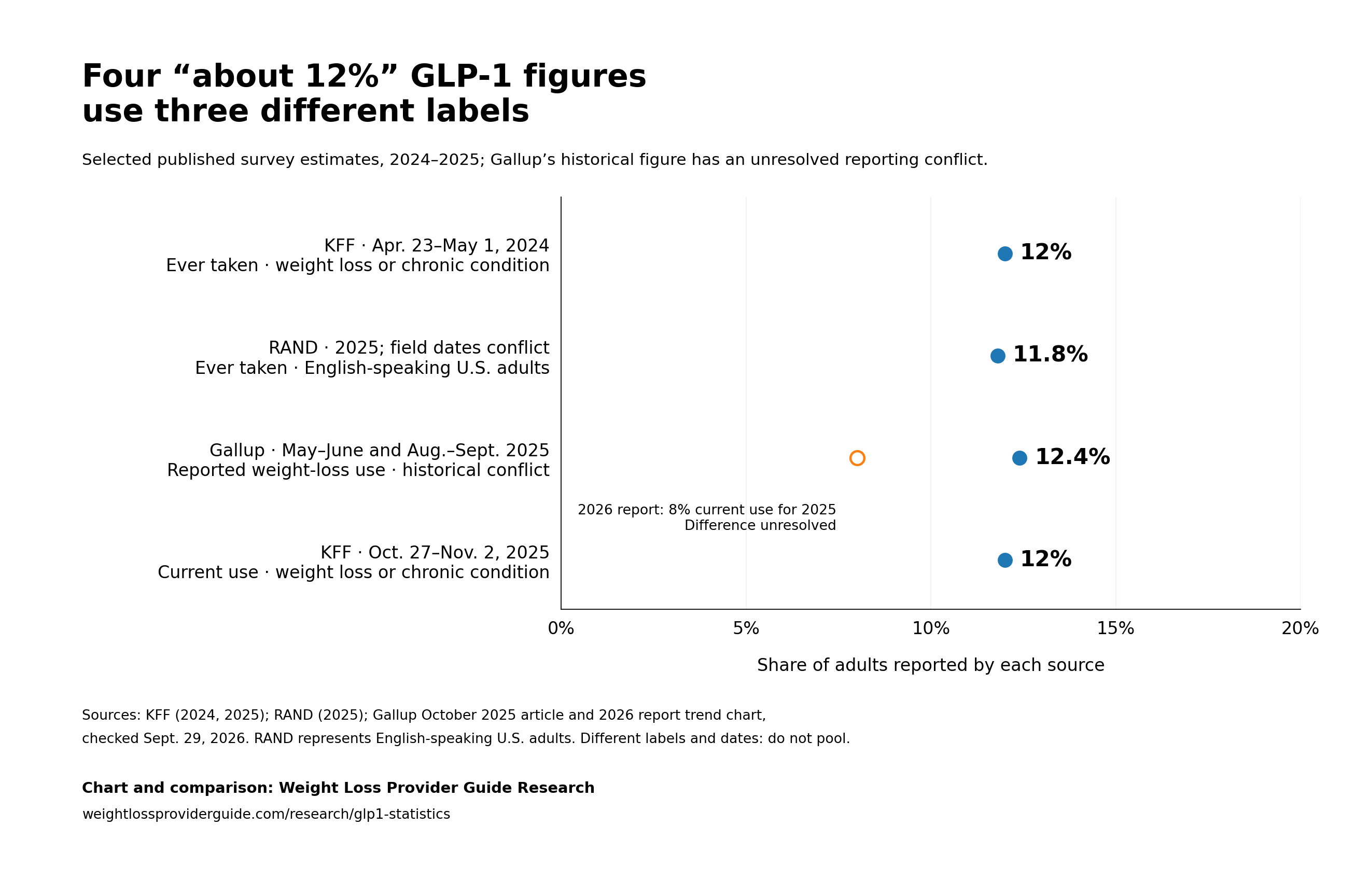
So "1 in 8 Americans take GLP-1s" can be right or wrong depending on the year. In KFF's 2024 poll, 1 in 8 had ever taken one, and only 6% were taking one. In its 2025 poll, 1 in 8 were taking one right now.
Gallup adds a twist. Its October 2025 report said 12.4% of adults were taking a GLP-1 for weight loss in 2025. Its 2026 report's trend chart, checked Sept. 29, lists 2025 differently: 8% taking one and 12% who had ever taken one. Gallup's first 2024 figure, 5.8%, lines up the same way next to the newer 3% (taking) and 6% (ever). Both early numbers sit within half a point of the later ever-taken figures, not the taking-now figures. Gallup's articles don't explain the change. For a trend from the 2026 report, use its current/ever split and name that report. Do not silently relabel the older 12.4% as ever-use or claim the historical conflict has been resolved.
Which GLP-1 number should I use?
Match the number to the sentence you're writing. For "taking one now," use KFF's 12% from late 2025. For "ever tried," use 18%. For "taking one for weight loss," use Gallup's 11% from mid-2026.
| If your sentence says… | Use this | Source |
|---|---|---|
| "…of U.S. adults were taking a GLP-1 in late 2025" | 12% (about 1 in 8), any reason | KFF, Oct.–Nov. 2025 |
| "…of U.S. adults had tried a GLP-1 by late 2025" | 18% | KFF, Oct.–Nov. 2025 |
| "…reported taking a GLP-1 weight-loss medication in mid-2026" | 11% now; 15% ever (weight-loss question) | Gallup, May–June 2026 |
| "…took a GLP-1 mainly to lose weight" | 5% of all adults | KFF, Oct.–Nov. 2025 |
| "Gallup's 2026 report gives these 2025 rates…" | 8% current; 12% ever. The October 2025 report instead gave 12.4%; conflict unresolved | Gallup 2026 trend chart, checked Sept. 29 |
| "…million Americans took GLP-1s in late 2025" | An estimated 32 million (12% of about 269.8 million adults) | KFF + Census Bureau, our calculation |
| "…of people with diabetes" | 26.5% use a GLP-1 injectable; 45% of adults told they have diabetes take any GLP-1 | CDC, 2024; KFF, late 2025 |
| "…of adults 65 and older" | 9% taking one | KFF, Oct.–Nov. 2025 |
| "…Medicare patients on Ozempic" | About 2.0 million Part D enrollees in 2024 | KFF analysis of CMS data, 2024 |
| "Recorded use has more than quadrupled" | 1,884 → 8,819 per 100,000 eligible adult patients (4.7×) | Epic Research, Q2 2021 → Q1 2026 |
| "…by state" or "…on Ozempic, all Americans" | No matching estimate in this ledger | See states and Ozempic |
Source: primary reports linked in Table 1 and the Sources list; checked Sept. 29, 2026. Guidance by Weight Loss Provider Guide Research.
Want a subgroup that isn't in this table? The full data download has 203 rows, each with its source link and check date. The lookup specification below uses that file; the tables and CSV work without a lookup.
Local research lookup
GLP-1 number finder
Filter the published ledger in this browser. Filter choices are not submitted to a server, and this lookup does not store personal information.
Loading local ledger…
Which age groups use GLP-1s the most?
Adults ages 50 to 64 had the highest current-use estimate in KFF's late-2025 poll. In late 2025, 22% of them were taking one, compared with 4% of adults 18 to 29 and 9% of adults 65 and older (KFF). Ages 50–64 also had the highest point estimate in all four sources in Table 6. The groups and use measures differ across those sources.
| Age | Currently taking a GLP-1 | Ever taken a GLP-1 |
|---|---|---|
| 18–29 | 4% | 10% |
| 30–49 | 11% | 18% |
| 50–64 | 22% | 30% |
| 65 and older | 9% | 13% |
| All adults | 12% | 18% |
Source: KFF Health Tracking Poll, Oct. 27–Nov. 2, 2025 (1,350 U.S. adults). Rates are within each age group.
22% of adults ages 50–64 were taking a GLP-1 in late 2025, vs. 4% of adults 18–29 and 9% of adults 65 and older (KFF, Oct.–Nov. 2025).
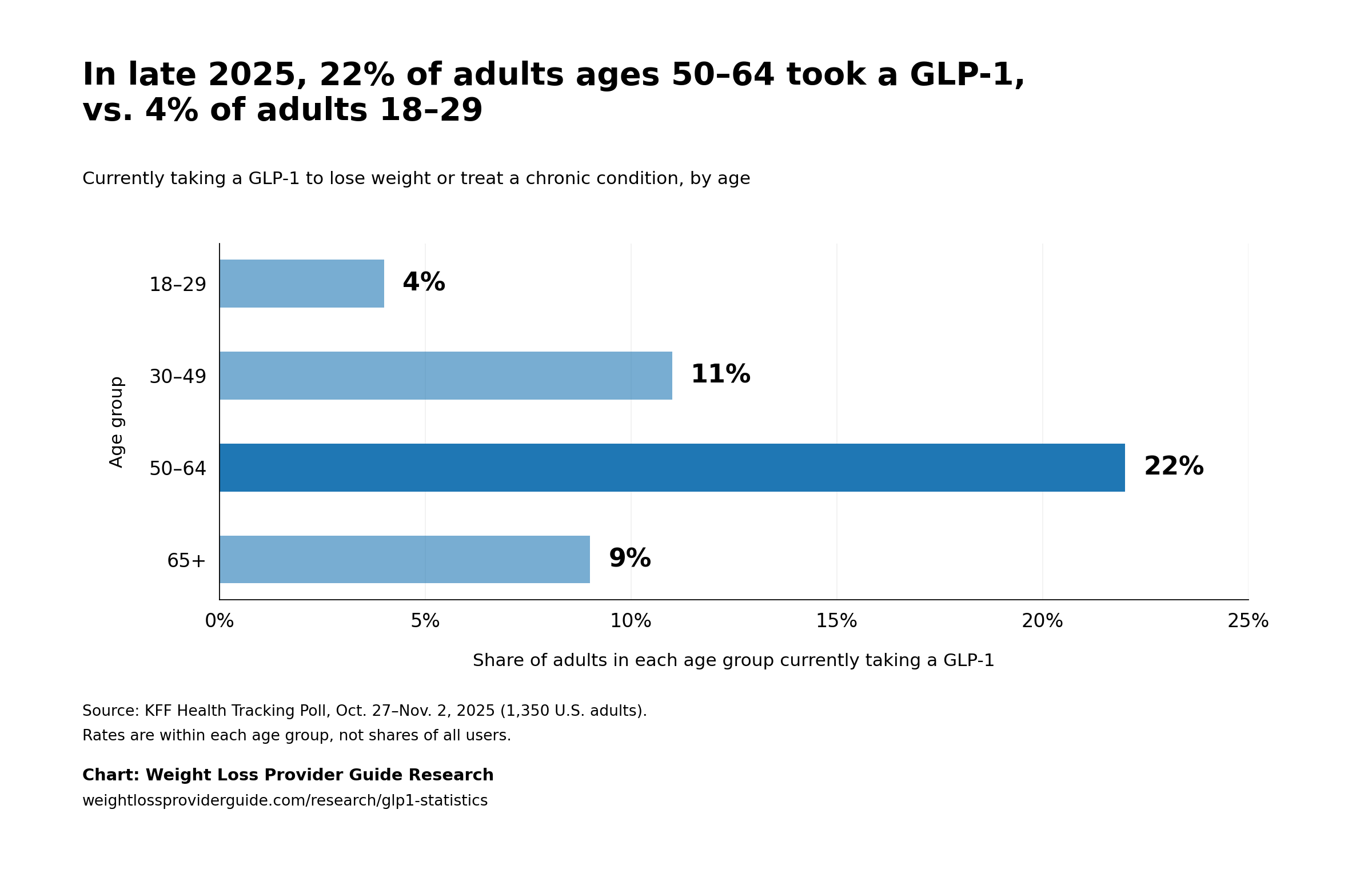
Here's the plain math. At KFF's late-2025 rates, out of 100 adults ages 50 to 64, about 22 were taking a GLP-1. Out of 100 adults ages 18 to 29, about 4 were. Divide 22 by 4 and you get 5.5. That is a 5.5-fold gap between the published age-group estimates, according to our calculation. Both inputs are rounded; 5.5 is not an exact population ratio.
Other surveys ask different questions, but ages 50–64 have the highest point estimate in each table below.
| Age | KFF 2025: taking now, any reason | Gallup 2025 (first published): taking for weight loss | RAND 2025: ever taken, any reason | CDC 2024: adults with diabetes, injectable |
|---|---|---|---|---|
| 18–29 | 4% | 6.7% | 3.3% | 25.3% (ages 18–34) |
| 30–49 | 11% | 9.6% (30–39); 16.2% (40–49) | 11.2% | 29.7% (ages 35–49) |
| 50–64 | 22% | 17.0% | 18.5% | 33.3% |
| 65 and older | 9% | 11.1% | 13.1% | 20.8% |
| 65+ compared with 50–64 | 59% lower | 35% lower | 29% lower | 38% lower |
Source: KFF, Gallup, RAND, CDC NCHS Data Brief 537; checked Sept. 29, 2026. Last row calculated by Weight Loss Provider Guide Research (for example, 1 − 9 ÷ 22 = 59%). Don't compare across columns; each source measures something different.
The lower estimate at 65 and older shows up in every column. KFF suggested Medicare's exclusion of drugs used solely for weight loss as one possible reason; these data do not prove that cause. The Medicare GLP-1 Bridge opened July 1, 2026 and runs through Dec. 31, 2027 for eligible Part D enrollees. It operates outside the Part D benefit, rather than repealing its weight-loss exclusion. The surveys here with known field dates ended before the Bridge began. PRC's field dates are not public.
For care routes rather than population statistics, see GLP-1 options for older adults.
Do women use GLP-1s more than men?
Yes, in surveys of all adults: 15% of women and 9% of men were taking a GLP-1 in late 2025 (KFF). Among adults with diabetes, though, CDC found no significant difference: 27.2% of women and 25.9% of men used a GLP-1 injectable in 2024.
| Measure | Women | Men | Women ÷ men |
|---|---|---|---|
| KFF 2025: taking a GLP-1 now, all adults | 15% | 9% | 1.67 |
| KFF 2025: ever taken a GLP-1, all adults | 22% | 14% | 1.57 |
| Gallup 2025 (first published): taking one for weight loss | 15.2% | 9.7% | 1.57 |
| CDC 2024: GLP-1 injectable, adults with diabetes | 27.2% | 25.9% | 1.05 (not significant) |
| CDC Aug. 2021–Aug. 2023: measured obesity, ages 20+, not age-adjusted | 41.3% | 39.2% | 1.05 |
Source: KFF, Gallup, CDC NCHS Data Brief 537, CDC NCHS Data Brief 508; checked Sept. 29, 2026. Ratios calculated by Weight Loss Provider Guide Research.
Here's the odd part. CDC's measured obesity rates for women and men ages 20 and older were nearly the same in 2021–2023, yet women reported taking a GLP-1 about 1.6 to 1.7 times as often in the two 2025 survey reports. In CDC's diabetes-only data, the gap isn't significant. The surveys don't say why, so we won't guess.
Interest follows the same pattern. Among adults not taking a GLP-1, 27% of women and 18% of men said they'd be at least somewhat interested in one for weight loss (KFF, Oct.–Nov. 2025).
RAND's age-by-sex numbers add detail. Among adults 30 to 49, 15.1% of women had ever taken a GLP-1, compared with 7.2% of men. At 65 and older, the point estimate for men was slightly higher: 13.5% vs. 12.8%. This does not establish a statistically significant difference. RAND's single highest group was women ages 50 to 64, at 20.0% (RAND, 2025).
One quick warning. "15% of women" means 15 out of every 100 women. It doesn't mean women make up 15% of GLP-1 users.
Does GLP-1 use differ by race or ethnicity?
In KFF's late-2025 poll of all adults, GLP-1 use did not differ significantly by race or ethnicity. Among adults with diabetes, CDC found Asian adults used GLP-1 injectables far less often (12.1%) than Hispanic (31.3%), Black (26.5%) or white (26.2%) adults in 2024.
| Group | Currently taking a GLP-1 | Ever taken a GLP-1 |
|---|---|---|
| Black | 13% | 22% |
| Hispanic | 11% | 19% |
| White | 13% | 18% |
Source: KFF's published demographic chart and data, Oct. 27–Nov. 2, 2025. These are within-group estimates, not shares of all users. KFF reports no statistically significant differences across these groups; the small point-estimate gaps are not a ranking.
| Group | Using a GLP-1 injectable | 95% confidence interval |
|---|---|---|
| Hispanic | 31.3% | 25.6%–37.5% |
| Black, non-Hispanic | 26.5% | 21.4%–32.2% |
| White, non-Hispanic | 26.2% | 24.0%–28.3% |
| Asian, non-Hispanic | 12.1% | 7.2%–18.7% |
Source: CDC NCHS Data Brief 537, National Health Interview Survey, 2024. CDC reports the Asian estimate as significantly lower than the other three groups.
A confidence interval shows sampling uncertainty around an estimate. A wider interval means less precision; it is not a hard boundary on the true rate. CDC found the Asian estimate statistically lower than each of the other three groups.
Who you count changes the answer. In KFF's 2024 poll of all adults, 18% of Black adults had ever taken a GLP-1, compared with 13% of Hispanic adults and 10% of white adults (KFF). By late 2025, KFF found no significant differences. Different year, different question, different group. Quote each with its label.
How many people with diabetes use GLP-1s?
About 1 in 4 U.S. adults with diagnosed diabetes, 26.5% or about 6.9 million people, were using a GLP-1 injectable in 2024, according to CDC. KFF's broader question, which counts any GLP-1 including pills, found 45% of adults who say they've been told they have diabetes were taking one in late 2025.
Why the big difference? The two numbers count different things. CDC counted only injectables, in 2024, among adults with diagnosed diabetes. KFF counted any GLP-1, in late 2025, among people who said a doctor had ever told them they had diabetes. Both are published estimates. These scope and date differences do not tell us how much each factor explains the gap. Just don't swap one for the other.
| Group | Using a GLP-1 injectable | 95% confidence interval |
|---|---|---|
| All adults with diagnosed diabetes | 26.5% (about 6.9 million) | 24.7%–28.5% |
| Women | 27.2% | 24.8%–29.8% |
| Men | 25.9% | 23.1%–28.7% |
| Ages 18–34 | 25.3% | 13.7%–40.2% |
| Ages 35–49 | 29.7% | 24.4%–35.4% |
| Ages 50–64 | 33.3% | 29.9%–36.9% |
| Ages 65 and older | 20.8% | 18.5%–23.4% |
| Family income below 100% of poverty level | 25.8% | 20.9%–31.2% |
| 100% to under 200% of poverty level | 24.2% | 20.2%–28.6% |
| 200% to under 400% of poverty level | 26.2% | 22.8%–29.9% |
| 400% of poverty level or more | 29.0% | 25.8%–32.4% |
| Underweight | No reliable estimate | Did not meet CDC reliability standards |
| Healthy weight | 16.7% | 12.9%–21.0% |
| Overweight | 22.2% | 19.1%–25.5% |
| Obesity | 32.4% | 29.7%–35.1% |
| Takes insulin | 31.3% | 28.1%–34.6% |
| Doesn't take insulin | 24.5% | 22.2%–26.9% |
| Takes oral glucose-lowering medicine | 28.1% | 25.8%–30.5% |
| Doesn't take oral glucose-lowering medicine | 22.2% | 19.1%–25.6% |
Source: CDC NCHS Data Brief 537, National Health Interview Survey, 2024; checked Sept. 29, 2026. CDC counted adults who said they were taking a non-insulin injectable to lower blood sugar or lose weight. Differences by sex and by income were not significant.
Among adults with diabetes, ages 50–64 have the highest GLP-1 injectable-use estimate (33.3%) and is lowest at 65 and older (20.8%), CDC 2024.
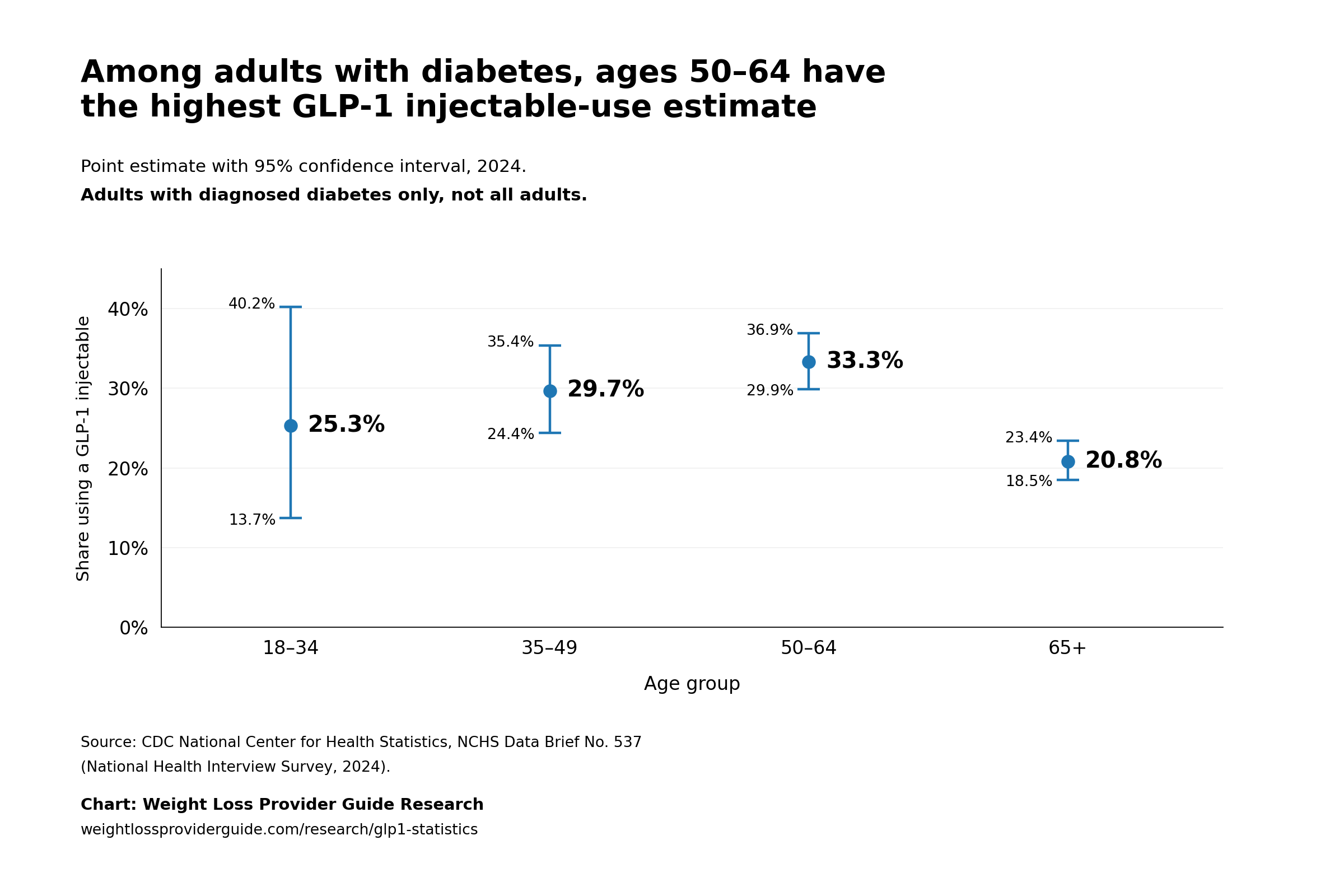
Look at the youngest interval. CDC's estimate for ages 18 to 34 is 25.3%, with a 95% confidence interval of 13.7%–40.2%. That wide interval makes the estimate less precise. CDC reports the 35–49 and 50–64 groups as significantly higher than the 65-and-older group, but not the 18–34 group.
Weight tracks closely too. Among adults with diabetes, 16.7% at a healthy weight used a GLP-1 injectable, compared with 32.4% of those with obesity. If you're curious where your own number lands, you can check the BMI cutoffs used for GLP-1 eligibility.
Does health insurance change who uses GLP-1s?
Insured adults were three times as likely as uninsured adults to be taking a GLP-1 in late 2025: 12% vs. 4% (KFF). That's a gap, not proof that insurance causes it. Public programs add claims-based counts: about 2 million Medicare Part D enrollees took Ozempic in 2024 (KFF analysis of CMS data).
| Insurance status | Currently taking a GLP-1 | Ever taken a GLP-1 |
|---|---|---|
| Insured | 12% | 19% |
| Uninsured | 4% | 6% |
Source: KFF demographic chart, Oct. 27–Nov. 2, 2025. Rates are within each insurance group.
| Program | Figure | Period |
|---|---|---|
| Medicare Part D | About 2.0 million enrollees took Ozempic (fewer than 150,000 in 2019) | 2024 |
| Medicare Part D | Nearly 1 million enrollees took Mounjaro (54,000 in 2022) | 2024 |
| Medicare Part D | About 21.8 million GLP-1 claims (4.8 million in 2019) | 2024 |
| Medicaid | About 8.4 million GLP-1 prescriptions | 2024 |
| Medicaid | 13 state programs covered GLP-1s for obesity (fee-for-service) | January 2026 |
| Medicare GLP-1 Bridge | Demonstration outside the Part D benefit covering select GLP-1s for obesity for eligible Part D enrollees | July 1, 2026–Dec. 31, 2027 |
Source: KFF analysis of CMS Part D data (Jan. 30, 2026); CMS on the Medicare GLP-1 Bridge; KFF on Medicaid coverage (Jan. 16, 2026); checked Sept. 29, 2026. Brand counts can't be added together, because one person can use two brands in a year.
For help comparing care routes, see GLP-1 providers that accept insurance. Insurance acceptance does not by itself mean the drug is covered.
For dollars instead of people, our Medicare GLP-1 spending by state data breaks down Part D gross costs by the prescriber's state.
Why do people take GLP-1s: weight loss, another chronic condition, or both?
Most people who have taken a GLP-1 say treating a chronic condition such as diabetes or heart disease was at least part of the reason. In late 2025, 38% took one mainly for a condition such as diabetes or heart disease, 32% for both, and 30% mainly to lose weight (KFF).
| Main reason | Spring 2024 | Late 2025 |
|---|---|---|
| Mainly to treat a chronic condition | 39% | 38% |
| Both a condition and weight loss | 23% | 32% |
| Mainly to lose weight | 38% | 30% |
| Adults asked | 189 | 239 |
Source: KFF Health Tracking Poll topline, question 20 with its 2024 trend column; checked Sept. 29, 2026. KFF's margin of error for past and current users in 2025 is plus or minus 8 points, so small shifts may be noise.
Across all adults, 5% had ever taken a GLP-1 mainly to lose weight. KFF reports 12% had taken one at least partly for a chronic condition such as diabetes or heart disease. The second share is 2.4 times the first (12 ÷ 5), using KFF's published combined total. This does not imply weight treatment is unrelated to health. KFF's separately rounded parts, 7% and 6%, add to 13%; use its published 12% net, not that sum.
The diagnosis breakdown adds context, not proof of why someone took the drug. Among adults who have ever taken a GLP-1, 84% say a doctor has told them they have at least one of three conditions: overweight or obesity in the past five years (77%), diabetes (49%) or heart disease (21%). Another 15% report none of the three (KFF). A diagnosis isn't the same as a reason, though. Someone with diabetes might still take a GLP-1 mainly to lose weight.
How fast has GLP-1 use grown?
Current use doubled in 18 months in KFF's polling, from 6% of adults in spring 2024 to 12% in late 2025. Gallup's weight-loss measure rose from 3% in 2024 to 11% in 2026. In Epic's health records, the rate of adult patients getting a GLP-1 was 4.7 times as high in early 2026 as in mid-2021.
| Source and measure | 2024 | 2025 | 2026 |
|---|---|---|---|
| KFF: taking now, any reason | 6% (Apr.–May) | 12% (Oct.–Nov.) | — |
| KFF: ever taken, any reason | 12% | 18% | — |
| Gallup: taking now, weight-loss question | 3% | 8% | 11% (May–June) |
| Gallup: ever taken, weight-loss question | 6% | 12% | 15% |
| Epic: patients per 100,000 eligible adult patients, per quarter | — | — | 8,819 (Jan.–Mar.) |
Source: KFF topline (2024 and 2025 columns); Gallup, 2026 report; revised Sept. 8 (trend table); Epic Research (Q2 2021 rate: 1,884). Checked Sept. 29, 2026. Compare across the years within one row, never between rows. The Gallup trend is the one displayed in its 2026 report, checked Sept. 29, 2026; its older report differs.
Two footnotes keep this honest. First, KFF reworded the introduction to its question between polls. In 2024 it described a class of drugs used for weight loss, diabetes and heart risk. In 2025 it named semaglutide and tirzepatide. KFF still reports the two waves as a trend.
Second, Epic's number isn't a prescription count. It's the share of adult patients who were prescribed, dispensed or reported starting a GLP-1 during the quarter. The group it measures is adults who had a BMI recorded or a prescription, dispense or reported medicine recorded that quarter at Epic health systems (Epic tracker definitions). It is a defined clinical-data population, not all U.S. adults. Our September 29 check did not retrieve a newer quarter than Q1 2026.
How many people stop taking GLP-1s?
About 1 in 3 adults who have ever taken a GLP-1, 35%, weren't taking one in late 2025 (KFF). Asked for the main reason, 14% of everyone who had taken one said cost, 13% said side effects, and 5% said their condition improved.
| Status | Share of ever-users |
|---|---|
| Still taking one | 65% |
| Not taking one now | 35% |
| – Stopped because of cost | 14% |
| – Stopped because of side effects | 13% |
| – Stopped because their condition improved | 5% |
| – Stopped for something else | 2% |
Source: KFF Health Tracking Poll topline, question 19/21 combined table; 239 past and current users, plus or minus 8 points; checked Sept. 29, 2026.
This isn't a yearly quit rate. It covers anyone who ever took a GLP-1, whenever they started, including people with different starting dates and lengths of use. Gallup's 2026 numbers point the same way: 15% ever, 11% now, so about 27% of people who tried one weren't taking one (our calculation from rounded numbers).
Where do people get GLP-1s, and how hard are they to pay for?
Most adults who had ever taken a GLP-1 reported getting the drug or a prescription from their doctor or a specialist (76%); 17% named an online provider or website, up from 11% in spring 2024 (KFF, late 2025). More than half (56%) said the drug was hard to afford, including 25% who said it was very hard.
| Where they got it | Spring 2024 | Late 2025 |
|---|---|---|
| Primary care doctor or specialist | 79% | 76% |
| Online provider or website | 11% | 17% |
| Medical spa or aesthetic center | 10% | 9% |
Source: KFF topline, question 22; adults who have ever taken a GLP-1 (189 in 2024, 239 in 2025); checked Sept. 29, 2026.
Those access routes make it worth knowing how to get a GLP-1 prescription safely online.
| How they paid | Spring 2024 | Late 2025 |
|---|---|---|
| Paid the full cost themselves | 19% | 27% |
| Insurance paid part | 57% | 50% |
| Insurance paid all | 24% | 22% |
| Adults asked | 171 | 227 |
Source: KFF topline, question 23; adults with health insurance who have ever taken a GLP-1; checked Sept. 29, 2026. KFF doesn't say whether the 2024-to-2025 changes are statistically significant.
Read that top row slowly. In late 2025, more than 1 in 4 insured GLP-1 users paid the whole bill themselves, even though they had health insurance. In spring 2024 it was about 1 in 5.
| Answer | Spring 2024 | Late 2025 |
|---|---|---|
| Very or somewhat difficult | 54% | 56% |
| Very difficult | 22% | 25% |
| Very or somewhat easy | 45% | 44% |
Source: KFF topline, question 24; checked Sept. 29, 2026.
If cost or coverage is the sticking point for you, you can compare online GLP-1 programs, including ones that help with insurance.
For a separate measure of cost relative to pay, see the GLP-1 affordability index; its assumptions and dates are shown on that page.
How common are compounded GLP-1s?
Gallup's article text reports that, among adults taking a GLP-1 weight-loss medication in mid-2026, 66% named a brand-name drug, 18% a compounded or custom-mixed version, and 13% were unsure. Its embedded chart instead shows 68%, 19% and 12%. The text–chart conflict is unresolved; neither set is presented here as a confirmed correction of the other. FDA states that compounded drugs are not FDA approved.
The text shares add to 97%, and the chart shares add to 99%. Do not fill either gap, normalize the figures to 100%, or build a pie chart from them. Gallup's September 8 revision note does not say which of these particular values was changed. The source check links the competing figures.
Small groups carry big error bars here. Gallup says margins of error for findings within the compounded-user group run as high as plus or minus 10 points; that is not a published confidence interval for the 18% or 19% prevalence figure (Gallup).
For the difference between the products rather than survey shares, read compounded versus name-brand GLP-1s.
Is there GLP-1 usage data by state, or for Ozempic alone?
This ledger does not provide all-adult GLP-1 prevalence by state or a national current-user count for Ozempic alone. One verified brand-specific figure is about 2 million Medicare Part D enrollees who took Ozempic during 2024 (KFF analysis of CMS data). That is an annual count in one insurance program, not all U.S. Ozempic users.
Be careful with state maps you see elsewhere. A map of spending, raw claim counts or search interest is not an all-adult use rate. A claims-based rate needs its covered population and period attached. Our Medicare GLP-1 spending by state page is clear about that: it shows gross Part D drug costs by the prescriber's state, not how many people in each state take a GLP-1.
Why do GLP-1 numbers from the same source disagree?
We logged 14 specific report discrepancies, one cross-report Gallup trend conflict, and one Epic definition check. Some are wording errors; others remain unresolved. Here is what each source actually shows and how we handle it.
| Report | One place says | Another place says | How we handle it |
|---|---|---|---|
| Gallup 2026 | Text: brand-name 66% | Table: 68% | Both shown; unresolved |
| Gallup 2026 | Text: compounded 18% | Table: 19% | Both shown; unresolved |
| Gallup 2026 | Text: unsure 13% | Table: 12% | Both shown; unresolved |
| Gallup 2026 | Text: 36% of compounded users switched from brand-name; 11% switched the other way | Table: 35%; 10% | Both shown; unresolved |
| Gallup 2026 | Text: "extremely effective," 38% compounded, 33% brand-name | Table: 39%; 32% | Both shown; unresolved |
| Gallup 2026 | Text: 80% of compounded users say effective or extremely effective | Table adds to 77% | Both shown; unresolved |
| Gallup 2026 | Text: obesity 36.8% so far in 2026 | Table and its title: 36.4% | Both shown; unresolved |
| Gallup 2026 | Text: diabetes 12.8% | Table: 13.5% | Both shown; unresolved |
| Gallup 2026 | Methods: first 2026 wave began Feb. 28 | Another methods line: Feb. 18 | Unresolved; cite both |
| Gallup 2025 | Text: first measured February 2024 | Methods: March 4–9, 2024 | Methods |
| RAND 2025 | Summary: people used GLP-1s "for weight loss" | Survey question: to lose weight or treat a chronic condition | Question wording |
| RAND 2025 | Text: fielded April and May 2025 | About-the-panel methods: May 19–June 13, 2025 | Cite the year only |
| RAND 2025 | Dates its KFF comparison survey to April 2023 | KFF's own methods: April 23–May 1, 2024 | KFF's dates |
| RAND 2025 | Figure: men 50–64, 16.8% | Appendix table: 17.0% | Both retained with source labels; unresolved |
| Gallup 2025 vs. 2026 | October 2025 report: 12.4% taking for weight loss (2025); 5.8% (2024) | 2026 report trend, checked Sept. 29: 8% current, 12% ever (2025); 3% and 6% (2024) | Use the 2026 report's split only as that report's trend; historical conflict remains |
Source: Gallup 2026, Gallup 2025, RAND, KFF 2024; checked Sept. 29, 2026. Review by Weight Loss Provider Guide Research.
Gallup says it revised estimates on Sept. 8, 2026 after changing its weighting. That note does not identify the update history of each embedded chart, so it does not resolve the conflicts above. We checked the article and its direct data exports: product type, switching, effectiveness, and obesity and diabetes. The headline usage estimates, 11% current and 15% ever, match the trend chart.
One more wording trap appears in Epic's own article: it sometimes says "per 100,000 U.S. adults." The tracker definitions use eligible adult patients in its clinical records. Keep that denominator attached.
What changed since these surveys were taken?
Two things happened after most of these surveys were in the field. KFF fielded its late-2025 poll before the federal government's November 2025 announcement on GLP-1 prices and coverage (KFF). And the Medicare GLP-1 Bridge launched on July 1, 2026, after Gallup's latest survey closed (CMS). It is a demonstration outside the Part D benefit. Later age-group estimates can track the gap between adults 65 and older and those ages 50–64; these earlier surveys cannot measure the Bridge's effect.
How we built this
We assembled eight selected national-estimate entries from reports published between May 2024 and September 2026: two from KFF polls, three from two Gallup reports, and one each from RAND, PRC and Epic Research's health-record tracker. We added four sources that cover part of the population: CDC's survey of adults with diabetes, KFF's analyses of Medicare and Medicaid data, and CDC's measured obesity rates.
- Where the numbers come from. The original report, topline or data table for each source, never a news story or roundup. For Gallup, we also read the data exports behind its embedded charts. We do not use news coverage to decide which conflicting value is correct.
- When we checked. The original source review was completed on Sept. 29, 2026. On October 3, 2026, we rechecked Gallup’s 2026 article and the chart versions currently embedded in it, replacing superseded exports and resolving eight text–chart comparisons. Individual records retain their own check dates. A verified transcription of a remaining conflict is not proof that either conflicting estimate is correct.
- What we recorded. For each number: who was asked, when, how many people, what the question counted (ever vs. now, and for what reason), the margin of error or confidence interval where published, and any note the source attached.
- What we calculated. Headcounts, ratios, gaps and growth multiples. Each one shows its formula in the data download. We never averaged numbers from different surveys, because they don't measure the same thing.
- Rules we followed. We use a documented correction when the publisher identifies one. For embedded charts, we follow the version linked from the current article and retain superseded versions only as history. When current text and tables disagree without a clear correction, we retain both with their labels. Blank values are explained: CDC suppressed one unreliable estimate, while one KFF row records a qualitative finding. Neither blank means zero.
- How to check us. Download the CSV, pick any row and open its source link. Every calculation row names the rows it uses.
- What we checked directly. KFF reports and its questionnaire tables; Gallup articles and their embedded data exports; RAND's report, Figure 2 and appendix; CDC's tables and confidence intervals; Epic's article and tracker definition; and the Census Bureau's published adult-population table. KFF's Medicare and Medicaid figures are attributed to its original CMS-data analyses; we did not recount the raw CMS claims. PRC's 13.2% comes from its public summary; its full methods were not available without the gated brief.
What changed in September 2026: this page was rebuilt around GLP-1 usage and demographics. We added the ledger, the source check, three charts and the data download, and removed older cost and trial statistics to keep this page focused on usage.
October 3, 2026 source correction: we updated Gallup’s product-type, switching, effectiveness, obesity and diabetes chart references to the versions embedded in its current article. Eight previously logged text–chart discrepancies now resolve to agreement. The older Gallup cross-report comparison remains labeled as unresolved.
What can't this data tell you?
These numbers describe groups of people, not you. They can't tell you whether a GLP-1 is right for you, and they can't explain why one group uses them more than another.
- Most figures come from surveys, so they rely on what people report. Epic, Medicare and Medicaid figures come from records instead.
- Questions, dates and groups differ. For a trend, compare numbers from the same source.
- Gallup asks about "weight loss medications." Someone taking Ozempic for diabetes may or may not say yes.
- Small groups have big margins of error. KFF's past-and-current user group is plus or minus 8 points.
- This ledger does not supply all-adult state prevalence or an all-payer national current-user count for one brand. It does not establish that no other source has such data.
- The headcounts are ballpark numbers built from rounded rates.
If you're weighing a GLP-1 for yourself, the free Find My GLP-1 Path tool helps you compare your options with no email required. A licensed clinician decides whether treatment is right for you.
How to cite this page
Ready-to-copy citation:
WPG Research Team. "GLP-1 Usage Statistics and Demographics: 1 in 8 Adults, by Age and Sex." Weight Loss Provider Guide Research. Updated September 2026. https://weightlossproviderguide.com/research/glp1-statistics
Ready-to-copy finding:
Weight Loss Provider Guide's September 2026 review compares four published GLP-1 survey results near 12% with three labels: ever-use, current use, and reported weight-loss use. These are not interchangeable estimates. Gallup's older weight-loss figure remains in conflict with its newer trend.
When you quote a survey figure from this page, please name the survey too, such as "KFF, October–November 2025."
Reuse: You may reuse WPG's original charts and calculations with credit to Weight Loss Provider Guide; keep the underlying source attribution and applicable third-party terms, and no link is required.
Spot an error? Email hello@weightlossproviderguide.com and we'll check it.
Download the data
Free CSV files, no sign-up:
-
GLP-1 Usage Ledger (CSV): 203 rows. The main statistical tables and calculations, each with its source link, field dates, population, uncertainty where published and check date. Report discrepancies are in the source-check file.
-
Source check (CSV): 16 rows. The report discrepancies, cross-report conflict and metric-definition check, with both source locations and our handling.
-
Reproduce our calculations (CSV): 31 original calculations, including formulas and input record IDs from the full ledger.
Chart data (CSV) lists the exact rows drawn in the three charts.
Version 1.2. Original review Sept. 29, 2026; Gallup chart-version correction checked October 3, 2026.
GLP-1 usage FAQ
How many Americans are on GLP-1 drugs?
An estimated 32 million adults, based on applying KFF's late-2025 12% rate (roughly 1 in 8) to the Census adult-population estimate. KFF measured the percentage, not that headcount. About 18% had ever taken one. Gallup's May–June 2026 survey found 11% taking a GLP-1 weight-loss medication. Source and headcount math.
What percentage of Americans are on Ozempic?
The national survey figures in this ledger do not give an Ozempic-only current-use rate. In late 2025, 12% of U.S. adults were taking some GLP-1, a group that includes Ozempic, Wegovy, Mounjaro, Zepbound and others (KFF). In Medicare, about 2 million Part D enrollees took Ozempic in 2024. Sources: KFF survey and KFF Medicare analysis.
How many people take Ozempic?
One verified count comes from Medicare: about 2 million Part D enrollees took Ozempic in 2024, up from fewer than 150,000 in 2019 (KFF analysis of CMS data). This ledger does not provide a total covering every Ozempic user across all types of insurance. KFF analysis.
Why does Gallup say 11% when KFF says 12%?
They ask different questions at different times. Gallup asks about "weight loss medications" and surveyed in May–June 2026. KFF asks about GLP-1s taken to lose weight or treat a chronic condition and surveyed in October–November 2025. KFF and Gallup.
Which age group uses GLP-1s the most?
Adults ages 50 to 64. In late 2025, 22% of them were taking a GLP-1, compared with 4% of adults 18 to 29 and 9% of adults 65 and older (KFF). The same age group had the highest point estimate in all four sources in Table 6, which use different populations and measures. Age comparison.
Does 26.5% mean 1 in 4 Americans take a GLP-1?
No. CDC's 26.5% covers only adults with diagnosed diabetes and only injectable GLP-1s, in 2024. For all U.S. adults, use KFF's 12% from late 2025. CDC.
Why are so many people on GLP-1s?
Most past and current users in KFF's late-2025 poll said a chronic condition such as diabetes or heart disease was at least part of the reason. Among adults who have taken one, 70% took it at least partly for a condition such as diabetes or heart disease (KFF). Among adults told they have diabetes, 45% were taking one in late 2025. KFF.
How many people stop taking GLP-1s?
Among adults who had ever taken a GLP-1, 35% weren't taking one in late 2025 (KFF). The most common reasons were cost (14% of ever-users) and side effects (13%). That's not a yearly quit rate; it covers anyone who ever started. KFF topline.
Is there GLP-1 usage data by state?
The sources assembled here do not supply all-adult use rates by state. Our related Medicare Part D page shows spending by prescriber state, which counts dollars, not users; it should not be relabeled as prevalence. State and brand limits.
Sources
Original sources checked Sept. 29, 2026. Gallup’s 2026 article and its current embedded chart exports were rechecked October 3, 2026.
- KFF. KFF Health Tracking Poll: Prescription Drug Costs, Views on Trump Administration Actions, and GLP-1 Use. Published Nov. 14, 2025; fielded Oct. 27–Nov. 2, 2025.
- KFF. Poll: 1 in 8 Adults Say They Are Currently Taking a GLP-1 Drug… News release, Nov. 14, 2025.
- KFF. Topline, KFF Health Tracking Poll, November 2025 (PDF), questions 19–30, with 2024 trend columns.
- KFF. KFF Health Tracking Poll May 2024: The Public's Use and Views of GLP-1 Drugs. Published May 10, 2024; fielded Apr. 23–May 1, 2024.
- Gallup. In U.S., GLP-1 Usage Reaches New High. Published July 7, 2026; updated Sept. 8, 2026; fielded May 28–June 5, 2026.
- Gallup. Obesity Rate Declining in U.S. Published Oct. 28, 2025.
- RAND. New Weight Loss Drugs: GLP-1 Agonist Use and Side Effects in the United States (RR-A4153-1). Published Aug. 6, 2025.
- PRC. PRC's National Health Survey Brief: GLP-1 Use in the US. Published Mar. 5, 2026.
- Epic Research. GLP-1 Use Has More Than Quadrupled Since 2021 as Obesity Rates Continue to Show Signs of Decline. Published May 21, 2026.
- Epic Research. GLP-1 Trends tracker: metric definitions.
- CDC, National Center for Health Statistics. GLP-1 Injectable Use Among Adults With Diagnosed Diabetes: United States, 2024 (NCHS Data Brief No. 537, August 2025); data tables (PDF).
- CDC, National Center for Health Statistics. Obesity and Severe Obesity Prevalence in Adults: United States, August 2021–August 2023 (NCHS Data Brief No. 508).
- KFF. Recent Trends in GLP-1 Use and Spending in Medicare. Published Jan. 30, 2026.
- Centers for Medicare & Medicaid Services. Medicare GLP-1 Bridge and July 1, 2026 launch release. Program operates outside the Part D benefit; scheduled through Dec. 31, 2027.
- KFF. Medicaid Coverage of and Spending on GLP-1s. Published Jan. 16, 2026.
- U.S. Census Bureau. SCPRC-EST2025-18+POP: population ages 18 and older, U.S. row, July 1, 2025 estimate; released January 2026. Publication page.
- KFF. Demographic chart data, attached to its November 2025 report; current and ever-use by age, sex, race/ethnicity, insurance and diagnosis.
- Gallup. Current data exports from its 2026 report, checked October 3, 2026: current/ever trend, product type, switching, effectiveness, and obesity/diabetes. The superseded exports remain documented in the source-check file. Data export from its October 2025 report: age groups, originally checked Sept. 29, 2026; the cross-report historical conflict remains unresolved.
- FDA. Concerns with unapproved GLP-1 drugs used for weight loss, definition and approval status of compounded drugs.
- KFF. Medicaid prescription chart, from its January 2026 analysis of CMS State Drug Utilization Data; 2024 total displayed as 8.4 million.
Weight Loss Provider Guide Research is the self-funded research and reference section of weightlossproviderguide.com.