Ozempic Face: Causes, Prevention & Treatment Guide (2026)
Disclosure: Some links on this site are affiliate links. If you purchase through these links, we may earn a commission at no extra cost to you. Thank you for supporting our site. For informational purposes only—not medical advice.
On this page
Ozempic face is a popular term for when your face looks hollow, saggy, or older after losing weight on GLP-1 medications like Ozempic, Wegovy, or Mounjaro. It can occur because rapid weight loss may shrink the fat pads in your cheeks and temples faster than your skin can adapt—potentially leading to sunken cheeks, deeper wrinkles, and loose skin around the jaw and neck.
Ozempic face isn't usually dangerous, but rapid weight loss can make facial volume loss and skin laxity more noticeable—which some people feel makes them look older or more tired. The good news: it may be less likely (and often less noticeable) when weight loss is slower and steadier, and it's treatable with options ranging from $700 fillers to $15,000+ surgical procedures.
This is the complete guide to Ozempic face—what causes it, how to tell if you have it, how to prevent it, and every treatment option with real costs.
Quick Reference: Ozempic Face at a Glance
| Question | Answer |
|---|---|
| What is it? | Facial volume loss and sagging from rapid weight loss on GLP-1 medications |
| What causes it? | Loss of facial fat pads and skin that may not adapt as quickly as volume is lost |
| Who's at higher risk? | Older age / lower skin elasticity, rapid or large weight loss, naturally lean facial structure |
| Is it permanent? | Partially reversible; depends on age, amount lost, and skin elasticity |
| Can it be prevented? | It may be less likely (and often less noticeable) with slower, steadier weight loss, resistance training, adequate protein, and sun protection. Results vary. |
| Treatment options | Fillers ($700-$3,000), fat grafting ($3,000-$8,000), facelift ($8,000-$20,000+) |
| Is it dangerous? | Mainly cosmetic, but rapid weight loss and poor nutrition can have health risks—don't stop medication without medical advice |
What Is Ozempic Face?
"Ozempic face" is a nickname—not an official medical term—for the facial changes some people get when they lose weight quickly on GLP-1 medications like Ozempic, Wegovy, or Mounjaro.
The term was popularized around 2022-2023 by dermatologists including Dr. Paul Jarrod Frank, a New York City dermatologist. He used it to describe the hollow, old-looking faces he was seeing in patients who lost weight fast on these medications.
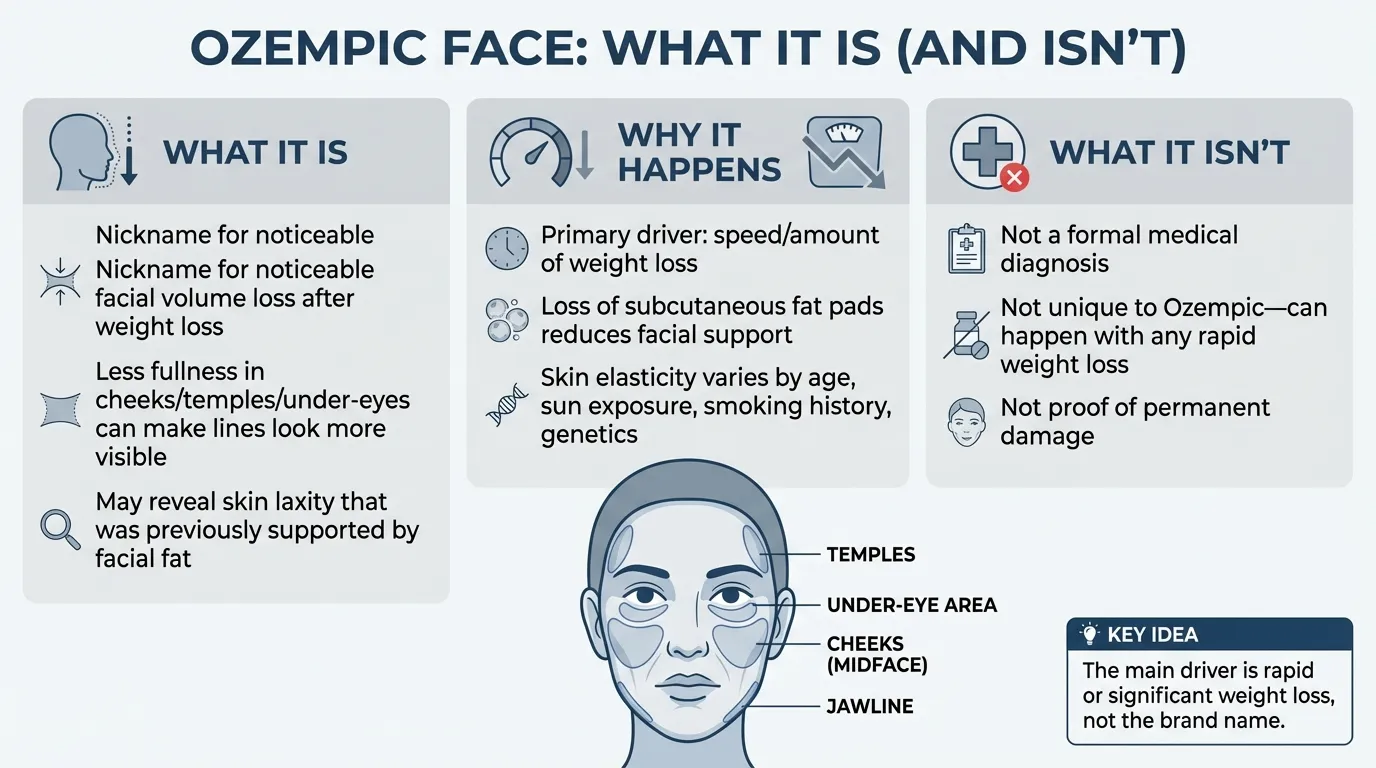
Illustration for educational purposes only. Individual results vary.
What It Actually Means
Despite the name, Ozempic face isn't caused by Ozempic itself. It's associated with rapid weight loss—and can happen with any method of losing weight quickly, including bariatric surgery, extreme dieting, or other medications.
The key distinction: Ozempic is the vehicle, not the cause. Your face changes because you're losing fat everywhere—including the fat that gives your face its youthful fullness.
Other Names for the Same Thing
You might hear this called:
- Semaglutide face
- Wegovy face
- Mounjaro face
- GLP-1 face
- Weight loss face
They all describe the same thing: facial volume loss from rapid weight reduction.
Why the Name Is Somewhat Misleading
Calling it "Ozempic face" implies the medication does something unique to your face. It doesn't. What happens is straightforward:
- GLP-1 medications suppress appetite and slow digestion
- You eat less and lose weight
- Fat comes off your entire body—including your face
- If weight loss is rapid, skin can't adapt fast enough
- Result: hollowing, sagging, and visible aging
According to the FDA's prescribing information for Ozempic, the medication is approved for type 2 diabetes management and works by mimicking the GLP-1 hormone to regulate blood sugar and appetite. Wegovy contains the same active ingredient (semaglutide) at a higher dose and is FDA-approved specifically for chronic weight management.
The facial changes aren't listed as a side effect because they're not caused directly by the drug—they're caused by the weight loss the drug helps you achieve.
Signs and Symptoms: Do I Have Ozempic Face?
Recognizing Ozempic face early gives you more options for prevention and treatment. Here's what to look for.
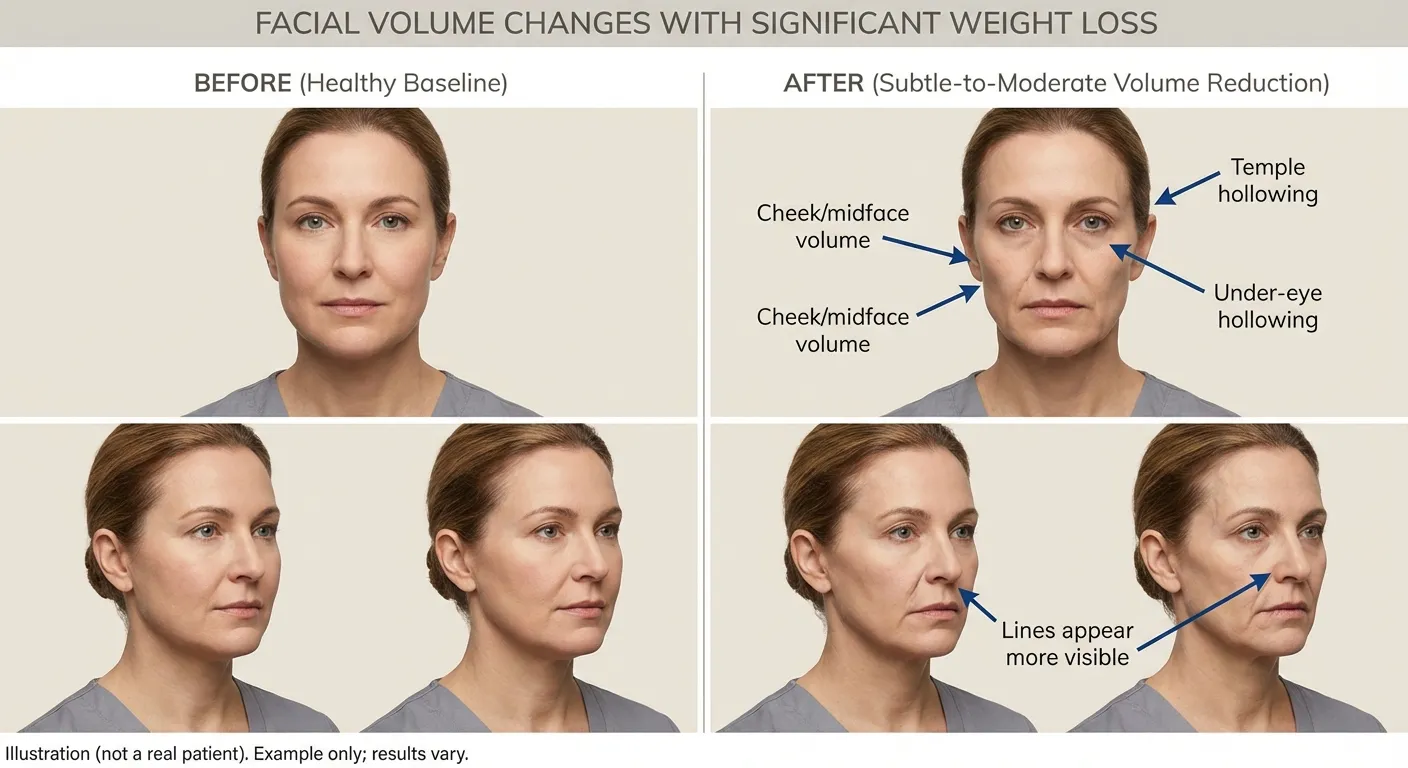
Illustration (not a real patient). Example only; results vary.
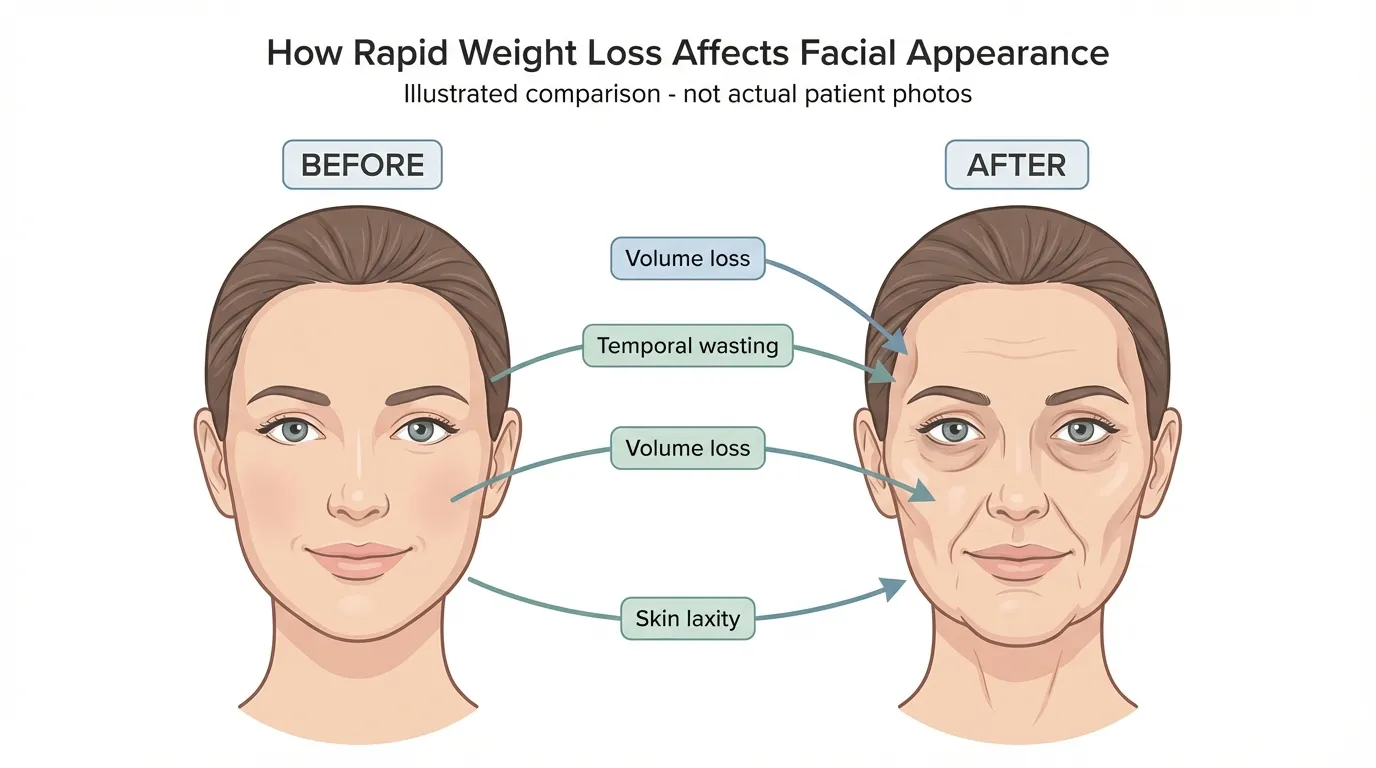
Medical illustration for educational purposes. Not actual patient photos. Individual results vary significantly.
The Key Visual Changes
Volume Loss (Hollowing):
- Cheeks appear sunken or deflated
- Temples look more concave
- Under-eye area appears hollow with darker circles
- Jawline becomes more angular and prominent
- Face looks "longer" or more skeletal overall
Skin Changes:
- New wrinkles appearing rapidly
- Skin feels looser, especially around the jaw and neck
- Nasolabial folds (nose-to-mouth lines) have deepened
- Marionette lines (mouth-to-chin lines) more visible
- Jowling or sagging along the jawline
- Neck skin loosens ("turkey neck" appearance)
Overall Appearance:
- Face looks "deflated" rather than "slimmer"
- Aged appearance that seems disproportionate to weight lost
- Bony structures more visible than before
- Hollow and bony rather than healthy-thin
Ozempic Face vs. Normal Weight Loss Changes
Not all facial changes from weight loss are "Ozempic face." Here's how to tell the difference:
| Normal Weight Loss Changes | Possible Ozempic Face Signs |
|---|---|
| Gradual, subtle thinning over months | Hollowing that can become noticeable sooner |
| Face looks "slimmer" | Face may look hollow, bony, or "deflated" |
| Minimal new wrinkles | New wrinkles or deepening may be noticeable |
| Skin adjusts over time | Skin may not fully rebound |
| In line with overall body changes | Facial changes may seem disproportionate to weight lost |
| Looks younger/healthier overall | May look older despite weight loss |
When Changes Can Become Noticeable
Many people notice facial changes after meaningful weight loss, especially if it happens quickly. Timing varies—some notice changes within the first few months, while others don't notice much at all.
In general, faster weight loss can make changes show up sooner than slower weight loss.
What Causes Ozempic Face? The Science Explained
Understanding the mechanism helps you prevent and address it effectively.
The Primary Driver: Facial Fat Loss
Your face has specific fat compartments—called facial fat pads—that give it volume and a youthful appearance. These include:
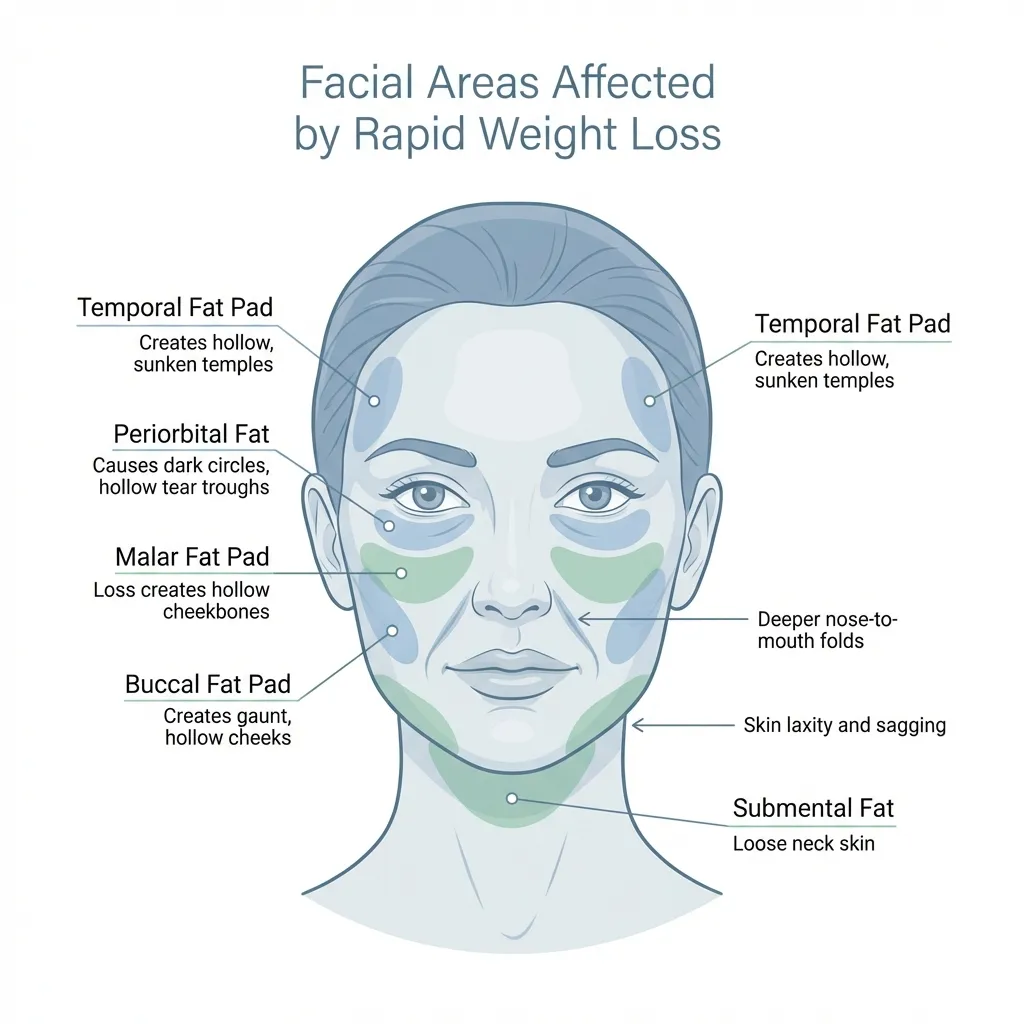
Anatomical illustration for educational purposes only.
- Malar fat pads (cheek fullness)
- Buccal fat pads (lower cheek/jowl area)
- Temporal fat pads (temple region)
- Periorbital fat (around the eyes)
- Nasolabial fat (nose-to-mouth area)
When you lose weight, you lose fat everywhere—including these facial compartments. Unlike belly fat, which many people want to lose, facial fat loss can make you look older rather than healthier.
The Three Mechanisms Behind Ozempic Face
1. Facial Fat Depletion
As the fat under your skin decreases, the "cushions" that support your skin deflate. This creates:
- Visible hollows where fat used to be
- More prominent bone structure
- Loss of the youthful "roundness" in cheeks
2. Reduced Skin Support
When facial volume drops quickly, skin can look looser because it has less underlying support. How much your skin "snaps back" depends largely on age, sun exposure, genetics, and baseline skin elasticity.
Factors that may worsen skin quality during weight loss:
- Severe calorie restriction and poor nutrition
- Reduced protein intake (common with appetite suppression)
- Inadequate hydration
3. Muscle Mass Loss
This is often overlooked. In body-composition studies (using DXA scans), some of the weight lost is lean soft tissue (fat-free mass)—estimates range around 25-40% of total weight loss. Not all of that is muscle, but it includes:
- Facial muscles that provide support and definition
- Makes the hollow, bony look even worse
- Loss of structural support for overlying skin
Why Speed May Matter: Gradual vs. Rapid Weight Loss
General patterns—individual results vary widely based on age, genetics, and other factors.
| Factor | Slower, Gradual Loss | Faster, Rapid Loss |
|---|---|---|
| Skin adaptation time | More time for skin to adapt | Less time for skin to adapt |
| Skin support | May be better preserved | May decline more noticeably |
| Muscle retention | Often higher (with protein/exercise) | May be lower |
| Nutritional status | Easier to maintain | Higher deficiency risk |
| Likelihood of noticeable changes | Generally lower | Generally higher |
Note: The CDC generally recommends a slower, sustainable weight loss pace for long-term success. This may also give your skin more time to adapt, though individual responses vary.
Who Is Most At Risk? Ozempic Face Risk Factors
Not everyone who loses weight on these medications ends up with a hollow face. Your risk depends on a few things you can check right now.
The 7 Key Risk Factors
1. Age (Important Factor)
Age is often one of the most important factors in how skin responds to weight loss, though individual variation is substantial.
| Age Group | Risk Level | Why |
|---|---|---|
| Younger | Generally lower | Typically better skin elasticity and recovery |
| Middle-aged | Moderate | Skin elasticity often declining |
| Older | Generally higher | Skin elasticity often reduced |
2. Rate of Weight Loss
| Weekly Loss (General Guideline) | Likelihood |
|---|---|
| Slower (around 1-2 lbs/week) | Lower |
| Moderate | Moderate |
| Faster (consistently rapid) | Higher |
These are general guidelines, not diagnostic thresholds. Individual responses vary widely.
3. Total Weight Lost
| Amount Lost (General Guideline) | Likelihood |
|---|---|
| Smaller amounts | Lower |
| Moderate amounts | Moderate |
| Larger amounts | Higher |
Individual results depend on many factors beyond weight loss amount.
4. Starting Facial Characteristics
- Fuller face before: May have more "buffer" before changes are noticeable
- Naturally lean face: Higher risk—less fat to lose before hollowing appears
- Strong bone structure: May look more skeletal as fat depletes
5. Skin Quality History
Higher risk if you have:
- Lots of sun exposure over the years
- Current or past smoking
- Previous large weight fluctuations
- Naturally thin or dry skin
- Family history of premature skin aging
6. Genetic Factors
Some people are genetically predisposed to:
- Lower baseline collagen production
- Faster collagen breakdown
- Less elastic skin
- Specific patterns of fat distribution
7. Nutritional Status During Weight Loss
Higher risk if you're:
- Not meeting protein requirements
- Deficient in vitamins C, D, or E
- Severely restricting calories
- Not staying adequately hydrated
Educational Risk Self-Check (Not a Medical Tool)
Important
This is an educational self-check, not a validated medical tool. It cannot predict outcomes for any individual. Use it to guide questions for your clinician.
| Risk Factor | Lower Likelihood | Moderate Likelihood | Higher Likelihood |
|---|---|---|---|
| Age | Younger | Middle-aged | Older |
| Weight loss rate | Slower/Gradual | Moderate | Faster/Rapid |
| Total weight loss | Smaller amounts | Moderate amounts | Larger amounts |
| Skin quality | Better elasticity | Average | Lower elasticity |
| Starting facial fullness | Fuller/rounder face | Average | Already lean face |
How to Use This Self-Check (Not a Diagnosis):
Use this table to identify which factors apply to you, then discuss your situation with your clinician. This is for self-reflection and conversation with your provider—it cannot predict individual outcomes.
Is Ozempic Face Permanent?
This is the question that causes the most anxiety. The honest answer: it depends.
Factors That Determine Reversibility
Factors That May Favor Natural Improvement:
- Younger age
- Smaller total weight loss
- Good baseline skin elasticity
- Slower rate of weight loss
- Strong nutritional status maintained
- Shorter duration of rapid loss
Factors That May Make Natural Improvement Less Likely:
- Older age
- Larger total weight loss
- Lower baseline skin elasticity (sun damage, smoking history)
- Very rapid weight loss
- Extended period at lower weight
- Nutritional deficiencies during loss
How Long Improvement Can Take (Varies)
After weight stabilizes, some people notice gradual changes over months as swelling, hydration, and skin adaptation settle. There isn't a single proven timeline—improvement depends on individual factors like age, genetics, and baseline skin quality.
If you're concerned about persistent changes, consider discussing options with a specialist after you've been at a stable weight for a period of time.
What to Realistically Expect
For many adults—especially with larger or faster weight loss—facial changes may not fully reverse on their own, and improvement varies by age, genetics, and skin elasticity.
This doesn't mean you're stuck with it. Treatment options exist at every budget level. But waiting and hoping for complete natural reversal may not be realistic, especially for older adults or those with significant volume loss.
How to Prevent Ozempic Face: The Complete Protocol
Prevention is way easier than fixing it later. If you're just starting GLP-1 medication or early in your weight loss, these strategies can make a huge difference.
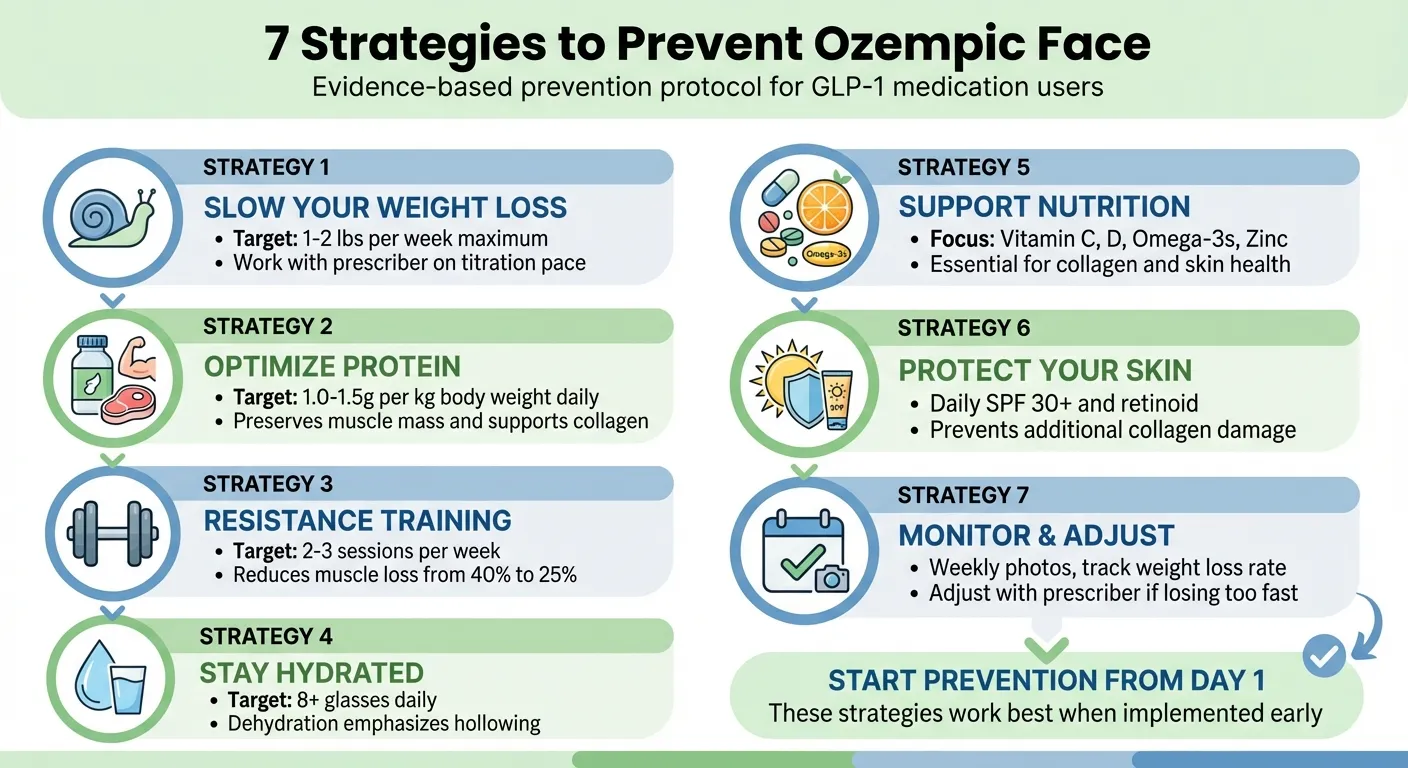
Prevention strategies work best when implemented early. Individual results vary.
Strategy 1: Control Your Weight Loss Speed
This is the single most important factor you can control.
General Guideline: Many clinicians suggest aiming for around 1-2 pounds per week (individual targets vary—discuss with your prescriber)
Strategies That May Help:
- Discuss dose titration with your prescriber. You don't have to rush to the maximum dose. Staying on lower doses longer means slower, steadier weight loss.
- Don't skip meals entirely. Even if you're not hungry, eating adequate nutrition matters more than maximizing weight loss speed.
- Track weekly, not daily. Daily weight fluctuates due to water, food timing, and other factors. Weekly averages give you accurate data.
- Communicate with your healthcare provider. If your weight is dropping faster than expected, discuss whether a dosage adjustment makes sense.
Strategy 2: Optimize Protein Intake
Protein is critical for preserving muscle mass and supporting collagen production.
General Guideline: Many sources suggest around 1.0-1.5 grams of protein per kilogram of body weight daily during weight loss, though individual needs vary significantly.
Important
Protein needs are highly individual—especially with kidney disease, diabetes, or other conditions. Always confirm your personal target with your clinician or registered dietitian before making changes.
Sample ranges (for reference only—your needs may differ):
| Body Weight | Sample Range |
|---|---|
| 150 lbs (68 kg) | ~68-102 grams |
| 175 lbs (80 kg) | ~80-120 grams |
| 200 lbs (91 kg) | ~91-136 grams |
| 225 lbs (102 kg) | ~102-153 grams |
The GLP-1 Challenge:
Appetite suppression makes eating adequate protein difficult. Many people on these medications struggle to eat enough of anything, let alone enough protein.
Solutions:
- Prioritize protein at every meal (eat it first)
- Use protein shakes to supplement
- Choose protein-dense foods over empty calories
- Set protein alarms/reminders
Strategy 3: Strength Training
Resistance exercise helps preserve lean muscle mass—including facial muscles—during weight loss.
General Guideline: Regular strength training (often 2-3 sessions per week is suggested, though frequency should match your overall health and goals)
Research shows that resistance training while on GLP-1 medications helps preserve strength and lean tissue during weight loss. That's why strength training and adequate protein are commonly recommended during weight loss.
Strategy 4: Hydration
Dehydration makes skin look worse and accelerates the appearance of volume loss.
Target: Hydrate enough that you're not consistently thirsty and your urine is usually pale yellow. If you have kidney or heart conditions, ask your clinician about fluid intake.
Strategy 5: Nutrition for Skin Health
| Nutrient | Role | Sources |
|---|---|---|
| Vitamin C | Essential for collagen synthesis | Citrus, bell peppers, broccoli |
| Vitamin D | Skin cell growth and repair | Sun exposure, fatty fish, supplements |
| Omega-3s | Skin barrier function, elasticity | Fatty fish, walnuts, flaxseed |
| Zinc | Wound healing, skin repair | Meat, shellfish, legumes |
| Vitamin E | Antioxidant protection | Nuts, seeds, spinach |
Strategy 6: Skincare Basics
Core Routine:
- Daily Sunscreen (SPF 30+): UV damage accelerates collagen breakdown. Apply every day, even indoors.
- Retinoid (prescription) or Retinol (OTC): The gold standard for stimulating collagen production.
- Vitamin C Serum: Antioxidant protection and supports collagen synthesis.
- Hyaluronic Acid: Helps skin retain moisture and appear more plump.
What Skincare Can't Do:
Be real with yourself: skincare products can't bring back lost fat or tighten loose skin. They help your skin stay healthy and may improve fine lines and texture, but they won't fix Ozempic face on their own.
Strategy 7: Monitor and Adjust
- Take weekly photos (same lighting, same angle)
- Track weight loss rate
- Adjust with prescriber if losing too fast
Ozempic Face Treatment Options: Complete Guide
If prevention didn't work or changes are already obvious, you have options at every price point.
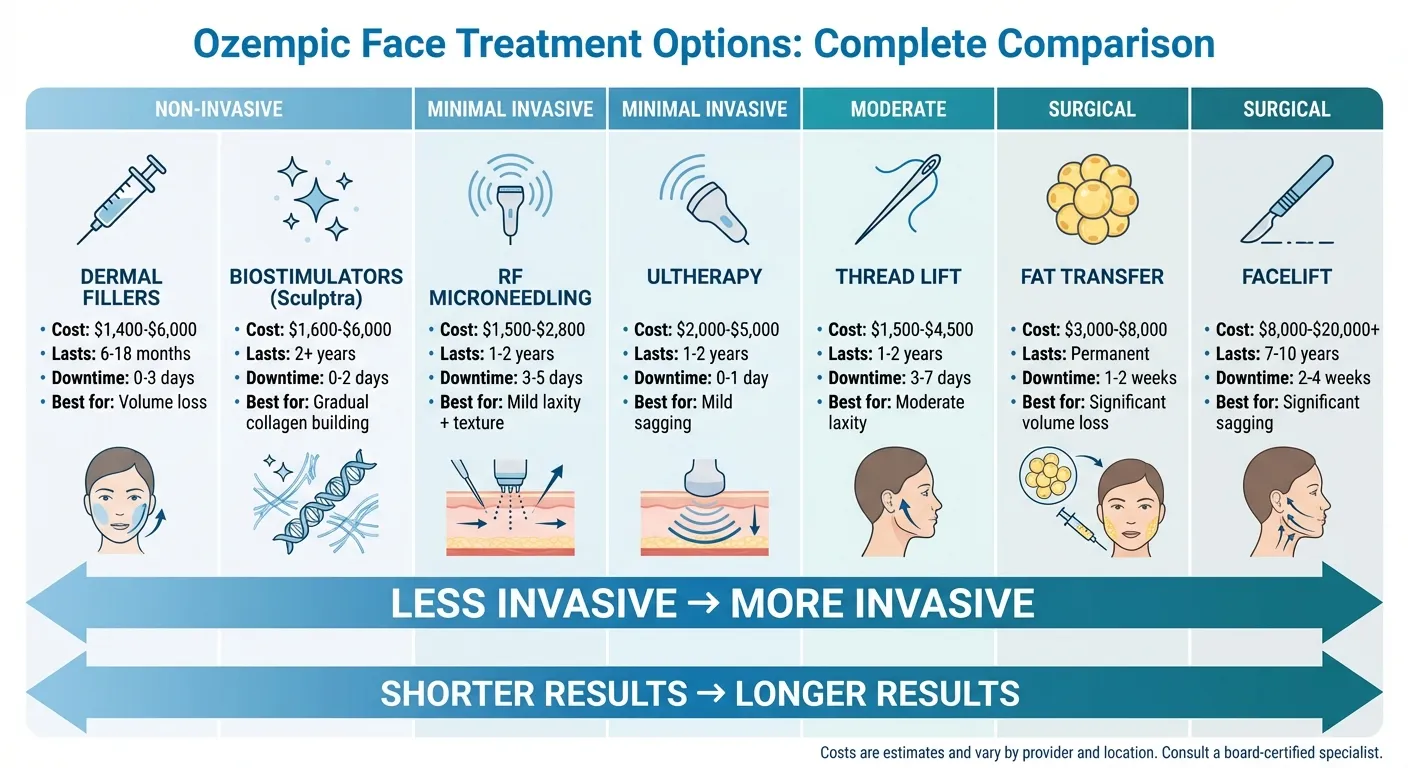
Costs are estimates and vary by provider and location. Consult a board-certified specialist.
Treatment Comparison Table
| Treatment | What It Addresses | Typical Cost | Duration | Downtime |
|---|---|---|---|---|
| HA Fillers (Juvederm, Restylane) | Volume loss | $700-$1,000/syringe | 6-18 months | 1-3 days |
| Biostimulators (Sculptra) | Volume + collagen | $800-$1,500/vial | 2+ years | 1-3 days |
| RF Microneedling (Morpheus8) | Texture, mild tightening | $800-$1,500/session | 1-2 years | 3-5 days |
| Ultherapy | Skin tightening | $2,000-$5,000 | 1-2 years | None-minimal |
| Thread Lift | Lifting, collagen | $1,500-$4,500 | 1-2 years | 3-7 days |
| Fat Transfer | Long-lasting volume (variable retention) | $3,000-$8,000 | Long-lasting (50-60% retention typical) | 1-2 weeks |
| Mini Facelift | Sagging, jowls | $5,000-$12,000 | 5-7 years | 1-2 weeks |
| Full Facelift | Full face lifting | $8,000-$20,000+ | 7-10 years | 2-4 weeks |
Non-Surgical Treatment Options
Dermal Fillers
What They Do: Restore volume by injecting gel-like substances into hollowed areas.
Best For: Cheeks, temples, under-eyes, nasolabial folds, jawline, chin
Types:
Hyaluronic Acid Fillers (Juvederm, Restylane, RHA):
- Most common, versatile
- Reversible (can be dissolved if needed)
- Results immediate
- Duration: 6-18 months depending on location and product
Biostimulators (Sculptra, Radiesse):
- Stimulate your own collagen over time
- Results are gradual (2-6 months to see full effect)
- Longer lasting (2+ years)
- Not reversible
Typical Investment:
- Most Ozempic face patients need 2-6 syringes
- At $700-$1,000 per syringe: $1,400-$6,000 initial treatment
- Maintenance every 6-18 months
Skin Tightening Devices
Ultherapy (Ultrasound):
- Deepest penetration of non-surgical options
- FDA-cleared for lifting
- One treatment, results at 2-6 months
- Cost: $2,000-$5,000
- No downtime
RF Microneedling (Morpheus8, Sylfirm X):
- Combines needling with radiofrequency
- Addresses both texture and mild tightening
- 3-4 treatments recommended
- Cost: $800-$1,500 per session
- 3-5 days downtime
Thread Lifts
What They Do: Dissolvable threads are inserted under the skin to physically lift tissue and stimulate collagen.
Best For: Mild to medium sagging, especially in the jawline and mid-face area
Cost: $1,500-$4,500 depending on number of threads and areas treated
Pros:
- Less invasive than surgery
- Faster recovery than facelift
- Natural-looking results
Cons:
- Results less dramatic than surgery
- Duration limited (1-2 years)
- Not suitable for severe laxity
Surgical Treatment Options
Fat Transfer (Fat Grafting)
What It Does: Fat is harvested from your body (usually abdomen or thighs), processed, and injected into the face for volume restoration.
Advantages Over Fillers:
- Uses your own tissue (no foreign material)
- Long-lasting but variable (some resorption occurs; touch-ups sometimes needed)
- Can treat large areas efficiently
Cost: $3,000-$8,000 (may need additional procedure for touch-up)
Facelift (Rhytidectomy)
Mini Facelift:
- Less invasive than full facelift
- Targets lower face and jawline
- Best for: Moderate laxity, younger patients
- Cost: $5,000-$12,000
- Downtime: 1-2 weeks
Full Facelift:
- Complete lifting of lower face and neck
- Fixes serious sagging, jowls, and loose neck skin
- Best for: Severe loose skin, major sagging
- Cost: $8,000-$20,000+
- Downtime: 2-4 weeks
- Results last 7-10 years
Treatment Costs: What to Actually Expect
Total Investment by Approach
| Approach | Initial Investment | Maintenance | 5-Year Total |
|---|---|---|---|
| Conservative (fillers only) | $1,500-$4,000 | $1,000-$2,000/year | $6,500-$14,000 |
| Moderate (fillers + tightening) | $3,500-$8,000 | $1,500-$3,000/year | $11,000-$23,000 |
| Fat Transfer | $3,000-$10,000 | Minimal | $3,000-$15,000 |
| Surgical (facelift + fat) | $12,000-$25,000 | Minimal for years | $12,000-$30,000 |
Does Insurance Cover Treatment?
Short answer: No.
Ozempic face treatments are considered cosmetic procedures. They're not medically necessary, so insurance doesn't cover them.
- Standard health insurance: Not covered
- HSA/FSA: Usually not eligible (cosmetic)
- Medicare/Medicaid: Not covered
Financing Options:
- CareCredit (medical credit card)
- Alphaeon Credit
- Practice payment plans
- Personal loans
Ozempic vs Wegovy vs Mounjaro: Does the Medication Matter?
A common question: does your specific medication affect your risk of facial changes?
Medication Comparison
| Medication | Active Ingredient | Trial Results (not head-to-head) | Potential for Noticeable Facial Changes |
|---|---|---|---|
| Ozempic | Semaglutide 0.5-2mg | Varies (diabetes indication) | Varies (depends on weight loss amount/speed) |
| Wegovy | Semaglutide 2.4mg | ~15% mean at ~68 weeks | Higher on average (more weight loss in trials) |
| Mounjaro/Zepbound | Tirzepatide | ~15-21% mean at ~72 weeks | Higher on average (more weight loss in trials) |
These percentages come from different clinical trials (different doses and populations). They are not head-to-head comparisons, and real-world results vary. Ozempic is FDA-approved for type 2 diabetes, not chronic weight management.
The Key Insight
Most evidence suggests the primary driver is weight loss, not a unique direct effect of the medication.
This means:
- More effective medication → more weight loss → higher potential for facial changes
- Tirzepatide (Mounjaro/Zepbound) often produces more weight loss than semaglutide, so users may see changes faster
- Using a "milder" medication won't prevent Ozempic face if you lose the same amount of weight
A Note on Compounded Semaglutide
Compounded versions of semaglutide contain the same active ingredient as branded products. From a facial change perspective, they carry the same risk—because the risk comes from weight loss, not the specific formulation.
However, the FDA has issued warnings about compounded semaglutide products regarding quality, safety, and efficacy concerns. If you're considering compounded options, see our Compounded GLP-1 vs Name Brand guide for a complete comparison.
Questions to Ask Your Doctor
Before Starting GLP-1 Medication
- "Based on my age and skin characteristics, what level of concern should I have about facial changes?"
- "What weight loss rate should I target to minimize facial impact while still achieving health goals?"
- "Would it make sense to stay on lower doses longer to slow weight loss?"
- "What protein intake do you recommend during treatment?"
If You're Experiencing Facial Changes
- "Is what I'm seeing normal for how much weight I've lost, or is it more extreme than expected?"
- "Should we adjust my dosage or titration schedule?"
- "Would you recommend I see a dermatologist or plastic surgeon for evaluation?"
At a Cosmetic Consultation
- "Based on my facial changes, what treatment category makes most sense?"
- "What results can I realistically expect?"
- "How many similar cases have you treated?"
- "Can I see before/after photos of patients with similar concerns?"
- "What's the total expected cost, including any touch-ups?"
Who to Consult
- Your prescribing physician: For medication adjustments and medical guidance
- Board-certified dermatologist: For non-surgical options, skincare, injectables
- Board-certified plastic surgeon: For surgical evaluation and procedures
Verify Credentials:
- American Board of Medical Specialties: ABMS.org
- American Board of Plastic Surgery: ABPS.org
- American Academy of Dermatology: AAD.org
Frequently Asked Questions
What is Ozempic face?
Ozempic face is a nickname for the hollow, saggy, old-looking face that some people get after losing weight fast on GLP-1 medications like Ozempic, Wegovy, or Mounjaro. Signs include sunken cheeks, hollow temples, deeper wrinkles, and loose skin around the jaw and neck. It's not an official medical condition or a direct side effect—it happens because you lose facial fat faster than your skin can tighten.
Is Ozempic face permanent?
Ozempic face can be partly permanent, depending on your age, skin quality, and how much weight you lost. Younger people with good skin may see some natural improvement over time. Older people or those who lost a lot of weight may need treatment to address the changes. If you regain weight, facial fat often returns, but loose skin may not fully tighten.
How can I prevent Ozempic face?
Commonly recommended strategies include: (1) Aim for slower, steadier weight loss (discuss pacing with your prescriber), (2) Consume adequate protein to preserve muscle (targets vary—confirm with your clinician), (3) Do regular strength training, (4) Stay well hydrated, (5) Use daily SPF and consider a retinoid for skin health, and (6) Consider proactive treatments if you're concerned about higher risk.
How long does it take to develop Ozempic face?
Facial changes typically become noticeable after meaningful weight loss, especially if it happens quickly. Timing varies—some notice changes within the first few months, while others don't notice much at all. In general, faster weight loss can make changes show up sooner.
Does everyone on Ozempic get Ozempic face?
No, not everyone on GLP-1 medications develops noticeable Ozempic face. Risk factors include: older age, rapid or large weight loss, poor baseline skin elasticity (from sun damage or smoking), and having a naturally lean face to start. Younger patients losing weight gradually with adequate protein and strength training are less likely to experience dramatic facial changes.
What does Ozempic face look like?
Ozempic face usually looks like: hollow or sunken cheeks, visible cheekbones and jawline (bony appearance), sunken temples, dark circles under eyes, deeper lines from nose to mouth, sagging along the jawline (jowls), loose neck skin, and new or worse wrinkles. Overall, the face looks deflated, bony, and older than before.
How much does it cost to fix Ozempic face?
Costs vary widely by treatment approach: Dermal fillers typically run $700-$1,000 per syringe, and most patients need 2-6 syringes, totaling $1,500-$6,000. Skin tightening treatments like Ultherapy cost $2,000-$5,000. Fat transfer costs $3,000-$8,000. A facelift ranges from $8,000-$20,000+. Insurance doesn't cover these cosmetic procedures.
Do fillers help Ozempic face?
Yes, fillers are one of the most popular and effective fixes for Ozempic face. They add volume back into your cheeks, temples, under-eyes, and jawline. Hyaluronic acid fillers give instant results that last 6-18 months. Sculptra works slower but lasts longer. Most people need 2-6 syringes for a full treatment, costing $1,500-$6,000.
Is Wegovy face different from Ozempic face?
No, they're the same thing. Both Ozempic and Wegovy contain the same drug (semaglutide)—Wegovy just has a higher dose for weight loss. "Ozempic face" became the popular term because Ozempic got more media attention first. The facial changes associated with weight loss are similar regardless of which medication you use.
Is Mounjaro face worse than Ozempic face?
Mounjaro (tirzepatide) often produces more weight loss than semaglutide products—averaging 20-22% of body weight versus 15-17% for Wegovy. More weight loss can mean more facial volume loss. However, "worse" depends on individual factors. The same prevention strategies apply: controlling weight loss rate matters more than which medication you use.
Can men get Ozempic face?
Yes, people of any sex can notice these changes. Differences in outcomes are more strongly driven by age, skin elasticity, and amount/speed of weight loss than sex. The same risk factors, prevention tips, and treatments apply to everyone.
Will gaining weight back reverse Ozempic face?
If you regain weight, facial fat usually comes back and your face may look more like it did before. But skin that got stretched may not tighten back up, especially in older people or those who kept the weight off for a long time. The loose skin part may stick around even if the fat comes back.
Can skincare products fix Ozempic face?
Skincare products can't bring back lost fat or really tighten loose skin—you need procedures for that. But a good skincare routine (especially retinoids and sunscreen) keeps your skin healthy, can improve fine lines and texture, and may slow down further damage. Think of skincare as keeping your skin healthy, not fixing Ozempic face.
What's the difference between Ozempic face and normal aging?
Normal facial aging happens slowly over years—you lose collagen bit by bit, fat shifts around, and skin gets looser over time. Ozempic face compresses similar changes into a much shorter timeframe. The speed is the giveaway: if facial changes appear quickly over months during rapid weight loss, that's different from gradual aging that happens over years.
Is it safe to get fillers while still on Ozempic?
Yes, getting fillers while on GLP-1 medication is generally safe. However, some providers recommend waiting until your weight has stabilized, as continued weight loss can affect results. Fillers placed in a face that subsequently loses more fat may not look the same. Discuss timing with both your prescriber and your cosmetic provider.
What should I eat to prevent Ozempic face?
Focus on adequate protein (1.0-1.5g per kg body weight daily), as protein supports muscle preservation and collagen production. Include nutrients important for skin health: vitamin C (citrus, peppers), omega-3 fatty acids (fatty fish, walnuts), vitamin D (fortified foods, sun exposure), and zinc (meat, legumes). Avoid severe calorie restriction that leads to nutritional deficiencies.
Does exercise help prevent Ozempic face?
Strength training helps you preserve lean tissue while losing weight—and that includes the muscles in your face. Resistance training is commonly recommended during GLP-1 treatment to help maintain strength. Exercise won't stop fat from leaving your face, but keeping muscle helps you look less hollow and bony.
Should I stop Ozempic or Wegovy to avoid Ozempic face?
Don't stop your medication without talking to your prescribing clinician first. GLP-1 medications provide significant health benefits beyond weight loss, including blood sugar control and cardiovascular protection. If you're concerned about facial changes, discuss options like dose adjustments or slower titration schedules with your doctor. Stopping medication abruptly can lead to weight regain and other health issues.
How long does Ozempic face last once weight stabilizes?
Once your weight stabilizes, some improvement may occur naturally over months as skin slowly adapts and any swelling settles. However, significant volume loss and skin laxity may not fully reverse on their own, especially in older adults. Improvement varies by individual factors like age, genetics, and baseline skin quality. Many people find that maintaining stable weight plus targeted treatments produces the best long-term results.
Sources and Methodology
How We Define Ozempic Face
In this guide, "Ozempic face" means the facial changes—like hollow cheeks, loose skin, and looking older—that can happen when you lose weight quickly, especially on GLP-1 medications. It's a nickname, not an official medical term.
How We Choose Sources
This guide prioritizes:
- FDA prescribing information and official drug labels
- Peer-reviewed research from medical journals
- Guidance from major medical organizations (CDC, ASPS, AAD)
- Expert opinions from board-certified specialists in dermatology and plastic surgery
We avoid:
- Unverified claims from social media
- Celebrity speculation without confirmation
- Marketing materials from treatment providers
- Sensationalized media coverage
References
- FDA Ozempic (semaglutide) Prescribing Information - Official FDA drug label for Ozempic
- FDA Wegovy (semaglutide) Prescribing Information - Official FDA drug label for Wegovy
- FDA Zepbound (tirzepatide) Prescribing Information - Official FDA drug label for Zepbound
- STEP 1 Trial - Semaglutide for Weight Loss (NEJM) - Wegovy clinical trial showing ~15% average weight loss
- SURMOUNT-1 Trial - Tirzepatide for Weight Loss (NEJM) - Tirzepatide clinical trial showing up to 22.5% weight loss
- CDC Healthy Weight Guidelines - CDC recommendation for 1-2 pounds per week weight loss
- Cleveland Clinic: What Is Ozempic Face? - Authoritative medical explanation
- Facial Volume Loss After Weight Loss - Systematic Review (PMC) - Peer-reviewed research on facial changes
- Body Composition Changes with GLP-1 Medications (PMC) - DXA analysis of lean tissue changes
- Fat Grafting Volume Retention - Meta-Analysis - Research showing ~50-60% fat graft retention
Limitations of Current Knowledge
- There's no official count of how many people get Ozempic face because it's a nickname, not a coded medical condition
- Long-term studies on facial changes are limited
- Much of what we know comes from doctors seeing patients, not controlled studies
- Everyone is different—results vary a lot based on personal factors
Related Resources
Looking for more information on GLP-1 medications? Check out these guides:
- What Is GLP-1? Complete Beginner's Guide
- Compounded GLP-1 vs Name Brand: 2026 Decision Guide
- Cons of GLP-1: Side Effects and Risks Explained
- GLP-1 Nausea Relief: What to Eat
This content was last reviewed and updated in January 2026. We regularly update our guides to reflect the latest research and pricing information.
How we rank + verify
Last verified: March 3, 2026
What we verified: FDA prescribing information for Ozempic, Wegovy, and Mounjaro; CDC weight loss guidelines; peer-reviewed research on body composition during GLP-1 treatment; American Society of Plastic Surgeons treatment cost data.
Sources: FDA.gov drug labels, CDC healthy weight guidelines, clinical trial data on muscle mass during weight loss, ASPS procedure cost statistics, AAD skincare recommendations
Related Articles
This content is educational only and does not replace professional medical advice. Always consult a qualified healthcare provider before starting any medication.