How to Get GLP-1 in New Jersey: The Safest, Fastest, and Cheapest Paths
By the WPG Research Team · Last Updated: March 17, 2026 · Pricing Last Verified: March 17, 2026 · Affiliate Disclosure · Full editorial policy
How to get GLP-1 in New Jersey — yes, you can get GLP-1 medication in New Jersey right now, and you probably don't need to visit a doctor's office to start. We spent three weeks verifying every legal path a New Jersey resident can take to get FDA-approved GLP-1 treatment, checking NJ telehealth rules, confirming pricing against provider websites, and reviewing the state's Medicaid coverage. What we found is that most NJ residents are overpaying, choosing the wrong pathway for their situation, or stuck comparing options that aren't even available in their state.
Here's the quick decision: For most NJ residents, the best first move is FDA-approved medication plus an insurance check. If you want online help with insurance paperwork, Ro is the strongest fit — they prescribe only FDA-approved GLP-1s (Wegovy, Foundayo, Zepbound), fight your insurance company for coverage on your behalf, and their clinicians are licensed to treat patients in New Jersey. If you want cash-pay simplicity, Hims or Hers make the process fast and easy.
If you're on NJ FamilyCare, the rules are narrower. We break down the limited coverage exceptions below. What follows is every path, every price, every catch, and the specific NJ rules that affect your options. By the end, you'll know exactly which door to walk through.
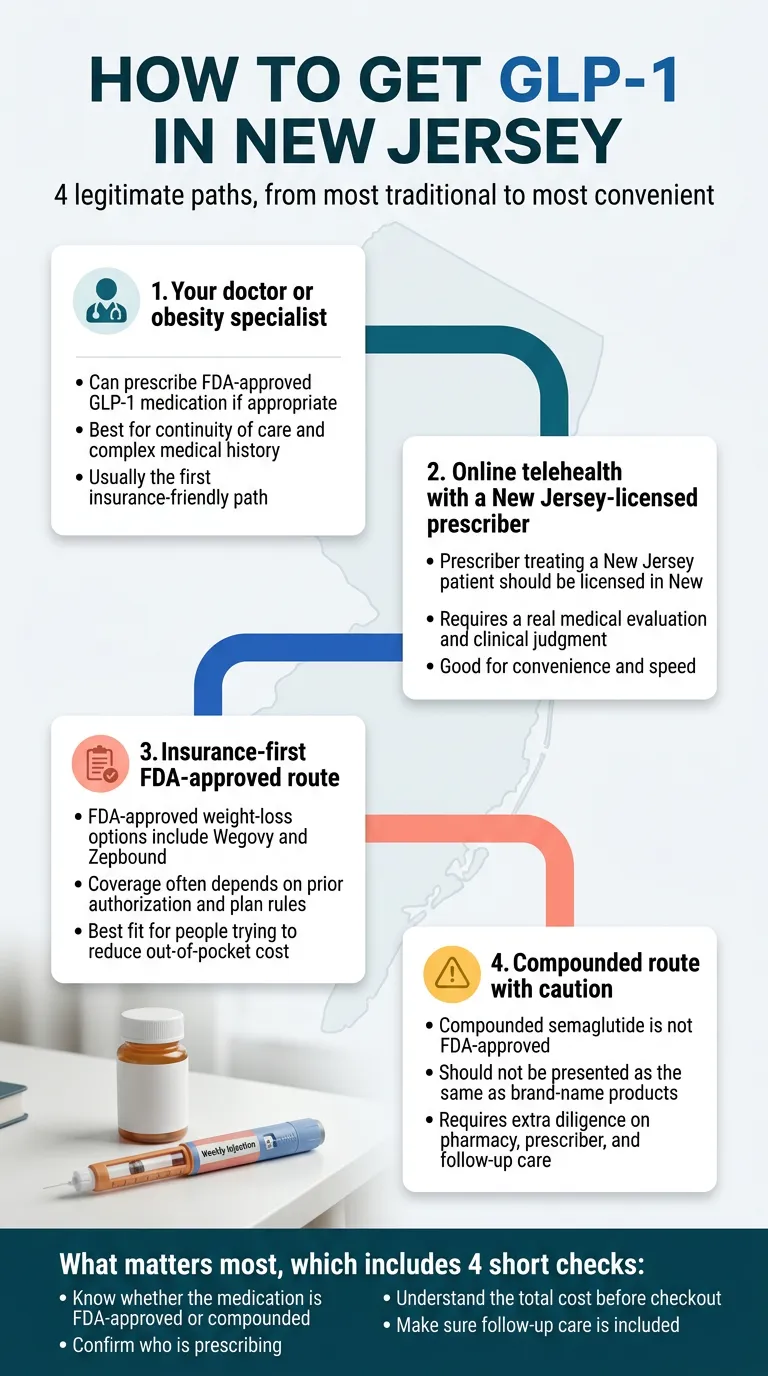
What's the Best Way to Get GLP-1 in New Jersey?
There isn't a single "best" way. There's a best way for your situation. But if we had to give one answer for most people, it's this:
Start with FDA-approved medication and check your insurance first. Brand-name Wegovy and Zepbound have undergone rigorous FDA review for safety and effectiveness. If you have eligible commercial coverage and a manufacturer savings card, your monthly cost could be as low as $0–$25. Government insurance beneficiaries (Medicare, Medicaid) are not eligible for manufacturer savings cards. If insurance isn't an option, cash-pay prices have dropped significantly — the Wegovy pill starts at $149/month for starting doses.
If your primary care doctor is someone you trust and see regularly, start there. If you'd rather handle everything online, a reputable telehealth platform with NJ-licensed prescribers can get you started within days.
If you're drawn to lower-cost compounded options, read our safety section first. The FDA has warned that compounded GLP-1 products can carry higher risks, has documented adverse events and dosing errors, and has issued warning letters over misleading compounded-GLP-1 claims.
Ro Body
Takes 2 minutes — a licensed provider reviews your answers, no commitment required
Compare Every Way to Get GLP-1 in New Jersey — at a Glance
This table covers the main pathways available to NJ residents right now. We confirmed NJ availability for each one.
| Pathway | Starting Cost | Medication Type | Insurance Help? | Best For | Biggest Downside |
|---|---|---|---|---|---|
| Your NJ Doctor (PCP) | Depends on insurance | FDA-approved (Wegovy, Zepbound, Ozempic) | Yes — they bill directly | People with a trusted doctor and decent insurance | Prior auth delays (1–3 weeks), not all PCPs prescribe GLP-1s |
| Ro Body Program | $149/mo membership + medication | FDA-approved only | Yes — dedicated insurance concierge | People who want FDA-approved meds + someone to fight insurance | Membership fee adds up; metabolic testing may be required |
| Hims / Hers | From $69/mo for non-GLP-1 oral kits; GLP-1 injectable from $199/mo | FDA-approved GLP-1 options; compounded semaglutide may be available in limited cases | Limited | Cash-pay convenience seekers, needle-averse (oral kits) | Plans are prepaid, refund policies vary; $69 kits are not GLP-1 medications |
| NovoCare Pharmacy | $149/mo (Wegovy pill, starting doses) | FDA-approved Wegovy | No — just medication fulfillment | Self-pay patients who already have a prescription | No clinical support or provider included; maintenance doses cost more |
| Walgreens Weight Management | $49/visit + medication | FDA-approved | No | People who want a local pharmacist relationship | Available in 28 states (NJ included), limited availability |
| GoodRx Care | $39/mo + medication (separate) | FDA-approved | No | Brand-name GLP-1s with delivery or pickup | Medication cost is extra and varies; subscription pricing may change |
| Compounded Telehealth | $179–$299/mo | Not FDA-approved | No | Budget-first patients who accept higher regulatory risk | FDA scrutiny increasing, shortage-based flexibility has ended |
Prices verified against provider websites, March 2026. GLP-1 pricing changes frequently.
A note on "compounded" vs. "FDA-approved": These are not interchangeable. FDA-approved medications (Wegovy, Zepbound, Ozempic, Mounjaro) have been rigorously tested for safety, effectiveness, and manufacturing quality. Compounded versions have not undergone that review. The FDA has explicitly warned that compounded GLP-1 products carry higher risks, including dosing errors and adverse events.
Ro Body
Answer a few health questions — find out if your insurance covers more than you think
Which GLP-1 Path in New Jersey Is Right for You?
We get it — the table above has a lot of options. Here's how to narrow it down in about 30 seconds.
"I want the safest, most established route"
Start with FDA-approved medication. Either see your PCP and ask them to prescribe Wegovy or Zepbound, or use Ro's Body Program where a licensed provider handles the prescription and their insurance concierge tackles the paperwork. This path gives you the highest confidence in medication quality and the best chance at insurance coverage.
"I want the simplest fully-online route"
Hims and Hers make it genuinely easy — fill out an online assessment, get a provider review, and your medication ships to your NJ address. They offer FDA-approved GLP-1 injectables (Wegovy, Zepbound, Ozempic, Mounjaro), and separate non-GLP-1 oral medication kits starting at $69/month. If you specifically want a GLP-1, their injectable plans start at $199/month.
"I want the lowest out-of-pocket cost (and accept the trade-offs)"
The cheapest FDA-approved path right now is the Wegovy oral pill at $149/month through NovoCare Pharmacy for the starting doses (1.5 mg and 4 mg) — but you'll need a prescription first, and maintenance doses (9 mg, 25 mg) cost $299/month. If even that is a stretch, compounded GLP-1 options exist at lower price points, but you're trading FDA oversight for savings. Read our red flags section before committing.
"I'm on NJ Medicaid or Medicare"
Your path is different. Short version: NJ Medicaid does not currently cover GLP-1s for weight loss, but there are limited coverage exceptions tied to other FDA-approved indications. Medicare Part D coverage for weight loss is expected to begin through the Medicare GLP-1 Bridge demonstration in July 2026. See our full insurance breakdown below.
Can You Legally Get GLP-1 Online in New Jersey?
Yes — but not from just anyone. And this matters more than most people realize.
New Jersey has clear rules about telehealth prescribing. Under NJ law, any clinician treating a New Jersey patient via telehealth must be licensed in New Jersey (NJ Rev Stat § 45:1-62 et seq.). They're held to the same standard of care as if you walked into their office. That means a provider cannot simply hand you a prescription based on a five-question online form and call it a day. They need to establish a real provider-patient relationship, review your medical history, and exercise clinical judgment.
This is actually good news. It means the bar for getting prescribed online in NJ is higher than in some states — which protects you from the sketchier corners of the telehealth world.
When evaluating any platform, verify that the prescriber is licensed for New Jersey and that the evaluation is more than a questionnaire. Under NJ rules, a questionnaire alone is not sufficient to establish the provider-patient relationship required for prescribing.
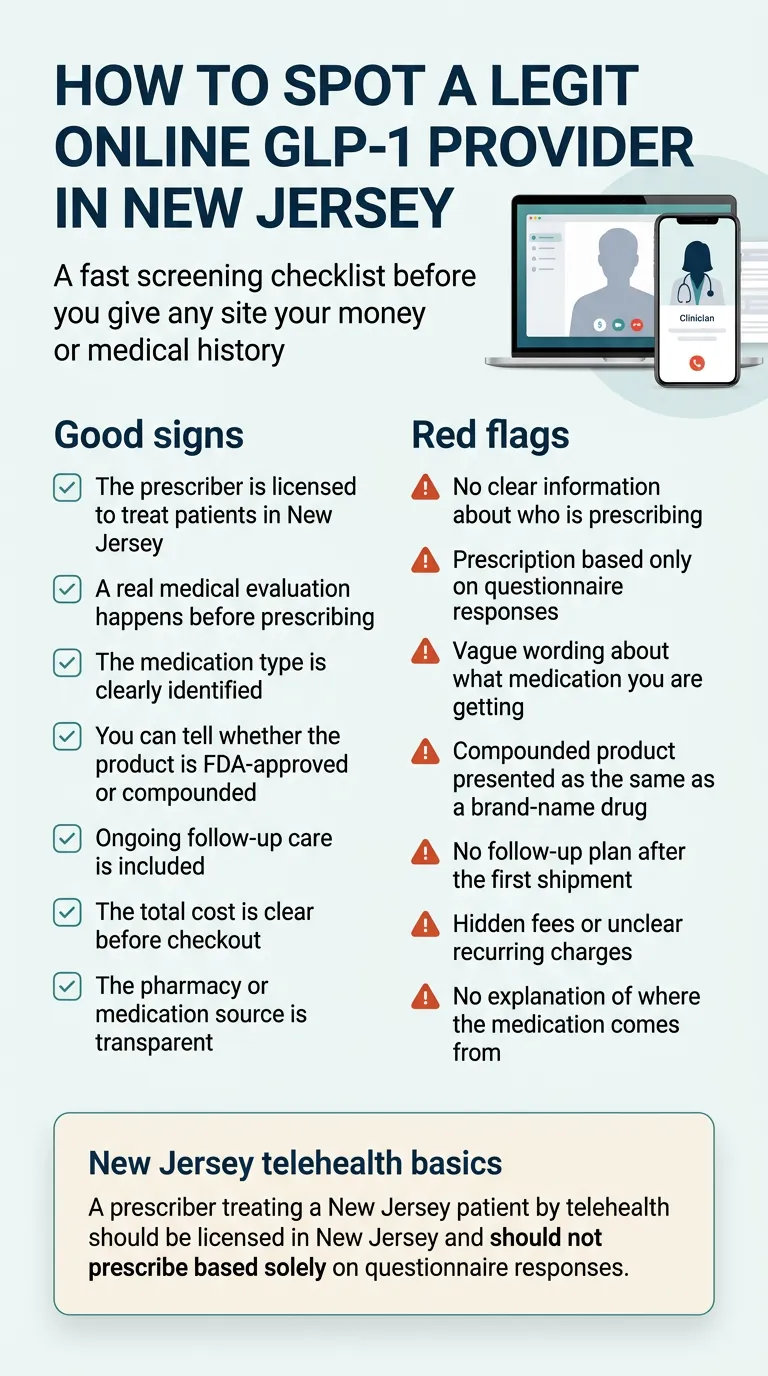
How to Spot a Legitimate Online GLP-1 Provider in NJ
Before you sign up anywhere, run through this checklist:
NJ-licensed prescriber. The provider treating you should be licensed in New Jersey. If the site doesn't tell you who's prescribing, that's a problem.
Real medical review. Not just a questionnaire. A legitimate platform will have a licensed provider review your full health history, and many require a video or phone consultation.
Clear medication sourcing. You should know whether you're getting FDA-approved brand-name medication or a compounded product. If it's vague, ask.
Follow-up support. GLP-1 treatment involves dose adjustments, side effect management, and ongoing monitoring. "Subscribe and we'll ship it" isn't medical care.
Transparent pricing. The total cost — including membership fees, medication, and any lab work — should be clear before you commit.
Not questionnaire-only prescribing. Under NJ rules, a questionnaire alone is not sufficient to establish the provider-patient relationship required for prescribing.
If a site fails more than one of these, close the tab.
Which GLP-1 Medication Are You Actually Trying to Get?
This is where a lot of people get confused. There are four main medications in this space, and they are not the same thing.
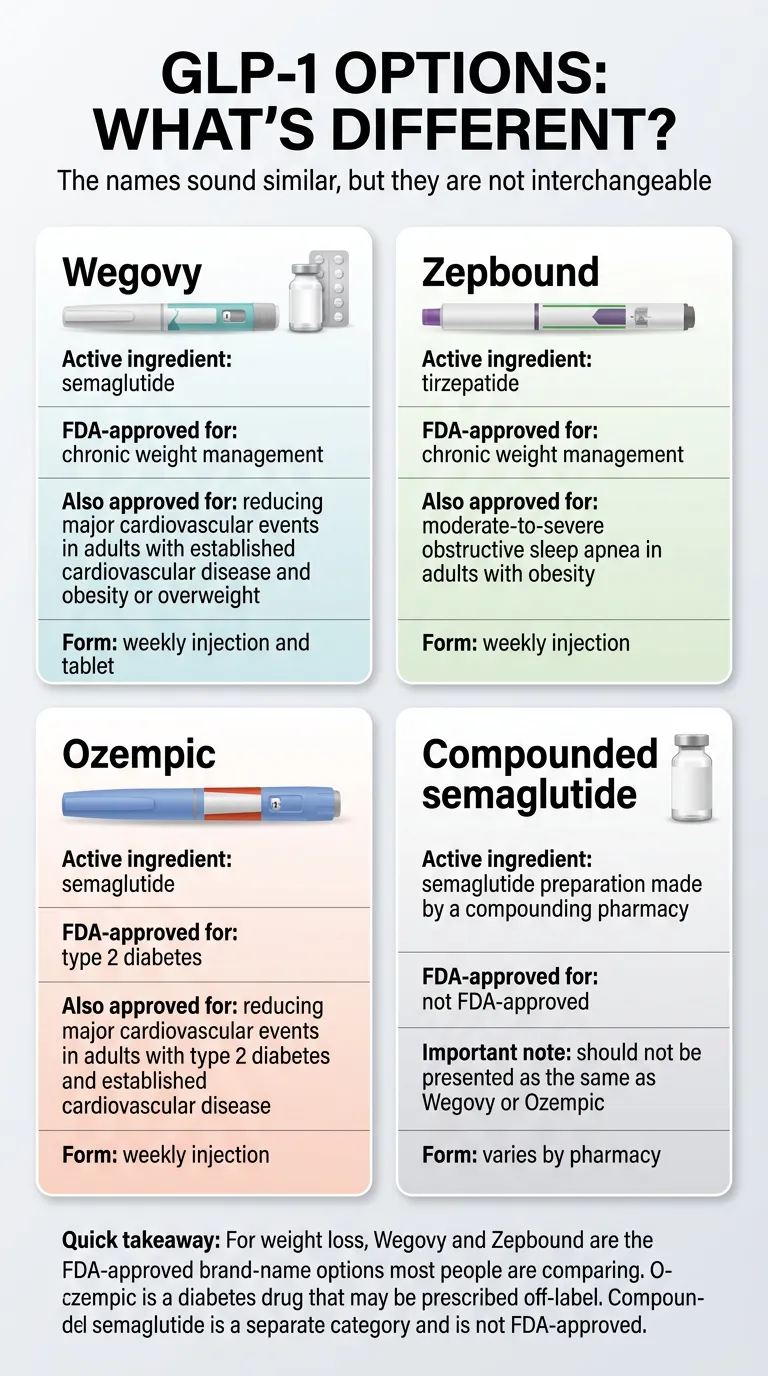
Wegovy (semaglutide) — The Gold Standard for Weight Loss
Wegovy is FDA-approved specifically for chronic weight management. It's the medication most people are actually looking for when they search "how to get GLP-1 in New Jersey." Available as both a weekly injection (2.4mg maintenance dose) and a daily oral pill (25mg maintenance dose, FDA-approved December 2025).
In the OASIS 4 clinical trial, people taking the oral pill achieved an average weight loss of approximately 17% (16.6%) when all patients stayed on treatment, and approximately 14% (13.6%) in the full analysis regardless of adherence, compared with about 2–3% for placebo. Wegovy is also FDA-approved for reducing cardiovascular risk in adults with heart disease who have obesity or overweight — which matters for insurance coverage.
Who it's best for: Anyone whose primary goal is weight loss and who wants the strongest clinical evidence behind their treatment.
Zepbound (tirzepatide) — The Newest and Potentially Most Powerful
Zepbound is FDA-approved for chronic weight management. It works on two hormone pathways (GLP-1 and GIP) rather than just one, which may explain its edge in clinical trials — participants lost an average of roughly 20% of their body weight in the SURMOUNT-1 trial.
It's also approved for moderate-to-severe obstructive sleep apnea in adults with obesity, which gives you a second insurance angle if you have that condition.
Who it's best for: People looking for maximum weight loss potential, especially those with sleep apnea.
Ozempic (semaglutide) — The Diabetes Drug People Use for Weight Loss
Ozempic is FDA-approved for type 2 diabetes and cardiovascular risk reduction, not weight loss. However, it contains semaglutide at lower doses than Wegovy, and doctors frequently prescribe it off-label for weight management.
The advantage: if you have type 2 diabetes, insurance coverage is much more straightforward. The disadvantage: the maximum dose (2mg) is lower than Wegovy's weight-loss dose (2.4mg), so the weight loss results may be somewhat less dramatic.
Who it's best for: People who have type 2 diabetes and want weight loss as an added benefit, or people whose insurance covers Ozempic but not Wegovy.
Compounded Semaglutide — Lower Cost, Higher Risk
Compounded semaglutide is prepared by compounding pharmacies. It is not FDA-approved and has not been evaluated by the FDA for safety, effectiveness, or quality. We cannot call it the same as Wegovy or Ozempic because, per FDA guidance, it is not — compounded products may use different salt forms, different manufacturing processes, and different inactive ingredients.
The appeal is price: compounded options typically run $179–$299/month compared to $349+/month for brand-name injectables without insurance. The risk is that the FDA has warned that compounded GLP-1 products can carry higher risks, has documented adverse events and dosing errors (some requiring hospitalization), and has issued warning letters in fall 2025 and again in early 2026.
Shortage-based flexibility has already narrowed significantly: the FDA officially resolved the semaglutide shortage in February 2025 and the tirzepatide shortage in October 2024.
Who it's for: People who cannot afford FDA-approved options and accept the trade-offs after understanding the risks. Not our first recommendation for anyone.
Do You Qualify for GLP-1 in New Jersey?
Most adults who feel they need help losing weight are surprised to find they actually meet the criteria. Here's what providers look for.
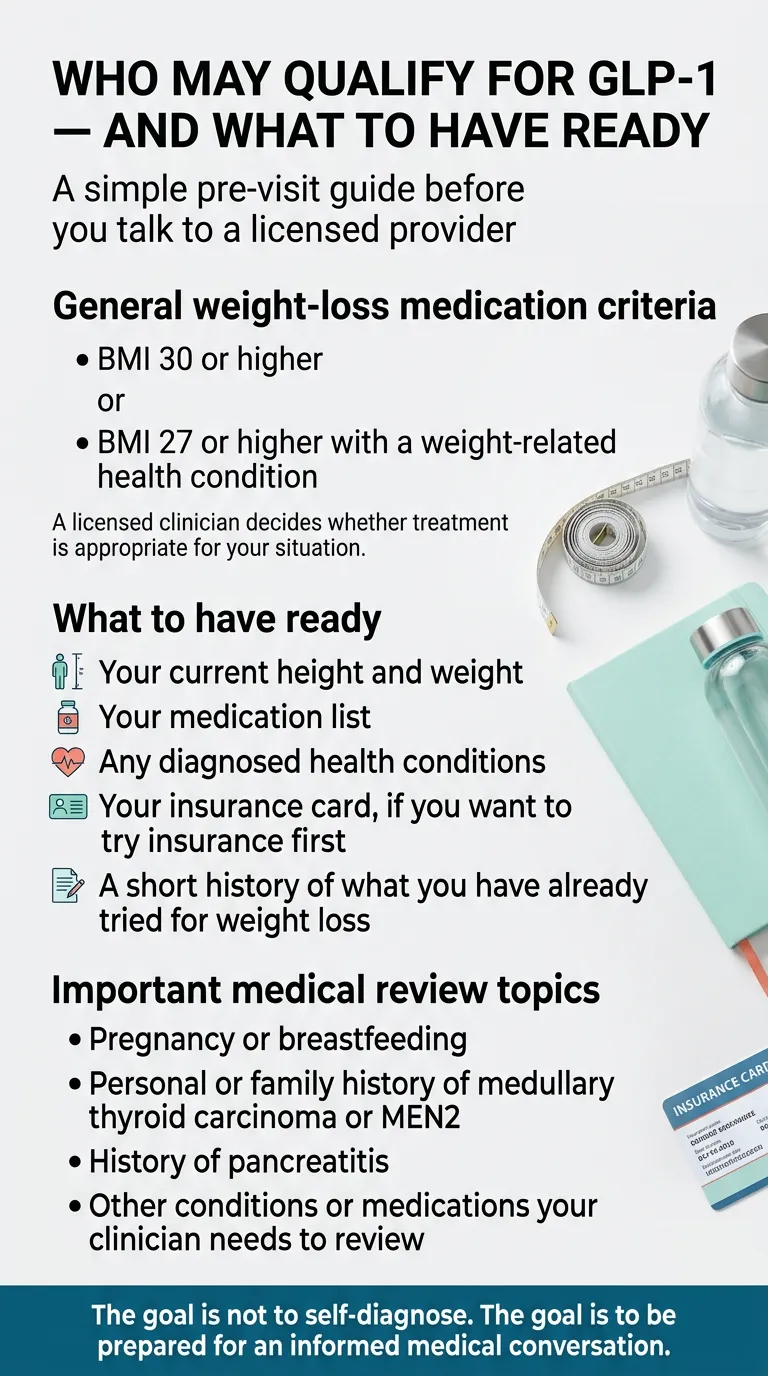
You're likely eligible if you have:
- A BMI of 30 or higher (clinically classified as obesity), OR
- A BMI of 27 or higher with at least one weight-related health condition — type 2 diabetes, high blood pressure, high cholesterol, obstructive sleep apnea, PCOS, or cardiovascular disease
These situations require individualized medical review:
- Pregnancy, planning to become pregnant, or breastfeeding (Wegovy may cause fetal harm; discontinue at least 2 months before a planned pregnancy)
- Personal or family history of medullary thyroid carcinoma (MTC) or MEN 2 — explicit contraindications
- History of pancreatitis — a warning and precaution in the prescribing information
- Known serious hypersensitivity to semaglutide or tirzepatide
Not sure about your BMI? A 5'4" person weighing 175 lbs has a BMI of 30. A 5'9" person weighing 200 lbs has a BMI of 29.5. Many people are closer to eligibility than they think.
What to Have Ready Before Your Appointment
- Your current weight and height
- List of current medications
- Any diagnosed health conditions (diabetes, hypertension, sleep apnea, etc.)
- A brief history of what you've already tried for weight loss
- Your insurance card (if you plan to use insurance)
Most telehealth platforms let you complete this information in an online form in under 5 minutes. A provider then reviews it and determines whether GLP-1 treatment is appropriate for your situation.
Ro Body
A licensed provider evaluates your health profile and tells you if you qualify — free
How Much Does GLP-1 Cost in New Jersey?
Let's break this down clearly, because pricing in this space is genuinely confusing.
FDA-Approved Medication Pricing (Without Insurance) — March 2026
| Medication | Form | Cash Price | Where to Get It |
|---|---|---|---|
| Wegovy pill | Daily tablet | $149/mo (1.5mg, 4mg through Apr 15) → $199/mo (4mg after Apr 15) → $299/mo (9mg, 25mg) | NovoCare, CVS, Costco, Walgreens, Ro, GoodRx |
| Wegovy pen | Weekly injection | $199/mo intro (first 2 months, 0.25mg & 0.5mg, through Mar 31) → $349/mo ongoing | NovoCare, Ro, pharmacies |
| Zepbound | Weekly injection | $299/mo (2.5mg) → up to $449/mo (higher doses) | LillyDirect, Ro, pharmacies |
| Ozempic (off-label) | Weekly injection | ~$900+ retail; lower with GoodRx coupons | Local pharmacy |
Prices verified against provider websites, March 17, 2026. Introductory pricing expires on stated dates.
FDA-Approved Medication Pricing (With Insurance)
| Medication | Typical Copay (If Covered) | Notes |
|---|---|---|
| Wegovy (pill or pen) | As low as $0–$25/mo with manufacturer savings card | Eligible commercially insured patients only; government insurance excluded |
| Zepbound | Varies by plan | Eli Lilly offers savings programs for eligible commercially insured patients |
| Ozempic | Often covered for diabetes indication | Off-label weight loss coverage is plan-dependent |
Telehealth Platform Total Costs (Medication + Service Fees)
| Platform | Monthly Total | What's Included |
|---|---|---|
| Ro Body Program | $149/mo membership + medication cost | Provider visits, insurance concierge, coaching, unlimited messaging |
| Hims | From $69/mo (non-GLP-1 oral kit, 10-mo plan) or $199/mo (GLP-1 injectable, 6-mo plan) | Provider access, prescription, shipping, app tools |
| Hers | Same as Hims, women-focused platform | Same inclusions with women's health focus |
| GoodRx Care | $39/mo + medication (separate) | Subscription, provider access, fill at any pharmacy or home delivery |
Four Ways to Lower Your Cost
- Check your insurance first. Some NJ employer plans through Horizon BCBS, Aetna, Cigna, and UnitedHealthcare cover Wegovy or Zepbound with prior authorization. Ro's insurance concierge handles the paperwork for you.
- Use manufacturer savings programs. Novo Nordisk offers a Wegovy savings card that can bring commercially insured copays down to $0–$25/month; government insurance beneficiaries are excluded. NovoCare Pharmacy offers the Wegovy pill at $149/month for self-pay patients at starting doses.
- Pay with your HSA or FSA. GLP-1 medications — and telehealth consultation fees — are eligible medical expenses under most Health Savings Accounts and Flexible Spending Accounts.
- Ask about dose optimization. Staying on a clinically effective lower dose can reduce your monthly medication cost. Your provider can help determine the right maintenance dose.
Will Insurance Cover GLP-1 in New Jersey?
This is the section that saves (or costs) NJ residents the most money. The short answer: it depends entirely on what kind of insurance you have.
If You Have Commercial Insurance Through an NJ Employer
Some employer-sponsored plans in New Jersey cover FDA-approved GLP-1 medications for weight management, usually with prior authorization. That means your provider (or a platform like Ro) needs to submit paperwork documenting your BMI, health conditions, and previous weight management attempts.
Tips that increase your odds of approval:
- Make sure your medical record documents your BMI and at least one weight-related comorbidity at every visit
- Ask your provider to submit under the cardiovascular risk reduction indication for Wegovy if applicable
- If you have obstructive sleep apnea, Zepbound has an approved indication for this, which may open a coverage pathway
- If denied, appeal with supporting documentation from your provider
Important note about Ro:
Their insurance concierge service is one of the strongest reasons to choose them. They handle prior authorization, submit appeals, and work directly with your insurance company. However, Ro does not coordinate GLP-1 coverage for government plans. If you have Medicaid or another government-funded plan, you cannot join the Ro Body membership or pay out of pocket through Ro. Medicare and TRICARE members can join and pay cash for certain options.
If You're on NJ Medicaid (NJ FamilyCare)
Here's the hard truth: NJ Medicaid does not currently cover GLP-1 medications prescribed solely for weight loss. New Jersey is among the states that have not expanded Medicaid coverage for obesity-indicated GLP-1s.
But there are important exceptions. NJ FamilyCare does provide coverage when GLP-1s are prescribed for other FDA-approved indications:
- Ozempic is covered when prescribed for type 2 diabetes management
- Wegovy may be covered when prescribed for cardiovascular risk reduction in patients with established cardiovascular disease and obesity or overweight
- Zepbound may be covered for obstructive sleep apnea in eligible patients
If you have one of these conditions in addition to wanting help with weight, talk to your doctor about whether prescribing under that indication makes clinical sense for you.
What about the future? The CMS BALANCE Model (announced December 2025) could bring Medicaid GLP-1 coverage to participating states as early as May 2026. New Jersey has not confirmed participation as of this writing, but we're tracking it. Some NJ legislators have also introduced bills (including Assembly Bill A5200) that would require state health plans and Medicaid to cover anti-obesity medications.
If NJ Medicaid won't cover it: The Wegovy oral pill at $149/month through NovoCare is the most affordable FDA-approved path for starting doses — that works out to roughly $5 per day.
If You're on Medicare
Medicare Part D does not currently cover GLP-1 medications for weight loss. Coverage continues for type 2 diabetes (Ozempic, Mounjaro) and cardiovascular indications. That is expected to change on a specific timeline:
- July 1, 2026: The Medicare GLP-1 Bridge demonstration begins, running through December 31, 2026. Eligible Medicare Part D beneficiaries who meet prior authorization criteria will pay $50/month for GLP-1 medications.
- BALANCE Medicare Part D (date TBD): The BALANCE Medicare Part D model has been delayed — CMS has not confirmed a new launch date. Check cms.gov for current status.
Until the Bridge launches in July 2026, cash-pay through NovoCare or a telehealth platform is the primary option for Medicare beneficiaries who want GLP-1 for weight loss.
Ro Body Program — Best for NJ Residents Who Want FDA-Approved Meds and Insurance Help
The one-line pitch: If you want the highest-confidence path — FDA-approved medication, a real provider relationship, and a team that fights your insurance company for you — Ro is the pick.
Ro prescribes only FDA-approved GLP-1 medications: Wegovy (pen and the new pill), Foundayo (orforglipron), Zepbound (KwikPen and vials), Ozempic, and Mounjaro. Their clinicians are licensed in the states they serve, including New Jersey. Members get ongoing access to Ro-affiliated providers and care support.
What the Process Looks Like
- Complete an online health assessment (5–10 minutes)
- A provider reviews your information online. If metabolic testing is ordered, Quest testing is included in membership, or an at-home kit is available for $75.
- Additional messaging or visits may be required depending on your case
- If approved, your prescription is filled and medication ships to your NJ address
- Ongoing check-ins, provider messaging, and dose adjustments as needed
What It Costs
- $39 for the first month (trial period to see if GLP-1s are right for you)
- $149/month ongoing membership (includes provider visits, insurance concierge, coaching, messaging)
- Medication cost is separate and depends on what you're prescribed and insurance coverage
- If insurance covers your medication, you may only pay a copay
The insurance concierge is the standout feature. Ro's team handles prior authorization submissions, fights denials, and helps you navigate coverage. For NJ residents with commercial insurance, this alone can save hundreds per month.
What's Not Ideal
The membership fee adds up even if your medication is covered by insurance. Metabolic testing adds a step compared to some competitors. And Ro cannot coordinate coverage for Medicaid patients — if you have Medicaid or another government-funded plan, you cannot join Ro Body. Medicare and TRICARE members can join and pay cash for certain options.
Ro Body
Ro's concierge handles the insurance paperwork — you just answer health questions
Hims & Hers — Best for Fully Online Cash-Pay Convenience in NJ
The one-line pitch: The widest menu of options, easy signup, and non-GLP-1 oral medication kits for people who don't want needles or want a lower price point. Best for cash-pay patients who value simplicity.
Hims (for men) and Hers (for women) offer a range of weight loss options: FDA-approved GLP-1 injectables (Wegovy, Zepbound, Ozempic, Mounjaro), and separate non-GLP-1 oral medication kits that can include metformin, bupropion, topiramate, naltrexone, and vitamin B12. Compounded semaglutide may also be available in limited, clinically necessary cases as determined by a provider. New Jersey is confirmed as an available state for their services.
Important distinction:
The $69/month oral kits are not GLP-1 medications. They work through different mechanisms. If you specifically want a GLP-1, you need one of their injectable plans starting at $199/month.
What makes them different: The signup process is fast — answer health questions, get a provider review, and if approved, medication ships to you. Their app includes tracking tools, recipes, and unlimited provider messaging. They've also been shifting toward FDA-approved options through a partnership with Novo Nordisk for direct access to brand-name Wegovy.
What It Costs
- Non-GLP-1 oral medication kits from $69/month (10-month plan, paid upfront)
- GLP-1 injectable options from $199/month (6-month plan, paid upfront)
- FDA-approved branded options at manufacturer pricing (varies by medication and dose)
What's Not Ideal
Plans are prepaid, which means you're committing upfront. Refund policies are limited — read the terms carefully before choosing a long-term plan. Insurance support is minimal compared to Ro. And if you're prescribed a compounded product, it carries the regulatory risks we outlined earlier.
Who should consider Hims/Hers over Ro: Cash-pay patients who want speed and simplicity, people who want non-GLP-1 oral medication (no needles, lowest price point), and people who are comfortable managing their own treatment without heavy hand-holding.
Your NJ Primary Care Doctor — Best for Complex Cases and Continuity
The one-line pitch: If you have a doctor you trust, a complex health history, or good insurance, starting with your PCP may be the smartest move.
Your primary care physician can prescribe any GLP-1 medication and bill your insurance directly. They have your full medical history, can monitor your labs and vitals in person, and can coordinate with specialists if needed.
The script to bring to your appointment:
"I'd like to discuss whether I'm a candidate for Wegovy or Zepbound based on my BMI, health history, and insurance coverage. I've been struggling with weight management despite lifestyle changes, and I'd like to explore medication options."
That's it. You don't need to be nervous about asking. GLP-1 prescriptions for weight management are now a standard part of primary care practice.
What's not ideal: Not all PCPs are comfortable prescribing GLP-1s — some may refer you to an endocrinologist or obesity specialist, which means a potentially long wait (2–4 months in some parts of NJ). Prior authorization through your doctor's office can also take 1–3 weeks.
When to go this route: You already see a PCP regularly, you have multiple health conditions that need monitoring, or you have insurance that covers in-office visits and GLP-1 prescriptions.
What About Compounded Telehealth Options?
We need to be straight with you here, because there's a lot of money being spent on marketing that makes compounded GLP-1s look simple and safe.
Compounded GLP-1 products are available in NJ through several telehealth platforms at lower price points — typically $179–$299/month. The appeal is real: that's significantly cheaper than brand-name medication without insurance.
But the risk is also real:
- These products are not FDA-approved. They have not been reviewed for safety, effectiveness, or manufacturing quality by the FDA.
- The FDA has warned that compounded GLP-1 products can carry higher risks, has documented adverse events and dosing errors (some requiring hospitalization), and has issued warning letters in fall 2025 and again in early 2026.
- The FDA has documented dosing errors with compounded injectable GLP-1s — including cases requiring hospitalization. As of February 2025, the FDA had received more than 455 adverse event reports with compounded semaglutide and more than 320 with compounded tirzepatide.
- Some compounded products use different salt forms (semaglutide sodium, semaglutide acetate) that the FDA says have not been evaluated and whose safety properties are unknown.
- Shortage-based flexibility has already narrowed significantly. The FDA officially resolved the semaglutide shortage in February 2025 and the tirzepatide shortage in October 2024. Enforcement discretion periods for compounders have largely ended.
We're not saying compounded GLP-1s never have a place. A licensed provider may determine a compounded product is clinically appropriate for a specific patient. But do not choose compounded simply because it's cheaper without understanding what you're giving up. And if a compounding telehealth site tells you their product is "the same" as Wegovy or Ozempic, they are making a claim the FDA has specifically called false and misleading.
If budget is the deciding factor and FDA-approved isn't in reach, at minimum confirm that:
- The platform works with a licensed, US-based compounding pharmacy
- The pharmacy is properly licensed and sourcing is transparent
- The provider prescribing is licensed in New Jersey
- You have access to ongoing clinical support, not just medication shipments
What About the New Wegovy Pill?
If you've been waiting for a needle-free GLP-1 option, this is it.
The Wegovy oral pill was FDA-approved in December 2025 and became broadly available in January 2026. It's the first and only oral GLP-1 medication approved for weight loss in adults. It contains semaglutide — the same molecule in the Wegovy injection — delivered as a daily tablet instead of a weekly shot.
Why it matters for NJ residents:
- No needles. One pill every morning, first thing on an empty stomach with a small sip of water. Wait 30 minutes before eating, drinking, or taking other medications.
- No refrigeration required. Unlike the injectable pens, the pill can be stored at room temperature.
- Available through NovoCare and participating pharmacies and telehealth partners including CVS, Costco, Walgreens, Ro, and GoodRx.
- Clinical results are substantial. In the OASIS 4 trial, patients taking the oral form achieved approximately 17% (16.6%) weight loss when staying on treatment, and approximately 14% (13.6%) in the full intent-to-treat analysis — versus about 2–3% for placebo.
- Pricing starts at $149/month for the 1.5 mg and 4 mg starting doses without insurance. With commercial insurance and the Novo Nordisk savings card, copays can be as low as $0–$25/month (government insurance excluded).
The dose ladder: You'll start at 1.5mg and work up to the maintenance dose of 25mg over several months. The pricing changes at higher doses — 9mg and 25mg tablets cost $299/month at cash-pay pricing, and the 4 mg dose rises to $199/month after August 31, 2026. Make sure you budget for the maintenance dose, not just month one.
Ro Body
A licensed provider evaluates your options — including whether insurance might cover the cost
Red Flags That Should Make You Close a GLP-1 Website Immediately
This section exists because we genuinely care about your safety, and the GLP-1 space has attracted some operators who care more about your credit card.
Walk away if you see:
No information about who's prescribing. If you can't identify the licensed clinician who will review your case, that's a serious red flag.
No NJ licensure transparency. The prescriber treating NJ patients must be licensed in New Jersey.
Questionnaire-only prescribing with no real medical review. Under NJ law, this doesn't meet the standard of care required for telehealth prescribing.
Vague medication sourcing. If the site doesn't clearly state whether you're getting FDA-approved or compounded medication, assume they're hiding something.
Language implying compounded medication is equivalent to FDA-approved brands. The FDA has specifically flagged this as false and misleading.
Hidden total cost. If you can't figure out the full monthly price before entering your credit card, keep looking.
No follow-up support after checkout. GLP-1 treatment requires dose adjustments and side effect monitoring. A site that ships medication without ongoing provider access isn't providing medical care.
Fake review stars or implausible testimonials. The FTC has been increasingly active against deceptive review practices in health care.
Pressure to commit to a long plan immediately. Legitimate providers will let you get started before locking into a 12-month prepaid plan.
This isn't about being paranoid. It's about applying the same diligence you'd use for any medical decision. The good news: the legitimate options we've covered in this guide don't have these problems.
What Happens After You Sign Up?
Here's what to expect once you choose a path, so nothing catches you off guard.
Step 1: Health assessment. You'll answer detailed questions about your medical history, current medications, health conditions, and weight loss goals. Typically 5–10 minutes online.
Step 2: Provider review. A licensed clinician (NJ-licensed for telehealth platforms) reviews your information. Some platforms include a video or phone consultation; others use asynchronous review.
Step 3: Lab work (if required). Ro may require a metabolic blood test depending on provider review. Hims/Hers often starts without lab work, though your provider may order labs later.
Step 4: Prescription decision. If GLP-1 medication is appropriate, your provider prescribes a specific medication and starting dose. You don't get to pick your own medication off a menu.
Step 5: Medication delivery or pharmacy pickup. Telehealth platforms typically ship to your NJ address in 5–10 business days. Through your PCP, the prescription goes to your preferred pharmacy.
Step 6: Start low, go slow. Every GLP-1 treatment begins with the lowest dose to minimize side effects. You'll stay there for 4 weeks before your provider considers increasing.
Step 7: Ongoing monitoring. Regular check-ins with your provider to adjust dosing, manage side effects, and track progress.
Side Effects: What to Expect (Honestly)
We're not going to sugarcoat this — but we're also not going to make it scarier than it is.
Most people experience some GI side effects, especially in the first 2–4 weeks. The most common: nausea, diarrhea, constipation, vomiting, and abdominal discomfort. For many people, these are mild to moderate and fade as the body adjusts, particularly when the dose is increased gradually.
The first dose increase is usually the worst. Each time your dose goes up, you may experience a temporary return of symptoms. This is normal, and it's exactly why providers start low and titrate slowly.
Serious side effects are rare but real. Pancreatitis, gallbladder problems, and kidney issues have been reported. GLP-1 medications carry a boxed warning about the risk of thyroid C-cell tumors based on animal studies — this has not been confirmed in humans, but it's why these medications are contraindicated for people with a personal or family history of medullary thyroid cancer or MEN 2 syndrome.
What the experience is really like for most people: The most commonly described positive change isn't the number on the scale — it's the quieting of "food noise." Patients consistently report that the constant mental chatter about food, cravings, and eating fades significantly. Many describe feeling "normal" around food for the first time.
How to Minimize Side Effects
- Eat smaller meals more frequently
- Prioritize protein at every meal
- Stay well-hydrated (water is your best friend on GLP-1s)
- Avoid fatty, fried, and heavily processed foods — your body will let you know if you push it
- Take the injection on the same day each week; take the pill first thing each morning
If side effects are significant, your provider can slow the titration schedule, hold your current dose, or switch you to a different medication. The goal is to find the dose that works for your body — not to power through misery.
How Much Weight Will You Actually Lose?
We know this is the real question. Here's what the evidence shows — no hype, just data.
Clinical Trial Averages
- Wegovy injection (semaglutide 2.4mg): ~15% body weight loss over 68 weeks in the STEP 1 trial. For a 230-lb person, that's roughly 35 lbs.
- Wegovy pill (oral semaglutide 25mg): ~17% (16.6%) in patients who stayed on treatment, ~14% (13.6%) in intention-to-treat analysis, in the OASIS 4 trial.
- Zepbound (tirzepatide): ~20% in the SURMOUNT-1 trial. For a 230-lb person, that's roughly 46 lbs.
Real-world results: A study published in JAMA Network Open found that patients in regular clinical settings lost approximately 5.9% of body weight at 3 months and 10.9% at 6 months on semaglutide — consistent with what clinical trials showed.
What the Timeline Typically Looks Like
Weeks 1–4:
Appetite suppression kicks in. The food noise quiets. You may lose 2–5 lbs, but the real change is in how you relate to food.
Months 2–3:
Visible changes. Clothes fit differently. Others start to notice.
Months 4–6:
Significant weight loss accumulating. Lab improvements often become measurable.
Months 6–12:
Approaching peak effect for most people. This is where the 15–20% body weight loss data comes from.
Results vary. Your starting weight, dose achieved, activity level, protein intake, and consistency all play a role. But the clinical evidence is clear: for most eligible patients, GLP-1 medications produce meaningful, sustained weight loss that's very difficult to achieve through diet and exercise alone.
What Happens Long-Term? The Questions Nobody Else Answers
Do I Take This Forever?
That's between you and your provider. GLP-1 medications are approved for long-term use, and the evidence suggests that stopping treatment leads to weight regain for most people — research from the STEP 1 extension study shows approximately two-thirds of lost weight may return within a year of discontinuation. This is consistent with how the medication works: it changes your appetite signaling while you're on it, but those signals can return when you stop.
Many providers support long-term maintenance dosing (sometimes at a lower dose) to sustain results. Think of it less like an antibiotic you take for 10 days and more like a blood pressure medication you take ongoing to manage a chronic condition — because obesity is a chronic condition.
The good news: the habits you build while on medication — eating less, choosing better foods, moving more — don't disappear. Many people find that even if they eventually stop, they've fundamentally changed their relationship with food.
What About Cost After the Introductory Pricing Expires?
- Wegovy pill: $149/mo for starting doses (1.5mg, 4mg through August 31, 2026) → $199/mo (4mg after August 31) → $299/mo at maintenance (9mg and 25mg)
- Wegovy injection: $199/mo intro for first 2 months of starting doses (through December 31, 2026) → $349/mo ongoing
- Ro membership: $39 first month → $149/mo ongoing (plus medication cost)
- Hims/Hers: Plans are prepaid at the quoted rate, but pricing may change at renewal
Budget for the long-term cost, not just month one. If insurance covers your medication, the ongoing out-of-pocket is much more manageable.
Can I Cancel Easily?
- Ro: Month-to-month after the first month. Cancel anytime.
- Hims/Hers: Plans are prepaid. Refund policies vary by plan length and whether you've had a visit. Read terms before committing.
- NovoCare: No subscription. Fill your prescription as needed.
- Your PCP: No cancellation — just stop scheduling appointments.
How We Evaluated GLP-1 Options for New Jersey Residents
We want you to trust our recommendations, so here's exactly how we built them.
- NJ legality and licensure — Is the platform confirmed to serve NJ with NJ-licensed prescribers?
- FDA-approved vs. compounded — We prioritize FDA-approved options for safety and regulatory certainty
- Insurance integration — Can the platform help NJ residents navigate insurance coverage?
- Transparent pricing — Is the total cost (including all fees) clear before signup?
- Speed to first dose — How quickly can a NJ resident go from signup to medication in hand?
- Ongoing clinical support — Is there real follow-up care, not just shipments?
- Cancellation friction — How easy is it to stop or change your plan?
Every price in this guide was checked against the provider's own website or official documentation as of March 2026. NJ Medicaid coverage information was verified against the official NJ DMAHS memo. Insurance guidance is based on publicly available formulary information and manufacturer coverage tools.
Affiliate disclosure: We have affiliate partnerships with some providers mentioned in this guide. If you sign up through our links, we earn a commission at no additional cost to you. This never influences which providers we recommend or how we rank them. Our methodology is the same whether or not a provider offers an affiliate program.
Use the NJ GLP-1 Pre-Visit Checklist Before You Choose
Before you sign up with any provider or walk into any office, run through this checklist. Print it out or save it on your phone.
About the Medication
- ☐ Do I want FDA-approved medication only? (Recommended)
- ☐ Am I open to an oral pill, or do I prefer a weekly injection?
- ☐ Do I understand the difference between brand-name and compounded?
About My Insurance
- ☐ Have I checked the Wegovy coverage tool at NovoCare.com?
- ☐ Have I checked the Zepbound coverage tool at Zepbound.com?
- ☐ Do I know whether my plan requires prior authorization?
- ☐ Do I know my expected copay?
About the Provider
- ☐ Is the prescribing clinician licensed in New Jersey?
- ☐ Does the platform offer real follow-up care?
- ☐ Is the total monthly cost clear before I sign up?
- ☐ Can I cancel without being locked in?
- ☐ Is the medication source clearly identified?
About My Health
- ☐ Do I know my current BMI?
- ☐ Have I listed my current medications?
- ☐ Have I documented any relevant health conditions?
- ☐ Do I have recent lab work available?
If you can check most of these boxes, you're ready to take the next step with confidence.
Still Not Sure Which GLP-1 Path Is Right for You?
You've just read through every option, every price, every catch, and every NJ-specific rule that affects your decision. If you're still weighing your options, here's the simplest way to decide:
Want someone to handle insurance for you?
Start with Ro BodyWant the fastest, simplest online path?
Start with HimsStart with HersWant to see someone face-to-face?
Call your NJ doctor and ask for a GLP-1 evaluation
Not sure yet?
Take our free 60-second quizThe eligibility assessment takes about 2 minutes and costs nothing. A licensed provider reviews your answers and tells you whether you qualify, which medication makes sense, and what the next step is. No commitment, no charge for the initial check.
The people who see results all have one thing in common: they started.
Ro Body
Free eligibility assessment — 2 minutes
Frequently Asked Questions
This page is for informational purposes only and does not constitute medical advice. Always consult with a licensed healthcare provider before starting any medication. GLP-1 medications require a prescription and are not appropriate for everyone.
Last updated: May 2026. We review and update this guide monthly.
Sources: Wegovy Prescribing Information (FDA Access Data, NDA 215256, NDA 218316); Zepbound Prescribing Information (FDA Access Data, NDA 217806); STEP 1 Trial — Wilding JPH et al., NEJM 2021; SURMOUNT-1 Trial — Jastreboff AM et al., NEJM 2022; Novo Nordisk press release — FDA Approves Wegovy Pill, December 2025; OASIS 4 Trial — NEJM; NJ DMAHS GLP-1 Coverage Memo (nj.gov); KFF — Medicaid Coverage of GLP-1s (January 2026); CMS BALANCE Model (December 2025); CMS Medicare GLP-1 Bridge FAQ; FDA — Concerns with Unapproved GLP-1 Drugs; FDA — Policies for Compounders as GLP-1 Supply Stabilizes; Ro Body Program pricing and insurance (ro.co, March 2026); Hims/Hers Drug Pricing (hims.com, forhers.com, March 2026); NovoCare — Wegovy Coverage and Savings; Wegovy.com pricing; JAMA Network Open — Weight Loss Outcomes with Semaglutide (2022); Horizon BCBS NJ — GLP-1 Non-Diabetic Use Policy; GoodRx — Weight Loss Telemedicine (November 2025); Walgreens Virtual Healthcare Weight Management (February 2026); NIDDK — Prescription Medications for Overweight and Obesity; NJ Assembly Bill A5200; NJ Telemedicine Act — NJ Rev Stat § 45:1-62 et seq.; FTC Endorsement Guides; STEP 1 Extension Study — Weight regain after semaglutide discontinuation.