How to Get GLP-1 in Florida: The Fastest Legal Paths to Wegovy, Zepbound, and Semaglutide in 2026
By the WPG Research Team · Last Updated: March 17, 2026 · Pricing Last Verified: March 15, 2026 · Florida Law Last Checked: March 2026 · Affiliate Disclosure · Full editorial policy
How to get GLP-1 in Florida — here's the short version. Many Florida residents can start GLP-1 treatment online — often without an in-person visit — if the provider determines telehealth is sufficient. Florida's telehealth law (Statute §456.47) supports it. Medication-only self-pay pricing currently starts at $149 per month, though your total cost depends on the provider, dose, and any membership or visit fees.
But — and this is the part most sites skip — not every online GLP-1 offer is equally safe, equally legal, or equally honest about what you'll actually pay after month two.
We spent the last several weeks verifying Florida telehealth rules, current provider pricing, FDA guidance, and real monthly costs (including the fees they bury in the fine print). What follows is everything a Florida resident needs to choose the right GLP-1 path and avoid the wrong one. Cash-pay paths can move within days; insurance-based paths often take longer.
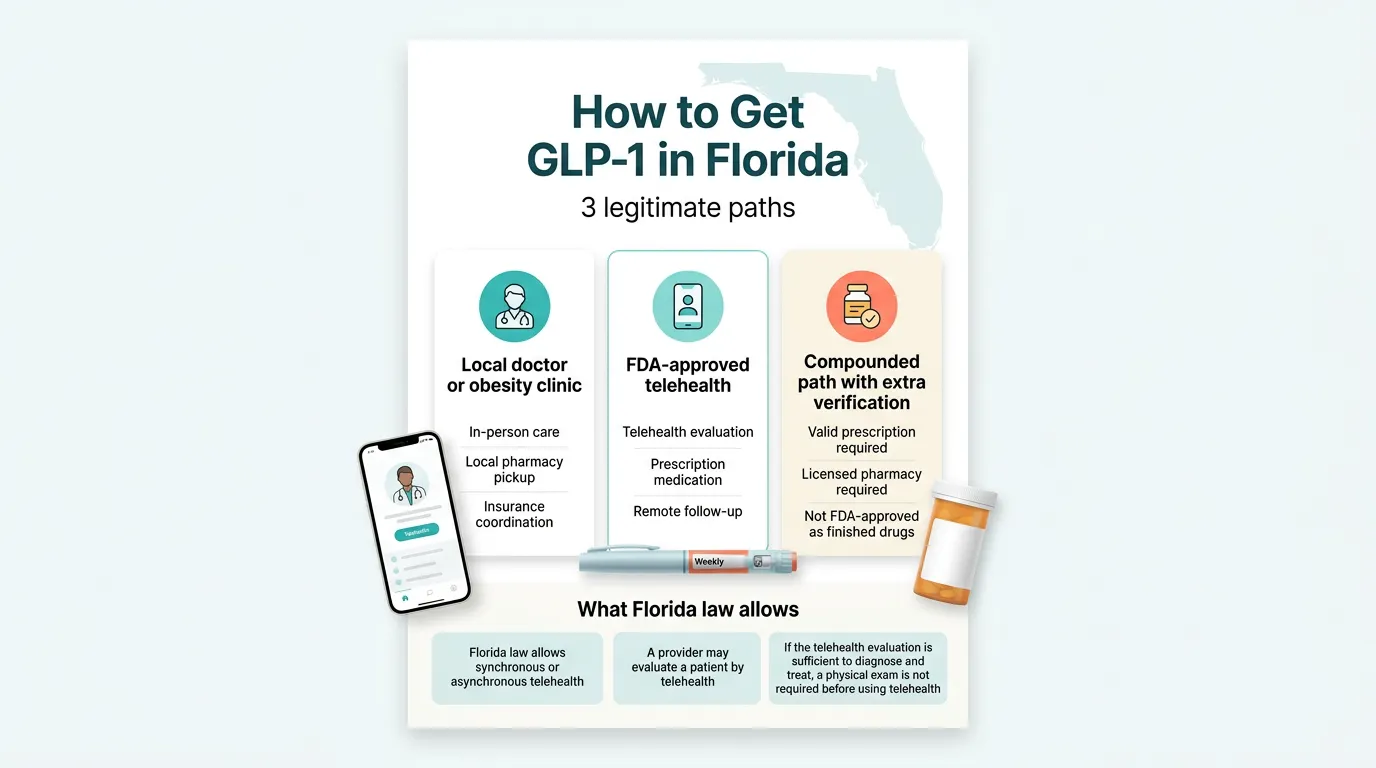
Your fastest next step depends on your situation:
Have insurance (or want help getting coverage)?
→ Ro Body is strongest for people who want insurance help plus FDA-approved options — they have a dedicated insurance concierge and manufacturer-linked self-pay pricing.
Check Your Eligibility FreeWant the simplest cash-pay route?
→ Walgreens Weight Management — $49 visit, no subscription, Wegovy from $149/mo.
Want the lowest monthly cost?
→ MEDVi starts at $179/mo for compounded options — but read our verification section first.
One honest caveat before we go deeper: the cheapest GLP-1 offer is not always the safest one. The FDA resolved the semaglutide injection shortage in February 2025 and has since warned about fraudulent compounded GLP-1 products. That doesn't mean every compounded option is bad — but it does mean you need to verify before you pay. We'll show you exactly how.
How Do the Top Florida GLP-1 Providers Actually Compare?
We built this table to answer the question every Florida resident has: What will I actually pay, and what do I actually get?
Most comparison tables online show you the promotional price and nothing else. Ours shows the true monthly cost — membership fees, medication, and what happens after the intro pricing expires.
| Ro Body | Hims / Hers | MEDVi | Walgreens | Local FL Doctor | |
|---|---|---|---|---|---|
| Medication Type | FDA-approved (Wegovy, Zepbound, Ozempic) | FDA-approved + compounded options | Compounded GLP-1 options (semaglutide program from $179) | FDA-approved (Wegovy, Foundayo, Zepbound KwikPen) | FDA-approved (provider decides) |
| Month 1 Total Cost | $194 ($39 membership + $149 Wegovy pill) | Varies by product and plan; compounded semaglutide from $199/mo on prepaid plans | $179/mo (all-in) | $198 ($49 visit + $149 Wegovy pill) | Varies — office visit + Rx + pharmacy |
| Ongoing Monthly Cost | $294+/mo ($149 membership + $149+ medication) | Varies by medication, dose, and subscription length | $299/mo refills | $149–$349/mo medication + $49 per visit | Insurance copay or cash Rx price |
| Insurance Support? | ✅ Full concierge — fights prior auth for you | ❌ Cash-only; HSA/FSA reimbursement may vary by plan | ❌ Cash-only | ❌ No insurance handling | ✅ Your doctor submits to insurance |
| Labs Included? | Quest testing included if your provider orders it | Verify current lab requirements on Hims/Hers site | Verify current lab policy on MEDVi site | HbA1c + metabolic panel required for refills | Usually covered by insurance visit |
| Florida Telehealth? | ✅ Licensed in FL | ✅ (verify current FL availability on site) | Uses U.S.-licensed clinician network; verify FL details before paying | ✅ Walgreens-affiliated practices | ✅ In-person or FL telehealth |
| Time to First Dose | Varies; cash-pay is faster, insurance path takes 2–3 weeks | Varies by medication and approval | Varies; verify shipping timeline before paying | Varies by pharmacy | Varies |
| Cancel Policy | Month-to-month, cancel anytime | Prepaid plans; best pricing on longer commitments | Month-to-month, no contract | No subscription — per-visit | N/A |
| Best For | Insurance navigation + FDA-approved meds | Speed + app experience | Lowest entry cost | Simple self-pay, no commitment | Complex health history, insurance Rx |
| Biggest Tradeoff | $149/mo membership adds up | Multi-month commitment required | Compounded = not FDA-approved | No insurance help, limited support | Slower, potentially more expensive |
Prices reflect publicly listed rates as of March 2026. Your actual cost may differ based on dose, medication, and insurance. We verify pricing monthly and update this table when anything changes.
Ro Body
From $194 first month — Wegovy pill + insurance concierge
Which Florida GLP-1 Path Fits You Best?
You don't need to read 9,000 words to make a decision. Pick the scenario that sounds like you.
"I have insurance and want to use it."
Start with Ro Body. Their insurance concierge team handles the prior authorization paperwork, fights denials, and submits appeals on your behalf. If your plan covers Wegovy or Zepbound, you may pay as little as $0–$25/mo with a manufacturer savings card. If insurance denies you, your Ro provider will recommend FDA-approved cash-pay alternatives.
This is the path where someone else does the hard work for you. The $149/mo membership covers coaching, labs, and the concierge team — it's the price of not spending hours on hold with your insurance company.
See If Your Insurance Covers GLP-1s"I don't have insurance. I want FDA-approved medication at the lowest price."
The Wegovy pill through NovoCare (accessible via Ro or Walgreens) starts at $149/mo for the 1.5mg starting dose. That's the manufacturer's direct price — the same whether you go through Ro, Walgreens, or NovoCare directly.
If you prefer injectable Wegovy, the intro price is $199/mo for the first two months (0.25mg and 0.5mg doses only through December 31, 2026), then $349/mo for ongoing doses.
For Zepbound (tirzepatide), vials start at $299/mo for the 2.5mg dose through LillyDirect or Ro.
"I want the absolute lowest monthly payment."
MEDVi starts at $179/mo for the first month — all-in, no hidden membership. That's for compounded medication, which we need to be upfront about: compounded GLP-1s are prepared by licensed pharmacies but are not FDA-approved as finished products and have not undergone the same safety and efficacy review as brand-name medications.
Read our compounded vs. FDA-approved breakdown before choosing this path.
"I want the fastest possible start."
Hims or Hers. Complete the health questionnaire in under five minutes. No phone calls, no waiting rooms. Their March 2026 partnership with Novo Nordisk means broader access to FDA-approved Wegovy and Ozempic alongside their existing options.
The downside: best pricing often requires multi-month prepay. Check current plan terms and cancellation policy on their site before committing.
"I have a complicated medical history and want real in-person care."
See a local Florida doctor. If you have multiple health conditions, take several medications, or just want someone who can see the full picture, an in-person obesity medicine physician or your primary care provider is the right move. They can prescribe GLP-1 medication and submit directly to your insurance. Florida Medicaid or Medicare may cover GLP-1s for certain indications through your doctor.
How to Get GLP-1 in Florida: The Step-by-Step Process
Here's exactly what happens from "I'm interested" to "medication in my hand."
Step 1: Confirm You Likely Qualify
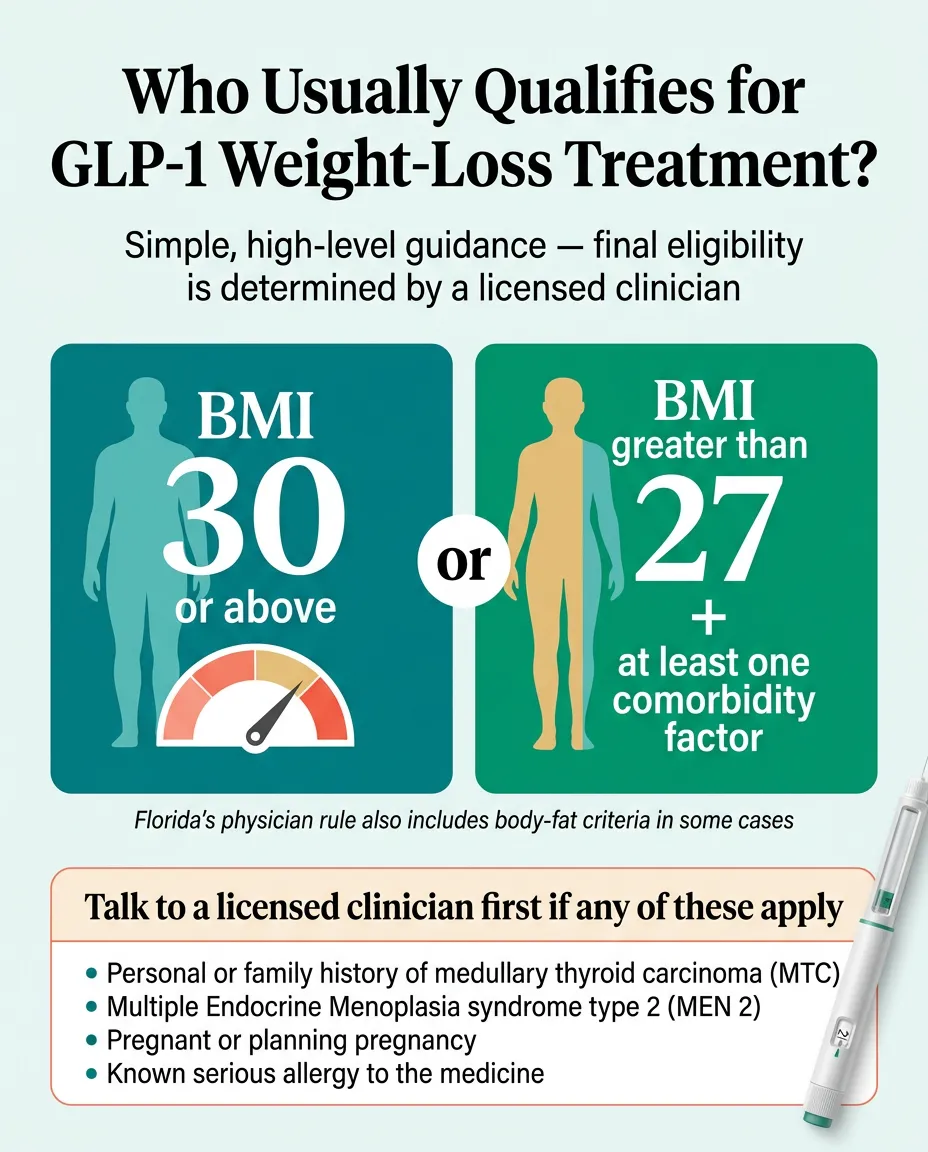
Most GLP-1 medications are prescribed for adults who meet these criteria:
- BMI of 30 or higher (classified as obesity), OR
- BMI of 27 or higher with at least one weight-related condition — high blood pressure, Type 2 diabetes, high cholesterol, sleep apnea, PCOS, or cardiovascular disease
Quick BMI Reference for Common Heights
| Height | Weight for BMI 27 | Weight for BMI 30 |
|---|---|---|
| 5'4" | 157 lbs | 175 lbs |
| 5'7" | 172 lbs | 191 lbs |
| 5'10" | 188 lbs | 209 lbs |
| 6'0" | 199 lbs | 221 lbs |
| 6'2" | 211 lbs | 234 lbs |
You should NOT take GLP-1s if you have:
- A personal or family history of medullary thyroid carcinoma (MTC)
- Multiple Endocrine Neoplasia syndrome type 2 (MEN2)
- A known allergy to semaglutide or tirzepatide
- You're pregnant or planning to become pregnant
If you have a history of pancreatitis or gallbladder disease, your provider will evaluate whether GLP-1 treatment is appropriate for you.
Ro Body
Takes 2 minutes — no cost, no commitment
Step 2: Choose Your Provider
Based on the comparison above, pick the path that matches your insurance status, budget, and preferences. We've already done the research — you don't need to compare 15 providers. The table above covers the realistic options for Florida residents.
Step 3: Complete the Online Health Intake
Every legitimate telehealth platform starts with a HIPAA-secured health questionnaire. You'll answer questions about your medical history, current medications, weight, height, and health goals. It takes 5–10 minutes. Some providers (like Ro) include lab work at no additional cost. Others may require it at an added fee ($75–100) or only if clinically needed.
Step 4: Provider Review and Prescription
A Florida-licensed physician, nurse practitioner, or physician assistant reviews your intake. Under Florida Statute §456.47, this telehealth evaluation legally establishes the patient-provider relationship — no in-person visit required. Review timelines vary by provider and demand.
If you're approved, your provider prescribes the appropriate GLP-1 medication and creates a dosing schedule. Everyone starts on a low dose that gradually increases over several weeks. This is called titration, and it's intentional — it minimizes side effects and lets your body adjust.
Step 5: Medication Ships to Your Door
Your prescription is filled by a licensed U.S. pharmacy and either shipped directly to your Florida address in temperature-controlled packaging or sent to a local pharmacy for pickup, depending on the provider, medication, and payment path. If you're using insurance through Ro, the timeline is typically 2–3 weeks (because prior authorization takes time). Cash-pay paths are generally faster.
Step 6: Follow Up and Adjust
Florida's Board of Medicine rule for anti-obesity prescribing (Florida Administrative Code 64B8-9.012) requires re-evaluation at least every three months. Legitimate providers schedule regular check-ins to adjust your dose, manage side effects, and monitor progress. This isn't optional red tape — it's how the medication works best.
Is It Legal to Get GLP-1 Through Telehealth in Florida?
Yes. Unambiguously yes. And here's exactly why.
Florida Statute §456.47 allows licensed healthcare practitioners to evaluate patients, diagnose conditions, and prescribe medications through telehealth — including GLP-1 receptor agonists like semaglutide and tirzepatide. The law permits both synchronous telehealth (live video) and asynchronous methods (like secure questionnaire-based intake).
Here's what matters for Florida residents specifically:
GLP-1 medications are not controlled substances under Florida law. That's important because Florida restricts telehealth prescribing of Schedule II controlled substances in most cases. GLP-1s don't fall into that category, which means the prescribing pathway is cleaner and faster.
Out-of-state providers must register. If your telehealth provider is based outside Florida, they must be registered through the Florida Telehealth Provider Registration Program (flhealthsource.gov/telehealth). You can verify registration status before paying — we show you how in our verification section.
Florida has a specific Board of Medicine rule for anti-obesity drugs (Florida Administrative Code 64B8-9.012). This sets BMI and comorbidity thresholds for prescribing, requires written informed consent, and mandates provider re-evaluation at least every three months. It's not a barrier — it's a framework that protects you.
Bottom line: Getting GLP-1 through telehealth in Florida is legal, regulated, and routine. Whether you live in Miami, Tampa, Jacksonville, Orlando, Tallahassee, or rural Panhandle country — the medication ships to you regardless of zip code.
Do I Need an In-Person Exam or Lab Work to Get GLP-1 in Florida?
Not for the initial evaluation. Florida's telehealth law allows providers to conduct the initial patient evaluation entirely online — via video or even secure questionnaire — as long as they determine the telehealth format is sufficient to diagnose and treat.
When telehealth alone is enough:
Most straightforward GLP-1 prescriptions for patients who meet BMI criteria and have no complex contraindications. You complete the health intake online, the provider reviews it, and you receive a prescription decision — timelines vary by provider and demand.
When labs may be needed:
Some providers order baseline metabolic labs (blood sugar, thyroid, kidney function) before prescribing or before refills. Ro includes these at Quest Diagnostics at no extra cost. Walgreens requires an HbA1c and metabolic panel for refill visits. Other providers order labs only if something in your health history warrants it.
When in-person care makes more sense:
If you have multiple complex health conditions, take medications with potential interactions, or have a history that warrants hands-on examination. In these cases, a local Florida physician can provide more thorough initial workup.
The practical takeaway: for most Florida residents, the entire GLP-1 process happens online. You don't need to drive anywhere, sit in a waiting room, or take time off work.
How Much Does GLP-1 Actually Cost in Florida? (Every Scenario)
Cost is the number one reason people hesitate. Let's kill the confusion.
If You Have Commercial Insurance
Only about 19% of large employer plans covered GLP-1 medications for weight loss as of 2025. That number is growing, but slowly. Here's how to navigate it:
- If your plan covers GLP-1s: Your copay with a manufacturer savings card could be as low as $0–$25/mo. Novo Nordisk's NovoCare savings tools support Wegovy access; Eli Lilly has a savings card for Zepbound. These cards work with commercial insurance only — not Medicare, Medicaid, or TRICARE.
- If your plan doesn't cover GLP-1s (or you don't know): Ro's insurance concierge will check your coverage for free, submit prior authorization, and fight denials. This alone is worth the membership fee for many people.
- What the insurance fight actually looks like: Your provider documents medical necessity. The insurance concierge submits paperwork. If denied, they appeal. The process takes 2–3 weeks but saves hundreds per month if it works.
If You're Paying Cash (No Insurance)
Here's what each path actually costs — no promo language, just the monthly number:
FDA-approved options:
- Wegovy pill: $149/mo for 1.5mg and 4mg doses (4mg promo runs through August 31, 2026, then $199/mo). Higher doses: $299/mo.
- Wegovy pen (injectable): $199/mo intro for first 2 months at starter doses (0.25mg and 0.5mg only, through December 31, 2026), then $349/mo ongoing.
- Zepbound vial: Lilly's current self-pay pricing lists $299/mo for 2.5mg, $399/mo for 5mg, $499/mo for 7.5mg, and $699/mo for 10/12.5/15mg.
- Ozempic (off-label): New self-pay patients can pay $199/mo for the first 2 fills of 0.25mg or 0.5mg (through December 31, 2026). After that, $349/mo for 0.25–1mg, $499/mo for 2mg through NovoCare.
Compounded options:
- MEDVi: $179/mo first month, $299/mo refills.
- Other compounded providers: $199–$499/mo depending on formulation and dose.
Platform fees (on top of medication):
- Ro: $39 first month, $149/mo after (includes labs, coaching, insurance concierge)
- Hims/Hers: No membership fee, but prepaid plan commitment
- MEDVi: No membership fee
- Walgreens: $49 per visit (no subscription)
The True Total Cost Comparison for Month 1
If You're on Medicare
Big update for 2026: Medicare coverage for GLP-1 weight loss medications is changing. Historically, Medicare was prohibited from covering drugs used for weight loss. That's shifting:
- Medicare GLP-1 Bridge (July–December 2026): CMS announced a short-term demonstration covering Wegovy and Zepbound for eligible Medicare Part D beneficiaries, with a $50/month copay. Eligibility requires BMI of 35+ alone, or BMI of 27+ with additional clinical criteria. This program operates outside the Part D benefit — meaning the $50 copay won't count toward your Part D deductible or out-of-pocket cap.
- BALANCE Model (date TBD — delayed): A longer-term CMS model designed to provide ongoing Medicare Part D coverage for GLP-1 medications. Part D plans must opt in, so availability may vary by plan.
- Already-covered uses: If your provider prescribes Wegovy to reduce cardiovascular risk (in adults with established CV disease and obesity/overweight) or Zepbound for obstructive sleep apnea, these uses may already be coverable under your existing Part D benefit — ask your plan.
Until July 2026, cash-pay programs remain the most accessible path for Medicare beneficiaries seeking GLP-1s for weight loss. The manufacturer self-pay pricing above applies.
Source: CMS Medicare GLP-1 Bridge FAQ (cms.gov, updated March 2026); BALANCE Model announcement (December 2025)
If You're on Florida Medicaid
Florida Medicaid coverage for GLP-1 weight loss medications is extremely limited. Some plans may cover GLP-1s for Type 2 diabetes indications — check your specific formulary or call your plan directly. For weight loss specifically, cash-pay telehealth is the most reliable path.
Can You Use HSA or FSA?
GLP-1 medications are generally HSA/FSA eligible, but how you pay depends on the provider. Hims/Hers states that FSA/HSA eligibility varies by plan. Ro currently does not accept HSA/FSA cards directly at checkout, though you may be able to submit receipts for reimbursement — check your plan's rules. Always verify with your plan administrator.
What's the Real Difference Between FDA-Approved and Compounded GLP-1s?
This is the question that separates informed patients from confused ones. The landscape shifted significantly in 2025–2026, and a lot of online content hasn't caught up.
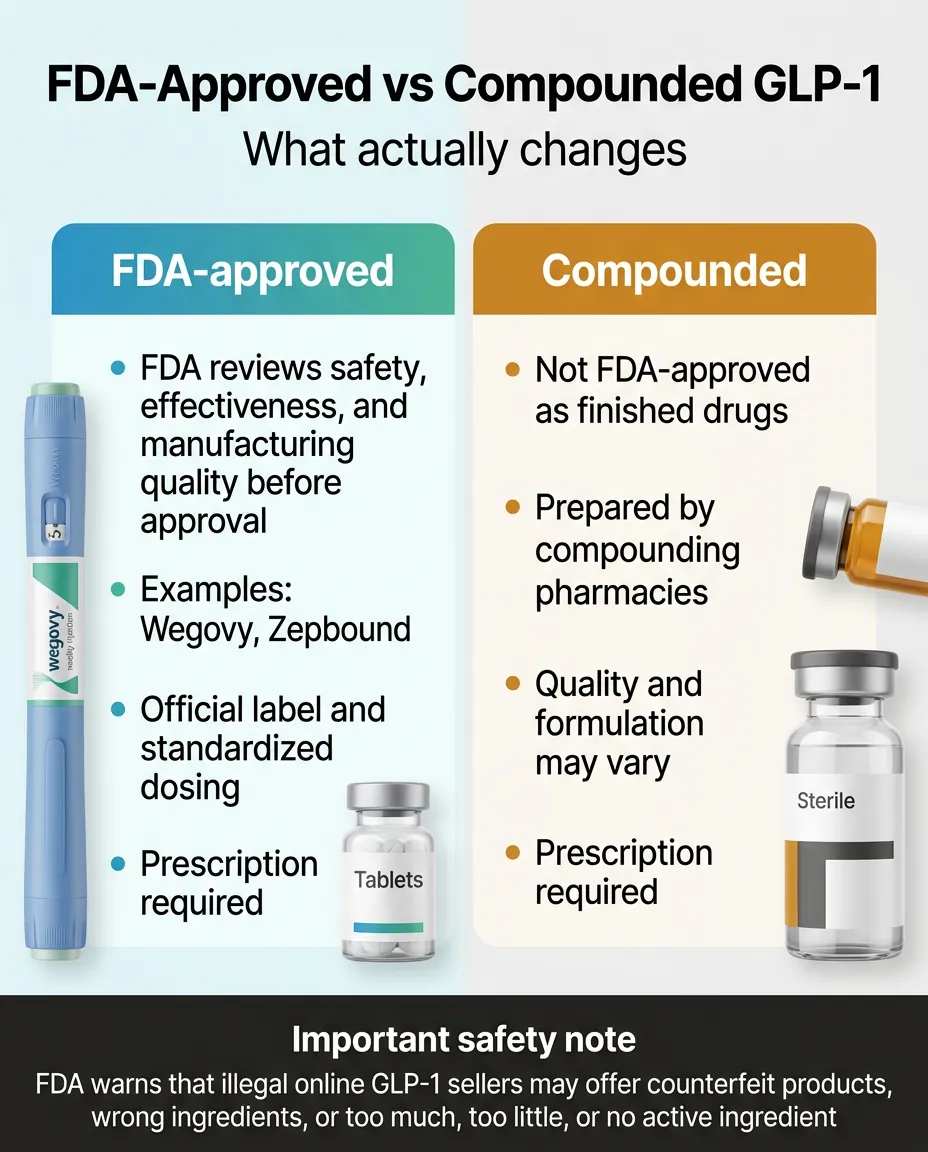
FDA-approved medications — Wegovy, Ozempic, Zepbound, Mounjaro, Rybelsus — have undergone full FDA review for safety, efficacy, and manufacturing quality. When you take Wegovy, you know exactly what's in it, how it was made, and that clinical trials with thousands of patients confirmed its effects.
Compounded GLP-1 medications are prepared by licensed compounding pharmacies (503A or 503B facilities). They are not FDA-approved as finished products and have not been through the same rigorous review process. The FDA does not evaluate compounded medications for safety, effectiveness, or quality before they reach patients.
What changed in 2025–2026:
- The FDA declared the semaglutide injection shortage resolved in February 2025. This significantly narrowed the conditions under which compounding pharmacies could produce semaglutide at scale.
- The FDA has warned consumers about unapproved and fraudulent GLP-1 products, including dosing errors, questionable semaglutide salt forms, and illegal marketing.
- The Hims & Hers pivot: In March 2026, Hims & Hers announced they were shifting their U.S. weight-loss business toward FDA-approved GLP-1 access and away from advertising compounded GLP-1s. They signed a deal with Novo Nordisk to offer Wegovy and Ozempic directly. This is a signal of where the market is heading.
What this means for you as a Florida patient: If you can afford FDA-approved medication — now starting at $149/mo for the Wegovy pill — that's the safest, most straightforward choice. If cost is genuinely the barrier, compounded options through a vetted provider (licensed pharmacy, licensed prescriber, clear labeling) remain available. But go in with eyes open, verify the pharmacy, and understand you're choosing a different risk profile.
We never want you to choose the cheapest option by default. We want you to choose the right option with full information.
Ro Body: A Strong All-Around Option for Florida Residents Who Want FDA-Approved GLP-1s
If you want one recommendation for the typical Florida resident who's ready to start GLP-1 treatment, Ro Body is where we'd point most people. They solve the two biggest problems — insurance navigation and access to FDA-approved medications at manufacturer-linked pricing — in a way that few competitors match.
What Makes Ro Different
The insurance concierge is the killer feature. Most telehealth GLP-1 providers are cash-only. Ro's team will check your insurance coverage, submit prior authorization requests, and fight denials on your behalf. If you're one of the lucky ones whose plan covers Wegovy or Zepbound, this could save you hundreds per month. If insurance says no, Ro pivots you to cash-pay options at manufacturer-direct pricing — the same prices available through NovoCare or LillyDirect.
FDA-approved medications, period. Ro prescribes Wegovy (pill and injectable), Zepbound (vials), and Ozempic. These are brand-name, FDA-reviewed medications — not compounded alternatives.
Labs included when ordered. If your Ro provider determines you need metabolic lab panels, testing at Quest Diagnostics is included in the membership. Not every patient needs labs on day one, but it's covered when they do.
Structured support. You get 1:1 coaching, nurse check-ins, a 12-month weight loss curriculum, and unlimited provider messaging. For someone new to GLP-1s who wants guidance on side effects, diet adjustments, and dose titration, this matters.
What It Costs
The membership is $39 for your first month, then $149/mo ongoing. Medication is billed separately:
- Wegovy pill: from $149/mo
- Wegovy pen: from $199/mo (intro) → $349/mo
- Zepbound vial: from $299/mo
- Ozempic: from $349/mo
Your true first-month cost with the cheapest path: $194 ($39 membership + $149 Wegovy pill).
The Honest Downside
The membership fee. At $149/mo on top of medication, Ro is not the cheapest option for someone who just wants a refill and nothing else. You're paying for the coaching, labs, and insurance concierge whether you use them all or not. If you're an experienced GLP-1 user who simply needs medication access, there are leaner options.
But here's the thing — for most people starting GLP-1 treatment for the first time, that support is exactly what prevents the two most common failure modes: quitting because of side effects you didn't know how to manage, or stopping because your insurance denied coverage and you didn't know how to fight it.
Real Ro members describe the experience as feeling genuinely supported — from regular check-ins to having someone answer medication questions at midnight. The program is designed to keep you on track, not just ship you a box.
Ro Body
From $194 first month — FDA-approved, insurance concierge included
Hims & Hers: Best for Speed and a Polished Digital Experience
If your priority is getting started fast with minimal friction, Hims (for men) and Hers (for women) deliver.
What Makes Them Stand Out
Speed. Complete the intake questionnaire in under five minutes. Provider review is fast. No phone tag, no waiting rooms.
The Novo Nordisk partnership. In March 2026, Hims & Hers announced they were bringing Wegovy and Ozempic directly to their platform through a deal with Novo Nordisk. This is a meaningful shift — it means FDA-approved options alongside their existing product lineup.
Polished app experience. Both Hims and Hers have invested heavily in their mobile app. Unlimited messaging with your care team, prescription management, and progress tracking in one place. Hers in particular is designed around women's health — the onboarding, the content, and the provider communication all reflect that focus.
No membership fee. Unlike Ro, there's no ongoing subscription charge on top of medication. You pay for the treatment plan.
What It Costs
Compounded semaglutide starts from $199/mo on prepaid plans. FDA-approved options (Wegovy, Ozempic, Zepbound) are available at varying price points. HSA/FSA reimbursement may vary by plan.
The Honest Downside
Best pricing often requires multi-month prepay — Hims has offered 2-, 4-, and 6-month plan options for various products. If you want true month-to-month flexibility, this isn't ideal. Check current terms and cancellation policy on their site before committing. Some users report it takes persistence to reach support for plan changes.
Also worth noting: Hims states that GLP-1 medications are not available in all 50 states. Verify Florida availability on their website before starting intake.
That said, for someone who values a clean app interface, fast onboarding, and doesn't mind committing to a few months — Hims and Hers are genuinely good options, especially with the new FDA-approved access.
MEDVi: The Budget Path (With Important Caveats)
MEDVi consistently shows up as one of the most affordable GLP-1 telehealth options online, and for good reason — the pricing is genuinely lower than most competitors.
What You Get
A licensed provider evaluates you through the OpenLoop Health network. If approved, you're prescribed a compounded GLP-1 medication shipped from a licensed U.S. pharmacy. Month-to-month, no contract, no hidden membership fees. Unlimited messaging with your care team and 24/7 support.
First month: $179 all-in. Refills: $299/mo.
The Honest Downside
MEDVi's medications are compounded — not FDA-approved as finished products. We've explained what that means in our compounded vs. FDA-approved section above, and we strongly recommend reading it before choosing this path.
There's no insurance support — this is a cash-only path. If you want brand-name Wegovy or Zepbound, MEDVi isn't the provider for you. And with the Wegovy pill now starting at $149/mo through manufacturer programs, the price gap between FDA-approved and compounded has narrowed considerably. Verify the pharmacy, clinician licensure, and follow-up care details on MEDVi's site before paying.
Who Should Consider MEDVi
Someone who has already read the compounded section above, understands the tradeoffs, and still prefers the lower price point. Someone who wants month-to-month flexibility without a prepaid commitment. Someone who's been on GLP-1s before and needs straightforward medication access without the bells and whistles.
Don't Overlook Your Local Florida Doctor
We're a telehealth-focused site, so it might surprise you that we're recommending a local doctor. But for some Florida residents, it's genuinely the best path.
- If your insurance might pay, a local physician can submit to insurance directly, handle prior authorization through their own billing team, and prescribe brand-name GLP-1s that get filled at your neighborhood pharmacy. For someone with good insurance and a willing PCP, this could be the cheapest option long-term.
- If you have multiple health conditions, an in-person provider can do a full workup — blood pressure, labs, EKG, review your entire medication list — and manage your GLP-1 prescription alongside everything else.
- If you want continuity, a local doctor-patient relationship offers something telehealth can't replicate: a provider who knows your full history, sees you quarterly (as Florida law requires for anti-obesity prescribing), and adjusts your treatment based on the whole picture.
The downside: it's slower. You'll need to schedule an appointment, potentially wait weeks, and handle pharmacy logistics yourself. But for the right person, it's the right choice.
You can verify any Florida physician's license through the Florida Department of Health MQA Portal at mqa-internet.doh.state.fl.us.
Who Should NOT Pick Each Path? (The Honest Tradeoff Matrix)
We've told you who each provider is best for. Now here's who should actively avoid each one. This is the part most affiliate sites won't write — but it's the part that actually helps you decide.
| Path | Skip This If... |
|---|---|
| Ro Body | You hate subscription fees. The $149/mo membership adds up, and if you don't use the coaching, labs, or insurance concierge, you're paying for services you don't need. If you're an experienced GLP-1 user who just wants a refill, Ro has more overhead than you need. |
| Hims / Hers | You want month-to-month flexibility. Best pricing requires multi-month prepay. If you change your mind early, unwinding takes effort. Also skip if you need certainty about brand-name medication availability in Florida right now — verify on their site first. |
| MEDVi | You specifically want FDA-approved medication. MEDVi is a compounded-medication path. If brand-name matters to you — for efficacy confidence, for regulatory peace of mind, or because your doctor recommended it — MEDVi is not the right fit. |
| Walgreens | You want insurance help. Walgreens doesn't handle prior authorization or insurance navigation for GLP-1s right now. It's pure self-pay. Also, follow-up support is limited compared to membership-based platforms. |
| Local FL Doctor | You want the fastest possible start. Booking an appointment, getting labs, waiting for insurance approval — this is the slowest path. If speed matters, telehealth is faster. |
Nobody is "best for everyone." Anyone who tells you otherwise is selling, not helping.
Wegovy vs. Ozempic vs. Zepbound vs. Mounjaro: Which GLP-1 Medication Is Best?
This section exists because you're going to wonder about it — and if we don't answer it here, you'll go back to searching. So let's settle it.
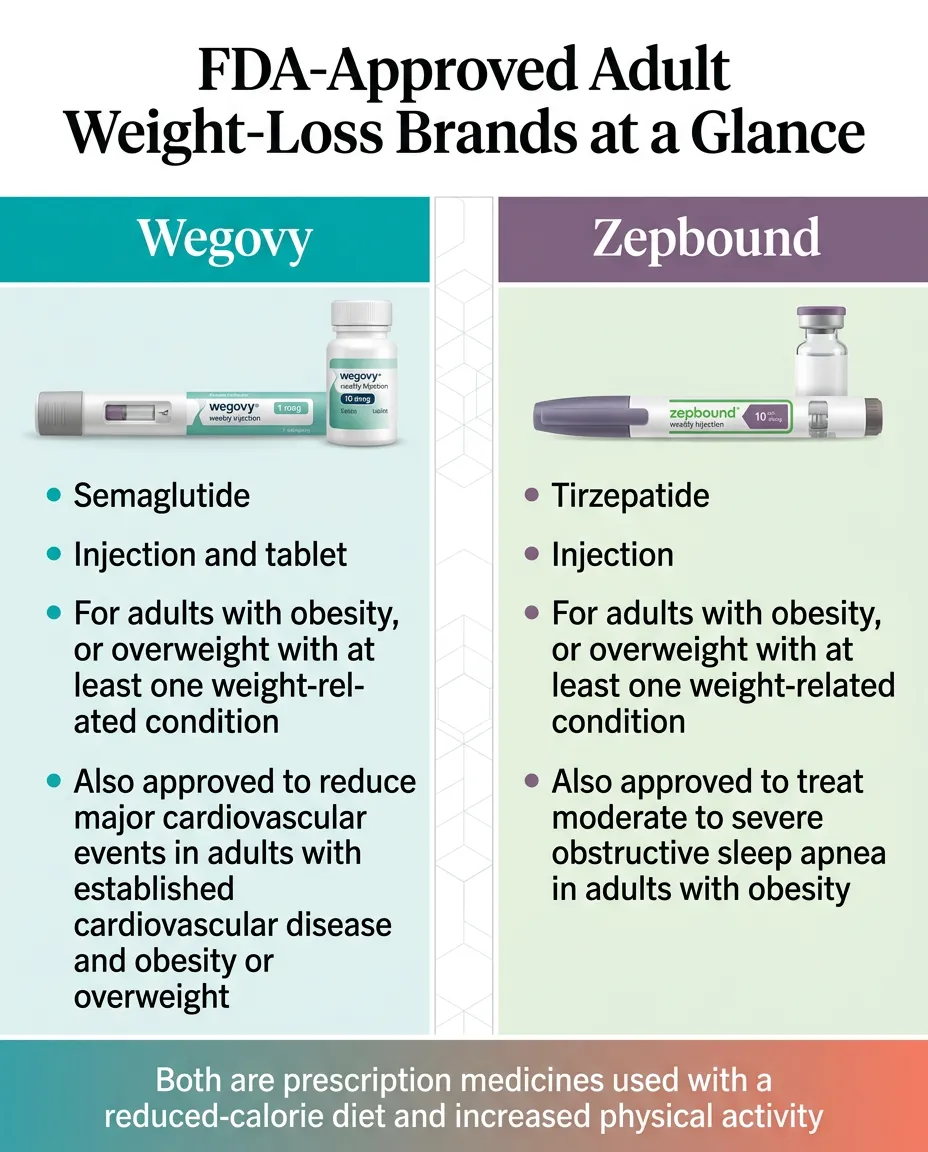
Wegovy (semaglutide — for weight loss)
Wegovy is FDA-approved specifically for chronic weight management. It's the most-studied GLP-1 for weight loss, with the landmark STEP trials showing an average 15% body weight reduction over 68 weeks. Available as both a once-weekly injection and a daily pill (FDA approved oral Wegovy on December 22, 2025; it became available in early January 2026). The starting dose is low (0.25mg injection or 1.5mg pill) and increases gradually over several months.
Best for: Someone whose primary goal is weight loss and who wants the medication with the most weight-management-specific clinical data behind it.
Cost without insurance: Pill from $149/mo. Pen from $199/mo (promo) → $349/mo ongoing.
Ozempic (semaglutide — for Type 2 diabetes)
Ozempic contains the same active ingredient as Wegovy (semaglutide) but is FDA-approved for Type 2 diabetes, not weight loss. Clinicians can and do prescribe it off-label for weight management — this is legal and common, but the approved doses are lower than Wegovy's weight-loss doses.
Best for: Someone who has Type 2 diabetes and also wants weight management benefits. Some providers prescribe Ozempic off-label for weight loss when Wegovy isn't available or affordable.
Cost without insurance: $349/mo for 0.25–1mg doses, $499/mo for 2mg through NovoCare.
Zepbound (tirzepatide — for weight loss)
Zepbound is Eli Lilly's FDA-approved weight loss medication. It's a dual GIP/GLP-1 receptor agonist — meaning it targets two hormones instead of one. The SURMOUNT clinical trials showed average weight loss of 15–22% of body weight, making it among the most effective options currently available. Injectable only, once weekly.
Best for: Someone who wants the highest potential weight loss and is okay with the injectable format. Some providers consider it when semaglutide hasn't produced the desired results.
Cost without insurance: Vials from $299/mo (2.5mg) through LillyDirect or Ro.
Mounjaro (tirzepatide — for Type 2 diabetes)
Same active ingredient as Zepbound, but FDA-approved for Type 2 diabetes. Like the Ozempic/Wegovy relationship, Mounjaro may be prescribed off-label for weight loss.
Best for: Someone with Type 2 diabetes who also wants weight management benefits from the tirzepatide mechanism.
Quick Medication Comparison
| Wegovy | Ozempic | Zepbound | Mounjaro | |
|---|---|---|---|---|
| Active Ingredient | Semaglutide | Semaglutide | Tirzepatide | Tirzepatide |
| FDA-Approved For | Weight loss | Type 2 diabetes | Weight loss | Type 2 diabetes |
| Format | Injection or pill | Injection | Injection (vial) | Injection (pen) |
| Avg. Weight Loss (trials)* | ~15% | ~6% (lower dose) | ~15–22% | ~15–22% (at similar doses) |
| Lowest Cash Price | $149/mo (pill) | $349/mo | $299/mo (vial) | Varies by pharmacy |
*These figures come from different trials with different patient populations and are not head-to-head comparisons. Individual results vary.
Your provider will recommend the right medication based on your health profile, insurance situation, and goals. You don't have to pick — that's their job.
How to Verify a Florida GLP-1 Provider Before You Pay
This section might save you more than anything else on this page. The GLP-1 telehealth space has exploded, and not every provider deserves your trust or your money.
Before you pay any provider — whether it's one we recommend or one you found on your own — run through these checks:
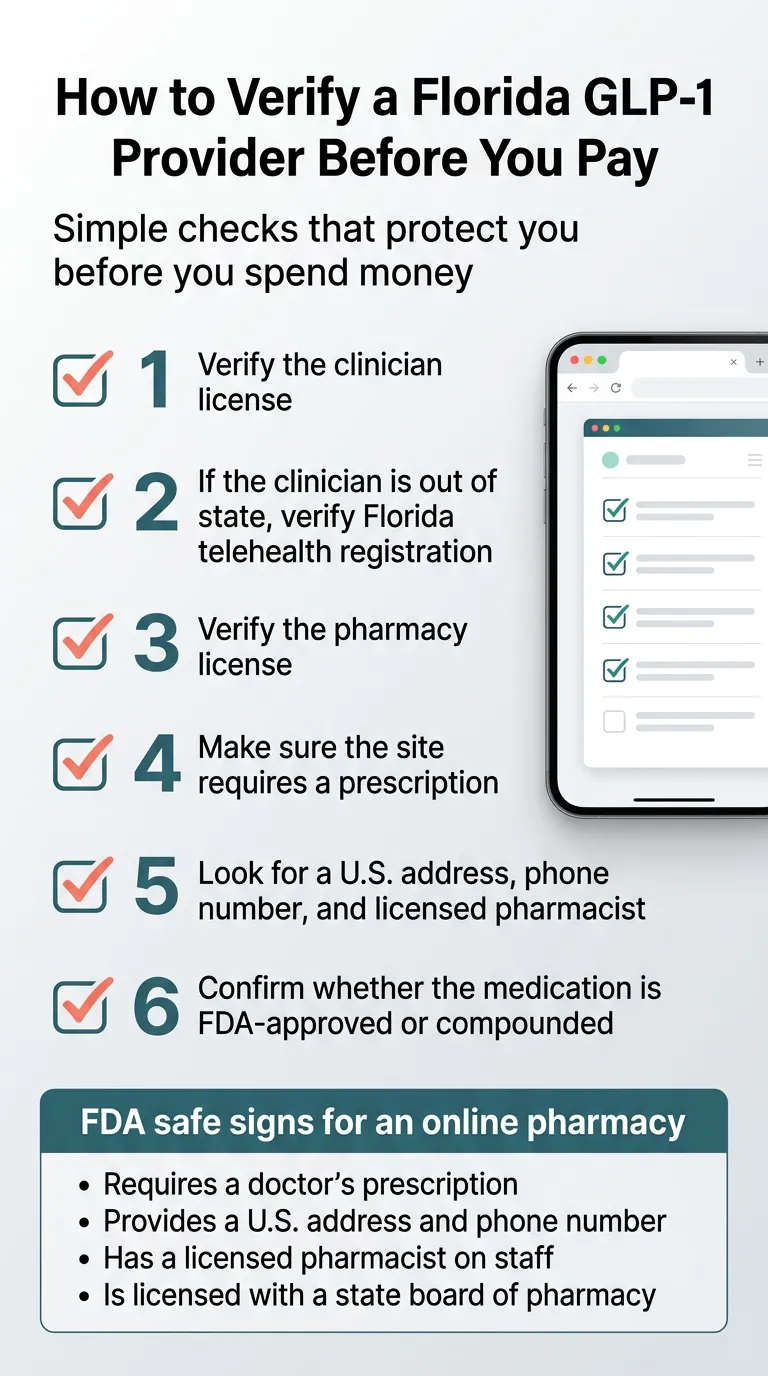
Check 1: Verify the Clinician's License
Search for the prescribing provider at the Florida MQA Healthcare Provider Search (mqa-internet.doh.state.fl.us). Confirm they hold an active Florida medical license or, if they're out of state, confirm they've registered through Florida's telehealth registration program (flhealthsource.gov/telehealth).
Check 2: Verify the Pharmacy
If the provider uses a specific pharmacy, check it against the Florida Board of Pharmacy (floridaspharmacy.gov) and the NABP Safe Site Search (safe.pharmacy). The FDA recommends verifying that online pharmacies require a valid prescription, have a U.S. address, and provide access to a licensed pharmacist.
Check 3: Confirm What You're Getting
Is the medication FDA-approved (brand-name like Wegovy, Zepbound, Ozempic) or compounded? The provider should tell you clearly — on the website, during intake, and on your receipt. If it's hard to tell, that's a red flag.
Check 4: Understand the Real Cost
Get clear answers before you pay: What is the monthly medication cost? Is there a membership fee? What's the cost after the promotional period? Are labs extra? What's the cancellation policy?
Check 5: Confirm Follow-Up Care
Florida requires re-evaluation at least every three months for anti-obesity prescribing. Any legitimate provider will schedule regular check-ins. If a provider writes a prescription and never follows up, that's not just bad medicine — it may not comply with Florida rules.
Ro Body
FDA-approved medications — free eligibility check
What About Side Effects? The Honest Truth.
Let's address this head-on, because it's probably one of the reasons you're still reading instead of already signing up.
The most common side effects are gastrointestinal — nausea, vomiting, diarrhea, constipation, stomach upset, headache, dizziness, and fatigue are among the most commonly reported per FDA prescribing information. Nausea is the most frequent, especially in the first few weeks. That sounds concerning until you understand the context:
It's temporary. Side effects typically peak during the first 2–4 weeks and improve significantly as your body adjusts. This is exactly why every legitimate provider starts you on a low dose and increases gradually.
It's manageable. Simple strategies make a real difference: eat smaller, lower-fat meals. Stay well hydrated. Take your injection at the same time each week. Report persistent symptoms to your provider — a dose adjustment usually resolves them.
Most people continue treatment. While side effects are common early on, the majority of clinical trial participants stayed on medication through the study period. The side effects are real, but for most people they're a temporary speed bump — not a roadblock.
Rare but serious side effects to know about:
Severe abdominal pain could signal pancreatitis. A lump or swelling in your neck could be thyroid-related. Allergic reactions, gallbladder problems, kidney injury, and depression/suicidal thoughts are among the serious warnings in the FDA labeling. These are uncommon, but your provider monitors for them — that's why regular check-ins exist.
Source: Wegovy FDA prescribing information (NDA 215256); Zepbound FDA prescribing information (NDA 217806)
What About Weight Regain?
Here's the part most GLP-1 ads conveniently skip: if you stop the medication without building sustainable lifestyle habits, weight regain is likely. Research consistently shows this. It's not a failure of the drug — it's biology. GLP-1 is most effective as a long-term tool paired with nutritional and exercise changes, not a short-term fix.
But here's what that actually means in practice: patients who stay on treatment and pair it with even modest lifestyle changes see results that weren't possible with diet and exercise alone. Real patients describe the experience not as white-knuckling through hunger, but as finally having the constant mental negotiation with food go quiet.
As one Ro Body member put it: more energy, better physical stamina, and feeling genuinely supported by regular check-ins with a care team. (Note: Ro members were paid for their testimonials.)
That's not a diet trick. That's a medical intervention working as designed. The program is designed to keep you on track, not just ship you a box.
Ro Body
Free eligibility check — 2 minutes
What to Expect During Your First Month on GLP-1
Knowing what's coming makes the first month dramatically easier. Here's the honest week-by-week reality most Florida patients experience.
Week 1: Starting the Lowest Dose
Your provider starts you at the lowest available dose — 0.25mg for semaglutide injection or 2.5mg for tirzepatide. This isn't the "working" dose yet. It's your body getting acquainted with the medication. Many people notice reduced appetite within the first few days. Some notice nothing at all. Both are normal.
Side effects at this dose are typically mild if they happen at all. Light nausea is the most common — usually manageable by eating smaller meals and avoiding greasy food.
Weeks 2–4: Settling In
By the end of the first month, most patients report noticeably reduced appetite and fewer food cravings. You'll likely start eating smaller portions naturally — not because you're white-knuckling through hunger, but because you genuinely feel satisfied sooner. Some patients describe it as the constant "food noise" in their head going quiet for the first time in years.
Weight loss at this point is modest — maybe 2–5 pounds. That's expected. The medication is still at a starter dose, and significant weight loss happens during months 2–6 as the dose increases.
What to Do During Month 1
- Eat protein-rich meals. GLP-1 medications reduce appetite, which means the calories you do eat matter more. Prioritize lean protein, vegetables, and whole grains to prevent muscle loss.
- Hydrate aggressively. Dehydration worsens nausea and constipation. Aim for 64+ ounces of water daily.
- Don't panic about the scale. The first month is about adjusting, not dramatic results. The compound effect happens over months 2–12.
- Communicate with your provider. If nausea persists beyond two weeks, message your care team. Dose adjustments and timing changes often resolve issues quickly.
Months 2–6: Where the Real Results Happen
Your dose increases every 4 weeks (titration schedule) until you reach the maintenance dose. This is when weight loss accelerates. Most patients see their most significant changes between months 2 and 6. Energy levels improve. Bloodwork often improves. Clothing sizes drop.
The clinical trial data shows the trajectory clearly: weight loss is progressive through about month 16, then stabilizes. Patients who stay on medication maintain their results. Patients who stop — without establishing sustainable habits — typically regain weight over the following year.
That's why the best programs aren't just medication delivery services. They're treatment programs that build the habits alongside the medication.
Why Are So Many Florida Residents Turning to GLP-1?
Florida isn't just a big state — it's a state where the need for accessible weight loss treatment is acute.
The Florida Department of Health estimates obesity will cost the state nearly $34 billion annually over the next 20 years (American Diabetes Association, Florida obesity brief, 2025). Florida's self-reported adult obesity prevalence is 29.6% as of the 2024 BRFSS data (America's Health Rankings) — but a 2018 University of Florida study using clinical records from the OneFlorida Data Trust found the actual measured rate was closer to 37.1% when based on objective height and weight data rather than self-reported surveys. People tend to under-report their weight on phone surveys. The clinical reality is likely higher than the headline number.
Florida's large 65+ population — more than 20% of residents — drives demand, but Medicare's limited GLP-1 coverage leaves many seniors paying out of pocket. Florida's diverse communities (27% Hispanic/Latino population) also create demand for multilingual telehealth access, which the major national platforms increasingly support.
At the same time, Florida's telehealth laws are among the most permissive in the country for GLP-1 prescribing. No in-person visit required. No controlled substance barriers. Clear registration pathways for out-of-state providers. This combination — high need plus accessible legal framework — is why Florida has become one of the most active markets for GLP-1 telehealth.
How We Evaluated Florida GLP-1 Options
We research every provider on this page using seven criteria. We think you should know what they are, because it lets you evaluate any provider we don't cover.
- Medication legitimacy. Is it FDA-approved, prescribed off-label, or compounded? We separate these clearly because they are not the same.
- Florida legal compliance. Is the provider licensed or registered for Florida telehealth? Do they follow Florida's anti-obesity prescribing rules?
- True cost transparency. We calculate total monthly cost — membership, medication, labs, shipping — not just the promotional headline.
- Insurance support. Does the provider help navigate insurance coverage, prior authorization, and appeals?
- Clinical oversight quality. How often do you hear from a provider? Is follow-up built in or optional?
- Pharmacy verification. Can we verify the dispensing pharmacy through the Florida Board of Pharmacy and NABP?
- Cancel flexibility. Can you stop month-to-month, or are you locked in?
We verify pricing monthly and date-stamp every data point. When a provider changes their pricing or policies, we update within a week.
Affiliate disclosure: We earn commissions from some providers linked on this page. This does not influence our rankings, recommendations, or the inclusion of non-affiliate benchmarks (like Walgreens and local doctors). If we stripped every affiliate link from this page, the advice wouldn't change.
Your Next Step
You've done the research. You understand the options, the costs, the Florida rules, and the tradeoffs. The only question left is whether you medically qualify — and the only way to find out is to take the first step.
Insurance help + FDA-approved meds
Start with Ro BodySpeed + great app experience
Start with HimsStart with HersBudget is top priority
Check MEDVi EligibilityNot sure which path fits?
Take our free 60-second matching quizEach provider above has its own intake process. Some start with a free eligibility screener; others charge a visit fee upfront (Walgreens charges $49 per visit, for example). Review the pricing before you start — we've laid it all out above so there are no surprises.
Florida makes this as easy as any state in the country. The telehealth laws are clear. The providers are licensed. The medications are backed by some of the most robust clinical evidence in modern medicine. The hardest part was the decision to look into it — and you've already done that.
You deserve to know what it feels like to have energy again. To stop negotiating with hunger every hour. To get bloodwork that makes your doctor smile. That's what the clinical evidence supports, and it starts with choosing the path that fits your situation.
Tools Coming Soon for Florida GLP-1 Patients
We don't just write about this — we're building interactive tools to make the decision even easier. Here's what's in development:
- Florida GLP-1 Path Finder Quiz (coming soon) — Answer 5 questions about your insurance, budget, medication preference, and timeline. Get matched to the right provider in 60 seconds. No email required.
- Real Monthly Cost Calculator (coming soon) — Input your provider, medication, and dose. See the true monthly cost including membership fees, medication, labs, and shipping — plus the projected 6-month total.
- Florida Provider Legitimacy Checker (coming soon) — Paste a provider's website URL and we walk you through verifying their Florida license, telehealth registration, pharmacy accreditation, and medication transparency.
Bookmark this page — we'll update it as each tool goes live.
Florida GLP-1: Frequently Asked Questions
Medical Disclaimer: This content is for informational purposes only and does not constitute medical advice. GLP-1 medications are prescription-only and require evaluation by a licensed healthcare provider. Individual results vary. Side effects and contraindications may apply — consult your provider before starting treatment.
Sources: FDA Prescribing Information — Wegovy (NDA 215256), Zepbound (NDA 217806), Wegovy tablets (NDA 218316); Florida Statute §456.47; Florida Administrative Code 64B8-9.012; FDA GLP-1 compounding guidance (2025); Wilding JPH et al., NEJM 2021 (STEP 1); Jastreboff AM et al., NEJM 2022 (SURMOUNT-1); Cochrane Reviews (2025); Hims & Hers/Novo Nordisk partnership (SEC filing, March 2026); Ro pricing (ro.co, verified March 2026); Walgreens Weight Management (walgreens.com, verified March 2026); NovoCare savings offers; Zepbound savings (lilly.com); CMS Medicare GLP-1 Bridge FAQ; CMS BALANCE Model; America's Health Rankings — Florida BRFSS 2024; American Diabetes Association — Florida obesity brief (2025); Florida DOH MQA Portal; Florida Telehealth Registration.