6 Best Zepbound Providers That Send Prescriptions to CVS in 2026
The short answer
The best Zepbound providers that send prescriptions to CVS are CVS MinuteClinic ($29, no membership), Ro ($39 first month), and Sesame ($99 every 28 days) — but which one is right for you depends entirely on how you're paying. Paying cash? MinuteClinic has the lowest published one-time telehealth fee among the paid online routes we verified, and the Zepbound form to ask for at CVS is the KwikPen. Using commercial insurance? Ro's team checks coverage and files prior authorization paperwork when your plan requires it. Want to pick your own doctor and look for a same-day visit? Sesame.
Here's the part almost nobody tells you, and it's the reason people waste two weeks and a membership fee:
CVS can fill two of the three Zepbound forms most patients will see. It cannot fill the third.
The single-dose vial is available exclusively through LillyDirect self-pay. Lilly currently offers free home delivery or retail pickup at Walmart Pharmacy. Not CVS under the current LillyDirect terms, verified August 19, 2026.
The KwikPen is different. Lilly made it available at major pharmacies nationwide in March 2026, and CVS can fill it when the prescription, stock, and savings-card rules line up. The single-dose autoinjector pen can also go to CVS, most often through insurance.
So if an online provider sends a vial prescription to CVS, CVS cannot fill that product. You wait. You call. You get frustrated. And you still don't have your medicine.
We'll show you exactly which form to ask for, which of six routes fits your situation, and what the number at the register may be before you pay anyone.
What are the best Zepbound providers that send prescriptions to CVS?
A clinician who is licensed and authorized to treat you in your state can send a valid Zepbound prescription to your chosen CVS Pharmacy. The real question isn't who can send it — it's who helps you get it filled once it lands there. These six routes differ on cost, which form of Zepbound they can route to CVS, and whether anyone will fight your insurance company for you.
The CVS Zepbound Route Map
We built this table from official provider pages, CVS Health releases, Lilly's current savings terms, and CMS Medicare guidance on August 19, 2026. You would need about a dozen browser tabs to assemble it yourself.
| # | Route | Care cost | CVS-ready Zepbound form | Insurance help | Best for | The catch |
|---|---|---|---|---|---|---|
| 1 | CVS MinuteClinic | $29 per weight-loss visit; no membership | KwikPen or single-dose pen, if prescribed | Not spelled out publicly | Self-paying adults ages 18–64 who want the lowest published paid telehealth visit fee | Labs are separate. Prescribing varies by state. Stock is not guaranteed. |
| 2 | Ro | $39 first month, then $149/month, or about $74/month prepaid yearly | Insurance route sends the single-dose pen to your preferred pharmacy. Ro's cash flow usually promotes direct shipping; it also says cash prescriptions can be sent to a preferred pharmacy. | Yes — dedicated insurance concierge, prior authorization, and appeals | Commercially insured patients who expect paperwork | Medicine is separate. CVS cash pickup is not the clearest Ro route, so confirm it before paying. |
| 3 | Sesame | $99 every 28 days; as low as $59/month on the annual plan | An insured single-dose pen can go to a preferred pharmacy. Sesame's published discounted cash vial and KwikPen route goes through LillyDirect, not CVS. | Your selected provider helps; no separate central concierge is advertised | People who want to choose their clinician and use insurance at CVS | Cash pickup at CVS is not Sesame's published discounted route. Every 28 days means 13 charges a year, not 12. |
| 4 | PlushCare | $129 self-pay first visit or insurance copay; $19.99/month membership after a 30-day free trial | Local pharmacy, if prescribed | Care team says it handles prior authorization | People who want an ongoing primary-care-style relationship | Medication and labs are separate. The membership starts charging after the trial unless canceled. |
| 5 | Form Health | Insurance copay or deductible, or $299/month self-pay | Preferred local or online pharmacy | Yes — paperwork and prior authorization support | People who want an obesity-medicine clinician and registered dietitian | Requires an established primary care doctor and a PCP visit within the past 12 months. Medication and labs are separate. |
| 6 | Your own doctor | No new program fee; normal visit cost or copay may apply | KwikPen or single-dose pen | Depends on the office | Anyone who already has a clinician willing to manage this | Getting an appointment may take longer. |
A note on that last row. We put "your own doctor" on a page that earns affiliate commissions because for a lot of you, it is the correct answer, and pretending otherwise would make everything else here worth less.
Which Zepbound forms can CVS actually fill?
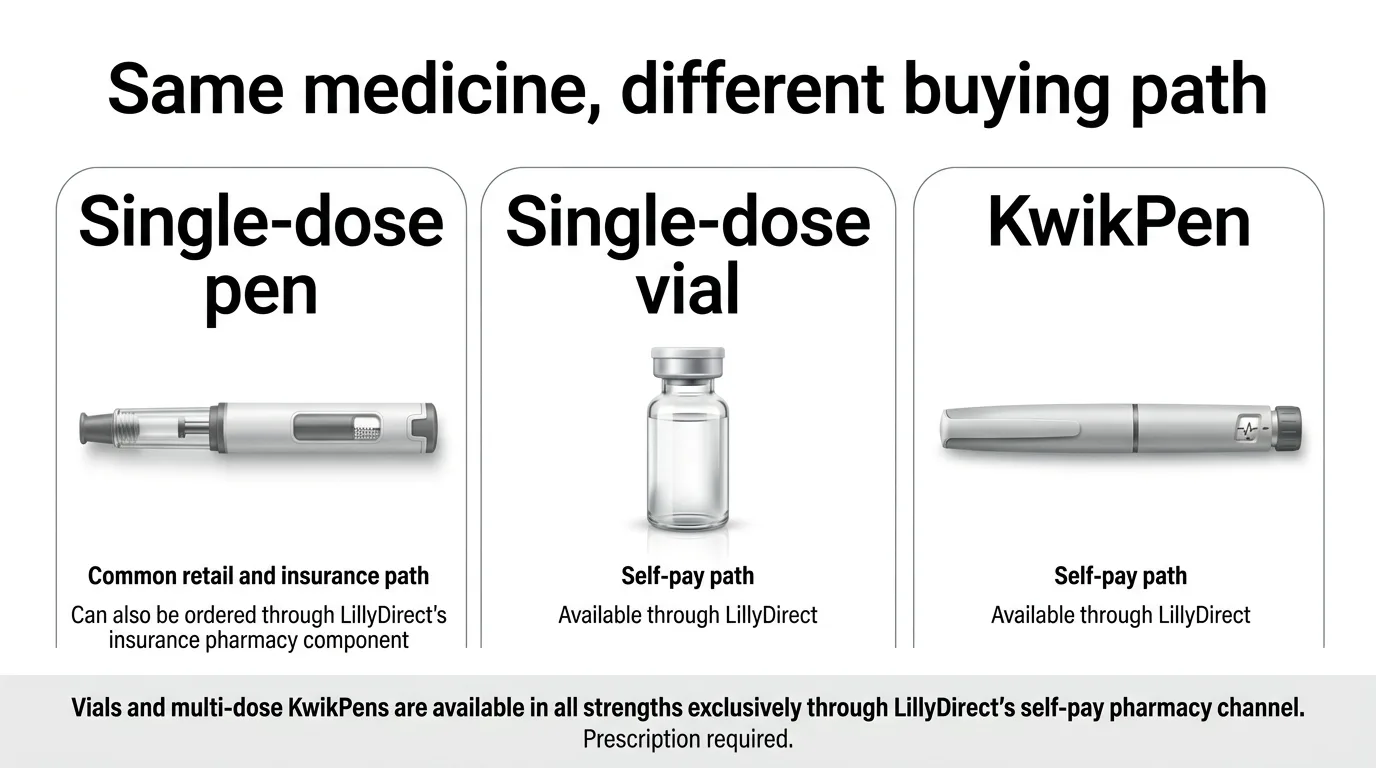
For current U.S. access, Lilly lists three Zepbound forms most patients will run into: a single-dose vial, a single-dose autoinjector pen, and a single-patient-use KwikPen. CVS can fill the single-dose pen and the KwikPen. It cannot fill the single-dose vial, because Lilly makes that vial available exclusively through LillyDirect self-pay. Asking for the wrong form is one avoidable reason a Zepbound prescription stalls at a CVS counter.
This one section will save more people more time than anything else on this page. Read it slowly.
The three forms, and where each one goes
Single-dose pen — the usual commercial-insurance route. Four separate pens, one per week. The needle is built in. This is the long-standing retail product, and CVS can fill it when the store has stock. With commercial insurance that covers Zepbound and current savings-card eligibility, the price can be as low as $25. The current list price is about $1,086 for a one-month supply.
KwikPen — the retail self-pay route and the Medicare Bridge form. One device holds four weekly doses. You use a new pen needle for each injection, and the needles may be a separate purchase. Lilly announced nationwide self-pay access through major pharmacies in March 2026. CVS can fill this form. Current Lilly self-pay pricing starts at $299 for 2.5 mg, subject to eligibility, terms, taxes, fees, and stock.
Single-dose vial — the one that cannot come to CVS. A one-month prescription contains four vials. You draw each weekly dose with a new syringe and needle. LillyDirect states that the vial is available exclusively through its self-pay pharmacy channel, with free home delivery or free retail pickup at Walmart Pharmacy.
That's the whole routing rule. Home delivery or Walmart for the vial. CVS is not a current vial option.
The finding that surprised us
Everyone assumes the vial is the cheap one. Under Lilly's current published self-pay pricing, it is not cheaper than the KwikPen.
| Dose | KwikPen — CVS can fill | Single-dose vial — CVS cannot fill | Price difference |
|---|---|---|---|
| 2.5 mg | $299 | $299 | $0 |
| 5 mg | $399 | $399 | $0 |
| 7.5 mg | $449* | $449* | $0 |
| 10 mg | $449* | $449* | $0 |
| 12.5 mg | $449* | $449* | $0 |
| 15 mg | $449* | $449* | $0 |
*For 7.5 mg through 15 mg, both forms use Lilly's current $449 first-fill and on-time-refill offer. To keep it, the next purchase must be completed within 45 days of the prior delivery or received date. Current regular prices for either form are $499 at 7.5 mg and $699 at 10 mg, 12.5 mg, and 15 mg. Terms, eligibility, taxes, and fees can apply.
So the form no longer changes Lilly's published self-pay price. It changes where you can get the prescription filled.
Read that again if you've been chasing the vial because you thought it was cheaper.
For either form, the regular price after you miss the 45-day offer window is $499 at 7.5 mg and $699 at 10 mg, 12.5 mg, and 15 mg. That refill clock does not change the $299 price at 2.5 mg or the $399 price at 5 mg. At CVS, the form in that rule is the KwikPen because CVS cannot fill the vial.
What this means for you in one sentence: if you're paying cash and you want pickup at CVS, ask whether the clinician can prescribe the KwikPen, enroll in the current KwikPen Self-Pay Savings Card before pickup, and set a reminder from the delivery or received date shown for any 7.5 mg-or-higher fill.
Say it this way
When you talk to whichever provider you choose, don't stop at "send Zepbound to my CVS." Say this:
"I'd like to ask about the Zepbound KwikPen, sent to the CVS at [full street address]. I plan to self-pay with the KwikPen Self-Pay Savings Card if I'm eligible."
Or, if you're using commercial insurance:
"I'd like to ask about the Zepbound single-dose pen, sent to the CVS at [full street address]. Please run my insurance and file the prior authorization if my plan needs one."
Those extra words can save you two weeks. The clinician still decides the form, dose, and whether Zepbound is appropriate.
Which CVS route fits your situation?
Pick your route based on the barrier most likely to stop you, not the lowest advertised price. If you're paying cash, you need a low-cost visit that can write a KwikPen prescription to your CVS. If you want insurance to pay, you need someone who will file prior authorization paperwork — a review your insurer may require before it covers the drug. Those are two different services, and paying for the wrong one costs you both money and weeks.
Choose CVS MinuteClinic if:
- You're paying cash for the clinical visit
- You're 18–64
- You want the lowest published paid telehealth visit fee on this page
- You want the KwikPen sent to CVS, if the clinician agrees it is right for you
- You're comfortable confirming state availability in the booking flow first
Choose Ro if:
- You have commercial insurance that might cover Zepbound
- You expect a prior authorization
- You've already been denied and may need an appeal
- You want an approved single-dose pen sent to your preferred CVS
Choose Sesame if:
- You want to read provider profiles and pick a specific clinician
- You want to look for an appointment today rather than wait weeks
- You have insurance and want a prescribed single-dose pen sent to your preferred CVS
- You're comfortable using LillyDirect instead of CVS if you choose Sesame's published discounted cash vial or KwikPen route
- You understand that $99 every 28 days creates 13 billing cycles in a 364-day year
Choose PlushCare if:
- You want an ongoing primary-care relationship, not a single transaction
- Your insurance is accepted for the visit itself
- You understand the $19.99 membership begins after the 30-day free trial
Choose Form Health if:
- You want an obesity-medicine clinician and a registered dietitian
- You have eligible private insurance or Medicare for the care program
- You already have a primary care doctor and had a PCP visit in the past 12 months
- You want long-term management, not just a prescription
Use your own doctor if:
- You already have one who will evaluate you
- You can wait for an appointment
- You want to avoid a new program fee
Find your GLP-1 path in 60 seconds
Answer five quick questions about your goals, budget, and preferences. The free matcher will show the access route and provider that fit your answers, with one clear next step.
Find my GLP-1 path → Free. No email required.
Does one of those situations sound like yours? Pick your route below and we'll go deep on each one.
Can CVS MinuteClinic prescribe Zepbound?
CVS MinuteClinic offers a $29 online weight-loss visit, available 24 hours a day with no membership or recurring fee, where a licensed clinician can evaluate you and prescribe an FDA-approved GLP-1 when clinically appropriate. CVS Health lowered the price to $29 in an August 5, 2026 announcement. The program is designed for self-paying adults ages 18–64 and is available in nearly all states, subject to state rules. It is the lowest published one-time telehealth fee among the paid online routes we verified for getting a Zepbound prescription routed to a CVS counter.
What $29 buys you
CVS revamped this whole program two weeks ago. Here's what the August 5 announcement actually said:
- MinuteClinic online weight-loss visits dropped to $29, available 24/7
- No membership. No recurring monthly fee. That's unusual in this market — Ro, Sesame, PlushCare, Form Health, and WeightWatchers all charge ongoing program fees
- CVS Pharmacy says it offers access to all FDA-approved GLP-1s, both injectable and oral; store stock still varies
- The visit connects you to a licensed clinician who can evaluate you and prescribe an FDA-approved GLP-1 where appropriate
- CVS ties the visit to pickup that can be as early as the same day at one of about 9,000 CVS Pharmacy locations, when the exact product is available
- In-person pharmacist support after pickup
CVS also announced a collaboration with Eli Lilly. By early fourth quarter of 2026, eligible Zepbound and Foundayo patients are expected to see transparent pricing — including cash-pay options — inside the CVS Health app, with pickup that may be available as early as the same day.
That last part matters more than it sounds. Today, your final price still depends on your product, insurance, deductible, and savings-program eligibility. The app is supposed to show more of that before you go to the counter.
What $29 does not buy you
Being straight with you about the gaps:
It is built for self-paying adults ages 18–64. CVS describes the program that way. That makes it a poor fit for someone trying to use Medicare for the clinical visit or someone outside that age range.
Labs aren't included. If your clinician wants bloodwork, that's a separate cost.
Not every prescribing service is available in every state. CVS says state rules apply and GLP-1 prescribing may not be available everywhere. Confirm your state in the booking flow before you pay.
No compounded medications. MinuteClinic says it will not prescribe compounded GLP-1s. For a Zepbound page, that's a feature — you're here for the FDA-approved brand.
Stock is not guaranteed. A prescription isn't inventory. More on that below.
Insurance help is unclear. CVS's public pages do not spell out how far MinuteClinic goes with prior authorization or an appeal after denial. Ro publishes a dedicated process. If you know you're heading into an insurance fight, that gap matters — and we'd send you to Ro instead.
Watch the price you click
During CVS's current June 5 through September 7, 2026 promotion, a general MinuteClinic Virtual Care visit is advertised at $89 cash. The $29 price lives inside the weight-loss booking flow specifically.
Same MinuteClinic platform. Three times the cash price if you enter through the wrong door. Start at the weight-management page, not the general virtual-care page.
If you're a self-paying adult ages 18–64 and just need a clinician to evaluate you, this is the lowest published paid telehealth visit fee on this page — and it's inside the pharmacy system you're already trying to use.
Check MinuteClinic's $29 weight-loss visit in your state →
We earn nothing from this link. It's just the lowest published paid telehealth visit fee.
Can Ro send a Zepbound prescription to CVS?
Yes. Ro's insurance workflow sends an approved Zepbound single-dose pen prescription to your preferred pharmacy, including CVS. Ro's real value is the insurance concierge that checks benefits, files prior authorization paperwork, and can handle an appeal. For an eligible patient whose commercial plan covers Zepbound, insurance plus the current Lilly savings card can move a one-month pen prescription from a list price of about $1,086 to as low as $25. Membership is $39 for the first month, then $149/month, or $888 paid upfront for a year — about $74/month. Medication is separate.
First, the thing that disqualifies Ro for some of you
We're putting this before the good part on purpose.
Ro does not make CVS cash pickup its clearest Zepbound route. Ro's Zepbound page says cash-pay medication ships to your door, while its broader insurance page says cash prescriptions can also be sent to a preferred pharmacy. Those two statements leave one practical question unanswered: will your discounted KwikPen prescription go to your CVS at the current manufacturer price?
If walking into CVS with the KwikPen self-pay card is the whole reason you're here, confirm the pharmacy destination and price before you pay Ro. MinuteClinic's $29 visit or your own doctor is the cleaner route. If you want a different counter, confirm that chain's current KwikPen routing before you pay.
Now here's why that is not a flaw for the person Ro is actually built for.
Ro built an insurance pipeline. At a CVS counter, commercial coverage and savings-card eligibility can be the difference between about $1,086 and as low as $25. The benefit check, prior authorization, missing document, denial, and appeal are the work you're paying Ro to handle.
Cash and insurance are two different games. Ro is clearest and strongest on the insurance one.
How the Ro-to-CVS path works
- Fill out the online intake. No in-person visit.
- A licensed provider reviews your history. Ro says you'll find out whether you're eligible within 2 days.
- Ro checks your insurance and files the prior authorization if your plan needs one.
- You choose your preferred CVS.
- Once coverage is approved, the prescription goes to that store.
- CVS runs the claim and checks stock.
- You get a pickup notification when the exact form and dose are ready.
Ro says an insurer's prior-authorization review usually takes 1–2 weeks, while its full insurance path may take about 2–3 weeks. Cash-pay treatment may arrive in under a week, but Ro's current Zepbound page describes that as home shipment.
What Ro costs, honestly
Ro charges for the program, and the medicine is another bill. This trips up almost everyone.
| Charge | What it is | Price |
|---|---|---|
| Ro Body membership, month 1 | The program | $39 |
| Ro Body membership, ongoing | The program | $149/month |
| Annual prepay | The program | $888 upfront — about $74/month |
| Zepbound | The medicine | Separate. Copay if covered, or the cash route available to you |
The "$39" in the ads is the program, never the drug. Add both numbers together before you compare Ro with anything else.
One thing we like: Ro says it charges the membership fee only if you're eligible for treatment.
Who Ro's insurance concierge cannot cover
- Medicare, Medicare Advantage, Medigap, and TRICARE — Ro says its concierge does not coordinate those plans
- Medicaid and some other government plans — not eligible for the Ro Body program
- Anyone who just wants the cheapest clinical visit — you're paying for coverage work you may not use
That does not mean every Medicare or TRICARE user is banned from every Ro cash option. It means Ro's insurance concierge is not the route for those benefits. If you're on Medicare and want the $50 Bridge price, skip to the Medicare section below.
What a Ro member said
"I was thrilled to not have to fight for my coverage." — Hannah, Ro member, published on ro.co
Disclosure, because it matters: Ro's own website states that Ro members were paid for their testimonials. We're including this quote because it describes the specific service we're recommending Ro for — insurance help — but a paid testimonial is marketing, not evidence. It doesn't tell you that coverage is typical, and it isn't a claim about medical results.
Does this sound like you — you've got commercial insurance and you have no idea whether it covers Zepbound? Ro's coverage check runs before you commit to the medicine route.
Check your Zepbound coverage free →
Checking coverage doesn't guarantee a prescription, approval, price, or stock at your store.
Can Sesame send a Zepbound prescription to CVS?
Yes, when the prescription uses a CVS-fillable form and route. Sesame says an eligible prescription can go to a preferred local pharmacy, including CVS. But Sesame's current Zepbound page sends its discounted self-pay vials and KwikPens to LillyDirect. That means its insured single-dose pen route can fit CVS; its published discounted cash route does not. Sesame's distinguishing feature is provider choice — you browse clinician profiles, read patient reviews, and pick the person you want. The Success by Sesame program starts at $99 per 28-day billing cycle, with medication billed separately.
What Sesame does better than anyone
You choose your doctor. By name. After reading reviews.
Sesame puts that choice front and center. Many large GLP-1 platforms assign the next available clinician. If you've had a bad experience being processed like a ticket number, this is worth real money.
Same-day appointment slots may be available. And Sesame's brand-name menu is broad — Zepbound, Wegovy, Ozempic, Mounjaro, Saxenda, Rybelsus, and other prescription options. Sesame says it does not offer compounded GLP-1s through this program.
The billing detail nobody mentions
Sesame bills every 28 days, not every calendar month.
That's 13 charges in 364 days, not 12.
At $99, that's $1,287 over 13 cycles, not the $1,188 you'd get by multiplying $99 by 12. An extra $99 in the same 364-day span.
It's not a scam — it's disclosed. But the difference is easy to miss, and most comparison pages never do the annual math. Now you know before you sign up.
The annual plan is advertised at $59/month, paid as $708 upfront. Sesame also lists a 6-month plan at $69/month and a 3-month plan at $79/month. Read the cancellation and renewal terms that apply when you enroll.
The CVS limitation
Sesame's published discounted cash-pay vial and KwikPen route goes through LillyDirect. That is not a standard CVS fill.
Sesame's insurance/local-pharmacy path can send a prescribed single-dose pen to your preferred pharmacy, including CVS. Stock and plan rules still apply.
So: Sesame + insured single-dose pen = CVS can work. Sesame + advertised cash vial or KwikPen = LillyDirect, not CVS.
One more honest note: Sesame says your selected provider helps with prior authorization. It does not advertise a separate centralized insurance concierge like Ro does. That's fine for many approvals. If you're heading into a long appeal, Ro publishes the clearer dedicated workflow.
What a Sesame patient said
"Easy to navigate and fast to get appointments and prescriptions." — Eric, New York, published on sesamecare.com
This describes the booking experience. It isn't a statement about Zepbound being prescribed, covered, or filled at CVS.
If you want to choose the person you're talking to instead of being assigned one — and you want to look for the earliest visit — this is your route.
Are PlushCare, Form Health, or WeightWatchers better for some people?
Yes, for specific situations. PlushCare fits someone who wants an ongoing primary-care-style relationship and can use insurance for the visit itself. Form Health fits someone who wants an obesity-medicine clinician and a registered dietitian, and its care program accepts Medicare. WeightWatchers Clinic fits someone who wants coaching alongside medication. All three cost more, require more setup, or ask for a longer commitment than the simplest CVS route.
PlushCare
PlushCare says it can send prescriptions to a local pharmacy, and its care team handles prior authorization when needed.
Cost: either your insurance copay or a $129 self-pay initial visit. The $19.99 monthly membership has a 30-day free trial and begins charging after the trial unless you cancel. Medication and labs are separate.
The honest bit: $19.99 is not your first-month self-pay visit cost. The first visit is $129. That is more than four times MinuteClinic's $29 before the medicine, and later visits can create more care charges.
Worth it when: you want a clinician you can go back to for other primary-care needs, not just this prescription.
Form Health
Form Health names Zepbound directly, sends prescriptions to a preferred local or online pharmacy, and does not ship the medicine itself. That makes a standard CVS fill possible when the prescribed product, coverage, and stock line up.
Cost: your copay or deductible if you're in network; $299/month self-pay. Labs and medication can be separate. That is $3,588 a year before either one.
What makes it different: an obesity-medicine clinician and a registered dietitian, not a prescription vending machine. The program accepts Medicare and major private insurance, but that does not guarantee your plan covers the medication.
The setup rule: Form says you must have a primary care doctor and must have seen that PCP within the past 12 months. It also needs your medical records.
The honest bit: $299/month is more than ten times a single MinuteClinic visit if all you need is one evaluation. You're buying a care team.
"It's so convenient to set up appts and get questions/concerns answered!" — Mary D., published on formhealth.co
A comment about care access. Not a claim about weight-loss results.
WeightWatchers Clinic
Cost: $25 the first month, then $74/month on the 12-month plan or $84/month on the 6-month plan. Medication is separate. The plan auto-renews for another term unless canceled under its terms.
The honest bit: that low first month comes attached to a six- or twelve-month commitment that auto-renews. WeightWatchers says its cash-pay single-dose vials and KwikPens are dispensed and purchased through LillyDirect, so those cash routes are not standard CVS pickup. Its live FAQ also lists older missed-window KwikPen prices that do not match Lilly's current terms. We use Lilly's current terms for every Zepbound price on this page. Confirm the exact form, destination, and total cost before you click.
Worth it when: the coaching and behavior side is the part you actually need, and CVS pickup is a preference rather than the whole point.
Is your own doctor the better option?
For a lot of people, yes. If you already have a primary care doctor or specialist who will evaluate you, handle the prior authorization, and send the prescription to your CVS, that route adds no separate telehealth program fee — versus $29 to $299 for the options on this page. Your normal visit cost or copay can still apply. The main tradeoff is time: getting an appointment may take longer than an online visit.
Call your doctor's office and ask three questions:
- "Will Dr. [Name] evaluate me for a GLP-1 for weight management?"
- "Does the office file prior authorizations and appeals for GLP-1 medications?"
- "How soon can I be seen?"
If the answers are yes, yes, and something under three weeks — stop reading this page and go book that. You'll likely save the program fee, and you'll have a clinician who already knows your history.
If the answer to #1 is no, or #3 is "November," come back. That's exactly what the six routes above are for.
We're an affiliate site telling you to try the route that may pay us nothing first. We'd rather you trust the rest of this page.
How much does Zepbound cost at CVS in 2026?
There is no single Zepbound price at CVS. What you pay depends on which form you're prescribed, whether your plan covers it, which savings program you qualify for, and whether CVS has the exact product. Current published self-pay pricing for the KwikPen starts at $299 for the 2.5 mg dose. With commercial insurance that covers the single-dose pen and current savings-card eligibility, the price can be as low as $25. The single-dose pen list price is about $1,086 for a one-month supply.
Your total is always two numbers
Care + medication = what you actually pay. Every paid provider on this page bills care separately from the medicine. Comparing one company's care fee with another company's drug price is how people end up shocked.
| Route | Care cost, first 28–30 days | Medication |
|---|---|---|
| CVS MinuteClinic | $29 per visit | Separate |
| Ro | $39 membership | Separate |
| Sesame | $99 per 28-day cycle | Separate |
| PlushCare, self-pay | $129 initial visit; membership begins after 30-day free trial | Separate |
| Form Health, self-pay | $299/month | Separate |
| Your own doctor | No new program fee; normal visit cost or copay may apply | Separate |
The medication side: every price we could verify
Cash pay — KwikPen Self-Pay Savings Card, the current CVS cash route:
| Dose | Price with current offer | Regular KwikPen price if the 45-day offer is lost |
|---|---|---|
| 2.5 mg | $299 | $299 |
| 5 mg | $399 | $399 |
| 7.5 mg | $449 | $499 |
| 10 mg | $449 | $699 |
| 12.5 mg | $449 | $699 |
| 15 mg | $449 | $699 |
The 45-day rule applies to keeping the $449 KwikPen offer after the first 7.5 mg, 10 mg, 12.5 mg, or 15 mg fill. Lilly says a one-month KwikPen supply is 28 days.
Read that right column again. At 10 mg, losing the $449 offer makes the published regular price $250 higher for one fill. That's the most expensive calendar reminder you'll ever set.
Two more rules on the current KwikPen self-pay card: it allows a maximum of 11 fills per calendar year, and it expires December 31, 2026. Lilly can change or end the program under its terms.
Commercial insurance — single-dose pen:
| Your situation | Current published possibility |
|---|---|
| Plan covers Zepbound + eligible savings card | As low as $25; current savings cap is $100 per month and $1,300 per calendar year |
| Commercial plan does not cover Zepbound + eligible card | As low as $499 for the single-dose pen, subject to current terms |
| No insurance, no card, single-dose pen | About $1,086.37 list price for a one-month supply |
The commercial card excludes people enrolled in government-funded coverage such as Medicare, Medicaid, VA, and TRICARE. Read the current Zepbound savings terms before budgeting around any number. Our separate Zepbound savings card guide walks through the two cards without mixing them up.
Medicare GLP-1 Bridge: $50 for eligible Part D beneficiaries using the KwikPen for weight management. It is a separate CMS route, not the commercial savings card. See the Medicare section below.
What about the vial?
Under current Lilly self-pay pricing, the single-dose vial is also $299 for 2.5 mg, $399 for 5 mg, and $449 for 7.5 mg through 15 mg under the applicable offer. But CVS cannot fill it. LillyDirect is the exclusive vial channel, with home delivery or Walmart pickup.
So the vial is no longer the cheaper answer. If CVS pickup matters, the KwikPen is the matching current self-pay form. Our KwikPen guide covers that device and route in more detail.
A CVS ad you should not trust for Zepbound
CVS's weight-loss pages advertise select GLP-1 medications from $149 without insurance when a patient uses a qualifying manufacturer offer. The footnote limits that price to select medicines, doses, eligibility rules, and participating pharmacies.
Zepbound is not the $149 medicine. Its current published self-pay starting price is $299.
The $149 headline can refer to qualifying doses of oral Wegovy, which contains semaglutide, not tirzepatide. It is a different FDA-approved drug from a different manufacturer.
And here's the date detail that matters: under Novo Nordisk's current terms, oral Wegovy 1.5 mg remains $149. The temporary $149 price for the 4 mg tablet requires the offer to be used by August 31, 2026; after that, the published 4 mg price is $199. Higher oral doses have different prices.
We're not calling CVS dishonest. The footnote is right there. But we've watched enough people read a hero price and budget around it. If you're planning for Zepbound at CVS, use $299 as the current published KwikPen self-pay floor, then add your care fee, possible pen needles, taxes, fees, and any card restrictions.
What did CVS just change about GLP-1 access?
On August 5, 2026, CVS Health announced a revamp of its direct-to-consumer weight-management program. The three changes that matter for Zepbound: MinuteClinic online weight-loss visits dropped to $29 with no membership, CVS Pharmacy says it offers access to all FDA-approved GLP-1s through insurance or cash-pay options, and a new collaboration with Eli Lilly is expected to put transparent Zepbound pricing inside the CVS Health app by early fourth quarter of 2026.
This announcement is fourteen days old. Most older pages about this search were written before it. Here's what's in it.
Now live:
- $29 MinuteClinic online weight-loss visits, 24/7, no membership or recurring fee
- Program designed for self-paying adults ages 18–64, subject to state rules
- Access to FDA-approved injectable and oral GLP-1 options; exact store stock still varies
- Oral and injectable Wegovy already available through CVS Pharmacy
- Pharmacist support in store after pickup
- CVS Pharmacy participation in the CMS Medicare GLP-1 Bridge
- MinuteClinic virtual weight-management access in nearly all states, subject to state-level rules
Expected by early Q4 2026:
- Eligible Zepbound and Foundayo patients can view reimbursed and self-pay pricing inside the CVS Health app
- Pickup may be available as early as the same day at one of about 9,000 CVS locations, if the product is available
Why the app thing is a bigger deal than it sounds
Right now, the honest answer to "what will Zepbound cost me at CVS?" is: CVS has to run your exact prescription, payer route, deductible, dose, and savings-program information.
Seeing a usable price in the app first changes the whole experience.
One thing the announcement doesn't say: which Zepbound form each cash-pay option in the app will use. Today, the cash form CVS can fill under the national retail route is the KwikPen. Lilly's vial remains exclusive to LillyDirect. We'll re-check when the app feature launches. Until then, plan around the KwikPen for CVS self-pay pickup.
Why aren't CVS Pharmacy and CVS Caremark the same thing?
CVS Pharmacy and CVS Caremark are two different businesses under one parent company, and they make two different decisions about your prescription. CVS Pharmacy fills prescriptions at about 9,000 stores. CVS Caremark is a pharmacy benefit manager — a company that administers drug benefits for health plans. Your local CVS may be able to dispense Zepbound even when a Caremark-administered plan will not pay for it.
This confuses almost everyone, and it costs people real money.
| CVS Pharmacy | CVS Caremark |
|---|---|
| Fills your prescription | Administers pharmacy benefits for participating plans |
| Checks whether the exact form and dose are in stock | Applies the plan's formulary, prior-authorization rules, and benefit design |
| Runs the claim and applies eligible savings information | Determines how a claim is covered under the plan's rules |
| Accepts valid prescriptions from clinicians authorized to treat you | Does not write prescriptions |
| About 9,000 retail locations | Approximately 88 million plan members as of March 31, 2026 |
Practical translation: when someone says "CVS dropped Zepbound," ask whether they mean a CVS Caremark formulary decision or a CVS Pharmacy stock problem. In the 2025 change discussed below, it was the formulary. Those are two different problems with two different solutions.
If Caremark is not your plan's pharmacy benefit manager, Caremark's template-formulary change may not apply to you even when you fill at CVS.
There's a third CVS
Caremark Mail Service and Maintenance Choice. Some plans use Maintenance Choice rules that require certain long-term prescriptions to move to CVS retail or Caremark mail after a limited number of fills elsewhere.
On those plans, CVS may stop being one option among many and become the required channel for certain prescriptions.
Whether Zepbound is included depends on your exact plan, its drug classification, and its Maintenance Choice rules. Do not assume a general rule applies. Ask the plan directly:
"How is Zepbound classified under my plan, and does Maintenance Choice or a required pharmacy channel apply to it?"
What changes on October 1, 2026?
CVS Caremark announced on May 28, 2026 that Zepbound will return to its most common commercial template formularies as an additional preferred option effective October 1, 2026 — for plan sponsors that elect weight-management coverage. Zepbound had been removed from the standard commercial template formulary on July 1, 2025. Prior authorization can still apply after the change, and plan sponsors can customize their own coverage.
The timeline
| Date | What happened |
|---|---|
| July 1, 2025 | Caremark removed Zepbound from its standard commercial template formulary. Wegovy became the preferred GLP-1 weight-management option on that template. |
| May 28, 2026 | Caremark announced Zepbound would return as an additional preferred option. |
| June 1, 2026 | Caremark removed the new-to-market block on Foundayo where plans approve coverage. |
| July 1, 2026 | The Medicare GLP-1 Bridge launched. |
| October 1, 2026 | Zepbound's template-formulary return takes effect for adopting plans. |
Wegovy keeps preferred status. Zepbound joins it as another preferred option on adopting template formularies. That does not prove the two drugs will sit on the same tier, have the same copay, or be equally easy to approve under your employer's plan. Those details are plan-specific and were not published in the announcement.
The arithmetic nobody's doing
October 1 is 43 days from August 19, 2026.
Here's the part that will catch people flat-footed. One current CareFirst Zepbound prior-authorization form administered by CVS Caremark asks whether the patient completed a comprehensive weight-management program with continuing follow-up for at least six months before drug therapy.
Do the math backward. Six months before October 1 was April 1.
October 1 is not the day you assume you start. Under a plan using that rule, it is the day your supporting record may already need to exist.
That is one plan-specific form dated December 26, 2025 — not a universal Caremark rule. Your own plan document controls. But if your paperwork asks for six months and you have no documented history, start gathering what already exists now: visits, dated weigh-ins, nutrition counseling, activity records, or program participation your plan accepts. Do not invent or backdate anything.
The sleep-apnea path is separate, not a shortcut. Zepbound is FDA-approved for moderate-to-severe obstructive sleep apnea in adults with obesity. That same CareFirst form uses a separate OSA route that does not list the six-month weight-program question, but it requires an established diagnosis, an apnea-hypopnea index of at least 15, a current BMI of at least 30, and supporting records. Snoring or feeling tired does not qualify by itself. A clinician and sleep testing determine whether you have OSA.
Three things "preferred" does not mean
- It doesn't mean automatic. Your plan sponsor has to adopt the updated formulary and weight-management coverage.
- It doesn't mean no prior authorization. Coverage review can still apply regardless of preferred status.
- It doesn't tell us your copay. The announcement does not publish your plan's post-October tier or price.
If your plan may add Zepbound on October 1, the record starts now — not then. Ro's insurance team publishes a process for benefit checks, prior authorizations, and appeals.
For a deeper answer, use your current plan document and ask your benefits administrator which formulary, prior-authorization rule, and pharmacy channel apply to you.
What if CVS Caremark dropped your Zepbound?
If you were on Zepbound and lost coverage after July 1, 2025, you weren't singled out and you didn't do anything wrong. CVS Caremark removed Zepbound from its standard commercial template formulary that day. A Truveta analysis of 700,907 patients found that the monthly rate of people switching away from tirzepatide rose from about 0.6% before the formulary change to 10.2% in the two months after it. The timing lines up with the change; it does not prove that every switch was caused by Caremark. Zepbound returns as an additional preferred option October 1, 2026 for plans that adopt the update.
We want to talk to you for a minute without selling you anything.
That 0.6% to 10.2% number comes from a large real-world analysis presented at a pharmacy-management conference in April 2026. It shows how sharply switching changed around one major formulary event. It does not tell us what happened to each person or why.
If that was you, here's what's true right now.
You can still get it. Current KwikPen self-pay pricing starts at $299 at retail pharmacies such as CVS for eligible cash patients using the correct card. That's not nothing. But it is a published number you can plan around, and it is far below the single-dose pen's list price.
Your plan sponsor may have the final say, not the template. Many employers and other plan sponsors choose or customize the pharmacy benefit they buy. Ask your benefits administrator whether your plan uses the Caremark template and whether it will adopt the October 1 update.
October 1 might fix this for you. Or it might not. Ask whether weight-management drugs are covered at all, whether Zepbound is being added, what prior authorization applies, and what pharmacy channel you must use.
If you've been off it, talk to a clinician before restarting. Dosing after a gap may not be the same as continuing. Do not guess or reuse an old plan without asking.
That's it. No button in this section. When you're ready, the comparison table near the top has all six routes.
Can Medicare patients get Zepbound at CVS?
Yes, some can use CVS through the Medicare GLP-1 Bridge — a temporary CMS program running July 1, 2026 through December 31, 2027. Eligible Medicare Part D beneficiaries can receive certain GLP-1 drugs for a flat $50 monthly copay when the drug is being used through the Bridge's weight-management route. For Zepbound, the Bridge covers the KwikPen only. CMS says the single-dose vial and single-dose pen are not available through the program. CVS Pharmacy participates.
Not every Part D beneficiary qualifies. CMS runs an eligibility and prior-authorization process, and the Bridge is for weight-management access when the person cannot receive the drug through the normal Part D path. A Part D-covered diagnosis such as moderate-to-severe OSA can send the claim through the normal Part D route instead.
What this means at the counter
Form matters more here than anywhere else on this page. If your prescriber writes a single-dose pen and you're relying on the Bridge, the $50 price will not apply. It has to be the KwikPen, and the prescription needs the information CMS requires for Bridge routing.
Say this to your prescriber:
"I'm on Medicare Part D and want to see whether I qualify for the Medicare GLP-1 Bridge for weight management. If I qualify, CMS covers the Zepbound KwikPen, not the single-dose pen or vial."
The prescriber and pharmacy still must follow the current CMS instructions. Do not treat this sentence as a substitute for the required diagnosis, prior authorization, or claim fields.
Two things to know before you go
Ro's insurance concierge is not the Bridge route. Ro says its concierge does not coordinate Medicare, Medicare Advantage, Medigap, or TRICARE. Ro may offer some government-insured users separate cash options, but that is not the $50 CMS Bridge claim. Your own doctor, a Medicare-friendly practice such as Form Health, or another clinician who handles the Bridge is the clearer fit.
The commercial savings card is not your fallback. Lilly's commercial single-dose pen/KwikPen card excludes people enrolled in government-funded coverage. The Medicare Bridge is a separate government program with its own rules.
The Bridge also sits outside the normal Part D payment flow. CMS says the Part D deductible does not apply, the $50 does not count toward true out-of-pocket costs, and there is no low-income subsidy added to that $50.
The Bridge is temporary. It ends December 31, 2027 under current CMS guidance. If you're relying on it, know that date.
What happens after a provider sends Zepbound to CVS?
"Sent" is not "ready." An electronic prescription arriving at CVS is only the first part of a five-stage path: the prescription has to reach the right store, the insurance or cash claim has to process, the store has to have the exact product or order it, and only then can it be filled. Most delays this page can help you solve happen at the claim or inventory stage.
The five stages
- Prescribed — your clinician decides Zepbound is appropriate and writes the exact form and dose
- Transmitted — the electronic prescription reaches your specific CVS
- Claim processed — CVS runs your insurance, Bridge claim, or the correct savings program
- Stocked or ordered — the store confirms it has the exact form and dose or can order it
- Filled — it is ready for pickup
A delay at stage 3 needs a payer or card fix. A delay at stage 4 needs a stock or routing fix. Calling the wrong person wastes days.
Where it gets stuck, and what to say
| What you're seeing | What's probably happening | Say this |
|---|---|---|
| Provider says sent, CVS has nothing | Wrong store, delayed transmission, or failed transmission | "Can you confirm the exact CVS street address and the date and time it was sent?" |
| CVS says prior authorization needed | Your plan has not approved the claim | "Has the prior authorization been started, who is submitting it, and what records are missing?" |
| CVS says out of stock | The exact form or dose is not on hand | "Can this store order it, and can you see another CVS that has this exact form and dose?" |
| The price is much higher than expected | Wrong payer route, deductible, wrong device, ineligible offer, or card not applied correctly | "Which claim was run, what rejected, and which Zepbound savings program are you trying to use?" |
| App says "in process" for days | The claim, order, or patient confirmation may still be pending | "Is the claim paid, rejected, waiting on stock, or waiting for me to approve an order?" |
An "in process" label does not tell you which one of those states you're in. One phone call can tell you whether CVS is waiting on the provider, insurer, inventory, or you.
If CVS says it's out of stock
Ask these four questions in this order:
- "Is the prescription in your system at this exact store?"
- "Is the claim approved, rejected, or waiting on prior authorization?"
- "Can this location order the exact form and dose I was prescribed?"
- "Can you see whether another nearby CVS has that exact product?"
If they can order it: ask for the expected arrival date, whether you need to approve the order, and whether the prescription stays active while you wait.
If another store has it: ask whether CVS can move it internally or whether your provider must send a new electronic prescription. Do not ask for duplicate active prescriptions at several stores without telling everyone involved; that can create a confusing claim and more calls.
If no CVS can fill it: ask about the next shipment, check another in-network pharmacy, ask your provider about rerouting, and — if you're paying cash — decide whether LillyDirect home delivery or Walmart pickup fits. Do not change your dose to match what's in stock. That's a clinician's decision.
If your savings card gets rejected
First, identify which program you are actually using. Zepbound has more than one current savings route, and the billing order is different.
Commercial single-dose pen card: the pharmacy normally runs your commercial insurance first and then applies the manufacturer card to the remaining eligible amount. The card can also have a different path when a commercial plan does not cover Zepbound.
KwikPen Self-Pay Savings Card: this is a cash-only program. Lilly's terms say you will not seek or accept third-party reimbursement for a KwikPen purchased with this card. Do not tell the pharmacy to run it as a secondary claim after insurance.
Then ask:
"Which Zepbound program are you billing — the commercial single-dose pen/KwikPen card or the KwikPen Self-Pay Savings Card — and what exact rejection message do you see?"
Common causes:
- Wrong card for the device or payer route. The KwikPen self-pay program is not the single-dose pen commercial-insurance route, and neither card applies to the LillyDirect-only vial in the same way.
- The card was not activated or enrollment was incomplete. Use the current Lilly enrollment flow before pickup.
- The claim was submitted in the wrong order. Commercial card claims and cash-only KwikPen claims are not billed the same way.
- You are not eligible under the current terms. Age, residency, insurance, government coverage, alternate-funding programs, and approved-use requirements can matter.
- You hit a fill or savings limit, or lost the 45-day KwikPen offer. Ask for the fill date CVS used and the price before the card.
- The pharmacy used the wrong NDC or product presentation. Ask it to confirm the exact KwikPen or single-dose pen being billed.
Use the support number printed on your current card or Lilly enrollment confirmation for the specific rejection. Do not rely on a saved screenshot from an old offer; terms can change.
Transferring a Zepbound prescription to CVS
CVS supports prescription transfers generally, but for Zepbound the cleanest path is often asking your prescriber to send a fresh electronic prescription for the correct form to your specific CVS.
Here's why transfers get complicated with this drug:
- From another retail pharmacy: it may be straightforward if the prescription is transferable and has refills. Give CVS the old pharmacy's name and phone number and confirm the exact form.
- From one CVS to another: it may be possible, depending on the prescription status, state law, and refills. Ask the receiving store.
- From a LillyDirect vial route to CVS: this needs a new CVS-fillable product prescription. The vial is exclusive to LillyDirect, so the clinician would need to prescribe a KwikPen or single-dose pen if medically appropriate. The vial channel and price do not transfer with the prescription.
- From a LillyDirect or home-shipped KwikPen route: ask the prescriber to send the next KwikPen prescription to CVS and confirm that you separately qualify for the current retail self-pay card. Do not assume the old checkout price follows automatically.
- A downloaded copy of your prescription: a reference copy is not the same as an electronic prescription CVS can fill. Ask the prescriber or platform to send it directly.
When your dose changes, you generally need an updated prescription. Do not assume a refill will automatically arrive at the higher dose.
What should you ask before paying for an online Zepbound visit?
Before you pay any telehealth company, confirm eight things: that it prescribes FDA-approved Zepbound rather than a compounded product, that you can select your specific CVS, which form it will send, whether medication is a separate charge, whether it files prior authorization, whether it handles an appeal, what happens if CVS cannot fill it, and what happens to your fee if nothing is prescribed. Vague language about "offering Zepbound" answers none of these.
The eight questions — copy these
- Do you prescribe FDA-approved Zepbound, not a compounded tirzepatide product?
- Can I choose this exact CVS Pharmacy? (Have the street address ready.)
- Which form of Zepbound can you send there — KwikPen, single-dose pen, or vial?
- Is the cost of the medication separate from the program or visit fee?
- Do you file the initial prior authorization?
- Will you handle an appeal if the prior authorization is denied?
- What happens if my CVS cannot fill the exact form and dose?
- What happens to my fee if the clinician decides not to prescribe Zepbound?
Question 3 is the one nobody thinks to ask, and it's the one that decides whether CVS can physically fill the prescription.
Have this ready before your visit
- Your CVS store name, full street address, and phone number
- Insurance card and pharmacy benefit card
- Current medication list
- Weight history and past weight-management attempts
- Any real, dated documentation of a weight-management program
- Prior denial letters, if you have them
- The form you want to ask about — without demanding a form or dose the clinician has not approved
Walk away if you see
- Compounded tirzepatide described as "Zepbound," "generic Zepbound," or the same as Zepbound
- A guarantee you'll be prescribed
- A guarantee your insurance will approve
- One price that quietly leaves out the medication
- No named prescribing entity
- No way to learn which pharmacy or fulfillment channel it uses
- An annual commitment buried in checkout
- Reviews or testimonials presented as proof of medical results
Is compounded tirzepatide the same as Zepbound?
No. Zepbound is an FDA-approved brand-name medication from Eli Lilly. Compounded tirzepatide products are not FDA-approved, are not generic Zepbound, and are not reviewed by the FDA for safety, effectiveness, or quality before marketing. In March 2026, the FDA warned 30 telehealth companies about marketing that implied compounded GLP-1 products were the same as approved brands or hid who made the drug.
We're covering this because a lot of people arrive at a page like this after seeing a low-price "tirzepatide" ad and wondering why Zepbound costs more.
Why compounded providers don't appear anywhere on this page:
You searched for Zepbound. Zepbound is a specific FDA-approved product. CVS MinuteClinic says it will not prescribe compounded GLP-1s, and a compounded product is not a Zepbound prescription that CVS fills as the Lilly brand.
FDA does not say that every compounded drug is automatically unlawful or never appropriate. Compounding can meet a patient-specific medical need in allowed circumstances. But FDA says compounded drugs should generally be used when a patient's needs cannot be met by an available FDA-approved drug, and marketers cannot call them generic, equivalent, or the same as Zepbound.
If you're open to compounded options, that's a different page, a different set of tradeoffs, and different regulatory ground. We won't blur the two here.
Who should not take Zepbound?
Zepbound has a boxed warning — the FDA's most serious warning — about the risk of thyroid C-cell tumors. Tirzepatide caused thyroid C-cell tumors in rats. Whether it causes them in humans is not known. Zepbound is contraindicated for anyone with a personal or family history of medullary thyroid carcinoma, anyone with Multiple Endocrine Neoplasia syndrome type 2, or anyone who has had a serious allergic reaction to tirzepatide or an ingredient in Zepbound.
Only a licensed clinician can decide whether Zepbound is right for you. Hitting a weight number doesn't mean you'll be prescribed it, and it shouldn't.
Tell your clinician about all of these before you start:
- Any history of pancreatitis
- Gallbladder problems
- Kidney problems, dehydration, or medicines that make dehydration more likely
- Severe stomach or digestive problems, including gastroparesis
- Diabetes, low-blood-sugar risk, or diabetic retinopathy
- Pregnancy, plans to become pregnant, or breastfeeding
- Every medicine you take, including insulin, sulfonylureas, other tirzepatide products, and any other GLP-1 medicine
- Oral hormonal birth control — Zepbound can reduce its effectiveness after starting and after dose increases, so ask about a non-oral method or an added barrier method for the timing listed in the prescribing information
- Any planned surgery or procedure using general anesthesia or deep sedation — delayed stomach emptying can matter
FDA completed a review of suicidal thoughts and behavior with GLP-1 medicines and found no increased risk. In January 2026, FDA requested removal of that warning from Zepbound and certain other GLP-1 labels. Mental-health symptoms still deserve care, but they should not be presented as a current Zepbound-specific label warning.
Zepbound should not be used with another tirzepatide product or with any other GLP-1 receptor agonist.
Get medical help right away for signs of a serious allergic reaction, severe or lasting stomach pain with or without vomiting, or any symptom that feels like an emergency. For other side effects or dosing questions, contact the prescribing clinician rather than changing the dose yourself.
Read the current Zepbound Prescribing Information and Medication Guide. This section is a summary, not a replacement for them.
How did we rank these routes?
We ranked these six routes on the published evidence for how they are designed to get a CVS-fillable Zepbound prescription to the counter — not on which company pays us the most. The weighting favors routing certainty and insurance support because those are the two things that stop people. Affiliate compensation adds zero points, which is why a $29 non-affiliate option ranks first and your own doctor stays on the page even though that route cannot earn us a commission.
What we weighted
| Factor | Weight |
|---|---|
| Can it route a CVS-fillable form, and does it explain which form? | 25% |
| Prior authorization and coverage support | 25% |
| Up-front care cost and pricing transparency | 20% |
| Published speed and process clarity | 15% |
| Ongoing support after the first fill | 10% |
| Cancellation and commitment terms | 5% |
Where our facts come from, in order of authority
- FDA prescribing information and FDA enforcement actions
- CMS guidance for Medicare programs
- Eli Lilly's official access pages, savings terms, and releases
- CVS Health releases and CVS Caremark formulary announcements
- Official provider pricing, routing, billing, and support pages
- Public patient reports used only as leads for questions we then verify — never as evidence for medical, safety, pricing, or regulatory claims
Why there are no scores out of 100
Because we haven't finished testing every route end to end. A "94/100" would look more authoritative and be less honest. When we've completed live enrollment tests in multiple states and run a prescription through each route to a CVS counter, we'll publish scores. Not before.
How we get paid
Some providers on this page pay us a commission when readers use our links. CVS MinuteClinic does not pay us. Your own doctor does not pay us. MinuteClinic ranks first, and the doctor route remains because it is often the cheapest total-care answer. Compensation does not affect ranking position, and it never determines what we tell you about a company's limitations.
Found something wrong? Tell us and we'll fix it with a dated note.
What we actually verified
Last verified: August 19, 2026
Being specific about the difference between what the source says and what we personally tested.
Provider-stated versus independently completed
| Claim | What the primary or provider source says | What we independently completed |
|---|---|---|
| MinuteClinic visit | CVS says $29, no recurring membership, 24/7, designed for self-paying adults 18–64 | We read the live CVS pages and release; we did not book the visit |
| CVS-ready Zepbound forms | Lilly lists the KwikPen for retail pharmacy access and makes the single-dose vial exclusive to LillyDirect | We read Lilly's current pages; we did not run a CVS register transaction |
| Ro routing and insurance | Ro says insured Zepbound pens go to a preferred pharmacy and its concierge handles prior authorization and appeals | We read Ro's workflow; we did not complete an appeal or CVS pickup |
| Sesame routing and billing | Sesame says eligible prescriptions can use local pickup, but its published discounted cash vial and KwikPen route goes through LillyDirect; month-to-month billing occurs every 28 days | We read the live program and Zepbound pages; we did not enroll or fill at CVS |
| PlushCare pricing | PlushCare lists a $129 self-pay initial visit and a $19.99 membership after a 30-day free trial | We read the live pricing pages; we did not book the visit |
| Form Health program | Form lists $299/month self-pay, clinician and dietitian care, Medicare acceptance, and preferred-pharmacy routing | We read Form's pages; we did not enroll or submit a claim |
| WeightWatchers cash routing and pricing | WeightWatchers says its cash-pay Zepbound vials and KwikPens are dispensed and purchased through LillyDirect; its live FAQ shows missed-window figures that conflict with Lilly's current terms | We used Lilly's current terms as the price source; we did not enroll or fill |
| Medicare Bridge | CMS says eligible Part D beneficiaries pay $50 and Zepbound is limited to the KwikPen | We read CMS guidance; we did not submit a Bridge claim |
✅ We read these primary sources on August 19, 2026:
- CVS Health's August 5, 2026 announcement — the $29 MinuteClinic visit, age range, Lilly collaboration, app pricing, store count, and Bridge participation
- CVS MinuteClinic's weight-loss program page — labs, state limits, stock disclaimer, and no compounded GLP-1 prescribing
- CVS Caremark's May 28, 2026 formulary announcement — Zepbound returning as an additional preferred option October 1, 2026, plus CVS Health's current store and plan-member counts
- CareFirst's current Zepbound prior-authorization form administered by CVS Caremark — the plan-specific six-month weight-program question and separate OSA criteria
- LillyDirect's Zepbound access page — KwikPen details and the single-dose vial's exclusive LillyDirect route
- Lilly's March 16, 2026 KwikPen statement — retail self-pay access at major pharmacies nationwide
- Zepbound's current savings page and terms — the dose-by-dose price ladder, two different cards, 45-day KwikPen rule, caps, eligibility, 11-fill limit, and December 31, 2026 expiration
- CMS Medicare GLP-1 Bridge guidance and formulation guidance — $50 copay, program dates, outside-Part-D rules, and KwikPen-only Zepbound access
- Ro's insurance workflow, Zepbound page, and pricing page
- Sesame's weight-loss program and Zepbound page
- PlushCare's Zepbound page and membership terms
- Form Health's FAQ, Zepbound page, and insurance page
- WeightWatchers' Zepbound page
- FDA's current Zepbound Prescribing Information, compounding Q&A, March 2026 telehealth warning announcement, and suicidal-warning update
- NovoCare's current Wegovy pricing — the $149 oral-dose distinction and August 31 deadline for the 4 mg offer
- Truveta's AMCP 2026 formulary-change analysis — the 700,907-patient switching analysis and its limits
❌ We have not independently completed:
- Sending a Zepbound prescription through each route to a CVS counter
- Testing eligibility in every state
- Running a prior authorization appeal through each program
- Store-level inventory checks
- A savings-card transaction at a CVS register
- A Medicare Bridge transaction
- A transfer between two CVS locations
⚠️ Could not verify from a public primary source:
- A MinuteClinic state-by-state GLP-1 prescribing list
- Exactly how MinuteClinic handles every prior authorization and appeal
- Which Zepbound form each early-Q4 CVS Health app cash option will display
- Your plan's post-October-1 tier, copay, or adoption decision
- Whether Ro will route a particular discounted cash KwikPen prescription to a particular CVS before enrollment
We'd rather show you the gaps than paper over them.
Frequently asked questions
Can an online doctor send a Zepbound prescription to CVS? Yes. A clinician licensed and authorized to treat you in your state can send a valid electronic prescription to your chosen CVS. What matters is the form: CVS can fill the KwikPen and single-dose pen, but Lilly keeps the single-dose vial in its LillyDirect channel.
Can CVS MinuteClinic prescribe Zepbound? CVS says MinuteClinic clinicians can evaluate eligible patients and prescribe FDA-approved GLP-1 therapy when appropriate. The online weight-loss visit is $29, available 24/7, has no recurring membership, and is designed for self-paying adults ages 18–64. State limits apply.
Why can't I get the Zepbound vial at CVS? Lilly says the single-dose vial is available exclusively through LillyDirect self-pay, with free home delivery or Walmart pickup. CVS is not part of that current vial channel.
What's the cheapest way to get Zepbound at CVS? For care, your own doctor may add no new program fee, and MinuteClinic charges $29. For the medicine, the current KwikPen self-pay price starts at $299 for 2.5 mg if you qualify for the program. With commercial insurance that covers the single-dose pen and eligible savings-card use, the price can be as low as $25.
How much is Zepbound at CVS without insurance? Current KwikPen self-pay pricing is $299 for 2.5 mg, $399 for 5 mg, and $449 for 7.5 mg through 15 mg under the current offer. To keep $449 after a first fill at 7.5 mg or higher, complete qualifying refills within 45 days. Taxes, fees, eligibility, and card terms apply.
Is the vial cheaper than the KwikPen? Not under Lilly's current published self-pay prices. The listed prices match at every dose. The difference is the channel: CVS can fill the KwikPen, while the single-dose vial stays with LillyDirect.
Does CVS Caremark cover Zepbound in 2026? Zepbound is not on Caremark's standard commercial template formulary before October 1, 2026. Caremark says it returns that day as an additional preferred option for plan sponsors that elect weight-management coverage. Your plan can customize coverage and may still require prior authorization.
Is CVS Caremark the same as CVS Pharmacy? No. CVS Pharmacy fills prescriptions at about 9,000 stores. CVS Caremark administers pharmacy benefits for health plans. A local CVS may be able to dispense Zepbound even when your plan will not pay for it.
What's the difference between the Zepbound KwikPen and single-dose pen? The KwikPen holds four weekly doses in one device and uses separate pen needles. The single-dose product is four separate autoinjector pens with built-in needles. The KwikPen is the current retail self-pay and Medicare Bridge form; the single-dose pen is the usual commercial-insurance form.
Can I use a Zepbound savings card at CVS? Yes, if CVS accepts the claim and you meet the current terms. But there are different programs. The commercial card and KwikPen cash-only card do not use the same billing path. Ask which program the pharmacy is running before troubleshooting.
How long does Zepbound prior authorization take? Ro says insurer review usually takes 1–2 weeks, while the full insurance path can take about 2–3 weeks. Your plan can be faster or slower, and missing records can extend it.
What happens if I miss the 45-day KwikPen refill window? The current published regular KwikPen price is $499 at 7.5 mg and $699 at 10 mg, 12.5 mg, and 15 mg instead of the $449 offer. The 45-day rule applies to qualifying refills at those higher doses.
Does Medicare cover Zepbound at CVS? Some eligible Part D beneficiaries can receive the KwikPen for a $50 monthly copay through the Medicare GLP-1 Bridge, which runs through December 31, 2027. CVS participates. The Bridge does not cover the Zepbound single-dose vial or single-dose pen.
What if my CVS doesn't have Zepbound in stock? Ask whether the store can order your exact form and dose, whether you need to confirm the order, and whether another nearby CVS has it. Do not change your dose to match stock; that is a clinician's decision.
Do I need a new prescription when my dose changes? Usually yes. A dose change generally requires an updated prescription from your clinician.
Can I transfer a Zepbound prescription from LillyDirect to CVS? A LillyDirect vial prescription cannot become a CVS vial fill. Your clinician would need to prescribe a CVS-fillable form — KwikPen or single-dose pen — if appropriate. For a home-shipped KwikPen, ask for a new prescription to CVS and confirm retail-card eligibility rather than assuming the old price follows.
Is compounded tirzepatide the same as Zepbound? No. Zepbound is FDA-approved. Compounded tirzepatide is not FDA-approved and is not generic Zepbound. CVS MinuteClinic says it does not prescribe compounded GLP-1s.
Will any provider guarantee I get Zepbound? No legitimate provider should. The clinician decides whether it is appropriate, the insurer decides coverage, the savings-program rules decide eligibility, and the pharmacy controls stock. A guaranteed prescription or guaranteed approval is a reason to leave.
Still not sure which GLP-1 program is right for you?
Take our free 60-second matching quiz. Answer five quick questions about your goals, budget, and preferences. The matcher will show the access route and provider that fit your answers, with one clear next step.
Find my GLP-1 path → Free. No email required.
Weight Loss Provider Guide is an independent comparison resource for GLP-1 telehealth providers. We may earn a commission from some links on this page. CVS MinuteClinic and your own doctor pay us nothing. Prescribing decisions are made by licensed clinicians. Coverage decisions are made by insurers and benefit programs. Stock decisions are made by pharmacies. Savings programs have eligibility rules and can change. Nothing on this page is medical advice.
Published: August 19, 2026 · Last verified: August 19, 2026 · Next scheduled check: September 2026 · Event checks: August 31, 2026, September 7, 2026, October 1, 2026, and early Q4 2026
Related Articles
Best Zepbound Providers That Send Prescriptions to Costco
Not every online provider can send real Zepbound to Costco. See which ones can, the cheapest way to pay (from $25/mo), and what to verify first.
Best Zepbound Providers That Send Prescriptions to Walgreens
Want Zepbound at Walgreens? See which online providers actually send it there, what you'll really pay ($25–$1,086/mo), and the route that ships elsewhere.
Best Zepbound Vial Providers Online: Real Prices
Best Zepbound vial providers online for 2026: real $299–$449, Ro vs. Sesame vs. LillyDirect vs. Walgreens, the 45-day refill trap, and fake-vial red flags.
Cheapest Wegovy Online: Verified Paths
Cheapest Wegovy online 2026: $25/mo with insurance, $149/mo cash for the pill, $199/mo intro for the pen. Every legitimate path verified April 2026. Pick yours.
Cheapest Zepbound Online: Prices by Situation
Cheapest Zepbound online starts at $299/month with a prescription — or as low as $25 with insurance. Verified April 2026. See which path is cheapest for you.
Eden Semaglutide Cost 2026: Real Price & Fees
Eden semaglutide cost: $129 first month, $209/mo on the 3-month plan. Real prices, hidden fees, cancel rules & how Eden compares. Verified April 2026.