Weight Regain After Stopping GLP-1: Stopping and Quitting Statistics From 20 Reports (2026)
By WPG Research Team · Updated September 2026
Weight regain after stopping semaglutide averaged about two-thirds of the weight lost within a year in the STEP 1 extension. 57.5% of a selected tirzepatide group regained at least half their loss within a year, according to Weight Loss Provider Guide's calculation from SURMOUNT-4 (September 2026). One clinic study found less. Here's why.
The tirzepatide group had first lost at least 10%. Final weights were measured for 266 of 308 people; the researchers estimated the other 42. See the counts and limits.
Key statistics on weight regain after stopping GLP-1
- 57.5% (177 of 308) of selected SURMOUNT-4 participants who lost at least 10% on tirzepatide, then were switched to placebo, regained at least half of that loss over the next 52 weeks; 42 final weights were estimated. Weight Loss Provider Guide calculation, September 2026, from the category counts in Horn et al., JAMA Internal Medicine, 2025.
- 9.9% and 5.6% below starting weight: the published group results one year after tirzepatide withdrawal in SURMOUNT-4 and semaglutide withdrawal in the STEP 1 extension, respectively. These are separate trial results, not one combined estimate. SURMOUNT-4 and STEP 1 extension.
- About two-thirds: in the STEP 1 extension (228 in the semaglutide analysis group, published 2022), people who had lost 17.3% on semaglutide 2.4 mg regained 11.6 percentage points in the year after the drug and the trial's lifestyle program both stopped. Wilding et al., Diabetes, Obesity and Metabolism.
- 14.0%: SURMOUNT-4 estimated that its placebo group gained 14.0% of its week-36 body weight over 52 weeks after stopping tirzepatide. That is not 14% of the weight they had lost. Aronne et al., JAMA, 2024.
- 60%: share of lost weight regained one year after stopping a GLP-1, modeled from 6 randomized trials with 3,236 people who stopped semaglutide, tirzepatide, or liraglutide; the model projects regain leveling off near 75.3%, beyond its observed follow-up. Budini et al., eClinicalMedicine, March 2026.
- 0.8 kg (about 1.8 lb) a month: modeled average regain after stopping semaglutide or tirzepatide, with a modeled 9.9 kg in the first year; the review projects a return to starting weight at about 1.5 years. West et al., The BMJ, January 2026.
- 64.8% vs. 46.5%: estimated one-year stopping rates among 48,950 U.S. adults without type 2 diabetes versus 76,524 with it, in a 125,474-person cohort (started 2018–2023; "stopped" means 60 or more days with no GLP-1 on hand). Rodriguez et al., JAMA Network Open, 2025.
- 33.2% → 60.9%: share of commercially insured adults without diabetes still on GLP-1 therapy a year after starting Wegovy or Zepbound, 2021 starters vs. first-half-2024 starters; switching GLP-1 products counted as continued therapy. Marshall et al., Journal of Managed Care & Specialty Pharmacy, March 2026.
- 44.6% (677 of 1,519): Cleveland Clinic patients treated for obesity, with weights at stopping and a year later, who held steady or kept losing after stopping semaglutide or tirzepatide. In the full 7,938-person group, 19.6% restarted the same drug and 35.2% got another obesity treatment within a year. Gasoyan et al., Diabetes, Obesity and Metabolism, March 2026.
- 47.6% (137 of 288): Cleveland Clinic patients who stopped within a year because of cost or insurance, the most common recorded reason; 14.6% stopped over side effects. Gasoyan et al., Obesity, 2025.
- 14% and 13%: share of all U.S. adults who have ever used a GLP-1 who say they stopped because of cost, or because of side effects. KFF Health Tracking Poll, Oct. 27–Nov. 2, 2025.
- −16.6% vs. −21.9% vs. −9.9%: model-estimated weight change from the start of SURMOUNT-MAINTAIN to week 112 for people moved to a lower 5 mg tirzepatide dose, kept on their full dose, or switched to placebo; 67% (60 of 90 in the rescue analysis) received rescue tirzepatide in the placebo arm. SURMOUNT-MAINTAIN, The Lancet, May 2026.
- 36.3%: estimated one-year restart rate among 18,923 eligible people without type 2 diabetes who stopped a GLP-1, had a weight recorded at stopping, and had a later visit. Rodriguez et al., JAMA Network Open, 2025.
- 8% (about 1 in 12): estimated share of commercially insured adults without diabetes still on GLP-1 therapy three years after starting for obesity in 2021 to early 2022; reported in a Prime Therapeutics conference-research announcement. Prime Therapeutics, June 2025.
On this page: The ledger · Tirzepatide: who regains half · Semaglutide · What "14%" means · Will it all come back? · Who keeps it off · How many quit · Why people stop · Lower doses · Health markers · Why numbers disagree · How we built this · Cite this page · Download · FAQ · Sources
The GLP-1 Stop & Regain Ledger: what each study measured
Studies say "regain" and mean different things: kilograms, a percent of body weight, or a share of the weight you lost. The STEP 1 extension found about 67% of mean semaglutide weight loss came back in a year. Three 2026 models give first-year estimates of 60%, about 67%, and 82.8%. They use different methods and groups (Budini; West; Kow).
That's the whole trick to reading this topic. Start with the same unit, "share of lost weight regained," then check the people, follow-up, and method. The unit alone does not settle a disagreement.
| Study (published) | Who and how many | How long off the drug | What "regain" was measured against | Published result | Share of lost weight regained |
|---|---|---|---|---|---|
| STEP 1 extension (2022) | 228 in the former semaglutide group; 197 with a final on-site weight; no diabetes; drug and lifestyle program both stopped at week 68 | 52 weeks | Starting weight | Lost 17.3%, regained 11.6 points; ended 5.6% below start | 67% (our calc) |
| SURMOUNT-4 (2024) | 670 adults without diabetes after a 36-week tirzepatide lead-in; 335 switched to placebo | 52 weeks | Weight at the switch (week 36) | Whole randomized group lost 20.9% during lead-in; placebo group then gained an estimated 14.0% and ended 9.9% below start | Not converted: lead-in mean shown is for both arms |
| SURMOUNT-4 follow-up analysis (2025) | 308 selected placebo-group adults who first lost at least 10%; 266 measured and 42 estimated final weights | 52 weeks | Each person's own loss | 82.5% regained at least a quarter | 57.5% regained at least half (our calc) |
| STEP 4 (2021) | 803 adults after a 20-week semaglutide run-in (lost 10.6%); 268 switched to placebo | 48 weeks | Weight at the switch (week 20) | Estimated placebo +6.9% vs. −7.9% for those who stayed on; placebo ended 5.0% below original start | Not converted from the all-arm run-in mean (see below) |
| SURMOUNT-MAINTAIN (2026) | 378 adults after a 60-week tirzepatide lead-in; 94 switched to placebo | 52-week maintenance phase; rescue allowed | Starting weight | Placebo ended an estimated 9.9% below start; 67% (60/90 in rescue analysis) got rescue tirzepatide | Not converted (rescue treatment) |
| BMJ review, newer drugs (2026) | 10 semaglutide/tirzepatide study arms, 1,776 people | Up to 52 weeks | Kilograms | Pooled mean loss 14.7 kg; modeled regain 9.9 kg in year one (0.8 kg a month) | 67% (our calc, modeled) |
| eClinicalMedicine review (2026) | 6 randomized trials, 3,236 people; includes liraglutide | Up to 52 weeks | Each study's loss | 60% at one year; projected to level off near 75.3% | 60% (modeled) |
| Bayesian re-analysis (2026) | 6 studies, 10 semaglutide/tirzepatide arms, 1,776 people | 4–52 weeks | Kilograms and model-estimated initial loss | Modeled 1.04 kg a month; 82.8% of loss regained at 12 months | 82.8% (modeled) |
| Cleveland Clinic (2026) | 7,938 real-world patients who stopped after 3–12 months; 1,519 obesity patients with paired weights | 1-year follow-up; later treatment allowed | Weight at stopping | Obesity-indication means: 8.4% lost before stopping; 0.5% gained afterward; 44.6% held steady or kept losing | Not converted: paired samples differ; later treatment allowed |
| Epic Research (2024, not peer-reviewed) | 20,274 patients who lost at least 5 lb on semaglutide, then stopped | 1-year follow-up | Each person's loss | 17.7% had regained all of it or more at one year | Not reported as a group average |
Source: study results as published; "our calc" = Weight Loss Provider Guide calculation, September 2026. Formulas are in the CSV. Checked September 29, 2026.
Why isn't STEP 4 converted? Its full report gives a 5.0% net loss for the placebo group from week 0 to 68, but the 10.6% run-in mean shown above covers both groups. We don't mix those groups to calculate a placebo-only share. The primary report gives both figures.
How many people regain at least half after stopping tirzepatide?
In SURMOUNT-4, 177 of 308 people who had lost at least 10% on tirzepatide, then switched to placebo, regained at least half of that loss within 52 weeks. That's 57.5%, nearly 6 in 10. About 1 in 6 (17.5%) regained less than a quarter (primary analysis).
The published analysis sorted people into four groups by how much of their own loss came back. We added the top two groups together. That's our combined number here, and it uses the study's own counts. Final weights were measured for 266 people; the researchers estimated the other 42 before assigning the regain categories.
| Share of their own loss regained | People | Share of the 308 |
|---|---|---|
| Less than 25% | 54 | 17.5% |
| 25% to under 50% | 77 | 25.0% |
| 50% to under 75% | 103 | 33.4% |
| 75% or more | 74 | 24.0% |
| At least 50% (our calc: 103 + 74) | 177 | 57.5% |
Source: Horn et al., JAMA Internal Medicine, 2025, post hoc analysis of SURMOUNT-4; people who lost at least 10% by week 36, then took placebo from week 36 to 88. Shares and the combined row: Weight Loss Provider Guide calculation, September 2026. Rounded category shares add to 99.9%; the combined row overlaps two categories and is not added to them.
Two things keep this number honest. Everyone in it had already lost at least 10%, so it doesn't describe people who lost less. And it's one trial of one drug, with people who had been on tirzepatide for 36 weeks.
57.5% regained at least half their weight loss within a year of stopping tirzepatide
Selected participants who first lost at least 10%; 266 final weights measured and 42 estimated.
Source: Horn et al., JAMA Internal Medicine, 2025 (SURMOUNT-4 post hoc; placebo-group adults who first lost ≥10%). Final weights: 266 measured, 42 estimated. Combined share: Weight Loss Provider Guide calculation, Sept 2026. weightlossproviderguide.com/research/glp1-stopping-quitting-statistics
Download chart PNG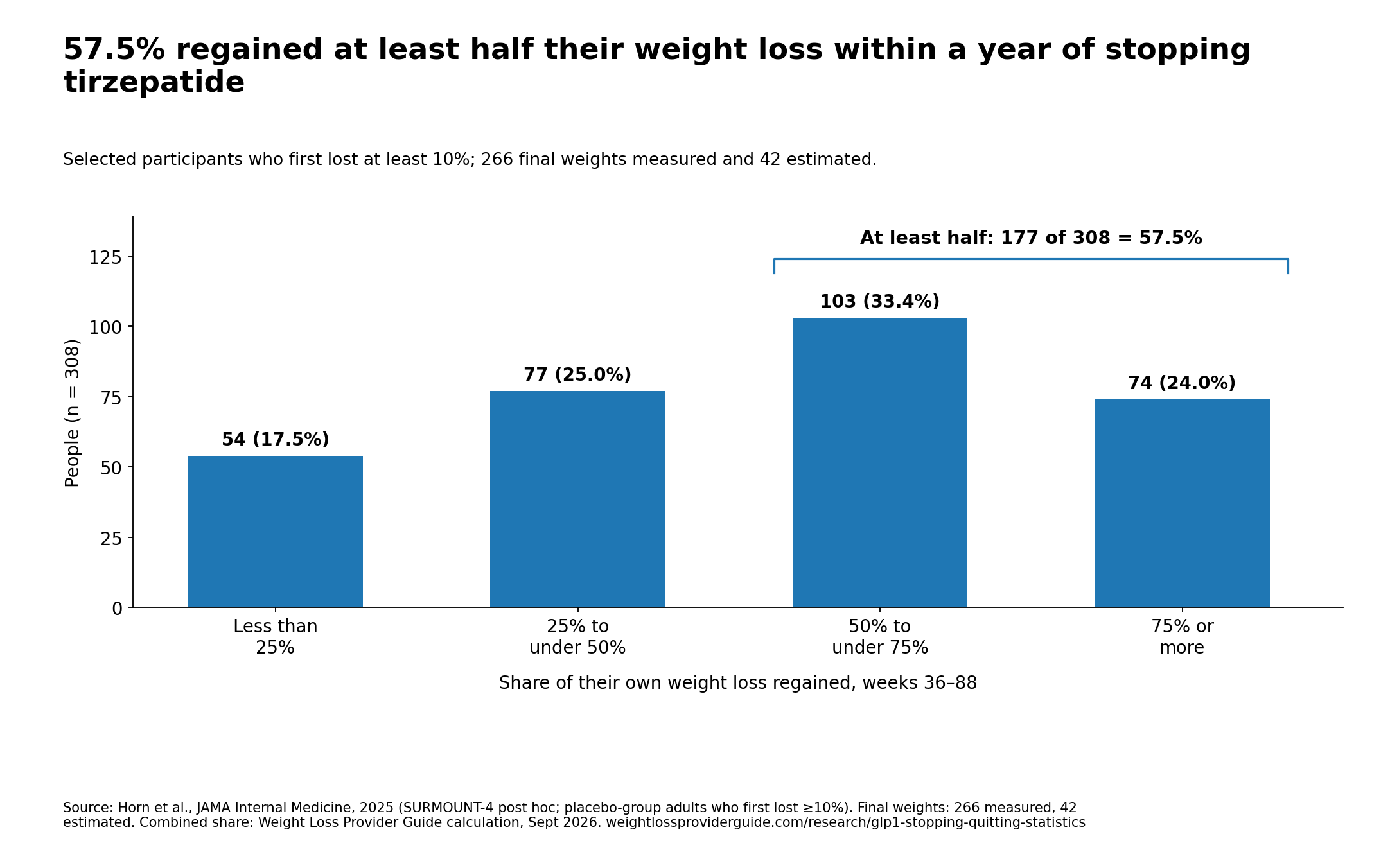
The same trial shows the other side. The estimated share keeping at least 80% of the lead-in loss was 89.5% among those who stayed on tirzepatide, versus 16.6% among those switched to placebo (SURMOUNT-4).
How much weight comes back after stopping semaglutide?
In the STEP 1 extension, the former semaglutide group had lost 17.3% on 2.4 mg and regained 11.6 percentage points in the 52 weeks after stopping. That's about two-thirds of what they lost. Its analysis group had 228 people, with 197 final on-site weights; the 327-person total also included the former placebo group. On average, they still weighed 5.6% less than when they started (Wilding et al., 2022).
Here's what that looks like for one hypothetical person. Say you start at 250 pounds and lose the average 17.3%. That's about 43 pounds, landing near 207. Scaling the published final group average gives about 236 pounds a year after stopping. That's about 29 pounds regained, but still 14 pounds lighter than day one. This is an illustration, not a forecast; the source reports the rounded means separately and the people measured differ by visit.
One detail gets lost a lot. At week 68, the trial stopped both the drug and its lifestyle program (full text). So this result shows what happened when both parts of the trial treatment ended at once. It doesn't test someone who keeps diet and exercise coaching going.
The two-thirds figure also isn't a plateau at 12 months. The authors say weight was still climbing at the last visit, week 120.
What STEP 4 adds. In STEP 4, 803 adults lost 10.6% during a 20-week semaglutide run-in. Then 268 were switched to placebo, with an estimated 6.9% gain over 48 weeks, while 535 who stayed on semaglutide had an estimated further loss of 7.9%. Lifestyle support continued for both groups (Rubino et al., JAMA, 2021).
That's an estimated 14.8-point gap between the two groups, measured from their week-20 weight. From the original starting weight, the placebo group ended 5.0% lower at week 68 (full report).
What does "14% weight regain" actually mean?
It means 14% of the weight you had when you stopped, not 14% of the weight you lost. In SURMOUNT-4, the placebo group gained 14.0% of its week-36 body weight. The 20.9% lead-in loss is a mean for both randomized groups, so combining it with the placebo-only result does not give an exact placebo-group share.
Headlines trip over this constantly, so here's the plain math.
| Step | Weight | What happened |
|---|---|---|
| Start | 100 kg | — |
| After losing 20% | 80 kg | Lost 20 kg |
| After gaining 14% of 80 kg | 91.2 kg | Gained 11.2 kg |
| Share of the lost 20 kg that returned | — | 11.2 ÷ 20 = 56% |
Hypothetical arithmetic, not a patient or a forecast. Weight Loss Provider Guide, September 2026.
So "14% regain" and "more than half the loss came back" can describe the same person. When you see a regain percent, ask what it's a percent of.
Will all the weight come back, and when?
There is no single measured deadline. Some observational reports follow patients for two years, but the newer-drug trial data used in these models end at about one year. Two 2026 reviews extend the line past that point and disagree. One projects a return to starting weight at about 1.5 years. The other projects regain leveling off near 75% of the loss.
The first-year estimates also differ. The BMJ review estimated that people who stopped semaglutide or tirzepatide regained about 0.8 kg a month, or 9.9 kg in the first year, after losing 14.7 kg (West et al., BMJ, 2026). That's about 22 pounds back out of 32 lost.
Beyond that, the projections split:
| Review | What it measured | Year one | Beyond one year (projection) | Data behind it |
|---|---|---|---|---|
| West et al., The BMJ (Jan 2026) | 37 studies, 9,341 people; newer-drug subgroup 1,776 | 9.9 kg regained (0.8 kg a month) | Back to starting weight at about 1.5 years (newer drugs) or 1.7 years (all drugs) | Newer-drug data go to 12 months at most |
| Budini et al., eClinicalMedicine (Mar 2026) | 48 studies; 6 trials, 3,236 people in the model | 60% of the loss | Levels off near 75.3% of the loss | Trial data go to 52 weeks |
| Kow et al., Endocrinology, Diabetes & Metabolism (Aug 2026) | 6 studies, 10 semaglutide/tirzepatide arms, 1,776 people; reused from the BMJ review | Modeled 82.8% of the loss at 12 months; 1.04 kg a month | Back to starting weight at 15.0 months | Trial follow-up 4–52 weeks; no new literature search |
Source: the three reports as published. Checked September 29, 2026.
First-year regain estimates differ by study and model
Different study groups and methods; not pooled, not head-to-head, and not a percentage of people. The reviews reuse some trial data.
Source: STEP 1 extension (Diabetes Obes Metab 2022); Budini et al. (eClinicalMedicine 2026); West et al. (BMJ 2026); Kow et al. (Endocrinol Diabetes Metab 2026). STEP 1 and BMJ ratios: Weight Loss Provider Guide calculations, Sept 2026. weightlossproviderguide.com/research/glp1-stopping-quitting-statistics
Download chart PNG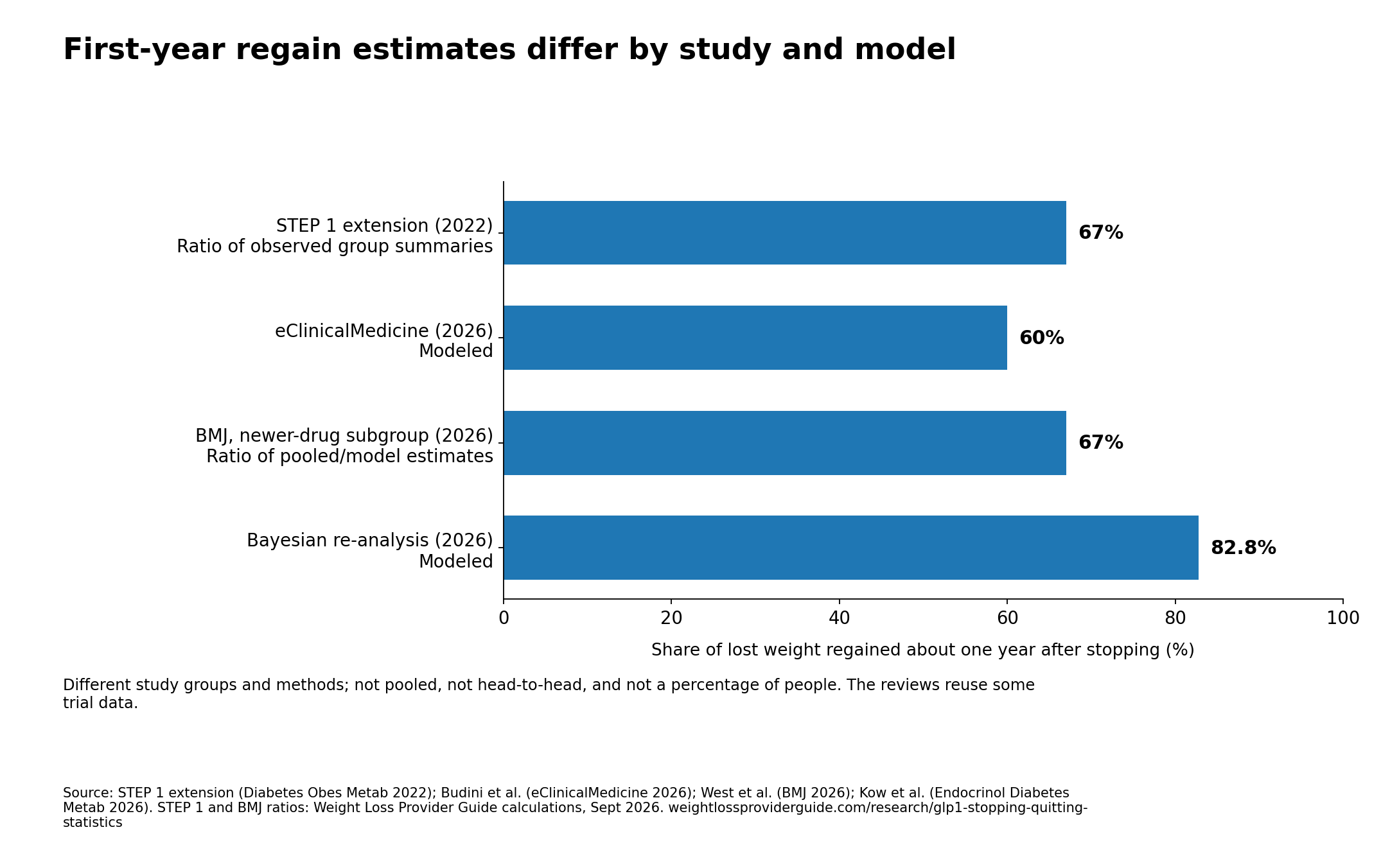
Why the split? The BMJ and Bayesian models extend straight lines. The eClinicalMedicine model draws a curve that bends flat. They also use different groups: the curved model includes liraglutide, while the newer-drug analyses include only semaglutide and tirzepatide. These models share some trials, not one identical dataset. Their results past a year are projections, not measured outcomes.
The August 2026 Bayesian re-analysis put average regain at 1.04 kg a month, with 82.8% of the loss regained at 12 months and a projected return to starting weight at 15.0 months (Kow et al., 2026). It re-analyzed existing trial summaries; it did not collect new patient results. Its published 82.8% comes from the model, not a count of people or a division of rounded averages.
For comparison, the BMJ team found people regained about 0.1 kg a month after diet-and-exercise programs, versus 0.4 kg a month after any weight-loss drug. That's about 4 times faster. This is an indirect comparison across studies, not a trial assigning people to stop a drug versus a diet program. Weight after diet programs was projected back to baseline at 3.9 years, versus 1.7 years after drugs.
Does anyone keep the weight off? Why real-world results look different
Some people do. In SURMOUNT-4's selected group who first lost at least 10%, about 1 in 6 people switched to placebo regained less than a quarter of their loss. At Cleveland Clinic, 44.6% of obesity patients held steady or kept losing in the year after stopping, but many had restarted a drug or begun another treatment.
Trials and clinics look far apart. They follow different people doing different things, so these numbers do not establish why the results differ.
Withdrawal trials assign people to placebo, but some allow rescue treatment or other care. In real life, people restart, switch, or get other help. In the Cleveland Clinic study of 7,938 people who stopped semaglutide or tirzepatide after 3 to 12 months, 19.6% restarted the same drug and 35.2% got another obesity treatment within a year (Gasoyan et al., 2026).
Clinic patients also lost less before stopping: 8.4% in the obesity group, versus 17% to 21% in the big trials (Cleveland Clinic study). Less lost can mean less to regain.
| Study | Who | What it found | What to keep in mind |
|---|---|---|---|
| Cleveland Clinic (2026) | 1,519 obesity patients with a weight at stopping and a year later | 677 (44.6%) held steady or kept losing; 842 (55.4%) gained | Measured from weight at stopping; "stopped" = a gap of more than 90 days after the previous supply ran out; 19.6% of the full cohort restarted |
| Epic Research (2024) | 20,274 patients who lost at least 5 lb on semaglutide | 17.7% had regained all of it or more at one year | Not peer-reviewed; health records |
| Epic Research (2025) | 188,722 across drugs and available follow-up months; at least 5 lb lost over 90+ treatment days; semaglutide month-24 count not reported | 56.1% of the semaglutide month-24 group kept or extended their loss | Not peer-reviewed; monthly groups differ; stops counting later weights after another weight-loss drug or GLP-1 prescription |
Source: studies as published. Checked September 29, 2026.
Cleveland Clinic included later treatment in follow-up. Epic's 2025 report stopped counting a patient's later weights after another weight-loss drug or GLP-1 was prescribed. So restarts cannot be used as one explanation for both. Controlled trials and these health-record reports answer different questions.
How many people stop GLP-1s, and how many restart?
Among 125,474 U.S. adults who started a GLP-1 between 2018 and 2023, estimated one-year stopping rates were 64.8% without type 2 diabetes and 46.5% with it. A separate claims study found higher persistence among later starters. Among commercially insured adults without diabetes, the share still on GLP-1 therapy a year after starting Wegovy or Zepbound rose from 33.2% for 2021 starters to 60.9% for first-half-2024 starters; product switches counted as continued therapy.
Every one of these studies has to decide what "stopped" means, and they don't all pick the same rule. That's why published one-year quit rates run all over the place.
| Study | Data | Who | "Stopped" means | Result |
|---|---|---|---|---|
| Rodriguez et al., JAMA Network Open (2025) | Health records, U.S. | 125,474 adults with overweight or obesity who started 2018–2023 | 60+ days with no GLP-1 on hand | Estimated stopping within 1 year: 64.8% without type 2 diabetes, 46.5% with. Within 2 years: 84.4% and 64.1%. Estimated restart within a year: 36.3% and 47.3% among 18,923 and 22,869 eligible discontinuers, respectively |
| Marshall et al., JMCP (2026) | Insurance claims, Prime Therapeutics | 33,607 commercially insured adults without diabetes starting Wegovy or Zepbound, 2021 to mid-2024 | Gap of more than 60 days; switching drugs allowed | Still on at 1 year: 33.2% (2021 starters) to 60.9% (first-half 2024 starters) |
| Prime Therapeutics (2025) | Insurance claims | 5,780 adults without diabetes who started a GLP-1 for obesity, Jan 2021 to Mar 2022 | Persistence definition in the research announcement; exact gap threshold not supplied there | Estimated still on at 3 years: 8% (14% for high-potency semaglutide); 38% switched products; conference report |
| Prime Therapeutics, JMCP (2024) | Insurance claims | 4,066 commercially insured adults with obesity, no diabetes, who started in 2021 | Study 60-day gap rule; switching allowed | Still on: 46.3% at 180 days, 32.3% at 1 year |
Source: studies as published. The 18.3-point gap (64.8 − 46.5) is a Weight Loss Provider Guide calculation. Checked September 29, 2026.
That "only 1 in 3 stays on a year" line you've seen? It traces to the 2024 Prime study of 2021 starters: 32.3%. Prime's newer report used a different, high-potency-drug cohort and found 33.2% for 2021 starters versus 60.9% for first-half-2024 starters—nearly double within that report. The authors suggest easing shortages as one explanation; they did not test that cause.
And stopping isn't always the end of the story. Among 18,923 eligible discontinuers without diabetes who had a weight at stopping and a later visit, the estimated one-year restart rate was 36.3%. More weight regained was linked to a higher chance of restarting (Rodriguez et al.).
Why do people stop GLP-1 medications?
Cost was the most common recorded reason in one clinic study. In a Cleveland Clinic review of 288 patients who stopped within a year, 47.6% stopped because of cost or insurance, and 14.6% because of side effects. Only 1.7% stopped because they weren't losing enough weight. A national KFF poll found 14% of everyone who ever used a GLP-1 stopped over cost, and 13% over side effects.
Those two sources count differently, so read the "out of" column before comparing.
| Reason | Cleveland Clinic (out of 288 who stopped) | KFF poll (out of all adults who ever used one) |
|---|---|---|
| Cost or insurance | 47.6% (137) | 14% (cost) |
| Side effects | 14.6% (42) | 13% |
| Drug shortage | 11.8% (34) | — |
| Switched to a compounded drug | 2.4% (7) | — |
| Not losing enough weight | 1.7% (5) | — |
| Condition improved | — | 5% |
| Other | 10.8% (31) | — |
| Not recorded | 11.1% (32) | — |
Sources: Gasoyan et al., Obesity, 2025 (medical-record review of adults without type 2 diabetes who stopped injectable semaglutide or tirzepatide within a year); KFF Health Tracking Poll, Oct. 27–Nov. 2, 2025 (1,350 U.S. adults; don't add KFF's shares together). Checked September 29, 2026.
Put simply: for every person in the Cleveland Clinic sample who quit over unsatisfactory weight loss, about 27 quit over money or insurance (137 vs. 5).
A 2026 survey by researchers including Johns Hopkins and the University of Colorado asked 440 adults who had stopped. In the weighted results, 54.6% stopped within 6 months and 79.7% within 12 months of starting. Reasons included cost (36.1%), side effects (33.3%), no insurance coverage (28.2%), and reaching a weight goal (26.1%). People could give more than one reason. These are shares of people who had already stopped, not quit rates among all users (DiStefano et al., JMCP, 2026; survey fielded June 2025).
For the practical side of stopping, see our consumer guide to stopping GLP-1 treatment.
If cost is why you're weighing a stop, Find My Path is our free tool for comparing care options. Our GLP-1 Telehealth Pricing Index tracks current self-pay prices, and our state employee GLP-1 coverage ledger covers one kind of insurance. Changes to a prescription are a decision for you and your prescriber.
Does a lower dose keep the weight off?
Partly. In SURMOUNT-MAINTAIN, adults who lost weight on full-dose tirzepatide were split three ways for a year. At week 112, the model estimated that those who stepped down to 5 mg were 16.6% below their starting weight, versus 21.9% on the full dose and 9.9% on placebo. Rescue tirzepatide was given to 25% of the lower-dose group and 67% of the placebo group.
This 2026 trial tested a lower dose for keeping weight off. After 60 weeks on their highest tolerated dose, 378 people were randomly assigned to keep it (140), drop to 5 mg (144), or switch to placebo (94) (Lancet abstract).
| Group from week 60 | People | Weight change from start (model-based) | Got rescue tirzepatide |
|---|---|---|---|
| Stayed on full dose (10 or 15 mg) | 140 | −21.9% | 8% (11 of 138) |
| Lowered to 5 mg | 144 | −16.6% | 25% (35 of 142) |
| Switched to placebo | 94 | −9.9% | 67% (60 of 90) |
Source: SURMOUNT-MAINTAIN, The Lancet, May 2026; rescue was offered from week 84 to anyone who had regained at least half their loss (original sponsor trial details). Rescue counts use slightly different denominators than the randomized groups. Checked September 29, 2026.
Read the placebo row carefully. Two in three people in its rescue analysis got rescue tirzepatide before the trial ended, so −9.9% isn't a clean "stopped and stayed off" number. The primary model assumes no further benefit from the assigned treatment after rescue starts; it is not a raw average that includes rescue's added effect (publisher Methods).
These are study doses, not dosing advice.
A lower tirzepatide dose kept off more weight than placebo, and less than the full dose
Rescue tirzepatide: 8% (11/138), 25% (35/142), 67% (60/90). These are study doses, not dosing advice.
Source: SURMOUNT-MAINTAIN, The Lancet, May 2026. Model-based estimates assume no added assigned-treatment benefit after rescue starts. Rescue allowed from week 84 for the trial weight-regain criterion. weightlossproviderguide.com/research/glp1-stopping-quitting-statistics
Download chart PNG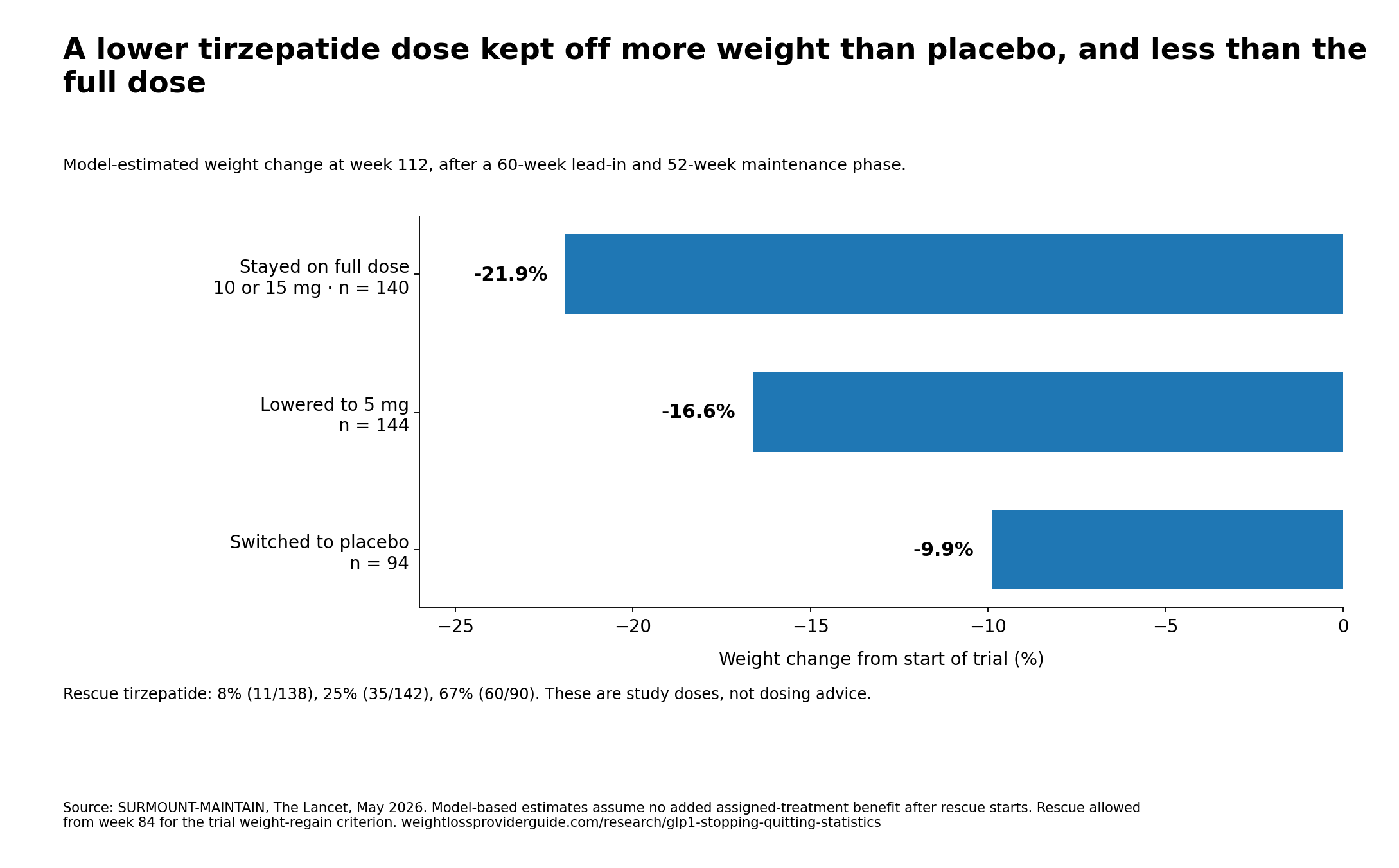
For the program side of staying on treatment, see our guide to GLP-1 maintenance program options.
Do the health benefits fade too?
Mostly, along with the weight. In the STEP 1 extension, most measured blood-pressure, blood-sugar, and lipid improvements drifted back toward where they started within a year of stopping. The BMJ review projects that blood sugar, blood pressure, cholesterol, and triglyceride gains return to baseline within about 1.4 years after stopping a weight-loss drug (STEP 1 extension; BMJ review).
How much came back seems to matter. In SURMOUNT-4, people who regained less than a quarter of their loss saw no significant change in waist size, triglycerides, non-HDL cholesterol, or insulin measures after stopping. Greater regain was linked to larger reversals in several of these markers (Horn et al., 2025).
The 1.4-year figure is a projection from trends, not a measurement (West et al., BMJ, 2026).
What else is linked to keeping weight off?
The evidence is thin, and some of it comes from an older drug. In one trial, the estimated regain was 9.6 kg in the year after liraglutide alone ended, 6.0 kg more than after supervised exercise plus placebo ended (Jensen et al., eClinicalMedicine, 2024).
That trial used liraglutide, an earlier daily GLP-1, so it's a hint rather than proof for today's weekly drugs. The BMJ review found no evidence that behavioral support after stopping slowed regain across the studies it pooled.
For support built in while you're on treatment, here are GLP-1 programs that include nutrition coaching.
Why the famous GLP-1 stopping numbers disagree
Each famous number is true for a specific group, time, and yardstick. Withdrawal trials compare assigned treatment paths, sometimes with rescue allowed. Health-record studies differ in whether they keep counting after a restart or switch. Quit rates also depend on the starting year, drugs, insurance, and gap rule.
| What you've read | Where it comes from | What it actually measured |
|---|---|---|
| "Two-thirds of the weight comes back" | STEP 1 extension, 2022 | Average share of lost weight regained in 52 weeks after semaglutide and lifestyle support stopped; not two-thirds of people |
| "14% weight regain" | SURMOUNT-4, 2024 | 14% of body weight at the switch; not 14% of the amount previously lost |
| "65% quit within a year" | Rodriguez et al., 2025 | Adults without type 2 diabetes who started 2018–2023; 60+ days without a GLP-1 on hand; health records |
| "Only 1 in 3 stays on for a year" | Prime, JMCP, 2024 | 32.3% of 2021 starters; a separate, high-potency-drug cohort found 33.2% in 2021 and 60.9% in first-half 2024 |
| "It all comes back in 1.5 to 1.7 years" | The BMJ, 2026 | A straight-line projection; newer-drug data stop at 12 months |
| "You keep about a quarter" | eClinicalMedicine, 2026 | A curve projected to level off at 75.3% regained; data stop at 52 weeks |
| "Almost half keep it off" | Cleveland Clinic, 2026 | 44.6% held or lost from their weight at stopping; many restarted or got other treatment |
Source: Weight Loss Provider Guide review of each study's methods, September 2026.
Why this matters now
In KFF's October 27–November 2, 2025 poll, 12% of U.S. adults said they were taking a GLP-1, and 18% said they had taken one (KFF, November 2025). That's a lot of people who will face a "should I stop?" moment.
And 2026 moved the evidence. Two reviews and a re-analysis put a pace on regain, a lower-dose trial reported, and a large clinic study showed what people actually do after stopping. Put side by side, they give a clearer answer: the withdrawal-trial averages and models show much of the loss returning within a year. That is not the same as saying everyone regains all of it or that routine-care results match those trials.
How we built this
We collected published results from 20 sources: 7 randomized trials and trial analyses, 3 reviews, 3 health-record studies, 2 non-peer-reviewed health-record analyses from Epic Research, 3 insurance-claims reports, and 2 national surveys. All were checked on September 29, 2026. We read the linked primary reports; for SURMOUNT-MAINTAIN we checked the publisher abstract and original sponsor details, and for Prime's three-year figures we checked its research announcement. Epic's reports are not peer-reviewed.
Here's the work we did ourselves, all of it arithmetic on published numbers:
- We calculated ratios of published group summaries: STEP 1, 11.6 ÷ 17.3 × 100 = about 67%; BMJ newer drugs, 9.9 ÷ 14.7 × 100 = about 67%. These are not averages of individual regain percentages. We did not mix an all-arm run-in mean with one arm's later result.
- We added the two top SURMOUNT-4 regain groups: (103 + 74) ÷ 308 × 100 = 57.5%. The study estimated 42 missing final weights; we did not estimate patient weights ourselves.
- We subtracted and divided where noted: 64.8 − 46.5 = 18.3 points; 60.9 ÷ 33.2 = about 1.8 times; 137 ÷ 5 = 27.4, or about 27. We also checked 95 ÷ 197 = 48.2% and 308 − 266 = 42, and checked the worked examples.
We did not survey anyone, run a trial, pool studies into one new estimate, or add up participants across studies. Several sources share the same people. For example, the SURMOUNT-4 follow-up analysis reuses SURMOUNT-4 participants, and the reviews include the trials. Where a study's numbers didn't convert cleanly, we left the cell blank.
The CSV lists the quantitative results used here from 19 of the 20 sources, plus their supporting values. The 20th, a SURMOUNT-4 quality-of-life analysis, is cited in the FAQ and has no single number to list. Each row includes the formula for our calculations, whether the result was observed, estimated, or projected, and what it's measured against. "Estimated" means a study used statistics to handle missing data or unequal follow-up. "Projected" means a model extends beyond the measured follow-up. Blank sample sizes mean the relevant count was not extracted or not publicly reported—not zero. Readers can redo our arithmetic and check each published result. We did not refit the researchers' statistical models, repeat their surveys, or obtain private patient data.
What this data does and doesn't show
It shows: what happened, on average, to groups of people in specific studies after they stopped a specific drug, and how often people stop, restart, and why.
It doesn't show:
- What will happen to you. These are group averages and group shares, not a personal forecast.
- A measured long-term outcome for everyone who stops semaglutide or tirzepatide. Some observational reports reach two years, but the longer-run results in the three models above are projections beyond their trial follow-up.
- A cause for the gap between trials and clinics. Restarts and different starting losses are likely parts of it, but no study here proves the split.
Be careful with:
- The headline. It covers selected people who first lost at least 10% on tirzepatide in one trial; 266 final weights were measured and 42 estimated.
- Comparisons across studies. They use different definitions of "stopped" (60 days, more than 60 days, or more than 90 days without a refill) and different yardsticks for "regain."
- Epic Research figures. They aren't peer-reviewed.
- Survey figures. KFF and DiStefano report weighted, self-reported results. KFF's stopping reasons use all ever-users as the base; DiStefano's use discontinuers and allow multiple answers.
How to cite this page
Citing the page:
WPG Research Team. "Weight Regain After Stopping GLP-1: Stopping and Quitting Statistics From 20 Reports (2026)." Weight Loss Provider Guide, updated September 2026. https://weightlossproviderguide.com/research/glp1-stopping-quitting-statistics
Citing the headline finding:
In a selected SURMOUNT-4 group who lost at least 10% on tirzepatide before switching to placebo, 177 of 308 people (57.5%) regained at least half their loss within 52 weeks, according to Weight Loss Provider Guide's calculation (September 2026); the source analysis includes 42 estimated final weights. Calculation and limits. Underlying data: Horn et al., JAMA Internal Medicine, 2025.
Reuse: Our original calculations, table and CSV arrangement, and independently drawn charts may be reused under CC BY 4.0 with credit to Weight Loss Provider Guide; retain the underlying sources' attribution and license terms, which this permission does not change.
Download the data
Download the GLP-1 Stop & Regain Ledger (CSV). It has 98 rows from 19 sources, free, with no form or email. Each row has the source link and check date.
Frequently asked questions
Do you regain all the weight after stopping Ozempic?
Not everyone regained all of it. In the STEP 1 extension, 95 of 197 people (48.2%) with a final semaglutide-group weight remained at least 5% below their starting weight after a year; the group averaged 5.6% below start despite regaining about two-thirds of its prior mean loss. This trial tested semaglutide 2.4 mg, not every Ozempic dose or patient group (primary report).
Why do so many people quit GLP-1 medications?
Cost was the most common recorded reason in the Cleveland Clinic study. In its review of 288 patients who stopped within a year, 47.6% stopped because of cost or insurance and 14.6% because of side effects; only 1.7% stopped over unsatisfactory weight loss (primary report).
Do you have to take a GLP-1 forever to keep the weight off?
Continued tirzepatide outperformed placebo in SURMOUNT-4: the estimated shares keeping at least 80% of their loss were 89.5% and 16.6%, respectively (trial report). Whether to continue, lower the dose, or stop is a decision to make with your prescriber.
Is "14% weight regain" the same as regaining 14% of what you lost?
No. SURMOUNT-4's 14.0% is a share of body weight at the time of stopping, not the amount lost. In our hypothetical 100-to-80 kg example, a 14% gain equals 56% of the prior loss. See the worked example.
Does a lower dose keep the weight off?
Partly. In SURMOUNT-MAINTAIN, model estimates were 16.6% below starting weight at week 112 after moving to 5 mg tirzepatide, versus 21.9% on the full dose and 9.9% on placebo. Rescue treatment was allowed and handled by the model. Those are study doses, not advice (publisher report).
How fast does weight come back after stopping semaglutide or tirzepatide?
The 2026 BMJ review modeled about 0.8 kg (1.8 pounds) a month, with a modeled 9.9 kg in the first year. A later re-analysis modeled 1.04 kg a month. These are estimates from different methods, not a fixed monthly gain for each person (West; Kow).
Does stopping affect how you feel?
It can. In SURMOUNT-4, people who regained more weight after switching to placebo reported worse health-related quality of life (Obesity, 2025). That measures health-related quality of life, not how many people felt grief or failure about stopping.
How can you stop without regaining weight?
These studies do not establish a way to stop with no regain. One liraglutide trial estimated 6.0 kg less regain after supervised exercise plus placebo ended than after liraglutide alone ended; the exercise-only group had not been taking active liraglutide during treatment (trial report). Stay-on and lower-dose options are covered above. Talk to your prescriber before changing a dose, especially if you also take the drug for diabetes.
Sources
All sources checked September 29, 2026.
- Wilding JPH et al. Weight regain and cardiometabolic effects after withdrawal of semaglutide: the STEP 1 trial extension. Diabetes, Obesity and Metabolism, 2022. https://pubmed.ncbi.nlm.nih.gov/35441470/ · full text: https://pmc.ncbi.nlm.nih.gov/articles/PMC9542252/
- Rubino D et al. Effect of continued weekly subcutaneous semaglutide vs placebo on weight loss maintenance (STEP 4). JAMA, 2021. https://pubmed.ncbi.nlm.nih.gov/33755728/
- Aronne LJ et al. Continued treatment with tirzepatide for maintenance of weight reduction in adults with obesity (SURMOUNT-4). JAMA, 2024. https://pubmed.ncbi.nlm.nih.gov/38078870/
- Horn DB et al. Cardiometabolic parameter change by weight regain on tirzepatide withdrawal: a post hoc analysis of the SURMOUNT-4 trial. JAMA Internal Medicine, published online November 24, 2025. https://pmc.ncbi.nlm.nih.gov/articles/PMC12645400/
- Tirzepatide associated with improved health-related quality of life in adults with obesity or overweight in SURMOUNT-4. Obesity, 2025. https://www.ncbi.nlm.nih.gov/pmc/articles/PMC12559773/
- Tirzepatide for maintenance of bodyweight reduction in people with obesity in the USA (SURMOUNT-MAINTAIN). The Lancet, May 12, 2026. https://pubmed.ncbi.nlm.nih.gov/42119587/ · publisher methods and results: https://www.sciencedirect.com/science/article/pii/S0140673626006562 · original sponsor rescue details: https://zepbound.lilly.com/hcp/clinical-data-weight
- West S et al. Weight regain after cessation of medication for weight management: systematic review and meta-analysis. The BMJ, January 7, 2026. https://www.bmj.com/content/392/bmj-2025-085304
- Budini B et al. Trajectory of weight regain after cessation of GLP-1 receptor agonists: a systematic review and nonlinear meta-regression. eClinicalMedicine, March 4, 2026. https://pubmed.ncbi.nlm.nih.gov/41938838/
- Weight regain trajectories after discontinuation of semaglutide or tirzepatide: a reconstructed aggregate-data Bayesian longitudinal meta-analysis. Endocrinology, Diabetes & Metabolism, 2026. https://pmc.ncbi.nlm.nih.gov/articles/PMC13529306/
- Jensen SBK et al. Healthy weight loss maintenance with exercise, GLP-1 receptor agonist, or both combined followed by one year without treatment. eClinicalMedicine, 2024. https://doi.org/10.1016/j.eclinm.2024.102475
- Gasoyan H et al. Obesity treatments and weight changes in clinical practice after discontinuation of semaglutide or tirzepatide. Diabetes, Obesity and Metabolism, 2026 (epub March 12). https://pubmed.ncbi.nlm.nih.gov/41816857/ · full text: https://pmc.ncbi.nlm.nih.gov/articles/PMC13146129/
- Gasoyan H et al. Reasons for discontinuation of obesity pharmacotherapy with semaglutide or tirzepatide in clinical practice. Obesity, 2025. https://pubmed.ncbi.nlm.nih.gov/41039650/
- Epic Research. Many patients maintain weight loss a year after stopping semaglutide and liraglutide. January 2024. https://www.epicresearch.org/articles/many-patients-maintain-weight-loss-a-year-after-stopping-semaglutide-and-liraglutide/
- Epic Research. Two years after stopping GLP-1s, most patients sustain at least some weight loss. September 2025. https://www.epicresearch.org/articles/two-years-after-stopping-glp-1s-most-patients-sustain-at-least-some-weight-loss/
- Rodriguez PJ et al. Discontinuation and reinitiation of dual-labeled GLP-1 receptor agonists among US adults with overweight or obesity. JAMA Network Open, 2025. https://pubmed.ncbi.nlm.nih.gov/39888616/ · full text, including two-year figures: https://jamanetwork.com/journals/jamanetworkopen/fullarticle/2829779
- Marshall LZ et al. Trends in 1-year persistence and adherence among initiators of high-potency, weight loss–indicated GLP-1 receptor agonists. Journal of Managed Care & Specialty Pharmacy, March 2026. https://doi.org/10.18553/jmcp.2026.32.3.281
- Prime Therapeutics. Only 1 in 12 remain on a GLP-1 drug for obesity at three years. June 25, 2025. https://www.prnewswire.com/news-releases/prime-therapeutics-leading-research-shows-only-1-in-12-remain-on-a-glp-1-drug-for-obesity-at-three-years-302490407.html
- Real-world persistence and adherence to GLP-1 receptor agonists among obese commercially insured adults without diabetes. Journal of Managed Care & Specialty Pharmacy, 2024. https://doi.org/10.18553/jmcp.2024.23332
- KFF Health Tracking Poll: prescription drug costs, views on Trump administration actions, and GLP-1 use (fielded October 27–November 2, 2025). https://www.kff.org/public-opinion/kff-health-tracking-poll-prescription-drug-costs-views-on-trump-administration-actions-and-glp-1-use/
- DiStefano MJ, Zon J, et al. Discontinuation of glucagon-like peptide-1 receptor agonists among US adults: a national survey. Journal of Managed Care & Specialty Pharmacy, August 2026. https://pubmed.ncbi.nlm.nih.gov/42504813/
More from our research desk: GLP-1 Consumer Research hub · GLP-1 Telehealth Pricing Index · State employee GLP-1 coverage by state
WPG Research Team is the research desk of Weight Loss Provider Guide (weightlossproviderguide.com).