GLP-1 Insurance Denial Reasons by Insurer (2026 Policy Data)
By Weight Loss Provider Guide Editorial Team
Last verified and updated: August 3, 2026 · Dataset version 1.0
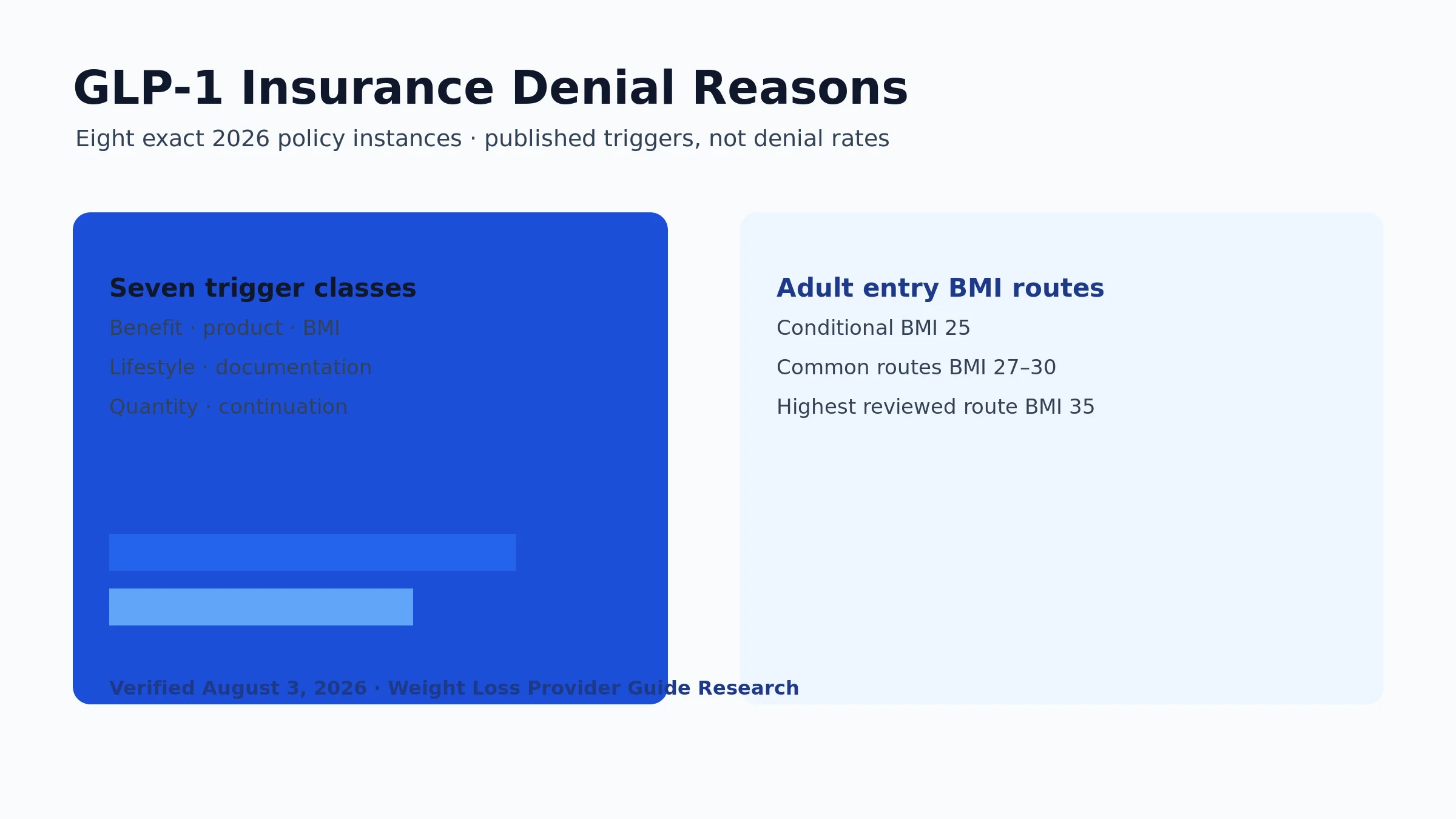
“Across eight exact 2026 policy instances, four required three or six months of prior lifestyle work, two required previous weight-management medications, and adult entry pathways ranged from a conditional BMI 25 route to a BMI 35 route. All eight imposed continuation conditions; none of the eight policy documents reported a denial rate.”
— Weight Loss Provider Guide Research, GLP-1 Insurance Denial Trigger Crosswalk v1.0, verified August 3, 2026
GLP-1 insurance denial reasons by insurer cannot be reduced to one national denial-rate comparison. The current CMS public prior-authorization metrics available in 2026 exclude drugs, and the eight insurer and pharmacy-benefit policy documents reviewed for this page report rules—not denial frequencies. What can be compared, precisely and in writing, is the condition each policy says can block an initial request or stop coverage later.
This distinction is not pedantry. It is the difference between a true statement and a false one.
| Measure | Finding |
|---|---|
| Exact policy instances reviewed | 8 |
| Documents establishing a prior-authorization, prior-approval, or clinical-review pathway | 8 of 8 |
| Adult pathways containing a BMI or diagnosis condition | 8 of 8 |
| Adult pathways containing a lifestyle condition | 8 of 8 |
| Policies stating a fixed pre-drug lifestyle period | 4 of 8 |
| Fixed periods observed | 3 or 6 months |
| Policies explicitly requiring previous weight-management medications | 2 of 8 |
| Policies imposing continuation or periodic-review conditions | 8 of 8 |
| Policies using a 5% adult weight-response threshold in at least one Wegovy or Zepbound continuation route | 8 of 8 |
| Adult entry BMI routes observed | 25 to 35, conditional on the exact route |
| Policy documents reporting a GLP-1 denial rate or denial-reason share | 0 of 8 |
Source: Weight Loss Provider Guide Research coding of eight official insurer, health-plan, and pharmacy-benefit policy instances. Verified August 3, 2026. “Eight of eight” describes this reviewed set, not every U.S. plan.
One definition before anything else: a denial trigger is a condition written into a published policy that can block approval or continuation when it is not met. It is not a count of denials, a measured reason share, or a claim that the insurer uses that reason most often.
What GLP-1 insurance denial statistics are actually public?
Answer: No standardized public dataset reviewed for this page reports insurer-level GLP-1 drug prior-authorization rates or reason shares. The current CMS public metrics cover medical items and services excluding drugs. CMS has proposed public drug metrics beginning in 2028 for 2027 data, but those proposed metrics are aggregate drug-request figures for specified payer categories—not a GLP-1-specific denial-rate table.
The current federal rule is CMS-0057-F. It requires specified Medicare Advantage, Medicaid, CHIP, and federally facilitated Marketplace payers to publish prior-authorization metrics, with the first set due March 31, 2026. CMS's implementation guidance says those metrics apply to medical items and services excluding drugs. The rule's 2026 requirement to give a specific reason for a denied prior authorization also excludes drug decisions.
CMS released proposed rule CMS-0062-P on April 10, 2026. Under the proposal, specified payers would publish drug prior-authorization metrics in 2028 using 2027 data. The accompanying proposed-metrics summary calls for a list of drugs requiring prior authorization and aggregate counts and percentages of drug requests approved, denied, approved after appeal, and denied after appeal. It does not create a proposed GLP-1-only metric. Medicare Advantage organizations would report only drugs payable under Part B; the Medicaid, CHIP, and federally facilitated Marketplace categories named in the proposal would report all drugs.
| CMS requirement | Status on August 3, 2026 | Drug scope | Can it compare insurers by GLP-1 denial rate? |
|---|---|---|---|
| CMS-0057-F public prior-authorization metrics | Final; first reports due March 31, 2026 | Medical items and services excluding drugs | No |
| CMS-0057-F specific reason for a denial | Final; begins in 2026 for covered non-drug decisions | The provision expressly excludes drug prior authorizations | No |
| CMS-0062-P public drug metrics | Proposed, not final | Aggregate drug requests for specified payer categories; Medicare Advantage limited to Part B drugs | No GLP-1-specific rate is proposed |
| CMS-0062-P specific reason for a denied drug request | Proposed for October 1, 2027 | State Medicaid and CHIP FFS, Medicaid managed care, CHIP managed care, and QHP issuers on federally facilitated exchanges | Would improve request-level explanations, but would not itself create a national GLP-1 insurer comparison |
Sources: Centers for Medicare & Medicaid Services, CMS-0057-F fact sheet, Prior Authorization API FAQ, CMS-0062-P fact sheet, and proposed metrics summary. Verified August 3, 2026.
The honest boundary is simple: this page can report what the reviewed policies say can cause nonapproval. It cannot report which insurer denies GLP-1 drugs most often.
What are the GLP-1 insurance denial reasons by insurer?
Answer: The published triggers fall into seven practical categories: a benefit or contract exclusion; a product, formulary, or indication mismatch; an age, BMI, or comorbidity mismatch; an unmet lifestyle or medication prerequisite; a documentation or prescriber requirement; a quantity or concurrent-therapy conflict; or an unmet continuation rule. The combination changes by exact policy instance, not merely by the logo on the insurance card.
| Code | Trigger class | What it means in this dataset |
|---|---|---|
| D1 | Benefit or contract exclusion | The applicable plan does not include the weight-management drug benefit, so clinical criteria cannot create coverage. |
| D2 | Product, formulary, or indication mismatch | The requested drug, formulation, diagnosis, or use does not fit the covered pathway. |
| D3 | Age, BMI, or comorbidity mismatch | The request does not satisfy the policy's demographic or clinical entry route. |
| D4 | Lifestyle or medication prerequisite unmet | A required program, behavioral period, previous medication, preferred product, or treatment sequence is missing. |
| D5 | Documentation, submission, or prescriber deficiency | Required baseline values, chart notes, records, attestations, recent measurements, or an eligible-prescriber condition are absent or unmet. |
| D6 | Quantity or concurrent-therapy conflict | The request exceeds a quantity rule or conflicts with a policy's combination-therapy restriction. |
| D7 | Continuation criterion unmet | The patient has not met or documented the response, ongoing-program, benefit, titration, or other renewal condition. |
Source: Weight Loss Provider Guide Research editorial taxonomy derived from the eight policy instances. These are not official insurer denial codes and do not measure frequency.
| Policy instance | Benefit and adult entry gate | Fixed prior lifestyle period | Previous medications | Other explicit trigger | Adult continuation route |
|---|---|---|---|---|---|
| UnitedHealthcare Commercial, program 2026 P 1114-21 | Optional program for clients or businesses that elected coverage; BMI ≥30, or BMI ≥27 with one weight-related comorbidity | Not stated | None stated | Requested product, indication, age, and applicable benefit must fit the pathway | Saxenda ≥4%; Wegovy ≥5%; Zepbound ≥5%; continued lifestyle modification |
| Aetna Non-Medicare, policy 6450-C P08-2025 v8 | Bulletin is not a contract; adult long-term weight route requires baseline BMI ≥35 | 6 months | None stated | Baseline BMI documentation and quantity limits | Saxenda ≥4% after at least 16 weeks; Wegovy, tirzepatide, or Foundayo ≥5% after at least 3 months at a stable maintenance dose |
| Cigna National Formulary, CNF 684 | Customer plan document can exclude coverage and supersedes the policy; BMI ≥30, or BMI ≥27 with one comorbidity | 3 months | None stated | Patient-specific evidence; concomitant GLP-1 or GLP-1/GIP use is listed as not medically necessary | Saxenda ≥4%; Foundayo, Wegovy, and Zepbound adult routes use ≥5%; continued lifestyle treatment |
| FEP Blue, Zepbound policy 5.99.031 | BMI ≥30, or BMI ≥27 with a qualifying condition; final clinical validation after documentation | Not stated | At least two oral weight-management medications | Comprehensive program, preferred product unless exception, medical records, and no prohibited dual therapy | ≥5% loss or maintenance of the initial 5% loss, with continued program and product rules |
| Kaiser Permanente Northwest, non-formulary Zepbound | Weight-loss-drug benefit required; BMI ≥30, or BMI ≥27 with one listed comorbidity | Active participation required; no fixed prior period stated | Two listed therapies with adequate three-month trials, then a six-month semaglutide trial and chart review, unless an exception applies | Current weight and BMI within approximately 30 days at initiation | Recently documented updated weight and BMI, plus achieved and maintained ≥5% loss |
| HCSC / Prime Therapeutics, effective June 15, 2026 | BMI ≥30; BMI ≥27 with one comorbidity; or a conditional BMI ≥25 route for South, Southeast, or East Asian descent | 6 months | None stated | No combination with another weight-loss agent or another GLP-1; plan type changes the initial approval clock | Adult Saxenda ≥4%; Wegovy, Foundayo, or Zepbound ≥5% or specified time-based route; continued regimen |
| Medical Mutual of Ohio, revised January 15, 2026 | Weight-loss-drug benefit required; BMI ≥32, or BMI ≥27 with two listed comorbidities | 3 months | None stated | Baseline documentation, specified prescriber pathway, and combination-therapy restrictions | Adult Saxenda ≥4%; Wegovy and Zepbound ≥5%; continued behavioral and dietary treatment |
| Regence / Cambia, policy dru787, version dru787.5 | Benefit contract controls and an exclusion cannot be overcome by clinical criteria; BMI ≥30, or BMI ≥27 with one comorbidity | Not stated | None stated | Clinical documentation, quantity limits, and combination obesity therapy treated as investigational | At least annual review; ≥5% loss from pretreatment baseline or current upward titration, plus benefit and lifestyle conditions |
Source: Weight Loss Provider Guide Research coding of the linked official policy documents. Verified August 3, 2026. Each row describes one exact policy instance, not every plan sold under the named organization.
How to read “not stated.” It does not mean the plan has no such rule. It means the rule did not appear in the exact adult pathway reviewed. Member contracts, formularies, employer benefit elections, state-specific documents, and other policies can add conditions.
How far apart are insurer BMI and prerequisite rules?
Answer: Ten BMI points separate the lowest and highest adult entry routes in the reviewed set: a conditional BMI-25 route in the HCSC/Prime policy and a BMI-35 route in the Aetna Non-Medicare policy. Four policies state a fixed three- or six-month pre-drug lifestyle period. Only FEP Blue and Kaiser Northwest expressly require previous weight-management medications in the reviewed adult chronic-weight pathways.
| Policy instance | General BMI-only route | Alternate route | Conditional route | Fixed prior lifestyle period | Explicit medication sequence |
|---|---|---|---|---|---|
| UnitedHealthcare Commercial | ≥30 | ≥27 + one comorbidity | — | Not stated | Not stated |
| Aetna Non-Medicare | ≥35 | — | — | 6 months | Not stated |
| Cigna National Formulary | ≥30 | ≥27 + one comorbidity | — | 3 months | Not stated |
| FEP Blue Zepbound | ≥30 | ≥27 + qualifying condition | — | Not stated | Two oral medications |
| Kaiser Northwest Zepbound | ≥30 | ≥27 + one comorbidity | — | Active participation; no fixed prior period stated | Two listed therapies, then six months of semaglutide, subject to exceptions |
| HCSC / Prime | ≥30 | ≥27 + one comorbidity | ≥25 for a specified Asian-ancestry route | 6 months | Not stated |
| Medical Mutual of Ohio | ≥32 | ≥27 + two comorbidities | — | 3 months | Not stated |
| Regence / Cambia | ≥30 | ≥27 + one comorbidity | — | Not stated | Not stated |
Source: Weight Loss Provider Guide Research coding of the linked official policies. Verified August 3, 2026.
Three differences matter most.
The BMI-25 route is real and narrow. The HCSC/Prime document allows pretreatment BMI ≥25 only for a patient identified as being of South Asian, Southeast Asian, or East Asian descent. It is a route inside that policy instance, not a national insurer standard and not a general clinical recommendation from this page.
One comorbidity and two comorbidities are not the same rule. Most reviewed alternate routes use BMI ≥27 plus one listed condition. Medical Mutual requires two in its reviewed adult pathway. A request can therefore fit one policy's alternate route and miss another's even when the BMI is identical.
A lifestyle condition is not always a timed prerequisite. All eight reviewed policies contain a lifestyle requirement, but only four assign a fixed pre-drug period. Treating “lifestyle required” and “six months required” as interchangeable would misstate half the dataset.
Do different GLP-1 drugs face different rules inside the same policy?
Answer: Yes. In the HCSC/Prime policy, adult Saxenda uses a 4% continuation threshold while Wegovy, Zepbound, and Foundayo use a 5% route. The same document also gives adult Saxenda a four-month initial approval under most listed plans while assigning 12 months to Foundayo, Wegovy, and Zepbound.
| Drug | Adult response route | Initial approval for “all other plans” in the document | Time-based alternative appearing in the policy |
|---|---|---|---|
| Saxenda | ≥4% loss from pretreatment baseline | 4 months | In the initial route, less than 16 weeks of therapy |
| Wegovy | ≥5% loss from pretreatment baseline | 12 months | Less than 52 weeks on the maximum-tolerated dose in renewal |
| Zepbound | ≥5% loss from pretreatment baseline | 12 months | Less than 52 weeks on the maximum-tolerated dose in renewal |
| Foundayo | ≥5% loss from pretreatment baseline | 12 months | Less than 52 weeks on the maximum-tolerated dose in renewal |
Source: HCSC Commercial Weight Management Prior Authorization with Quantity Limit Program Summary, effective June 15, 2026, pp. 14–17. The document gives 12-month initial approval to all listed products for certain BCBS Illinois and Montana plan types; the table shows its schedule for “all other plans.”
The same HCSC document separates chronic weight management from obstructive sleep apnea, MASH with F2–F3 fibrosis, and cardiovascular-risk reduction. The criteria change with the submitted indication. That is why “Does this insurer cover this drug?” is often one question too broad: the exact plan, product, and indication all matter.
Why can Ozempic or Mounjaro be denied when prescribed for weight loss?
Answer: The reviewed 2026 FDA labels for Ozempic and Mounjaro do not list weight reduction as an indication, while the reviewed Wegovy and Zepbound labels do. A plan can therefore apply a product or indication mismatch to a weight-management request for Ozempic or Mounjaro, even though semaglutide and tirzepatide also appear in weight-management brands.
“GLP-1” is a class description, not one interchangeable insurance product. Semaglutide is sold under both Ozempic and Wegovy; tirzepatide is sold under both Mounjaro and Zepbound. The molecule can be related while the brand, FDA label, formulation, and coverage pathway remain different.
| Product | Molecule | Weight reduction listed on the reviewed label? | Coverage issue a plan can apply |
|---|---|---|---|
| Wegovy | Semaglutide | Yes | The request can be evaluated under the plan's applicable weight-management or other labeled-indication route. |
| Zepbound | Tirzepatide | Yes | The request can be evaluated under the plan's applicable weight-management or OSA route. |
| Ozempic | Semaglutide | No; the reviewed label lists type 2 diabetes and specified cardiovascular and kidney-risk indications in adults with type 2 diabetes | A weight-management request can encounter a product or indication mismatch. |
| Mounjaro | Tirzepatide | No; the reviewed label lists glycemic control in patients age 10 and older with type 2 diabetes | A weight-management request can encounter a product or indication mismatch. |
Source: U.S. Food and Drug Administration prescribing information linked in the table. Labels reviewed August 3, 2026.
The accurate statement is not “Ozempic is never covered for weight loss.” The accurate statement is that the reviewed Ozempic label does not include weight reduction, so the request can fail an indication or product rule depending on the plan.
What does a real GLP-1 denial look like in writing?
Answer: New York's Department of Financial Services publishes searchable external-appeal case summaries that identify the health plan, drug, recorded dispute, and outcome. The eight records below show denials involving weight-response documentation, program proof, formulary alternatives, a supply restriction, and step therapy. They were deliberately selected to show different written reasons and are not a statistical sample.
| Case and health plan | Drug | Outcome | Issue recorded in the public case summary |
|---|---|---|---|
| 202203-148028 — CVS Caremark; self-funded | Wegovy | Overturned | Plan required documentation of at least 5% loss from baseline; the record showed weight fell from 173 to 156 pounds in under three months. |
| 202301-158201 — CVS Caremark; self-funded | Saxenda | Upheld | Continued coverage required at least 4% loss after the initial 16 weeks, but no weight data or medical records were provided. |
| 202302-159101 — Excellus | Saxenda | Upheld | Plan required at least three months in a qualified program with proof of monthly participation; submitted receipts did not show the required engagement. |
| 202202-146830 — Univera Community Health | Saxenda | Overturned | Initial request lacked proof of the required program; the appeal record established program participation. |
| 202304-162002 — Aetna | Mounjaro | Overturned | Non-formulary request; the listed alternatives were Ozempic, Rybelsus, Trulicity, and Victoza. |
| 202204-148109 — Univera Community Health | Wegovy | Overturned | Plan would not approve new Wegovy requests until all strengths were readily available, while the patient had already used it for six months. |
| 202211-155996 — Fidelis Care New York | Wegovy | Overturned | Patient had BMI 28 and dyslipidemia; the plan alternatives named in the record were diabetes products. |
| 202108-140345 — Oscar Insurance Company | Wegovy | Overturned | Step-therapy dispute; prior-authorization records documented trial and failure, intolerance, or contraindication to all appropriate formulary alternatives. |
Source: New York State Department of Financial Services public external-appeal case summaries linked above. Retrieved and reviewed August 3, 2026. The eight cases are purposively selected examples; no denial-rate, overturn-rate, or reason-frequency inference should be drawn from them.
Within this deliberately varied eight-case set, two records turned on weight-response documentation, two on program documentation, two on formulary alternatives, one on a supply rule, and one on step therapy. That is a description of the selected records, not a distribution of GLP-1 denials.
The cases also show why the entity named in a drug dispute may not match the carrier logo a member expects. Two records list CVS Caremark in the health-plan field. The policy and appeal record—not the brand name alone—identify what was actually reviewed.
What measured GLP-1 approval data exists?
Answer: A prospective observational study at UC Davis Health collected 150 prior authorizations—50 for weight-loss GLP-1s, 50 for diabetes GLP-1s, and 50 for high-volume non-GLP-1 medications. Weight-loss GLP-1 requests were approved 48% of the time versus 90% for diabetes GLP-1 requests, and they required 7.1 more minutes of mean hands-on staff time per request.
| Study field | Reported value |
|---|---|
| Design | Prospective observational study |
| Setting and period | UC Davis Health, October 2024 through April 2025 |
| Participants | Six licensed pharmacy technicians using a self-reported time survey |
| Sample | 150 prior authorizations; 50 per comparison group |
| Weight-loss GLP-1 approval rate | 48% |
| Diabetes GLP-1 approval rate | 90% |
| Approval odds comparison | OR 0.10; 95% CI 0.04–0.31; P < 0.0001 |
| Mean hands-on time difference | 7.1 minutes more; 95% CI 3.4–10.8; P < 0.0001 |
| Mean administrative cost difference | $6.74 more per request; 95% CI $3.21–$10.27 |
Source: Pham D, Duby JJ, Setoudeh S, et al. “Administrative costs of prior authorizations for glucagon-like peptide-1 agonists.” Journal of Managed Care & Specialty Pharmacy. 2026;32(3):292–299. doi:10.18553/jmcp.2026.32.3.292.
This study is measured evidence, but it is not an insurer-by-insurer comparison. It comes from one academic health system, uses self-reported technician time, and includes 50 weight-loss GLP-1 requests. It cannot establish a national approval rate or the rate for any named insurer.
Can a GLP-1 be denied even when the clinical criteria are met?
Answer: Yes. A member can satisfy the BMI, comorbidity, lifestyle, and documentation conditions while the governing benefit still excludes weight-management drugs. Several reviewed documents state directly that the benefit contract or member coverage controls over the general clinical policy.
| Policy instance | What the official document says about the benefit gate |
|---|---|
| UnitedHealthcare Commercial | The program is optional and is placed for clients or businesses that elected weight-loss-product coverage with prior authorization or notification. |
| Aetna Non-Medicare | The clinical bulletin is a partial, general description and does not constitute a contract. |
| Cigna National Formulary | A customer's benefit-plan document can contain an exclusion and always supersedes the coverage policy in a conflict. |
| Kaiser Northwest | Zepbound is covered for weight loss only for members whose prescription benefit covers medications used to treat weight loss. |
| Medical Mutual of Ohio | Prior authorization is available only for members with weight-loss-drug coverage; the policy says many plans specifically exclude these medications. |
| Regence / Cambia | Coverage cannot be approved when the member benefit contract excludes obesity or overweight treatment, regardless of clinical criteria met. |
Sources: The official UnitedHealthcare, Aetna, Cigna, Kaiser Northwest, Medical Mutual, and Regence documents linked in Table 4. Verified August 3, 2026.
A benefit exclusion and a failed prior authorization are different findings. A benefit exclusion says the contract does not provide the category of coverage. A failed prior authorization says a covered or potentially covered request did not satisfy the review pathway. A medical-necessity response does not by itself create a benefit that the governing contract excludes.
This also explains why two people with the same insurer can receive different answers. Employer elections, plan type, state, formulary, pharmacy-benefit arrangement, product, and indication can all change the governing document.
What causes a GLP-1 renewal or continuation denial?
Answer: All eight reviewed policy instances impose continuation or periodic-review conditions. Each uses a 5% adult weight-response threshold in at least one Wegovy or Zepbound chronic-weight route, but several also apply product-specific thresholds, time-based alternatives, updated measurements, continued lifestyle participation, benefit checks, preferred-product rules, or combination-therapy restrictions.
| Policy instance | Published adult continuation condition |
|---|---|
| UnitedHealthcare Commercial | Saxenda ≥4%; Wegovy ≥5%; Zepbound ≥5%; continued lifestyle modification. |
| Aetna Non-Medicare | Saxenda ≥4% after at least 16 weeks; Wegovy, tirzepatide, or Foundayo ≥5% after at least three months at a stable maintenance dose. |
| Cigna National Formulary | Saxenda ≥4%; Foundayo, Wegovy, and Zepbound adult routes use ≥5%; continued behavioral modification and reduced-calorie diet. |
| FEP Blue Zepbound | ≥5% loss or maintenance of the initial 5%, plus continued program participation, preferred-product rule, and no prohibited dual therapy. |
| Kaiser Northwest Zepbound | Recently documented updated weight and BMI, plus achieved and maintained ≥5% loss after starting tirzepatide. |
| HCSC / Prime | Adult Saxenda ≥4%; Wegovy, Foundayo, or Zepbound ≥5% or a specified time-based route; continued lifestyle regimen and no prohibited combination. |
| Medical Mutual of Ohio | Adult Saxenda ≥4%; Wegovy and Zepbound ≥5%; continued behavioral modification and reduced-calorie diet. |
| Regence / Cambia | At least annual review; ≥5% loss from pretreatment baseline or current upward dose titration, plus continued benefit coverage and lifestyle attestation. |
Source: Weight Loss Provider Guide Research coding of the official policy continuation sections. Verified August 3, 2026.
The 5% figure is common, but “every drug uses 5%” is false. Saxenda uses 4% in the reviewed UnitedHealthcare, Aetna, Cigna, HCSC, and Medical Mutual adult routes. Regence adds an upward-titration alternative. HCSC adds time-based routes for specified products. Kaiser requires a recent updated measurement at continuation, while its approximately 30-day measurement language appears in the initiation section.
A baseline or treatment-start value matters because a percentage change cannot be calculated without it. The New York cases above show both outcomes: one Wegovy denial was overturned when the record established more than 5% loss, while one Saxenda denial was upheld when the required weight data was absent.
What this data shows—and what it does not show
Answer: The dataset shows how eight exact, publicly posted policy instances define conditions that can block initial or continued GLP-1 coverage. It does not measure the number of requests denied, establish a national reason-frequency comparison, determine whether a denial was proper, or prove that a policy applies to an individual member.
We would rather understate this than have it misread.
What the dataset shows:
- Benefit, clinical, lifestyle, medication, documentation, quantity, combination, and continuation conditions in eight exact policy instances.
- The date, scope, drug, indication, and source location attached to each coded row.
- Original cross-policy findings generated from the row-level data.
- Eight separately published New York appeal examples showing how written reasons appear in case records.
What it does not show:
- How often any trigger produces a denial.
- Which reason is most common nationally or at a named insurer.
- Any insurer's overall GLP-1 denial rate.
- Whether a particular denial was clinically or legally proper.
- Whether an appeal will succeed.
- Whether the reviewed policy applies to a particular member.
- Every employer, state, Medicaid, Medicare, Marketplace, union, or formulary variation.
- Rules visible only inside private claims systems or member-specific documents.
“Two of eight” means two of eight reviewed policy instances. It does not mean 25% of insurers, plans, prescriptions, or covered lives. The data is not weighted for enrollment, market share, prescription volume, or the number of members governed by each document.
The New York appeal cases are also not a random sample. They were selected to illustrate different written reasons. Their outcomes cannot be converted into an appeal success rate or denial frequency.
How was the GLP-1 denial-trigger dataset built?
Answer: We read official insurer, health-plan, and pharmacy-benefit policy documents and normalized them into one row per exact policy instance. Each row preserves plan scope, drug and indication scope, policy date, benefit gate, adult entry criteria, prerequisites, documentation rules, combination restrictions, continuation conditions, source location, and verification date.
Unit of analysis
One row is one policy instance, defined by:
- Issuing insurer, health plan, or pharmacy-benefit organization.
- Line of business and geographic or plan scope.
- Exact policy title, number, or version.
- Drug and indication pathway.
- Effective or revision date.
- Official source document.
- Last-verification date.
The insurer brand is not the unit. That choice prevents a rule from one employer plan, formulary, state, or product from being silently generalized to every member with the same carrier name.
Inclusion criteria
A source entered the core dataset only when it:
- Was published on an official insurer, health-plan, or pharmacy-benefit domain.
- Identified a specific policy, program, or coverage-criteria instance.
- Contained an adult chronic-weight-management pathway.
- Carried a current 2026 effective, revision, or selected-revision date.
- Contained enough information to code initial and continuation conditions.
- Could be traced to a stable source URL and a document section or page range.
Exclusion criteria
The core policy dataset excludes:
- Consumer explainers and commercial appeal services.
- News summaries and search-result snippets.
- Forum posts and patient anecdotes.
- Private employer documents that were not publicly available.
- Policies whose current version could not be verified.
- Generic claims such as “most insurers require BMI 30.”
- Appeal-success estimates and unsourced denial percentages.
- Medical-service denial data that excludes prescription drugs.
- Policies limited only to diabetes, pediatrics, or another non-weight pathway.
Coding rules
- Explicit means the issuing source expressly states the rule.
- Not stated means the rule was not found in the exact reviewed pathway; it never means another plan document cannot impose it.
- Numeric fields are populated only when the issuing source states the number.
- A benefit exclusion is coded separately from a failed clinical criterion.
- Adult chronic weight management is coded separately from cardiovascular, OSA, MASH, diabetes, and pediatric pathways.
- Baseline or pretreatment wording is preserved exactly rather than converted to “current BMI.”
- A previous medication counts as step therapy only when an explicit sequence is required.
- A preferred-product rule is a separate field from medication step therapy.
- Product-specific continuation thresholds are not generalized across an organization.
- Every headline count is calculated from the row-level fields, not typed independently into the article.
Verification process
Each policy row was extracted from the issuing document and then reread against that document before publication. Seven PDF sources were downloaded during verification; the manifest records each retrieval date, file size, page count, and SHA-256 hash calculated from that verification copy. The Aetna source is live official HTML and is identified as such in the manifest. The source manifest records the exact source location used for each row.
The derived statistics are direct counts:
- Four of eight = rows with an express three- or six-month pre-drug lifestyle period.
- Two of eight = rows with an express previous-medication sequence.
- Eight of eight continuation conditions = rows with a renewal or periodic-review rule.
- Eight of eight 5% routes = rows with an express 5% adult continuation route for at least one Wegovy or Zepbound pathway.
- Conditional BMI 25 to BMI 35 = the minimum and maximum adult entry routes appearing in the reviewed rows; the BMI-25 route is limited to the HCSC/Prime ancestry pathway described above.
- Zero of eight denial rates = none of the policy documents reports a denominator-based denial rate or reason share.
Download the GLP-1 insurance denial data
Answer: The complete row-level crosswalk is available as CSV and JSON, with a separate source manifest. The files contain the exact policy-instance fields used to produce every original count in this article.
- GLP-1 Insurance Denial Trigger Crosswalk v1.0 — CSV
- GLP-1 Insurance Denial Trigger Crosswalk v1.0 — JSON
- Policy Source Manifest v1.0 — CSV
Dataset version: 1.0
Last verified: August 3, 2026
Unit of analysis: One exact policy instance
How often will this page be updated?
Answer: Source links are checked monthly, every policy row is substantively reverified at least quarterly, and a changed policy file, effective date, FDA label, benefit year, or CMS rule triggers an immediate review. Headline findings and tables are regenerated from the row-level data after any change.
Version history
| Version | Date | Change |
|---|---|---|
| 1.0 | August 3, 2026 | Initial eight-policy crosswalk; federal reporting analysis; FDA label comparison; eight New York case examples; UC Davis study context. |
Source: Weight Loss Provider Guide Research change log.
Frequently asked questions
Answer: These answers cover the distinctions most likely to change how a GLP-1 denial is understood: exclusion versus prior authorization, FDA labeling versus coverage, plan variation, baseline documentation, public-rate limits, appeals, and indication-specific rules. Each answer stays at the policy level and does not decide an individual case.
Is a benefit exclusion the same as a prior-authorization denial?
No. A benefit exclusion means the governing plan does not provide coverage for the drug category or indication. A prior-authorization denial means a covered or potentially covered request did not satisfy the review pathway. The denial notice and governing plan document control the terminology and next steps for an individual request.
Does meeting the FDA label guarantee insurance coverage?
No. FDA approval permits marketing for the labeled indication; it does not require every plan to cover the product. A plan can still apply a benefit exclusion, formulary rule, prior authorization, preferred product, quantity limit, or continuation condition.
Why can two people with the same insurance company face different GLP-1 rules?
Their employer benefit, plan type, state, line of business, formulary, pharmacy-benefit arrangement, drug, or indication may differ. The HCSC/Prime document reviewed here even assigns different initial approval lengths to different plan types governed by the same program summary.
Why does a plan ask for starting or baseline weight?
Every reviewed policy compares at least one adult continuation route with a starting, baseline, pretreatment, or post-initiation reference point. Without the relevant starting value, a required percentage change cannot be calculated. The exact definition and documentation requirement depend on the policy.
Are these the most common GLP-1 insurance denial reasons?
No. The dataset identifies published conditions in eight policy instances. It does not measure how often each condition produces a denial, and no frequency comparison is claimed.
Which insurance company denies GLP-1 drugs the most?
No standardized public dataset reviewed for this page can answer that question. Current CMS prior-authorization metrics exclude drugs, and the proposed future drug metrics are aggregate rather than GLP-1-specific.
Can a GLP-1 denial be appealed?
The denial notice should identify the review route available under the governing plan. Deadlines, internal review, external review, and the evidence required depend on the plan, jurisdiction, denial type, and benefit. The plan documents and the applicable regulator are the authoritative sources for an individual case.
Does the same drug follow the same rules under every indication?
No. The HCSC/Prime policy reviewed here contains separate pathways for chronic weight management, obstructive sleep apnea, MASH with F2–F3 fibrosis, and cardiovascular-risk reduction. The submitted indication changes the evidence and criteria the policy applies.
How to cite this page
Answer: The citation below identifies the page, publisher, and last-verification date. The dataset has a separate citation because its version can change independently from the article.
Weight Loss Provider Guide Editorial Team. “GLP-1 Insurance Denial Reasons by Insurer (2026 Policy Data).” Weight Loss Provider Guide Research. Last verified August 3, 2026. https://weightlossproviderguide.com/research/glp-1-insurance-denial-reasons-by-insurer/
Dataset
Weight Loss Provider Guide Editorial Team. “GLP-1 Insurance Denial Trigger Crosswalk, version 1.0.” Weight Loss Provider Guide Research. August 3, 2026. https://weightlossproviderguide.com/research/data/wlpg-glp1-denial-trigger-crosswalk-v1.0.csv
Primary sources
Answer: Every consequential policy, federal-rule, FDA-label, appeal-record, and measured-study claim traces to the original issuing source below. Consumer explainers, commercial appeal services, forum posts, and search snippets were not used as evidence.
Federal rules and agency material
- Centers for Medicare & Medicaid Services, CMS Interoperability and Prior Authorization Final Rule CMS-0057-F.
- Centers for Medicare & Medicaid Services, Prior Authorization API frequently asked questions.
- Centers for Medicare & Medicaid Services, 2026 CMS Interoperability Standards and Prior Authorization for Drugs Proposed Rule CMS-0062-P, April 10, 2026.
- Centers for Medicare & Medicaid Services, Proposed Metrics in CMS-0062-P.
- U.S. Food and Drug Administration, prescribing information for Wegovy, Zepbound, Ozempic, and Mounjaro.
Insurer, health-plan, and pharmacy-benefit policies
- UnitedHealthcare Commercial, program 2026 P 1114-21, effective July 1, 2026.
- Aetna Non-Medicare, policy 6450-C P08-2025 v8, dated April 10, 2026.
- Cigna National Formulary, CNF 684, selected revisions through April 15, 2026.
- FEP Blue, Zepbound policy 5.99.031, effective January 1, 2026.
- Kaiser Permanente Northwest, non-formulary Zepbound criteria, effective June 18, 2026.
- HCSC / Prime Therapeutics, Weight Management PA with Quantity Limit, effective June 15, 2026.
- Medical Mutual of Ohio, Weight Loss GLP-1 Agonists, revised January 15, 2026.
- Regence / Cambia, policy dru787, version dru787.5, effective July 15, 2026.
Case records and peer-reviewed evidence
- New York State Department of Financial Services external-appeal cases 202203-148028, 202301-158201, 202302-159101, 202202-146830, 202304-162002, 202204-148109, 202211-155996, and 202108-140345.
- Pham D, Duby JJ, Setoudeh S, et al. Administrative costs of prior authorizations for glucagon-like peptide-1 agonists. Journal of Managed Care & Specialty Pharmacy. 2026;32(3):292–299. doi:10.18553/jmcp.2026.32.3.292.
About this research
Answer: Weight Loss Provider Guide Research is an independent research and reference resource covering access, costs, coverage, and policy for medical weight-management care. This page separates published policy triggers from measured denial frequencies and does not sell treatment, coverage, or appeal services.
Who produced this: Weight Loss Provider Guide Editorial Team.
How it was produced: We read and normalized official insurer, health-plan, pharmacy-benefit, CMS, FDA, state, and peer-reviewed primary materials. Policy rows retain source dates and source locations, and the source manifest records file hashes calculated from seven downloaded policy PDFs.
Why it exists: GLP-1 coverage rules are scattered across differently structured documents and cannot be compared accurately by carrier name alone. This page puts exact policy instances into one reproducible dataset and states plainly what the public evidence cannot show.
Independence: This page contains no advertising, affiliate links, provider promotion, lead routing, paid placement, or commercial call to action.
This is an educational policy reference, not medical, legal, benefits, or insurance advice. Coverage decisions depend on the governing plan documents and the facts submitted with a request. For treatment decisions, consult the prescribing clinician. For an individual coverage dispute, use the denial notice, plan materials, and applicable regulator.
Related research: GLP-1 prior authorization requirements by insurer · GLP-1 insurance coverage mandates by state