How to Verify Your GLP-1 Prescriber’s License (State Board Lookup Guide)
Last verified: April 22, 2026 · By the Weight Loss Provider Guide Editorial Team
Not medical advice. We built this page so you can verify your prescriber the same way we do before we list any program. Affiliate disclosure.
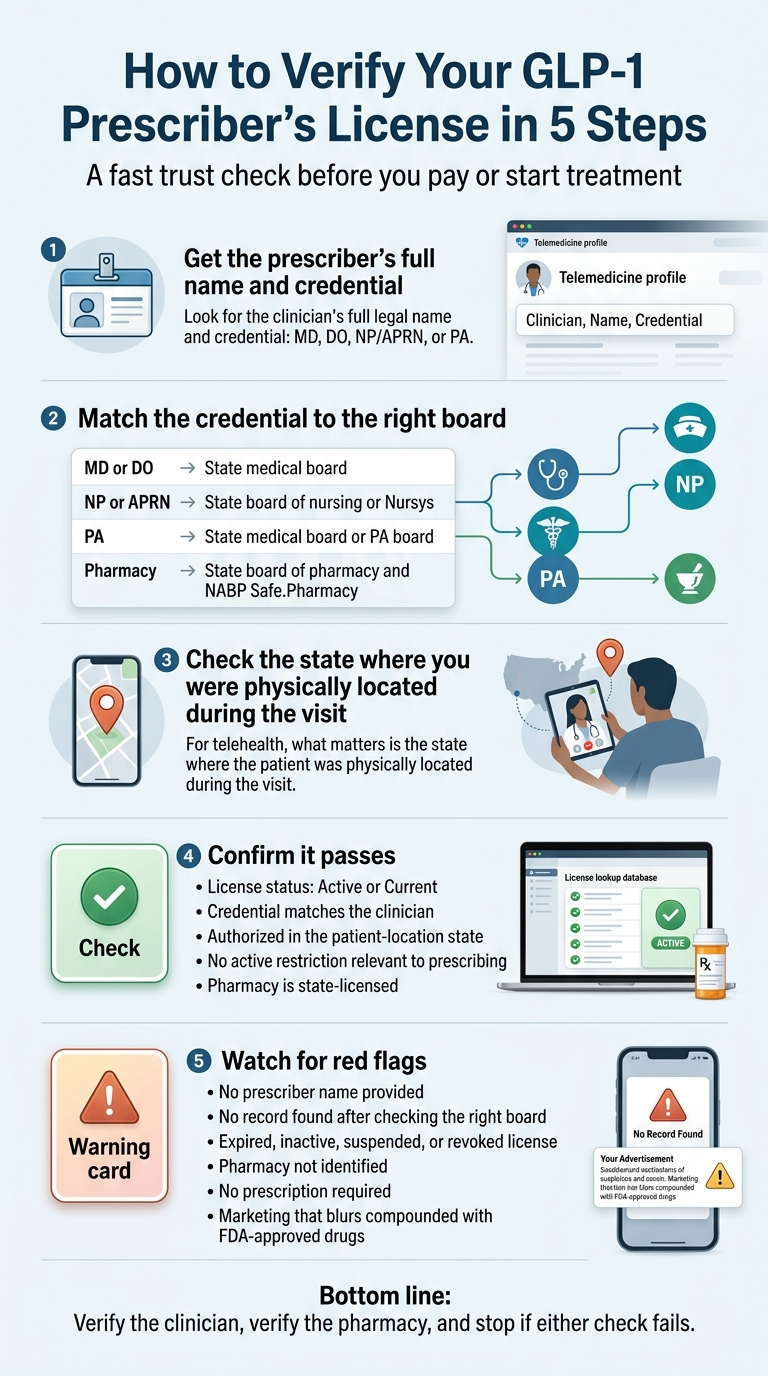
You can verify your GLP-1 prescriber’s license in about five minutes using free official government databases — and if you skip this step, you are taking a bigger risk than most telehealth ads will ever tell you. Here’s the short version: get your prescriber’s full name and credential (MD, DO, NP, or PA) from your telehealth platform, then search the board for that credential in the state where you were physically located during the telehealth visit. The license must show Active or Current status, an expiration date in the future, and no unresolved restriction, probation, suspension, or revocation.
In March 2026, the FDA announced it sent warning letters to 30 telehealth companies for “false or misleading claims” about compounded GLP-1 products. That was the second wave of GLP-1-related warning letters in six months. Verification is how you protect yourself.
Start Here: Which Board Do You Use for Your Prescriber?
Find your prescriber’s credential on your telehealth platform (their name will have letters after it — MD, DO, NP, APRN, or PA). Use the row that matches:
| If your prescriber is a… | Check this first |
|---|---|
| MD or DO (physician) | Your state medical board (or osteopathic board) |
| NP or APRN (nurse practitioner) | Nursys QuickConfirm — then your state board of nursing for APRN authority |
| PA (physician assistant) | Your state medical board (most states) |
| The pharmacy dispensing your prescription | FDA BeSafeRx routes to state board of pharmacy; NABP Safe.Pharmacy verifies domain |
What We Actually Verified on This Page
- Every state board URL in the directory was confirmed live as of April 22, 2026
- Prescriber-type-to-board logic cross-checked against FSMB, NCSBN, and NCCPA
- Cross-state telehealth rules cross-checked against current HHS telehealth licensure guidance and FSMB state-by-state policies
- FDA enforcement context current through March 3, 2026 (30-company warning letter action)
- We re-verify every link quarterly. If you spot a broken one, email us — we fix it within 24 hours.
Do You Actually Need to Verify Your GLP-1 Prescriber?
For telehealth, the state that matters is the one where you were physically located during the visit — not where the company is headquartered, not where the prescriber lives. HHS makes this explicit, and the Federation of State Medical Boards says physicians practicing telemedicine generally must be licensed or registered where the patient is located.
The enforcement is real. In 2023, the Mississippi State Board of Medical Licensure issued a public order suspending a physician’s license for three months for prescribing Ozempic through a messaging-only telehealth platform — no audio, no video, no meaningful medical evaluation.
If the prescriber isn’t licensed in the state where your visit happened:
- Your prescription may not be legally valid.
- Filing a state board complaint later can be complicated — the board you'd naturally complain to may not have jurisdiction.
- The clinical relationship may not meet your state's standards for how a prescribing relationship has to be established.
A legitimate telehealth program wants you to verify. It’s a five-minute check, they know that, and they build their model around being able to pass it. An illegitimate one hopes you won’t bother.
How to Verify Your GLP-1 Prescriber’s License in 5 Minutes
Step 1 — Get the full legal name, credential, and (if possible) NPI
Where the prescriber’s name usually appears:
- On your prescription label or e-prescription PDF
- On the shipping paperwork from the pharmacy
- In the welcome email from the telehealth platform
- On the platform's "Our Clinicians" page or equivalent
- On any signed paperwork — consent form, consultation summary
If you can’t find the name — send this exact message:
“Before I proceed with my prescription, please provide the full legal name, professional credential (MD, DO, NP, APRN, or PA), and state license of the clinician who evaluated me and will be writing my GLP-1 prescription. I’d like to independently verify their licensure.”
Any program operating by the book answers this in a normal support response. If you get stonewalled, keep reading to the red flags section.
Step 2 — Match the credential to the correct licensing board
Different credentials are regulated by different boards. Searching the medical board for an NP will return nothing — that’s not a scam, it’s the wrong board.
| Credential | What it means | Regulated by |
|---|---|---|
| MD | Doctor of Medicine | State medical board |
| DO | Doctor of Osteopathic Medicine | State medical board, or separate osteopathic board (varies by state) |
| NP / APRN | Nurse Practitioner / Advanced Practice Registered Nurse | State board of nursing (licensure); state-specific APRN/prescriptive-authority rules also apply |
| PA | Physician Assistant | State medical board in most states; a separate PA board in some |
| Pharmacist | (Dispenses, not prescribes — but must be licensed) | State board of pharmacy |
Step 3 — Use your state's official lookup tool
You don’t need a subscription service or anything paid. Every state in the U.S. runs a free public lookup for its licensees. Our 50-state directory is below — jump to it, click your state for the right board, and search by last name.
Step 4 — Read the result carefully
What you’re looking for:
- License status: Active or Current (exact wording varies by state)
- Expiration or renewal date in the future
- State of licensure is the state where your visit happened
- No active restriction, probation, suspension, or revocation
A closed disciplinary order from ten years ago may be fine; an active probation tied to prescribing is not. See the status decoder table below.
Step 5 — Also verify the pharmacy
A valid prescriber with no disciplinary record is necessary — but not sufficient. You also need the pharmacy dispensing your medication to be state-licensed and legitimately sourced. That’s the part where most verification guides stop. We don’t — keep scrolling.
Which Lookup for MDs vs DOs vs NPs vs PAs
MD and DO verification
Your state medical board is the authoritative source. FSMB DocInfo (free) aggregates information from all 70 U.S. medical and osteopathic boards — a strong secondary check for the cross-state picture. Caveat: the most up-to-date board-specific information still comes from the individual state board.
NP and APRN verification
Nurse practitioners write a large share of telehealth GLP-1 prescriptions. You must verify them on the nursing board, not the medical board. Nursys QuickConfirm is the NCSBN’s national license verification service — use it as your starting point. Then cross-check your state board of nursing for APRN-specific prescriptive authority, which is state-specific. The Nurse Licensure Compact (NLC) covers RN and LPN/VN licenses, not APRN practice authority. An APRN Compact exists separately but has not been fully enacted in enough states to be operational as of 2026.
PA verification
In most states, physician assistants are licensed by the state medical board. A handful of states have a separate PA licensing board. NCCPA confirms a PA holds current certification and shows reportable disciplinary actions since 2012 — useful as a secondary check, but not a substitute for the state license.
The 50-State GLP-1 Prescriber Verification Directory
Tip: Use Ctrl+F (⌘+F on Mac) to jump to your state.
State Medical Boards — for MDs, DOs, and PAs in most states
Boards of Nursing — for Nurse Practitioners (NP / APRN)
State Boards of Pharmacy — for verifying the dispensing pharmacy
How to Read a License Verification Result
Status language across 5 major state boards
| State (Board) | “Pass” status wording |
|---|---|
| California (MBC) | License Status: License Renewed & Current |
| Texas (TMB) | License Status: Active |
| Florida (MQA) | Status: Clear/Active |
| Georgia (Composite Medical Board) | Status: Active |
| New York (Office of the Professions) | Registration Status: Registered |
Status decoder — what each word actually means
| What you see | What to do |
|---|---|
| Active / Current / Registered | ✅ Pass — check the other fields |
| Active with encumbrance / stipulations | ⚠️ Read the order carefully |
| Expired | ❌ Stop |
| Inactive / Voluntary surrender | ❌ Stop |
| Probation | ⚠️ Read the order — depends on reason |
| Suspended / Revoked | ❌ Stop immediately |
| No records found | ⚠️ Investigate before drawing a conclusion |
License vs Certification vs NPI vs Pharmacy — What Each One Actually Proves
| Check | What it proves |
|---|---|
| State license | Legal authority to practice and prescribe in that state, current as of the search date |
| Board certification | Specialty expertise (e.g., Obesity Medicine) if the prescriber claims it |
| NPI Registry | The provider exists in the federal CMS system, their credential type, primary practice address |
| Pharmacy license | The dispensing pharmacy is legally allowed to operate in that state |
Cross-Checking with NPI Registry and FSMB DocInfo
How to use the NPI Registry
Go to npiregistry.cms.hhs.gov. Search by first + last name. The result tells you: NPI number, enumeration type (Type 1 = individual), credential, primary practice address, specialty taxonomy. What it confirms: the person exists in the federal healthcare system. What it doesn’t confirm: current licensure, discipline, or whether they can legally treat you today.
How to use FSMB DocInfo
Go to docinfo.org. Free for consumers. Includes: every state where the physician is actively licensed, medical school and graduation year, specialty certifications, and any state-level disciplinary action. Updates come monthly in most cases. DocInfo does NOT cover nurse practitioners — for NPs, use Nursys QuickConfirm.
The three-layer check
- 1State board (authoritative, current status) — verify first
- 2NPI Registry (confirms identity + credential match) — quick cross-check
- 3FSMB DocInfo or Nursys QuickConfirm (multi-state picture + discipline) — final layer
If all three line up, you’ve done more verification than 99% of telehealth patients ever do.
The Cross-State Telehealth Rule Most Patients Don’t Know
This is the single most-missed detail in telehealth GLP-1 verification. Patients look up their prescriber, find that yes, they’re licensed somewhere, and assume that’s enough. It isn’t. Telehealth regulators treat the visit as happening where the patient is sitting — not where the clinician is.
The five ways a clinician can legally treat you across state lines
- 1Full licensure in that state — the cleanest, most common.
- 2Licensure compact — the Interstate Medical Licensure Compact (MDs and DOs) and the Nurse Licensure Compact (RNs and LPNs, not APRNs) streamline multi-state licensing. A compact license does not mean one license covers all states — the clinician still holds an individual state license, obtained through a faster process. The APRN Compact exists but has not been fully enacted in enough states to be operational as of 2026.
- 3Reciprocity — some states accept other states' licenses in limited circumstances.
- 4Temporary practice laws — narrow exceptions for short-term care.
- 5Telehealth registration — several states run separate registration programs for out-of-state telehealth providers.
Example state telehealth pathways
| State | Cross-state path for out-of-state telehealth providers |
|---|---|
| Florida | Runs a Telehealth Provider Registration Program; out-of-state providers must register separately through the FL Department of Health. |
| Alabama | Physicians must hold an Alabama license; narrow exception for "irregular or infrequent" services (fewer than 10 days or 10 patients/year). |
| Georgia | Physicians treating Georgia-located patients must be licensed in Georgia or meet a narrow consultation exception. |
| Texas | Requires full Texas licensure for most ongoing telehealth practice; Texas is part of the Interstate Medical Licensure Compact. |
| California | Requires California licensure; California participates in neither the Interstate Medical Licensure Compact nor the Nurse Licensure Compact. |
A Clean License Doesn’t Mean the Pharmacy Is Legit — Here’s Why That’s Good News
The pharmacy verification workflow
Find the pharmacy's name
It'll be on the bottle, label, shipping paperwork, or medication box. If you can't find it anywhere, ask support.
Check against two sources
- FDA BeSafeRx — FDA’s consumer resource that routes you to the correct state board of pharmacy.
- Your state board of pharmacy — authoritative for in-state licensure.
- NABP Safe.Pharmacy — cross-check the website domain.
For compounded GLP-1s: extra check
- FDA Registered Outsourcing Facilities list — the official roster of 503B compounding facilities registered with the FDA.
- The pharmacy's state board listing to confirm it's a current 503A pharmacy (state-regulated, patient-specific compounding).
Confirm four basics
- The pharmacy required a valid prescription (no prescription = automatic fail)
- It has a physical U.S. address and phone number
- It provides access to a licensed pharmacist
- It accepts standard payment methods (not wire transfer, crypto, Zelle, or prepaid debit cards)
7 Red Flags — Walk Away If You See These
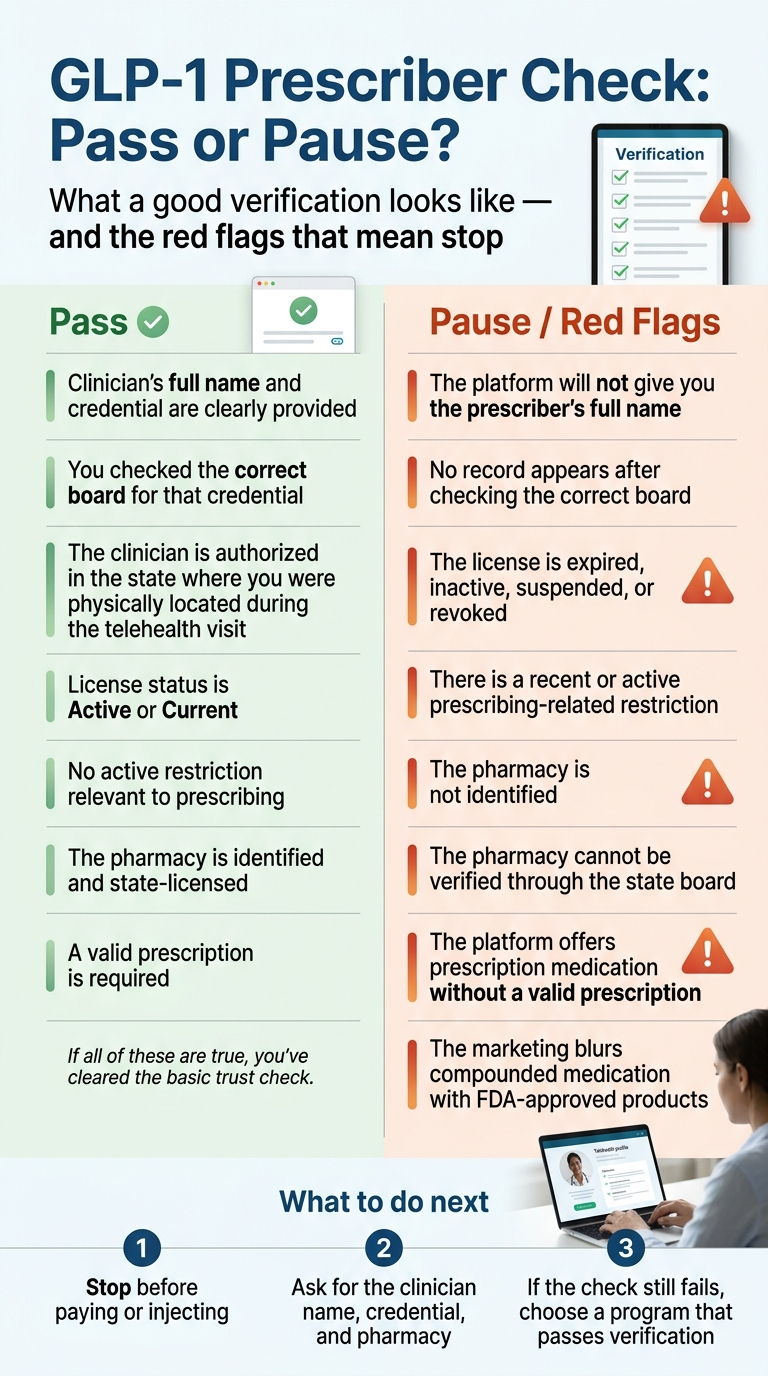
No records found in the state where your visit happened
Could be wrong spelling, wrong board, or unlicensed. Rule out the first two, then treat the third as a stop.
License status isn't Active or Current
Expired, inactive, voluntarily surrendered, suspended, revoked — none of these mean "still able to prescribe to you." Don't proceed.
Recent disciplinary action relevant to prescribing or telehealth
Read the order. Recent + relevant + repeated = walk away. A five-year-old administrative issue on an unrelated matter is different from an active order restricting the prescriber's ability to write for weight-loss medications.
The platform won't tell you your prescriber's name
"Reviewed by our licensed clinicians" without a specific name and credential is not a verification — it's a marketing phrase. If a company won't give you the name, that's the answer.
Text-only or questionnaire-only in a state that requires audio-visual
State rules vary. The 2023 Mississippi Board suspension of a physician for prescribing Ozempic via messaging-only telehealth was enforcement of exactly this.
The pharmacy isn't named or isn't licensed in your state
Even if the prescriber checks out, if the pharmacy can't be identified on your state board of pharmacy or NABP Safe.Pharmacy — stop. Legitimate pharmacies don't hide.
Marketing that blurs compounded with FDA-approved
"Same active ingredient as Wegovy." "Clinically equivalent to Zepbound." "FDA-registered pharmacy" (sounds like FDA-approved but isn't). This is exactly the language the FDA is currently enforcing against.
What to Do If the Platform Won’t Give You the Prescriber’s Name
Here’s the script to send — copy, paste, send:
Patient information request template
“Hello — before I move forward with my prescription, please provide the following so I can independently verify the clinician’s credentials:
- The full legal name of the clinician who reviewed my intake or evaluation.
- Their professional credential (MD, DO, NP, APRN, or PA).
- The state(s) in which they are licensed.
- The state license number, if available.
- The name and state license of the pharmacy that will dispense my medication.
I understand this is standard patient information and I’d like it in writing. Thank you.”
If they respond fully and promptly: run the verification, make your decision.
If they respond with only a first name or vague language: ask again, referencing your first message.
If they refuse, dodge, or don’t respond: cancel. Legitimate programs answer this question all day, every day.
What to Do If Your Verification Fails
Cancel the subscription immediately
- Use the in-app cancellation tool first. Take a screenshot of the confirmation.
- If blocked, contact your credit card company to dispute the charge.
- If you've received medication you're uncertain about, don't inject it. Keep the packaging.
Report the platform
- FDA MedWatch (fda.gov/safety/medwatch) — for suspected counterfeit or quality issues.
- Your state board of pharmacy — for pharmacy violations.
- Your state medical or nursing board — for prescriber violations.
- Your state attorney general or the FTC — for deceptive billing or fake reviews.
Find a program where verification is easy to pass
- Start here if you're not sure what you need. Two programs we've independently verified against the exact checklist in this guide:
What we verified for each recommended program
| What we checked | Embody | Ro |
|---|---|---|
| Prescribers disclosed before payment? | ✅ | ✅ |
| Dispensing pharmacy disclosed on paperwork? | ✅ | ✅ |
| Medication type | Compounded GLP-1 (injections/gum) | FDA-approved branded (Zepbound, Foundayo, Wegovy) |
| Clinical oversight disclosed? | ✅ | ✅ |
| Known FDA/FTC warning letter? | None found | None found |
| Price/membership clearly itemized? | ✅ | ✅ (Ro Body membership separate from medication cost) |
| Last independently verified | Current | Current |
Primary pick: Embody — Best low-cost GLP-1 starter and gum option
Embody offers low first-month pricing from $99 (semaglutide injection) or $149 (tirzepatide injection), no insurance requirement, and a unique needle-free GLP-1 gum option. Their clinical oversight is clearly disclosed, and prescribers are straightforward to verify using the method in this guide.
Check Embody Eligibility →FDA-approved brand-name with insurance help: Ro
Ro carries Zepbound®, Foundayo®, and Wegovy® plus a free GLP-1 Insurance Coverage Checker and insurance concierge support. Ro Body membership is $39 for the first month, then as low as $74/month on annual prepay (or $149/month month-to-month). GLP-1 medication is billed separately at manufacturer cash-pay pricing.
See Ro’s current GLP-1 options and pricing →Authoritative Source Quotes Used in This Guide
"Boards generally require physicians practicing telemedicine to be licensed or registered where the patient is located."
"Make sure the GLP-1 medication is provided by a licensed pharmacy and prescribed by a licensed health care provider."
"Check the pharmacy's license through the state board of pharmacy. If the pharmacy is not listed, do not use the site."
"It's a new era. We are paying close attention to misleading claims being made by telehealth and pharma companies across all media platforms — and taking swift action."
Frequently Asked Questions
If your provider passed every check
You did more due diligence than most telehealth patients ever do. Go ahead with confidence, save the screenshots, and re-run this same five-minute check once a year or any time you’re assigned a new clinician.
If your provider failed any check
You’ve just saved yourself a bad outcome. Cancel first, report second, pick a better program third.
Take the 60-second GLP-1 matcherRelated reading
- How to Get GLP-1 Medications Safely Online (2026 Guide)
- Prior Authorization for GLP-1s: Requirements, Forms & Approval Checklist
- SHED GLP-1 Reviews — Independent Deep-Dive
- Ro GLP-1 Review — Independent Deep-Dive
- SHED vs Ro GLP-1 (2026): Pricing, Meds, Honest Verdict
- Find Your GLP-1 Path — Free 60-Second Matching Quiz
About this guide
Written by the Weight Loss Provider Guide Editorial Team. Weight Loss Provider Guide is an independent comparison resource for GLP-1 telehealth providers. We don’t run a pharmacy or a telehealth platform.
Verification cadence
Quarterly for all state board URLs. Monthly for FDA and FTC enforcement context. Immediately after any material regulatory change.
Last verified: Current.
Affiliate disclosure: This page contains affiliate links. When a reader enrolls with Embody or Ro through our links, we may earn a commission. Compensation does not influence which programs we verify or recommend.
This is not medical advice. The information here helps you verify that a prescriber and pharmacy are licensed and legal. It does not replace an evaluation from a licensed clinician, and it does not determine whether a GLP-1 medication is appropriate for you personally.