GLP-1 Symptom Diary: What to Track + Free 28-Day Template
By WPG Research Team · Published · Last verified:
This page is educational. It is built from FDA prescribing information and peer-reviewed sources. Nothing here is medical advice. Talk to your prescriber for decisions about your medication.
A GLP-1 symptom diary is a 60-second daily log of your dose, symptoms, food, water, weight, and one question for your clinician. Done right, it shows you which day after your shot you actually feel worst, turns 28 days of memory into a 90-second summary your doctor can act on, and flags the few symptoms that should never sit in a diary while you “see if it passes.”
Most pages on this topic either sell you an app or hand you a pretty printable with no rationale behind the fields. We built this differently. The symptom and safety fields below are built from FDA prescribing information for Wegovy, Zepbound, Mounjaro, Ozempic, Rybelsus, Saxenda, Trulicity, and the newly approved Foundayo (orforglipron, approved April 1, 2026) — then trimmed into a tracker that's short enough to keep alive on the days you feel worst.
Free 28-day printable diary
One-page grid with the 5+2 fields, 0–3 severity legend, a red-flag card for the fridge, and space for your doctor-visit summary. No email required.
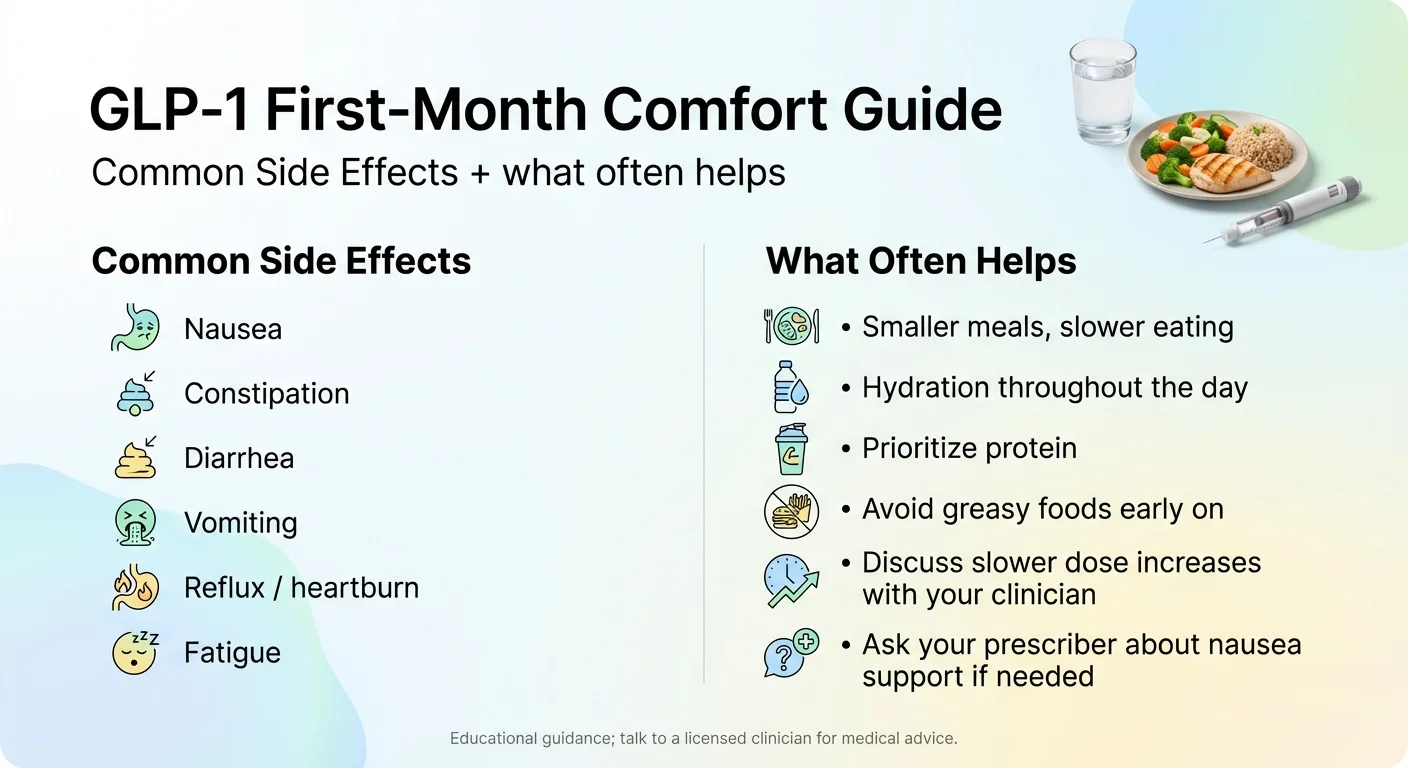
The 60-second tracker (your first screen)
Fill this in tonight. If you do nothing else today, do this.
| Field | What to write |
|---|---|
| Date + medicine + dose | "May 12 — Zepbound 5 mg, week 3 at this dose" |
| Shot day or pill time | "Sunday shot, day 2 since shot" |
| Injection site (if injectable) | "Right thigh" |
| Worst symptom today, rated 0\u20133 | "Nausea — 2" |
| Bowel movement | None / soft / hard / diarrhea |
| Water (rough is fine) | "6 cups" |
| Food note | "Heavy fatty dinner — made nausea worse" |
| Red flag today? [see table below] | No / Yes |
| One question for my clinician | "Should I hold this dose another week?" |
That's the whole daily fill-in: five core fields, two context lines, and two safety handoff lines. Repeat tomorrow. The rest of this page explains why each field matters, what the FDA label tells you about when symptoms typically peak, and which symptoms should not be tracked — they should be called in.
What is a GLP-1 symptom diary?
A GLP-1 symptom diary is a short daily record of your medication, symptoms, severity, and context (food, water, dose timing) while taking a GLP-1 receptor agonist — that's the drug class that includes semaglutide (Ozempic, Wegovy, Rybelsus), tirzepatide (Mounjaro, Zepbound), liraglutide (Saxenda, Victoza), dulaglutide (Trulicity), exenatide (Byetta, Bydureon), and orforglipron (Foundayo). The diary's job is pattern recognition and communication, not diagnosis.
It is not a triage tool. The diary does not decide whether a symptom is safe. That's what your Medication Guide and your clinician are for.
Who this is for
- You started a GLP-1 in the last 90 days
- You just got a dose increase and want a record before it gets fuzzy
- You’re going into a clinician visit and don’t want to say “I don’t really remember”
- You had a scary symptom day and want to know if it was the medication or the burrito
- A provider literally said “track your symptoms” and didn’t tell you how
Who it's not for
- ×Anyone hoping a diary will replace clinical advice
- ×Anyone trying to self-diagnose pancreatitis, gallbladder issues, or anything else serious
- ×Anyone planning to change their dose without a clinician
| The diary helps you… | The diary can’t… |
|---|---|
| Notice symptom timing patterns | Diagnose pancreatitis, gallbladder disease, dehydration, or allergic reaction |
| Build a 90-second summary for your clinician | Tell you to change, hold, or stop your dose |
| Remember which thigh, which dose week, which meal | Replace your Medication Guide |
| Catch a worsening trend early | Prove a symptom was caused by the medication |
| Stop blaming yourself for “weird” symptom days | Decide whether the medication is safe for you |
What should you track in a GLP-1 symptom diary?
Track seven things daily: dose context (medication, mg, day since last shot), one or two main symptoms rated 0\u20133, food context, hydration in cups, weight once a week, and on optional days, sleep and mood. These cover the most common labeled GLP-1 side effects, plus the context that explains most pattern variation.
| Field | Why it earned a spot | Source type |
|---|---|---|
| Dose context (drug, mg, day since last dose) | Dose escalation and timing affect tolerability across every GLP-1 label | FDA prescribing information |
| Symptom + 0–3 severity | Turns vague memory into a comparable pattern | Practical tracking design |
| Bowel movement | Constipation and diarrhea are labeled adverse reactions across the class | FDA prescribing information |
| Water intake | Vomiting and diarrhea can contribute to dehydration and kidney warnings on every GLP-1 label | FDA prescribing information |
| Food note | Meal composition and size are the most commonly cited modifiable trigger in clinical management guidance | Clinical management consensus (PMC 9821052) |
| Red-flag yes/no | Separates routine logging from action items | Medication Guides |
| One clinician question | Turns 28 days of logs into a productive visit | Practical tracking design |
The “5 + 2” framework, fields explained
Dose context — medication, dose (mg), and “days since last dose”
GLP-1 side effects are dose- and timing-dependent. Tirzepatide-based drugs (Zepbound, Mounjaro) have a half-life of about 5 days; semaglutide-based drugs (Wegovy, Ozempic) about 7 days. Without this field, you can’t tell whether today’s nausea is the medication or last night’s pizza.
Source: FDA prescribing information; SURPASS-2 trial, NEJM 2021.
Main symptom + severity 0–3
0 = none | 1 = noticed it, didn’t slow me down | 2 = bothered me, changed what I ate or did | 3 = affected my whole day. Track the standard GLP-1 list: nausea, vomiting, diarrhea, constipation, fatigue, headache, reflux, injection-site reaction, and appetite level.
Food note (one word + worst-tolerated food)
“Heavy,” “light,” “fatty,” “fine,” “skipped” — plus what hit hardest. High-fat and large-volume meals are the most commonly cited triggers. Slowed gastric emptying means the food sits longer than it used to, and fatty meals make that worse.
Hydration (rough cups of water)
The field most people skip and the most important for safety. The FDA labels for Wegovy and Zepbound both warn that nausea, vomiting, and diarrhea can lead to dehydration, and there are postmarketing reports of acute kidney injury in patients who got dehydrated from GI symptoms. Your water log is an early-warning system.
Weight (once a week, same time, same clothes)
Daily weight is noisy and emotionally costly. Weekly trend is what your clinician uses. GLP-1 weight loss isn’t linear — some weeks the scale doesn’t move, some weeks you’re up two pounds from water. The trend across four weeks is what tells the story.
Sleep (optional)
(optional)Hours and a 0–3 quality score. Fatigue is the second most reported symptom in the 2026 University of Pennsylvania analysis of about 67,000 GLP-1 users — second only to nausea. Sleep is often the missing variable behind “I felt awful and I don’t know why.”
Mood (optional)
(optional)One word: low, even, good. A line if anything notable. Mood and food-noise changes show up in real-world reports even when they’re not prominently labeled. If you notice mood changes, write them down — for your clinician, and for yourself.
How long do GLP-1 side effects last and when do they show up?
For weekly injectable GLP-1s, the labels support a dose-timing clue — not a universal symptom calendar. Tirzepatide reaches its peak blood concentration at a median of 24 hours after injection, with a range of 8 to 72 hours. Semaglutide injection reaches peak concentration 1 to 3 days after dosing.Both labels note that nausea, vomiting, and diarrhea are most common during dose escalation and tend to decrease over time. Your own diary is what tells you your personal worst-day window.
| What the label tells you | What only your diary can tell you |
|---|---|
| Tirzepatide reaches peak concentration at a median of 24 hours after injection (range 8–72 hours) | Whether your symptoms actually peak on day 1, 2, 3, or somewhere else |
| Semaglutide injection reaches peak concentration 1–3 days after dosing | Whether your worst day lines up with that exposure window |
| Nausea, vomiting, and diarrhea are most common during dose escalation and often decrease over time | Whether your symptoms are improving, stable, or worsening at your current dose |
| Half-life is roughly 5 days (tirzepatide) and 7 days (semaglutide) | Whether food, hydration, illness, or another factor is contributing |
Sources: FDA prescribing information for tirzepatide and semaglutide; SURPASS-2 trial, NEJM 2021; Foundayo prescribing information, FDA approval April 1, 2026.
How common are GLP-1 side effects? (FDA-label rates compared)
Nausea is the most common GLP-1 side effect across every drug in the class: about 44% on Wegovy 2.4 mg injection, 25\u201329% on Zepbound, and 26\u201335% on Foundayo depending on dose — all per FDA prescribing information. GI-specific discontinuation is much lower — roughly 2\u20136% across the major labels — meaning most people whose diaries get rough at week 2 are still on the medication at week 12.
| Side effect | Wegovy 2.4 mg (semaglutide injection) | Zepbound (tirzepatide) | Foundayo (orforglipron, oral) |
|---|---|---|---|
| Nausea | ~44% | ~25–29% | 26–35% (dose-dependent) |
| Diarrhea | ~30% | ~19–23% | 21–25% |
| Vomiting | ~24% | ~8–13% | 13–24% |
| Constipation | ~24% | ~11–17% | 20–27% |
| Discontinued due to GI symptoms | 4.3% (vs 0.7% placebo) | 1.9–4.3% depending on dose | 3–6% depending on dose |
Sources: Wegovy prescribing information, DailyMed, updated 2026; Zepbound prescribing information, FDA accessdata, 2024 and 2026 labels; Foundayo prescribing information, DailyMed, FDA approval April 1, 2026. Rates from controlled trials — not head-to-head comparisons.
What GLP-1 side effects are not on the label?
A 2026 University of Pennsylvania analysis published in Nature Health used AI to study more than five years of Reddit posts from approximately 67,000 GLP-1 users (about 410,000 posts). Beyond the labeled GI side effects, the researchers flagged menstrual irregularities, hot flashes and chills, mood changes, and fatigue as patient-reported signals. These are signals worth tracking and discussing, not confirmed new side effects.
| Symptom | FDA label status | Reported in 2026 Penn analysis | What to do if you see it |
|---|---|---|---|
| Nausea | Listed, top adverse reaction | ~37% (Reddit dataset) | Standard tracking; escalate only if severe or persistent |
| Fatigue | Listed | ~17% (higher than most trial-level reports) | Track sleep and protein intake context; mention at next visit if it lingers |
| Menstrual irregularity | Not prominently labeled | Reported repeatedly | Worth a clinical conversation — and see the contraception note in drug-specific section |
| Hot flashes / chills | Not prominently labeled | Reported | Log timing and frequency; bring to your provider |
| Mood changes | Not prominently labeled | Reported | Track separately. If low mood persists or worsens, treat it like the red flag it is — not a diary entry |
| Unusual skin sensations (dysesthesia) | Added to Wegovy labeling in 2024 | Documented in 2025 case reports | Document; mention to clinician |
Red-flag symptoms: when to call, not just log
A symptom diary should never delay action. Log the facts if you have time. Call first. The diary can catch up.
| What's in your diary | What it might signal | What to do |
|---|---|---|
| Mild nausea / fatigue (0\u20131), normal water, no other concerns | Normal adjustment | Self-manage |
| Nausea or constipation rated 2\u20133 for ≥3 days, OR water intake clearly dropping, OR symptoms worsening week over week | Possible intolerance or trend that needs attention | Schedule visit |
| Severe abdominal pain, especially radiating to the back, with or without vomiting | Possible pancreatitis — labeled warning for every GLP-1 | Call same-day |
| Persistent vomiting preventing fluids, severe diarrhea, signs of dehydration (dark urine, dizziness on standing, confusion) | Volume depletion → acute kidney injury risk | Call same-day |
| Upper-right belly pain with fever, yellowing skin or eyes (jaundice), or clay-colored stools | Possible gallbladder disease — labeled warning, especially with rapid weight loss | Call same-day |
| Rash, swelling of face / lips / tongue, breathing difficulty, fainting | Allergic reaction | ER / 911 now |
| Lump / swelling in the neck, persistent hoarseness, trouble swallowing — listed in boxed warning on every GLP-1 label | Possible thyroid tumor warning symptom | Call same-day |
| Shaky, sweaty, confused, hungry, headache, fast heartbeat — especially if you take insulin or a sulfonylurea | Hypoglycemia (low blood sugar) | Schedule visit |
| Thoughts of self-harm, sudden severe low mood, or major mental health changes | Mental health emergency — do not bury this in a diary | Call 988 or 911 |
| New or worsening vision changes (if you have diabetes) | Diabetic retinopathy concern (labeled) | Schedule visit |
Surgery and anesthesia \u2014 add a procedure-alert line
Sources: FDA prescribing information for Wegovy, Zepbound, Mounjaro, Ozempic, Foundayo. ASA patient guidance, madeforthismoment.asahq.org.
What to log for nausea, vomiting, diarrhea, and constipation
For GI symptoms, the most useful note is not just the symptom name — it is severity, timing, duration, meal context, hydration, and whether things are improving or getting worse. FDA labels for both Wegovy and Zepbound warn that persistent nausea, vomiting, and diarrhea can lead to dehydration and kidney problems, so duration and water intake are the fields your clinician will check first.
| Symptom | What to write | Why this combination matters |
|---|---|---|
| Nausea | Severity 0–3 + hours after dose + hours after meal + what helped | Timing tells you whether it is dose-cycle or food-related |
| Vomiting | Number of episodes + could you keep fluids down + any abdominal pain | Dehydration and pancreatitis are the two big concerns |
| Diarrhea | Frequency + duration + fluid intake + any fever | Volume depletion risk; fever changes the call |
| Constipation | Days since last bowel movement + stool difficulty + fluids + fiber + activity | Constipation can outlast a nausea spike and become its own problem |
| Reflux / belching | Meal timing + lying down vs. upright + nighttime pattern | Practical trigger context |
What to track for each GLP-1 medication
Use the same core diary for every GLP-1. Each medication just needs one or two extra fields. The point is not to rank medications — your diary tells you how you respond to yours.
Semaglutide injection \u2014 Ozempic, Wegovy
Add: injection site rotation (abdomen, thigh, upper arm). Track which site each week. Note the dose-escalation date — Wegovy's standard titration is 0.25 mg → 0.5 → 1 → 1.7 → 2.4 mg, every 4 weeks. Expect a fresh wave of mild symptoms for 1\u20132 weeks after each step-up.
Semaglutide oral tablet \u2014 Wegovy tablets
Add: pill timing. Wegovy tablets are taken once daily on an empty stomach in the morning with up to 4 ounces of plain water, then you wait at least 30 minutes before food, drink, or other oral medications. If you took it differently today, log it. The Wegovy tablet label notes that median duration of constipation in the tablet clinical study was about 26 days — worth knowing when you are deciding whether to ride it out or bring it up.
Semaglutide oral \u2014 Rybelsus
Add: pill timing. Rybelsus needs to be taken at least 30 minutes before the first food, drink, or other oral medication of the day, with no more than 4 ounces of plain water. If you took it differently today, log it. Absorption is sensitive to how you take it.
Tirzepatide \u2014 Mounjaro, Zepbound
Add: injection site rotation (abdomen, thigh, upper arm — at least 2 inches from your belly button per the Zepbound label). Note your dose-escalation week — Zepbound's titration runs 2.5 → 5 → 7.5 → 10 → 12.5 → 15 mg, at least 4 weeks between steps. The label lists hair loss at 4\u20135% across doses, associated with weight reduction — track shedding if you notice it.
Oral contraception note: Switch to a non-oral method or add a barrier method for 4 weeks after starting and 4 weeks after each dose escalation. Delayed gastric emptying can reduce absorption of oral contraceptives. (Same applies to Mounjaro.)
Orforglipron \u2014 Foundayo (newest, approved April 1, 2026)
Add: dose-step date. Foundayo escalates 0.8 → 2.5 → 5.5 → 9 → 14.5 → 17.2 mg, with at least 30 days between steps. No weekly cycle — symptoms track each escalation step. Foundayo can be taken at any time of day without food or water restrictions, but log your timing for consistency.
Oral contraception note: Non-oral or barrier method for 30 days after starting and 30 days after each dose escalation, per the Foundayo label.
Liraglutide \u2014 Saxenda, Victoza
Daily injectables — no weekly cycle. Add: daily injection time. Symptoms usually peak in the first 2\u20134 weeks and ease as you adjust. Saxenda escalates 0.6 → 1.2 → 1.8 → 2.4 → 3.0 mg daily.
Dulaglutide (Trulicity), exenatide (Byetta, Bydureon)
Older GLP-1s, still in use. Same core diary. Bydureon (weekly extended-release exenatide) is known for injection-site nodules — track site appearance specifically. Byetta (twice-daily) requires more attention to dose timing relative to meals.
How to use your diary at a doctor visit (the 90-second summary)
Bring a one-paragraph summary, not a stack of daily entries. The format below is built for a fast visit: medication, dose week, worst-day pattern, symptom severity, hydration, red flags, and one specific question. See also: questions to ask your prescriber.
The 90-second summary template
“I'm on [medication] [dose], in week [X] at this dose. Over the last 28 days, my worst symptom days were consistently [X hours/days] after my [day] dose — [main symptom] rated [X/3] on those days, dropping to [X] by [day]. I had [vomiting/diarrhea/other] [X times] in 28 days, [context]. Constipation has been steady around [X/3] most of the cycle. Water intake averaged [X] cups daily, dropping to [X] on the worst days. I lost [X lbs] across the 4 weeks. No [red flag symptoms]. I'd like to discuss [specific question].”
A worked example
“I'm on Zepbound 7.5 mg, week 6 at this dose. Over the last 28 days, my worst symptom days were consistently 24\u201348 hours after my Sunday injection — nausea rated 2\u20133 on those days, dropping to 0\u20131 by Thursday. I had vomiting twice in 28 days, both after high-fat meals. Constipation has been steady around 1\u20132 most of the cycle. Water intake averaged 7 cups daily, dropping to 4 on the worst nausea days. I lost 5 lbs across the 4 weeks. No abdominal pain, no jaundice, no allergic symptoms. I'd like to discuss whether to hold this dose another month before moving to 10 mg.”
What not to bring
- ×30 screenshots of every diary day
- ×Photos of every meal
- ×Unlabeled notes with no timestamps
- ×Anxiety without dates (your provider can’t help “I feel terrible sometimes”)
Not sure which GLP-1 program is right for you?
Our 60-second path finder matches you to the right provider based on your health situation, BMI, and insurance — including telling you when the answer is “not yet.”
App vs. spreadsheet vs. printable: which should you use?
The best tracker is the one you will actually use. There's no wrong choice — only the wrong choice for you.
| Format | Best for | Trade-off |
|---|---|---|
| Free printable PDF | Privacy, simplicity, low friction, sharing one page with a clinician | No reminders, no automatic charts, you have to keep the paper |
| App (Shotsy, MeAgain, GLP-1 Diary, MyFitnessPal GLP-1 tracker) | Reminders, injection-site rotation, charts, HealthKit / Google Fit sync | Data privacy varies — read the data-safety section before installing |
| Spreadsheet (Google Sheets, Notion, Excel) | Customizable, transparent, easy to export to a doctor, no app account needed | More setup, no built-in reminders |
| Notes app (Apple Notes, etc.) | Quick freeform | Hard to spot patterns, no scoring, easy to lose entries |
| Paper journal / Etsy printable | If paper is your thing | Cost ($3–$10), no editing, easy to lose |
App data privacy \u2014 read this before installing
Disclosure: we are not affiliated with any tracker app and do not earn anything from the apps listed above. The free printable on this page works without any third-party app.
What a GLP-1 symptom diary is not for
A diary records facts. It does not make decisions. Do not use it to diagnose pancreatitis, gallbladder disease, dehydration, allergic reactions, hypoglycemia, gastroparesis, or medication failure. Do not change, skip, increase, or stop your dose based on diary data without your clinician's input.
Do not use it to decide if your medication is “working”
A common confusion: people read their diaries, see “no major symptoms” and think the medication is not working. Side effects and effectiveness are different mechanisms. Plenty of people lose weight on GLP-1s with minimal nausea. Track appetite changes, weekly weight trend, and (if you have diabetes) glucose response. Those are the signals of efficacy.
Do not use it to justify unapproved sources
The FDA has warned about unapproved GLP-1 products sold online and through compounding pharmacies that may be counterfeit, may contain the wrong ingredients, or may contain no active drug at all. Your diary will not catch a counterfeit product — it will just record symptoms that may have a very different cause than you assume.
Frequently asked questions
How we built and verified this page
We built this diary by pulling FDA prescribing information directly from accessdata.fda.gov and DailyMed for Wegovy, Zepbound, Mounjaro, Ozempic, Rybelsus, Saxenda, Trulicity, and Foundayo. We cross-referenced peer-reviewed pharmacokinetic data including the SURPASS-2 head-to-head trial published in NEJM 2021. We used the 2026 University of Pennsylvania analysis in Nature Health for off-label patient-reported signals, framed as signals rather than confirmed side effects.
| Verified item | Source |
|---|---|
| Common adverse reaction frequencies (Wegovy, Zepbound, Foundayo) | FDA prescribing information via DailyMed and accessdata.fda.gov |
| Red-flag warnings (pancreatitis, gallbladder, dehydration, allergic, hypoglycemia, vision, thyroid) | Medication Guides and prescribing information |
| Tirzepatide peak concentration timing (median 24 hours, range 8–72 hours) and ~5-day half-life | Zepbound prescribing information; SURPASS-2 trial, NEJM 2021 |
| Semaglutide peak concentration timing (1–3 days) and ~7-day half-life | Wegovy and Ozempic prescribing information |
| Oral contraceptive interaction warnings (4 weeks tirzepatide, 30 days orforglipron) | Zepbound and Foundayo prescribing information |
| Foundayo approval and dosing schedule | FDA approval announcement, April 1, 2026; Foundayo prescribing information |
| Anesthesia / deep sedation guidance | American Society of Anesthesiologists patient guidance, madeforthismoment.asahq.org |
| Off-label patient-reported signals (~67,000 users, ~410,000 posts) | Nature Health 2026, University of Pennsylvania analysis |
| FDA warning on unapproved/counterfeit GLP-1 products | fda.gov |
The free 28-day printable
A one-page 28-day grid with the 5+2 fields, the 0\u20133 severity legend, a red-flag card you can keep on the fridge, and space for your 90-second doctor-visit summary. No email gate. Print at home, fold into a planner, or fill it in on an iPad with GoodNotes or Notability.
Free download
GLP-1 Symptom Diary — 28-Day Printable
Prefer digital? Use the same fields in a Google Sheets template or a notes app — whatever fits your week and your privacy preferences.
Related guides
GLP-1 Side Effects Overview
Complete guide to the full labeled side-effect profile.
Semaglutide Side Effects
Wegovy, Ozempic, Rybelsus — what to expect.
Tirzepatide Side Effects
Zepbound and Mounjaro — labeled rates and timing.
Managing GLP-1 Nausea
Evidence-based strategies for the most common symptom.
GLP-1 Constipation
Why it happens and what actually helps.
GLP-1 Diarrhea
Timing, hydration, and when to call.
Ozempic Side Effects
Semaglutide for diabetes — labeled and reported.
Wegovy Side Effects
Semaglutide for weight management.
Mounjaro Side Effects
Tirzepatide for type 2 diabetes.
Zepbound Side Effects
Tirzepatide for weight management.
Compounded GLP-1 Safety
What the FDA warnings mean for your diary.
GLP-1 and Surgery / Anesthesia
ASA guidance and how to prep your surgical team.
Questions to Ask Your Prescriber
12 questions to make your next visit productive.
Last verified: . We re-verify this page quarterly and whenever a major label updates.
Sources cited on this page:
- •Wegovy prescribing information, DailyMed, updated March 19, 2026
- •Zepbound prescribing information, FDA accessdata, 2024 and 2026 labels
- •Foundayo (orforglipron) prescribing information; FDA approval announcement, April 1, 2026
- •Mounjaro, Ozempic, Rybelsus, Saxenda, Trulicity prescribing information via DailyMed
- •SURPASS-2 trial: Frias JP et al., NEJM 2021
- •University of Pennsylvania analysis of GLP-1 side effects via Reddit, Nature Health 2026
- •Clinical recommendations for managing GLP-1 GI adverse events, PMC 9821052
- •American Society of Anesthesiologists patient guidance on GLP-1 medications and anesthesia
- •FDA: “FDA’s concerns with unapproved GLP-1 drugs used for weight loss”
- •Cleveland Clinic: GLP-1 agonists overview
Nothing on this page is medical advice. For decisions about your medication, talk to your prescriber.