Does SkinnyRx Accept HSA/FSA? Yes — But Check These 5 Things Before You Swipe (2026)
By the Weight Loss Provider Guide editorial team — an independent comparison resource for GLP-1 telehealth providers. · Last verified: May 1, 2026.
This page contains affiliate links. If you sign up through them, we may earn a commission at no extra cost to you. Our verification is independent of commission.
The short answer (decide in 30 seconds)
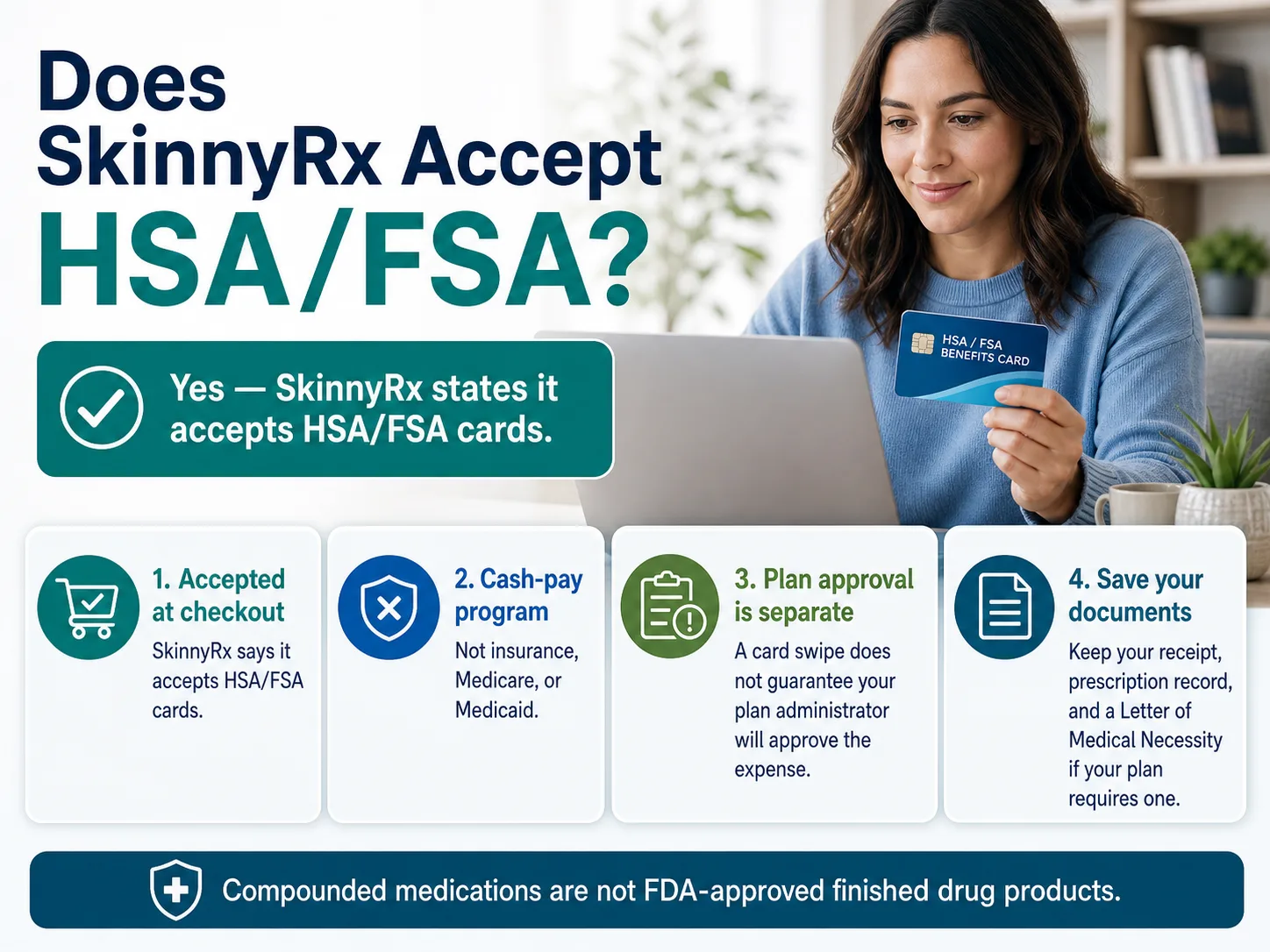
Yes — SkinnyRx accepts HSA/FSA cards at checkout, according to its published FAQ. SkinnyRx is cash-pay only — no insurance, no Medicare, no Medicaid — so HSA and FSA dollars are how most people lower the effective cost.
Here's the catch most pages skip: your card running at SkinnyRx checkout is not the same thing as your plan administrator approving the expense later. Two different decisions, two different parties, two different rule sets.
- ✅ Accepted at checkout — yes, SkinnyRx says so.
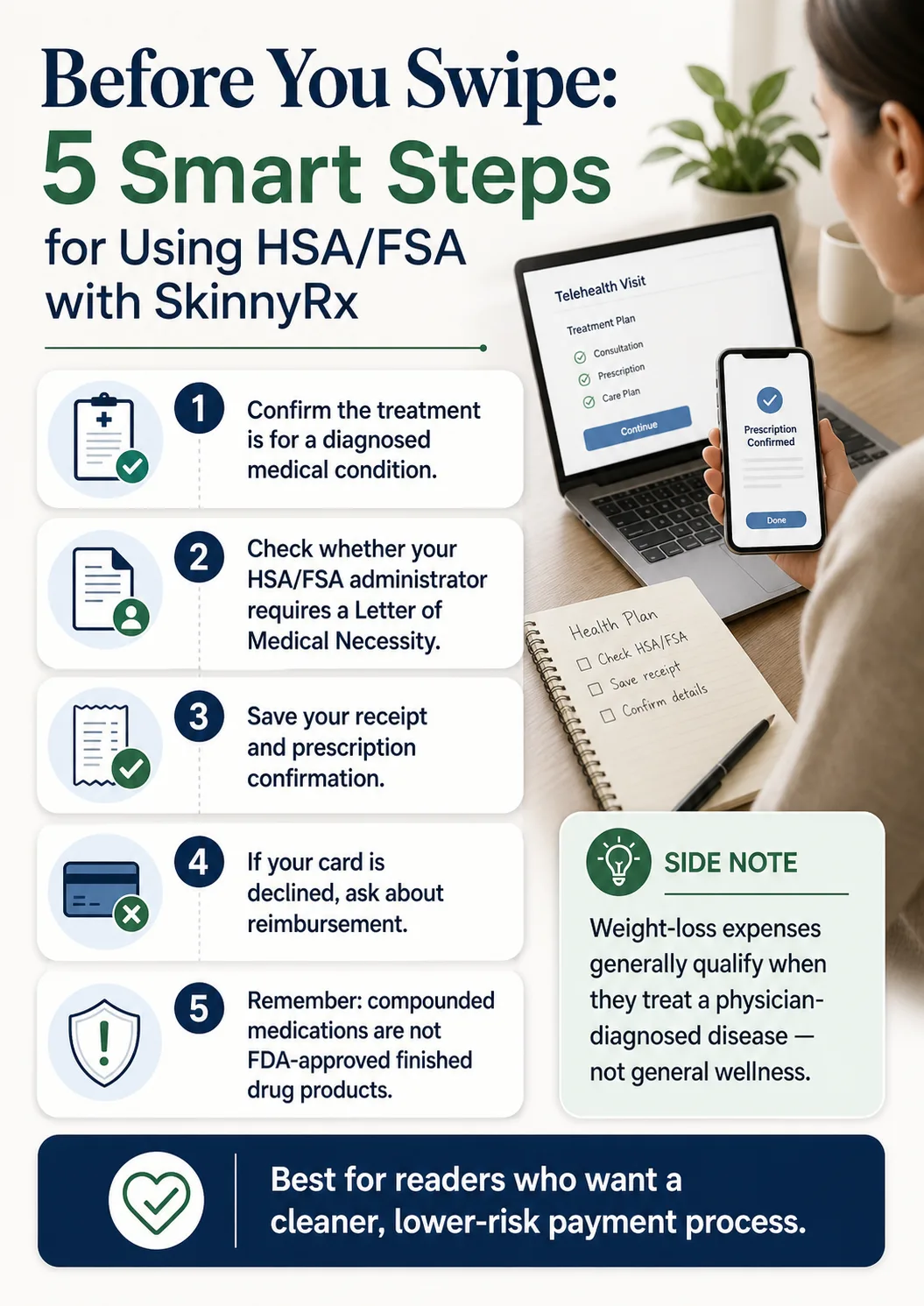
- ✅ IRS-qualified medical expense — potentially yes, when prescribed to treat a specific physician-diagnosed disease (obesity, diabetes, hypertension, heart disease). Not for general wellness or cosmetic weight loss.
- ⚠️ Reimbursed cleanly by your plan — depends on your administrator, your paperwork, and sometimes a Letter of Medical Necessity.
Best for
Adults with HSA or FSA balance who want compounded semaglutide or tirzepatide at $199–$299/month and are okay using a 503A compounded product.
Not for
Anyone who needs FDA-approved brand-name medication, whose plan administrator has already denied a compounded GLP-1 claim, or who lacks a documented qualifying diagnosis.
Key numbers
$199–$299/month before tax savings. Roughly $102–$211/month effective cost after pre-tax savings, depending on your bracket.
Compounded medications are not FDA-approved finished drug products. The FDA does not review compounded drugs for safety, effectiveness, or quality before they're marketed.
Free 5-minute intake. Patients who don't qualify medically receive a full refund within 24–48 hours. Confirm the charge timing on the checkout screen before submitting payment.
What we actually verified (and what's still on you)
✅ Verified on May 1, 2026
- ✅ SkinnyRx FAQ: "Yes, we accept FSA/HSA cards."
- ✅ Product pages label injectable semaglutide, sublingual semaglutide, semaglutide tablets, injectable tirzepatide, and tirzepatide tablets as FSA/HSA eligible.
- ✅ Insurance, Medicare, and Medicaid not accepted. Cash-pay only.
- ✅ Pricing: compounded semaglutide injectable or sublingual from $199/month (multi-month plan), semaglutide tablets from $249/month, tirzepatide from $299/month. Confirm plan length and total charge at checkout before paying.
- ✅ Available in all U.S. states except Alabama, Louisiana, and Mississippi. Verify during intake.
- ⚠️ SkinnyRx states it "cannot guarantee FSA/HSA eligibility" with your specific plan — verify with your administrator before purchasing.
- ⚠️ FDA Warning Letter #717989 issued February 20, 2026 to Lean Rx, Inc. dba SkinnyRx — marketing claims and misbranding. Not a contamination finding, recall, or manufacturing-inspection failure.
⚠️ Still user-specific (you must confirm these yourself)
- Whether your specific plan administrator approves compounded weight-loss expenses
- Whether your HSA/FSA card processes cleanly at SkinnyRx checkout (some employer cards have merchant restrictions)
- Whether your SkinnyRx-affiliated prescriber will issue a Letter of Medical Necessity on request
- Whether SkinnyRx provides itemized receipts with the exact line items your administrator requires — SkinnyRx-sourced coverage says they're available; confirm directly before paying if your plan has strict receipt requirements
We're an independent comparison resource. We don't compound, prescribe, dispense, or insure anything. We read the sources and tell you what they say.
Does SkinnyRx accept HSA/FSA cards at checkout?
Yes. SkinnyRx accepts HSA and FSA cards at checkout, per its published FAQ. Product pages also label all five formulations as FSA/HSA eligible. That puts SkinnyRx alongside Embody and MEDVi — cash-pay telehealth providers that advertise HSA/FSA acceptance, so you can put pre-tax dollars toward treatment instead of routing everything through insurance.
How the SkinnyRx checkout flow actually works
Complete the intake quiz
5–10 minutes. No charge to start.
A licensed provider reviews your information
SkinnyRx says patients who don't qualify medically receive a full refund within 24–48 hours.
Pick the formulation and plan length
This is where the real total lands. The "as low as $199/month" price is associated with a multi-month plan commitment — shorter plans cost more per month.
Enter your HSA or FSA card
Confirm the total charge and plan length on screen before submitting.
The medication ships
From a state-licensed compounding pharmacy. SkinnyRx-sourced coverage describes overnight shipping with cold-pack packaging for injectables.
What "accepted at checkout" does not mean
- It does not mean your plan administrator will automatically approve the expense.
- It does not mean you can skip a Letter of Medical Necessity if your administrator asks for one.
- It does not mean every employer-issued HSA/FSA card will cooperate (some have merchant-code restrictions).
- It does not mean you can throw away the receipt — you may still need it for substantiation.
A successful card swipe is a checkout fact. It is not a tax-and-administrator guarantee.
The one distinction that fixes everything: accepted ≠ eligible ≠ reimbursable
Most of the confusion around "Does SkinnyRx accept HSA/FSA?" disappears the second you separate three different questions that get jammed together.
Question 1 — Will the provider's checkout accept your card?
This is a merchant question. SkinnyRx says yes.
Question 2 — Is the expense an IRS-qualified medical expense?
This is a tax-law question. Per IRS Publication 502, prescription medicines and weight-loss programs qualify when used to treat a specific physician-diagnosed disease — examples named in IRS guidance include obesity, diabetes, hypertension, and heart disease. General-wellness or cosmetic weight loss does not qualify.
Question 3 — Will your specific plan administrator reimburse the full charge?
This is the wildcard. Some administrators wave weight-loss claims through. Some flag them for documentation review. Some require a Letter of Medical Necessity (LMN) before they release a single dollar.
The decision box you can copy and run
| Test | What "yes" looks like | What's at risk if "no" |
|---|---|---|
| Medical purpose | You have a diagnosed condition (obesity, type 2 diabetes, hypertension, heart disease, etc.) | Expense isn't qualified — for HSA, the distribution can be taxable and may trigger an additional 20% tax. For FSA, the claim may be denied or require repayment. |
| Prescriber involvement | A licensed clinician evaluated you and prescribed the medication | Without a real prescription, the expense fails both IRS rules and your plan |
| Documentation | You can produce: itemized receipt, prescription record, LMN if your plan requires one | Card may run, but admin can request repayment later |
Are SkinnyRx compounded GLP-1s HSA/FSA eligible under IRS rules?
Compounded medications are not FDA-approved finished drug products, which is the most important thing you should know about them. Whether that translates to a different HSA/FSA outcome depends on your administrator. The IRS sources we reviewed do not separately address compounded GLP-1 formulations — so the safer documentation standard is to focus on three things: a real prescription, a documented diagnosed disease, and clean records (receipt, prescription confirmation, LMN if required).
Documentation strength by scenario
| Scenario | Strength | Recommended documentation |
|---|---|---|
| Type 2 diabetes prescription | Strongest | Receipt + prescription record; LMN rarely requested |
| Obesity prescription tied to documented BMI and clinical evaluation | Strong | Receipt + prescription; some plans request LMN |
| Overweight with a documented comorbidity (diabetes, hypertension, sleep apnea, etc.) | Solid | Request LMN proactively if your plan is strict |
| General weight loss with no diagnosis | Do not use HSA/FSA | The IRS specifically excludes general-health expenses |
The 2026 limits that matter for SkinnyRx pricing
HSA Limits (IRS Rev. Proc. 2025-19)
- Self-only: $4,400
- Family: $8,750
- Catch-up (age 55+): additional $1,000
FSA Limits (IRS Rev. Proc. 2025-32)
- Contribution limit: $3,400
- Carryover into 2027: up to $680
- A SkinnyRx plan ($2,388–$3,588/year) fits within the FSA single-year limit.
Do you need a Letter of Medical Necessity for SkinnyRx HSA/FSA reimbursement?
A Letter of Medical Necessity is a short note from your prescribing clinician confirming three things: you have a diagnosed condition, this medication treats that condition, and the treatment is medically necessary — not cosmetic or general wellness.
When an LMN is more likely to be required
- The prescription is for weight loss rather than diabetes
- Your plan flags compounded medications for documentation review
- You're submitting for reimbursement instead of swiping a card
- The receipt describes a subscription bundle instead of a clear medical line item
- Your administrator has already denied a similar charge before
What a valid LMN should include
- Patient's name and date of birth
- Specific diagnosis with ICD-10 code (E66.9 for unspecified obesity, E11.x for type 2 diabetes)
- Specific medication or treatment prescribed
- Reason treatment is medically necessary
- Expected duration of treatment
- Provider's name, credentials, signature, and date
Your "ask the doctor" email script — copy and send
Subject: LMN Request for HSA/FSA Documentation — [Your Name]
Hi Dr. [Name],
I'm using my [HSA / FSA] to pay for a compounded GLP-1 medication prescribed through SkinnyRx, and my plan administrator may request a Letter of Medical Necessity. Could you please send a short LMN that includes:
- My diagnosis and ICD-10 code (I qualify under [obesity E66.9 / overweight + comorbidity / type 2 diabetes / other])
- The medication prescribed (compounded semaglutide or tirzepatide) and why it's medically necessary
- Confirmation that this is for treatment of a diagnosed condition, not cosmetic weight loss
- Your credentials, signature, and date
Most plan administrators accept a letter on practice letterhead. The FSAFEDS LMN form template also works if your administrator prefers a standard form. Thanks — appreciate you getting this on file.
Your "call the administrator" script
Before you swipe, call the number on the back of your HSA or FSA card and ask:
"I'm planning to pay for a physician-prescribed compounded GLP-1 weight-loss medication through an online telehealth provider. Do you require a Letter of Medical Necessity for weight-loss medication? What documentation do I need to keep — itemized receipt, prescription record, anything else? And does my plan accept compounded medications, or only FDA-approved ones?"
A 5-minute phone call prevents the most common post-purchase documentation headaches.
How much will using HSA or FSA at SkinnyRx actually save you?
| SkinnyRx plan | Annual cost | 22% bracket + 7.65% FICA = 29.65% | 24% + 7.65% + 5% state = 36.65% | 32% + 7.65% + 9% state = 48.65% |
|---|---|---|---|---|
| Sema injectable / sublingual ($199/mo, multi-month plan) | $2,388 | $708 saved → effective $140/mo | $875 saved → effective $126/mo | $1,162 saved → effective $102/mo |
| Sema tablets ($249/mo) | $2,988 | $886 saved → effective $175/mo | $1,095 saved → effective $158/mo | $1,454 saved → effective $128/mo |
| Tirz injectable / tablets ($299/mo) | $3,588 | $1,064 saved → effective $211/mo | $1,315 saved → effective $190/mo | $1,745 saved → effective $154/mo |
Sources: SkinnyRx public pricing (verified May 1, 2026); IRS Revenue Procedure 2025-19 (HSA limits); IRS Revenue Procedure 2025-32 (FSA limits); SSA FICA schedule. This table is illustrative — confirm your actual marginal rate with a tax professional. This is not tax advice.
The one-line takeaway most readers miss: If you have FSA dollars about to expire and an HSA that rolls over forever, spend the FSA first. FSA balances usually disappear at year-end (with up to $680 carryover into 2027). HSA balances are yours for life and grow tax-free. Order matters when you have both.
SkinnyRx HSA/FSA verification matrix — by formulation
SkinnyRx says it accepts FSA/HSA cards, and product pages for all five formulations currently show FSA/HSA eligible language. The variables are price and the documentation strictness your plan applies.
| Formulation | Starting price/mo | HSA/FSA card (per SkinnyRx FAQ) | Plan-admin scrutiny risk | Best documentation to save |
|---|---|---|---|---|
| Compounded semaglutide injectable | $199 (multi-month plan) | ✅ Accepted | Low–medium | Receipt, prescription, LMN if asked |
| Compounded semaglutide sublingual | $199 (multi-month plan) | ✅ Accepted | Low–medium | Receipt, prescription, LMN if asked |
| Compounded semaglutide tablets | $249 | ✅ Accepted | Medium | Receipt, prescription, LMN proactively |
| Compounded tirzepatide injectable | $299 | ✅ Accepted | Medium–high (higher annual cost) | Receipt, prescription, LMN proactively |
| Compounded tirzepatide tablets | $299 | ✅ Accepted | Medium–high (higher annual cost) | Receipt, prescription, LMN proactively |
Does SkinnyRx accept insurance, Medicare, or Medicaid?
HSA/FSA is not insurance — make sure you understand this
- Insurance = your insurer pays the provider, you pay a copay or deductible.
- HSA/FSA = your own pre-tax dollars paying the provider. Your insurer is not in the loop.
- SkinnyRx accepting your HSA/FSA card = SkinnyRx is fine taking your pre-tax dollars. It does not mean SkinnyRx is billing your health plan.
When SkinnyRx isn't your path — skip SkinnyRx if:
- You need insurance billing
- You need prior authorization handled for you
- You need FDA-approved brand-name medication only
- You're on Medicare or Medicaid and need a covered route
- You can't tolerate any reimbursement uncertainty with your plan administrator
Is SkinnyRx available in my state if I want to use HSA/FSA?
If you live in Alabama, Louisiana, or Mississippi and you want to use HSA/FSA dollars on a compounded GLP-1, route to MEDVi instead — it currently serves broader state coverage and accepts HSA/FSA cards directly. (Embody is not an option here: it does not currently serve Louisiana or Mississippi.)
What happens if your HSA or FSA card is declined at SkinnyRx?
| What happened | First step | Second step | Third step |
|---|---|---|---|
| Card declined at checkout | Pay with a regular card; submit for reimbursement after | Call admin; ask them to manually approve the merchant | Try a different HSA/FSA card if you have multiple, or ask SkinnyRx support |
| Card worked, admin requested documentation | Send itemized receipt + prescription confirmation | If still flagged, get LMN from prescriber and resubmit | If denied, request the appeals process from your administrator |
| Charge approved, then flagged in review later | Produce LMN + prescription + itemized receipt + diagnosis code | Request LMN retroactively if needed (most prescribers will write one) | Consult a tax pro about HSA tax/penalty exposure on any disallowed amount |
| You didn't qualify medically | SkinnyRx says a refund is issued within 24–48 hours | Refund should return to original payment method | Keep the refund confirmation in case your plan asks for substantiation |
Three SkinnyRx-specific snags that trip people up
1. Bundle pricing surprise.
The "as low as $199/month" price is associated with a multi-month plan commitment. The total charge at checkout for that tier can run $2,388 or more — that's not a billing error, that's the bundle. SkinnyRx's BBB profile shows a recurring complaint pattern around this exact issue. Confirm plan length and total charge on screen before you finalize.
2. HSA card with no balance.
The merchant runs the card; if your HSA balance is short, it declines or partially declines. SkinnyRx allows splitting tender in some checkout flows — confirm with support if you're stacking payment methods.
3. You don't qualify medically.
SkinnyRx says it issues a refund within 24–48 hours per published policy. The refund returns to the original payment method. Save the refund confirmation in case your plan asks for substantiation.
Your reimbursement-claim checklist (for declined cards)
Most denials are documentation problems, not eligibility problems. Patch the documentation, resubmit, move on.
Which SkinnyRx charges pass HSA/FSA review most easily?
| Charge type | Likely status | Why |
|---|---|---|
| Prescribed medication tied to obesity / type 2 diabetes diagnosis | More likely | Fits prescription-drug-for-disease logic cleanly |
| Provider consultation tied to your treatment | More likely | Medical services for diagnosis/treatment qualify |
| Injection supplies bundled with prescribed medication | More likely | Supplies tied to treatment can be medical expenses |
| Subscription / multi-month bundle | Maybe | Depends on itemization; ask for a line-item receipt |
| Shipping line items | Plan-specific | Ask your administrator whether shipping is reimbursable |
| Late fees, financing fees, Affirm interest | Risky | Not medical care |
| Cosmetic weight loss with no diagnosis | Not eligible | IRS specifically excludes appearance/general-health weight loss |
Can you use HSA/FSA and Affirm together at SkinnyRx?
If HSA/FSA covers the plan, use HSA/FSA first. Pre-tax dollars beat any financing structure on math. Affirm at 0% APR is fine; Affirm at 30% APR is not free money.
If your HSA/FSA balance is short, decide which dollars cover what. Don't use HSA dollars to pay Affirm interest — that's not a qualified medical expense.
If you must finance, pay with Affirm and reimburse yourself from HSA/FSA later — but only the medical portion of the charge, not the financing fee. Keep itemized records.
Ask both SkinnyRx support and your HSA/FSA administrator before committing to a hybrid structure. Don't assume.
The honest trade-off you should know about
On February 20, 2026, the FDA issued SkinnyRx (Lean Rx, Inc.) Warning Letter #717989. This was about marketing claims and misbranding on skinnyrx.com — specifically, product photos with "SkinnyRx" labels that implied SkinnyRx was the compounder when a separate compounding pharmacy actually compounds. The letter did not cite a manufacturing-inspection failure, contamination finding, recall, or adverse-event finding.
Separately — and this is true for every compounded GLP-1 provider on the market — compounded medications are not FDA-approved finished drug products. The FDA does not review compounded drugs for safety, effectiveness, or quality before they're marketed.
Does this affect your HSA/FSA decision? Not directly. IRS Publication 502 doesn't condition HSA/FSA eligibility on FDA marketing-claim status. Card processing is unchanged. The expense is still potentially qualified when prescribed for a diagnosed disease.
Does it change who SkinnyRx is right for? Maybe. If you'd rather start with the lowest cash-pay first-month price or want a needle-free GLP-1 gum option, Embody is another cash-pay route worth comparing (semaglutide injection from $99 the first month, then $299/month). Keep in mind that, like SkinnyRx, Embody's shipped options are compounded and not FDA-approved finished drugs. But SkinnyRx's prices ($199–$299/month) and five formulation choices with direct HSA/FSA card acceptance are exactly what most readers come to this page for.
Real customer voices on SkinnyRx payment experience
We pull testimonials from public Trustpilot reviews — service and support only. We don't use weight-loss results as testimonials.
"Carmy was very nice and had my payment problem resolved in less than 5 mins."— Trustpilot review, April 2026
"Jimmabelle very quickly and effectively solved the issue I was having."— Trustpilot review, April 2026
The honest other side: SkinnyRx's Trustpilot profile shows a 4.8 TrustScore across 5,013 reviews. SkinnyRx's BBB profile shows 139 complaints over the last three years, with 112 closed in the past 12 months. The recurring complaint themes are bundle-pricing confusion (people who thought they were signing up for a $199/month subscription and discovered they had committed to a multi-month plan totaling $2,388 or more), refund disputes after fulfillment, and cancellation friction.
The fix is simple: read the bundle pricing on screen before you confirm. Cancel through the help center, phone (1-888-979-9580), or patient portal before your next refill is prepared if you decide to stop.
When SkinnyRx isn't the right HSA/FSA fit — your Plan B
SkinnyRx is a strong fit if you want a low public starting price for compounded GLP-1s with direct HSA/FSA card acceptance. It's not the right fit if your plan administrator is strict, you want a stronger compliance file, or you want FDA-approved brand-name medication.
Quick three-way comparison
| Feature | SkinnyRx | Embody | Ro |
|---|---|---|---|
| Direct HSA/FSA card at checkout | ✅ Yes (per FAQ) | ✅ Yes — advertises HSA/FSA acceptance (confirm at checkout) | ❌ No — reimbursement-only via itemized receipt |
| Compounded options | ✅ Sema injection, sublingual, tablet; tirz injection, tablet | ✅ Compounded sema & tirz — injection or needle-free GLP-1 gum | ❌ Not the focus |
| FDA-approved options | ❌ No | ❌ No — compounded only | ✅ Foundayo, Wegovy pill/pen, Zepbound pen/KwikPen |
| Insurance support | ❌ Cash-pay only | ❌ Cash-pay only | ✅ Insurance concierge handles prior authorization |
| Public starting price | $199/mo (multi-month) | $99 first month (sema injection), then $299/mo; tirz $149 first month, then $399/mo | Ro Body $39 first month, then $149/mo or $74/mo annual (medication not included) |
| FDA warning letter on file | ⚠️ Yes — Feb 20, 2026 (marketing claims) | Compounded options are not FDA-approved finished drugs | None found in our FDA database check May 1, 2026 |
| Pharmacy-quality documentation | Standard 503A | Licensed compounding pharmacies; confirm specifics at intake | N/A — fills FDA-approved brand-name |
| Last verified | May 1, 2026 | May 1, 2026 | May 1, 2026 |
Plan B #1: Embody — for a low cash-pay starting price and a needle-free GLP-1 gum option
- Cash-pay program that advertises HSA/FSA acceptance — confirm the charge on the checkout screen.
- Low first-month pricing: semaglutide injection from $99 the first month, then $299/month ongoing; compounded tirzepatide injection $149 first month, then $399/month.
- Needle-free GLP-1 gum option for people who'd rather skip weekly injections (semaglutide gum $149 first month, then $349/month).
- No separate membership fee beyond the medication plan; ships to your door if a licensed provider approves treatment.
- 24/7 care-team messaging with clinician oversight and a fast online intake.
- Compounded semaglutide and tirzepatide — these are not FDA-approved finished drugs, and Embody does not dispense branded Wegovy, Ozempic, or Zepbound.
- Broad U.S. availability — confirm your state during intake.
Best for: the reader who wants the lowest cash-pay first-month price, or who prefers a needle-free GLP-1 gum option instead of weekly shots.
See Embody Pricing →Plan B #2: Ro — for FDA-approved medication with insurance handled
- FDA-approved formulary: Foundayo (orforglipron, oral), Wegovy pill, Wegovy pen, Zepbound pen, Zepbound KwikPen.
- Insurance concierge included — they handle prior authorization paperwork.
- Free GLP-1 Insurance Coverage Checker.
- Ro Body membership: $39 first month, then $149/month ongoing or $74/month with annual plan paid upfront. Medication not included.
- HSA/FSA path: Ro cannot accept HSA/FSA cards at checkout, but provides a detailed receipt and prescription copy you can submit for reimbursement.
Best for: anyone who needs FDA-approved + insurance + prior auth handled, or who wants no compounded uncertainty in the mix.
Check Free Insurance Coverage on Ro →Quick fit table
| If this sounds like you | Best next step |
|---|---|
| "I want to swipe my HSA/FSA card and be done — and I'm fine with compounded." | SkinnyRx — direct card at checkout, $199–$299/mo |
| "I want the lowest cash-pay first-month price, or a needle-free GLP-1 gum option." | Embody — from $99 first month, HSA/FSA accepted, GLP-1 gum option |
| "I want FDA-approved meds with insurance handled." | Ro — Zepbound, Wegovy, Foundayo + insurance concierge |
| "I'm comparing all HSA/FSA GLP-1 providers." | See our GLP-1 providers comparison guide |
| "I want to finance with Affirm." | Read our Does Skinny Rx Accept Affirm page first |
| "Honestly, I don't know yet." | Take the free quiz at the bottom of this page |
The 7-step "before you swipe" checklist
1. Confirm your treatment is medical, not general wellness. You need a real diagnosis (obesity, type 2 diabetes, overweight + comorbidity, etc.).
2. Call your plan administrator. Use the script above. Get a yes/no on weight-loss medication and LMN requirements.
3. Decide direct card vs. reimbursement. If your card has a merchant restriction, plan to pay with a regular card and reimburse yourself.
4. Verify SkinnyRx checkout still shows HSA/FSA acceptance. Things can change between our verification date and your purchase date.
5. Take screenshots of the product page and checkout page. Plan length, monthly price, total charge, payment method — all of it.
6. Save the receipt, prescription confirmation, and shipment tracking. All three. Every month.
7. Request an LMN early if your administrator says it's required. Don't wait until they ask.
How we verified this page (and what changes the answer)
What we read
- SkinnyRx public FAQ, terms of service, and product pages (May 1, 2026)
- FDA Warning Letter #717989 (full text from FDA.gov)
- FDA's "Compounding and the FDA: Questions and Answers" page
- IRS Publication 502 (Medical and Dental Expenses)
- IRS Publication 969 (Health Savings Accounts)
- IRS Revenue Procedure 2025-19 (2026 HSA limits)
- IRS Revenue Procedure 2025-32 (2026 FSA limits)
- FSAFEDS LMN form and weight-loss expense guidance
- Trustpilot profile (4.8 / 5,013 reviews; themes pulled May 1, 2026)
- BBB profile (139 complaints over 3 years, 112 closed in 12 months)
- Embody, MEDVi, and Ro public pricing and HSA/FSA language
What we did not do
- We did not test-purchase SkinnyRx with our own HSA/FSA card
- We did not call SkinnyRx billing support
- We are not affiliated with the FDA, IRS, SkinnyRx, Embody, MEDVi, or Ro
- We earn affiliate commission if you sign up through our links — that does not change our editorial verification, and we don't rank providers by payout
What changes the answer (recency plan)
| Element | Refresh cadence | How we verify |
|---|---|---|
| SkinnyRx FAQ HSA/FSA language | Monthly | Visit SkinnyRx FAQ directly |
| SkinnyRx pricing per formulation | Monthly | Visit each product page |
| SkinnyRx state availability | Monthly | Check SkinnyRx terms |
| FDA warning letter status / response | Monthly while active | Check FDA warning letter database |
| FDA compounding rules | Monthly | Monitor FDA compounding policy pages (FDA proposed additional GLP-1 compounding restrictions April 30, 2026 — this category is unusually live) |
| 2026 IRS HSA/FSA contribution limits | Annual | Check IRS Pub. 502, Pub. 969, Rev. Procs. |
| Embody / Ro pricing | Monthly | Visit each provider's pricing page |
| BBB complaint pattern | Quarterly | Check BBB profile |
| Trustpilot review themes | Quarterly | Check distribution + recent reviews |
Frequently asked questions
Does SkinnyRx accept HSA cards?
Yes. SkinnyRx accepts HSA cards at checkout per its published FAQ. The card processes through the standard merchant flow. Your HSA administrator may still require documentation showing the expense is qualified.
Does SkinnyRx accept FSA cards?
Yes. SkinnyRx accepts FSA cards at checkout per its published FAQ. FSA reimbursement depends on your plan rules and may require an itemized receipt, prescription record, or Letter of Medical Necessity.
Does SkinnyRx accept insurance?
No. SkinnyRx is cash-pay only. SkinnyRx and affiliated practices do not accept commercial insurance, Medicare, or Medicaid, and the platform will not submit claims on your behalf.
Is SkinnyRx HSA/FSA eligible?
Potentially yes — when prescribed for a physician-diagnosed disease. IRS Publication 502 makes prescription medicines and weight-loss programs qualified medical expenses when used to treat a specific physician-diagnosed disease (examples include obesity, diabetes, hypertension, and heart disease). Your plan administrator may still require documentation.
Do I need a Letter of Medical Necessity for SkinnyRx?
Maybe. For HSA purchases tied to type 2 diabetes, an LMN is often unnecessary. For FSA purchases for weight loss using a compounded GLP-1, an LMN is often required by stricter administrators. Request one proactively.
Does SkinnyRx provide a Letter of Medical Necessity?
We did not find this confirmed in SkinnyRx's public materials. Ask SkinnyRx support or the prescribing clinician before paying if your administrator requires an LMN. If LMN support is a hard requirement for your plan, ask whichever provider you choose — including a cash-pay option like Embody — exactly what documentation they will supply before you pay.
Does SkinnyRx provide itemized receipts for HSA/FSA?
SkinnyRx-sourced coverage says itemized receipts can be provided on request. Confirm directly with SkinnyRx support before paying if your plan has strict receipt-field requirements.
Is SkinnyRx available in my state if I want to use HSA/FSA?
SkinnyRx's current terms list services as available in all U.S. states except Alabama, Louisiana, and Mississippi. Within other states, eligibility still depends on provider availability and state-specific pharmacy regulations — verify during intake before paying.
How much does SkinnyRx cost with HSA or FSA?
Pre-tax dollars don't lower SkinnyRx's sticker price ($199–$299/month). They lower your effective cost by your marginal tax rate — typically 22% to 48%. Effective monthly cost lands roughly $102–$211/month after savings.
What if my HSA or FSA card is declined at SkinnyRx?
A decline often means a merchant-processing, balance, or plan-restriction issue — not a final IRS eligibility decision. Pay with a regular card, request an itemized receipt, and submit for reimbursement through your plan portal.
Can I use HSA/FSA for SkinnyRx semaglutide?
Yes, when prescribed for a qualifying medical condition. Both injectable and sublingual semaglutide ($199/month, multi-month plan) and tablet semaglutide ($249/month) are HSA/FSA-eligible under IRS rules with proper documentation.
Can I use HSA/FSA for SkinnyRx tirzepatide?
Yes, under the same rules. Compounded tirzepatide injectable and tablets ($299/month) are HSA/FSA-eligible with prescription and diagnosis. The higher annual cost ($3,588) means stricter administrators are more likely to request an LMN.
Does the SkinnyRx FDA warning letter affect HSA/FSA eligibility?
No. FDA Warning Letter #717989 (February 20, 2026) cited marketing-claim misbranding — not a contamination finding, recall, or manufacturing-inspection failure. IRS Publication 502 does not condition HSA/FSA eligibility on FDA marketing-claim status. The eligibility test is prescription + diagnosis.
Are SkinnyRx compounded medications FDA-approved?
No. Compounded medications, including SkinnyRx's compounded semaglutide and tirzepatide, are not FDA-approved finished drug products. The FDA does not review them for safety, effectiveness, or quality before they're marketed. They're prepared by state-licensed 503A compounding pharmacies under individual prescriptions.
Can I combine HSA/FSA and Affirm at SkinnyRx in the same transaction?
Probably not. Most checkouts process one tender per transaction. If HSA/FSA covers the plan, use those funds first — pre-tax dollars beat any financing structure.
What are the 2026 HSA and FSA contribution limits?
Per IRS guidance: HSA self-only $4,400, HSA family $8,750, age 55+ catch-up additional $1,000. FSA $3,400 with up to $680 carryover into 2027. A SkinnyRx plan ($2,388–$3,588/year) fits within these limits.
Is SkinnyRx legit?
Yes. SkinnyRx (operated by Lean Rx, Inc., based in Sacramento, California) is a real telehealth platform working with state-licensed 503A compounding pharmacies and U.S.-licensed clinicians. It has a 4.8 Trustpilot rating across 5,013 reviews, a "B" BBB rating (not BBB-accredited), and a February 20, 2026 FDA marketing-claims warning letter on file.
The bottom line
If you've read this far, you've done the work most people skip. You know SkinnyRx accepts HSA and FSA cards at checkout. You know the IRS rule that makes the medication potentially qualified when prescribed for a diagnosed condition. You know what an LMN does and when you need one. You know what to do if your card declines, you know SkinnyRx is unavailable in three states, and you know your Plan B routes.
The reader SkinnyRx fits best is the one who: wants compounded GLP-1s at one of the lowest verified public starting prices, has HSA or FSA balance to deploy, has a documented qualifying diagnosis, and is okay with a 503A compounded product instead of an FDA-approved brand.
Patients who don't qualify medically receive a full refund within 24–48 hours. Confirm the charge timing on the checkout screen before submitting payment.
Still not sure which GLP-1 program is right for you?
Take our free 60-second matching quiz. We'll factor in your payment method (HSA, FSA, insurance, cash), medication preference, insurance situation, and documentation requirements — and route you to the provider that fits your situation.
By: The Weight Loss Provider Guide editorial team — an independent comparison resource for GLP-1 telehealth providers.
Last verified: May 1, 2026. | How this was produced: We read SkinnyRx's public FAQ, terms of service, and product pages; FDA Warning Letter #717989 in full; FDA's compounding Q&A; IRS Publications 502 and 969; the 2026 HSA and FSA contribution rules; the FSAFEDS LMN form; and public Trustpilot and BBB review patterns. We separated provider-stated commercial facts from regulatory facts from editorial conclusions. Every claim is verifiable from the linked or named source.
Why this page exists: To help you decide whether using HSA or FSA at SkinnyRx is practical, documented, and appropriate for your situation — before you pay. We earn an affiliate commission if you sign up through our links. Our editorial conclusions are based on verified fit, not payout.
This page is informational and not medical, legal, or tax advice. Compounded medications are not FDA-approved finished drug products, and the FDA does not review compounded drugs for safety, effectiveness, or quality before they're marketed. Consult a licensed clinician before starting any GLP-1 medication, and consult a tax professional about HSA/FSA expense eligibility for your specific plan and situation. Pricing, FAQ language, and regulatory status can change — check the "Last verified" date at the top of this page.