How to Get GLP-1 Without Being Overweight: What Actually Qualifies in 2026
By WPG Research Team · Published · Last verified:
Affiliate disclosure: We may earn a commission if you use some provider links on this page. That does not change which paths we recommend, and we do not recommend bypassing BMI, diagnosis, or clinician requirements.
The short answer
If you are not overweight and have no qualifying medical condition, you usually cannot get a GLP-1 prescription for weight loss — and the providers who will write one anyway are the ones to walk away from. The FDA approves weight-loss GLP-1s like Wegovy, Zepbound, Saxenda, and Foundayo for adults with a BMI of 30 or higher, or a BMI of 27 to 29.9 plus at least one weight-related condition. Separate condition-specific paths exist: Wegovy for cardiovascular risk reduction, Wegovy injection for MASH with moderate-to-advanced fibrosis, and Zepbound for moderate-to-severe sleep apnea in adults with obesity. Outside those standard paths, there are six situations worth checking before you assume the answer is no.
GLP-1 Eligibility Path Finder
Answer 5 quick questions and see which path applies to your situation — or whether the right next step is something else entirely.
Your situation at a glance
| Your situation | What it usually means |
|---|---|
| BMI 30+ | You likely qualify for a standard weight-loss GLP-1 |
| BMI 27–29.9 with a weight-related condition | You likely qualify |
| BMI 25–26.9 with no condition | Usually not enough on weight alone |
| BMI under 25 (healthy weight) | Usually not appropriate for weight-loss GLP-1s |
| You used to qualify, now you don’t | Maintenance is its own conversation with your clinician |
| Type 2 diabetes (any weight) | Different path — diabetes medications, not weight-loss prescribing |
| Established cardiovascular disease + obesity or overweight | Wegovy has a specific FDA indication for this |
What we actually verified before publishing
- Current FDA-approved indications for Wegovy, Zepbound, Saxenda, Foundayo, Ozempic, Mounjaro, and Rybelsus (FDA drug labels and approval announcements)
- Wegovy’s cardiovascular risk indication (FDA, March 2024)
- Wegovy injection’s MASH indication (FDA, accelerated approval for adults with MASH and moderate-to-advanced fibrosis)
- Zepbound obstructive sleep apnea approval (FDA, December 20, 2024)
- Oral Wegovy approval (FDA, December 2025) and Foundayo (orforglipron) approval (FDA, April 1, 2026)
- CMS Medicare GLP-1 Bridge eligibility criteria (effective July 1, 2026)
- FDA warnings on unapproved and compounded GLP-1s (current as of FDA’s July 31, 2025 update)
- Ro and Sesame Care published pricing (verified May 2026)
- CDC adult BMI categories
What we did not verify: your personal eligibility, your state's telehealth rules, your specific insurance plan, or whether any single clinician will prescribe. That is what the eligibility check is for.
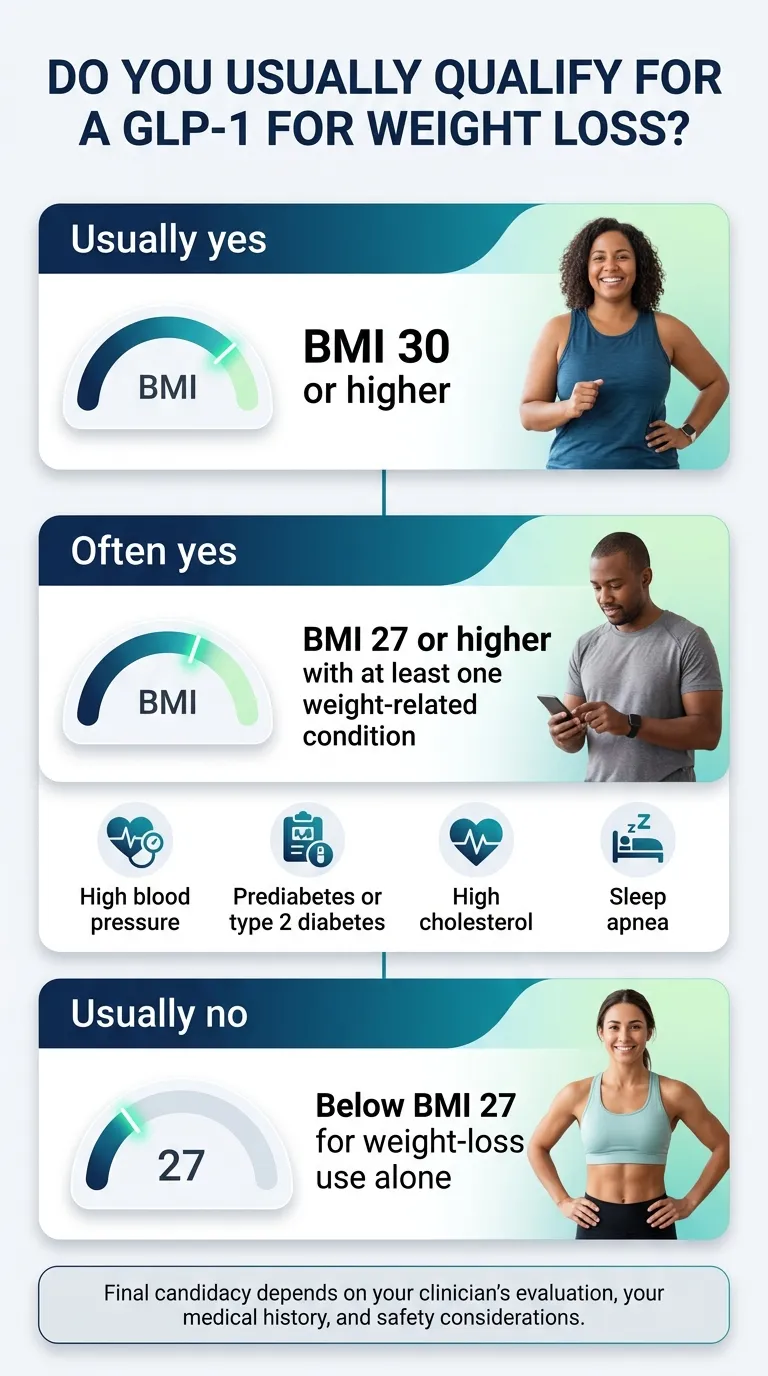
What BMI do you actually need for a GLP-1?
The capsule
Here is how the CDC actually splits adult BMI:
| BMI | CDC category |
|---|---|
| Below 18.5 | Underweight |
| 18.5 to 24.9 | Healthy weight |
| 25.0 to 29.9 | Overweight |
| 30.0 and up | Obesity |
So a person at BMI 26 is already overweight by the official definition. They are just not obese yet. A few real-world examples:
- BMI 28 with high blood pressure — Overweight + qualifying condition. Standard FDA pathway likely applies.
- BMI 26 with nothing else going on — Overweight, but doesn’t cross the BMI 27 comorbidity threshold. Gray zone.
- BMI 23 with no diagnosed condition — Healthy weight. No FDA-approved GLP-1 fits for weight loss alone.
The 2026 Below-Threshold GLP-1 Eligibility Matrix
Every “I'm not overweight” pathway in one place — path classification, what medication might apply, typical insurance posture, and the safest next step.
| Situation | Path | What might apply | Insurance | Next step |
|---|---|---|---|---|
| BMI 30+ | FDA weight-management path | Wegovy, Zepbound, Saxenda, Foundayo | Often covered with documentation | Telehealth or in-person clinician |
| BMI 27–29.9 + qualifying condition | FDA weight-management path | Wegovy, Zepbound, Saxenda, Foundayo | Often covered with documented comorbidity | Telehealth or in-person clinician |
| BMI 25–26.9, no condition | Not a current FDA path | Lifestyle + labs to rule out hidden risk factors | Generally not covered for weight loss | PCP visit, labs, structured plan |
| BMI under 25, no condition | Not appropriate for weight-loss GLP-1s | Address the underlying concern | Not covered | Clinician for underlying issue, not GLP-1 |
| Type 2 diabetes at any BMI | FDA-approved condition path (diabetes) | Ozempic, Mounjaro, Rybelsus, Trulicity | Often covered for T2D | Endocrinologist, PCP, or T2D telehealth |
| Established CVD + obesity or overweight | FDA cardiovascular indication | Wegovy injection or pill | Often covered with documented CVD | Cardiologist + obesity medicine clinician |
| MASH with moderate-to-advanced fibrosis | FDA liver-disease indication (not weight-loss) | Wegovy injection only | Coverage still developing | Hepatologist — not weight-loss telehealth |
| Moderate-to-severe OSA + obesity | FDA sleep apnea indication | Zepbound | Growing with sleep study | Sleep medicine specialist |
| Used to qualify, BMI now lower from treatment | Maintenance — not a new-start path | Same medication, often lower dose | May continue with documentation | Original prescriber with full records |
| Medicare Part D meeting CMS Bridge criteria | CMS coverage demonstration (not new FDA indication) | Foundayo, Wegovy injection/tablets, Zepbound KwikPen only | $50 copay during Bridge program | Bridge prior auth from eligible prescriber |
| PCOS with higher weight / post-bariatric maintenance | Off-label specialist scenario | Off-label use | Generally not covered | Reproductive endocrinologist or original bariatric surgeon |
| BMI <25, considering no-prescription seller | Never appropriate | Nothing legitimate | N/A | Walk away. Talk to a real clinician. |
6 situations worth checking before assuming the answer is no
None of these are loopholes. They are real medical paths that get missed when people only look at the standard BMI threshold.
Situation 1
Type 2 diabetes (any BMI) \u2014 FDA-approved condition path
If you have type 2 diabetes (T2D), GLP-1 medications like Ozempic, Mounjaro, Rybelsus, and Trulicity are FDA-approved for blood sugar control regardless of your weight. This is the most common legitimate “non-overweight” path to a GLP-1 — but it is a diabetes path, not a weight-loss path.
The ADA lists four ways to diagnose T2D: HbA1c of 6.5% or higher, fasting plasma glucose of 126 mg/dL or higher, 2-hour OGTT glucose of 200 mg/dL or higher, or a random plasma glucose of 200 mg/dL or higher with severe symptoms.
Honest catch
That said — if you want telehealth specifically for the GLP-1 part of your care (with your PCP or endo continuing the rest), Ro is the legitimate option:
Ro lists Ozempic, Wegovy pill, Wegovy pen, Zepbound KwikPen, and Foundayo, and their insurance concierge handles prior authorization paperwork where eligible. Ro currently cannot coordinate GLP-1 coverage for government insurance plans except FEHB.
Get started for $39, then as low as $74/month with annual plan paid upfront (medication separate). Best fit if: you want telehealth-managed GLP-1 access alongside existing diabetes care. Not the right fit if: you have Medicare or Medicaid, or you need full diabetes management in one place.
Situation 2
Established cardiovascular disease + obesity or overweight \u2014 FDA-approved CV indication
In March 2024, the FDA approved Wegovy to reduce the risk of cardiovascular death, heart attack, and stroke in adults with established cardiovascular disease and either obesity or overweight. This has since been extended to the Wegovy pill.
What counts as established cardiovascular disease: prior heart attack, prior stroke, or symptomatic peripheral artery disease. Not just high cholesterol. Not just family history.
The FDA's SELECT outcomes trial reported major cardiovascular events in 6.5% of Wegovy participants versus 8.0% of placebo participants. That evidence is why this is a separate FDA cardiovascular indication. In practice, many insurance coverage rules use BMI 27 as the threshold — but the FDA's public indication is broader. If you are in this band, the cardiovascular indication may unlock coverage even when weight-management coverage was denied.
Situation 3
MASH with moderate-to-advanced fibrosis \u2014 FDA-approved liver-disease indication
Wegovy injection is FDA-approved for adults with metabolic dysfunction-associated steatohepatitis (MASH) and moderate-to-advanced fibrosis, under accelerated approval. This is a liver-disease indication, not a weight-loss workaround.
This pathway runs through a hepatologist or metabolic-liver specialist, not a weight-loss telehealth platform. If you have MASH with documented fibrosis, your liver specialist decides whether Wegovy injection fits — and the Wegovy pill does not currently carry this indication.
Situation 4
Zepbound for moderate-to-severe obstructive sleep apnea with obesity
On December 20, 2024, the FDA approved Zepbound (tirzepatide) for moderate-to-severe obstructive sleep apnea in adults with obesity — the first FDA-approved medication specifically for OSA.
The catch: this indication is for adults with obesity (BMI ≥30) and a documented sleep study showing moderate-to-severe OSA. It does not open a path at lower BMIs, but it does open a coverage path for people whose insurance previously denied them under weight-loss criteria alone. If you use a CPAP regularly, talk to your sleep doctor about whether Zepbound fits your treatment plan.
Situation 5
The Medicare GLP-1 Bridge (starting July 1, 2026) \u2014 coverage demonstration
Beginning July 1, 2026, CMS is running a short-term Medicare demonstration called the Medicare GLP-1 Bridge through December 31, 2027. Eligible Medicare Part D beneficiaries can get coverage for FDA-approved GLP-1s under specific criteria — including a new prediabetes-plus-cardiovascular-risk pathway.
CMS Bridge criteria (age 18 or older, plus one of the following):
- BMI ≥35, or
- BMI ≥30 with heart failure with preserved ejection fraction, uncontrolled hypertension (systolic >140 or diastolic >90 despite two BP medications), or chronic kidney disease stage 3a or above, or
- BMI ≥27 with prediabetes (per ADA guidelines), previous myocardial infarction, previous stroke, or symptomatic peripheral artery disease
Eligible drugs under the Bridge: Foundayo, Wegovy injection and tablets, and Zepbound KwikPen only (not all Zepbound formulations). Pharmacies collect a $50 copay during the demonstration. The $50 copay does not count toward Part D true out-of-pocket costs.
Situation 6
PCOS with higher weight, or post-bariatric maintenance \u2014 specialist-only off-label scenarios
PCOS: Current 2023 International Evidence-Based Guideline discusses GLP-1s for higher weight in adults with PCOS alongside lifestyle intervention. A normal-weight PCOS diagnosis is not an automatic GLP-1 pathway. Reproductive endocrinologists who prescribe off-label typically require a documented diagnosis and a real metabolic workup. Insurance rarely covers it.
Post-bariatric maintenance: People who have had bariatric surgery and are now at a normal BMI sometimes use a low-dose GLP-1 to prevent weight regain. The path runs through your original surgical team, not a new telehealth signup. Any surgeon quoted on this is clear: they would not prescribe to someone trying to shed a few pounds.
Other off-label uses being researched (alcohol use disorder, addiction, neurodegenerative disease) are not legitimate paths to a weight-loss prescription today.
Can you get Ozempic, Wegovy, Zepbound, Mounjaro, or Foundayo if you are not overweight?
The capsule
| Medication | Ingredient | FDA-approved for | BMI criteria | Cosmetic path? |
|---|---|---|---|---|
| Wegovy injection | Semaglutide | Weight management; CV risk reduction; MASH with moderate-to-advanced fibrosis | ≥30, or ≥27 + comorbidity (weight mgmt). MASH: separate indication. | No |
| Wegovy pill (tablets) | Semaglutide | Weight management; CV risk reduction | ≥30, or ≥27 + comorbidity | No |
| Zepbound | Tirzepatide | Weight management; OSA in adults with obesity | ≥30, or ≥27 + comorbidity (weight mgmt). OSA: ≥30. | No |
| Saxenda | Liraglutide | Weight management | ≥30, or ≥27 + comorbidity | No |
| Foundayo | Orforglipron | Weight management (oral, approved April 1, 2026) | ≥30, or ≥27 + comorbidity | No |
| Ozempic | Semaglutide | Type 2 diabetes; CV risk reduction in T2D | None for T2D | No |
| Mounjaro | Tirzepatide | Type 2 diabetes | None for T2D | No |
| Rybelsus | Semaglutide (oral) | Type 2 diabetes | None for T2D | No |
- One: Ozempic and Wegovy are the same molecule (semaglutide). The brand controls what the FDA reviewed it for. Asking for “Ozempic for weight loss” without a diabetes diagnosis is asking for off-label prescribing of a diabetes drug.
- Two: Foundayo (orforglipron) is the newest. The FDA approved it on April 1, 2026 as the first once-daily oral non-peptide GLP-1 for weight management. Same BMI criteria as Wegovy and Zepbound. Not a workaround.
- Three: Wegovy injection and Wegovy tablets are not identical from an FDA standpoint. Both are approved for weight management and cardiovascular risk reduction, but only Wegovy injection currently carries the MASH indication.
Is off-label GLP-1 prescribing legal if you are not overweight?
The capsule
| Real off-label prescribing | Marketing dressed up as off-label |
|---|---|
| Documented clinical reason (e.g., PCOS with insulin resistance) | "We work with anyone who wants to lose weight" |
| Full medical history and labs reviewed | A 2-minute online form |
| Specific medication chosen for the condition | One protocol for everyone |
| Ongoing monitoring | Refills with no follow-up |
| Insurance not expected to cover; clinician explains why | "We guarantee approval" |
Is GLP-1 microdosing a safe workaround?
Short answer: No
Are compounded GLP-1s a way around BMI requirements?
Short answer: No
What to avoid completely
If you are searching for ways around the standard eligibility criteria, here is the list of things that turn a frustrating problem into a dangerous one:
- No-prescription GLP-1 sellers. The FDA has issued repeated warning letters. These products are unregulated and may be counterfeit.
- "Research peptide" sellers. Products labeled "for research use only" or "not for human use" are not pharmaceutical-grade. Taking them is exactly what FDA warns against.
- DIY mixing or "click counting". Splitting doses from a vial you bought online, mixing your own injectables, or counting pen clicks to extend supply is dose roulette.
- Any provider promising "guaranteed approval". Medicine does not work that way. A guarantee is marketing copy, not clinical practice.
- Medspas that prescribe by checkbox. A licensed prescriber should be doing a real medical review, not rubber-stamping an online form.
- Sites with no clear pharmacy disclosure. A reputable provider tells you which state-licensed pharmacy is filling your medication.
- Friends' or family members' prescriptions. Illegal, the dose is not yours, and the medication was prescribed for someone else’s specific situation.
What actually happens to your body if you take a GLP-1 without qualifying
The capsule
The lean-mass issue. GLP-1 weight loss is not all fat loss. Studies consistently show people on these drugs lose a meaningful amount of lean mass alongside the fat. At a starting BMI of 35, the medication is treating obesity-related excess weight. At BMI 22, any lean-mass loss is happening on a frame that did not have excess body weight to treat. If you lose lean mass during treatment and regain fat after stopping, you can end up with worse body composition even when the scale looks lower for a while.
The regain numbers. In the SURMOUNT-4 post hoc analysis, 82% of participants who switched from tirzepatide to placebo after a 36-week lead-in regained more than 25% of the weight they had lost within one year. In the STEP 1 semaglutide extension trial, participants regained about two-thirds of their prior weight loss within a year of stopping. That is a cycle to avoid at a healthy starting weight.
When the urge to take a GLP-1 is itself worth paying attention to
Important
We are not putting this in to lecture you. We are putting it in because a page about “how to get this medication when you are not technically overweight” would be irresponsible not to name it. If any of this sounds like your situation, the right resource is not a telehealth provider. It is:
- National Alliance for Eating Disorders Helpline: 1-866-662-1235
- Crisis Text Line: Text HOME to 741741
We are not routing to a GLP-1 provider from this section. That is intentional.
Safer alternatives if you do not qualify
If your BMI is in the healthy range with no qualifying condition, your concerns are not fake — they just point somewhere other than a GLP-1 prescription.
If your goal is losing 10–20 pounds
You are looking for body recomposition, not weight management. The fastest legitimate path is a 12-week structured plan with adequate protein (around 0.7–1g per pound of goal body weight), progressive resistance training 3–4 days per week, sleep consistency (7–9 hours), and a small calorie deficit (200–500/day below maintenance). This is the unsexy answer. It is also the one with the longest track record.
If your real issue is “food noise” or cravings
Food noise — the experience of constantly thinking about food — is real, and a GLP-1 quiets it. But it is not the only thing that does, and it is not the safest first move at a healthy weight. Things that genuinely help:
- ADHD evaluation (untreated ADHD raises food noise dramatically)
- Sleep evaluation (chronic short sleep raises ghrelin and cravings)
- Alcohol pattern review (alcohol drives next-day craving spikes)
- Anxiety or depression evaluation
- A registered dietitian who works on eating patterns, not diet rules
If you suspect something metabolic is off
Ask your PCP for a real workup:
- HbA1c (catches prediabetes)
- Fasting insulin and glucose (HOMA-IR for insulin resistance)
- Thyroid panel (TSH, free T4)
- Lipid panel
- Vitamin D and B12
- Liver enzymes
If anything is abnormal, that is a legitimate medical reason to keep talking. If everything is normal, the question shifts from “what medication can fix this” to “what behavior is driving the result I do not like.”
If body image is the real issue
A meaningful share of “I want to lose 10 pounds at BMI 23” searches are body-image driven, not health-driven. That is a real and valid feeling — and a therapist is far better-equipped to help than a telehealth prescriber.
How to talk to a doctor or telehealth provider if you might qualify
The best way to avoid wasting a consultation or being declined is to come prepared. Asking for an evaluation goes much better than asking for a specific prescription.
Step 1 — Know your numbers
- Current BMI (from your accurate height and current weight)
- Highest adult BMI you have reached
- Waist circumference
- Blood pressure (recent reading)
Step 2 — Document any qualifying condition
- Type 2 diabetes (with your most recent HbA1c)
- Prediabetes
- High blood pressure
- High cholesterol
- Sleep apnea (with your sleep study)
- Cardiovascular disease (with documentation of the event)
- MASH with moderate-to-advanced fibrosis
- PCOS (with your diagnosis paperwork)
Step 3 — Bring records
- Current medication list
- Recent labs (last 12 months)
- Prior weight history if you have it
- Prior GLP-1 history if any
- Insurance card
Step 4 — Know your safety flags (disclose to clinician)
- Pregnant, breastfeeding, or planning pregnancy
- History of pancreatitis
- History of gallbladder disease
- Severe gastrointestinal disease
- Personal or family history of medullary thyroid carcinoma or MEN2
- Current or past eating disorder
Step 5 \u2014 Use this question, not the other one
Do not say
“Can you prescribe me a GLP-1?”
This puts you in a vendor relationship.
Do say
“Based on my BMI, my health history, my labs, and my goals, is a GLP-1 medically appropriate? And if it is not, what is the safer path?”
This puts you in a medical relationship. The one that gets you a good outcome.
How much will a GLP-1 cost if you actually qualify?
| Path | Program cost | Medication examples | Insurance |
|---|---|---|---|
| Ro Body | $39 first month; $149/month; as low as $74/month annual | Wegovy pill from $149 first month; Foundayo from $149; Zepbound KwikPen from $299 first month / $399–$449/month | Insurance concierge handles paperwork; cannot coordinate government insurance except FEHB |
| Sesame Care | $59/month annual or $99/month | Cash-pay prices listed for Wegovy pill/pen, Foundayo, Zepbound KwikPen/vial, Ozempic | Self-pay model; lists cash-pay medication prices; provider-choice visits |
| Insurance route | Varies by plan | Brand-name medications $25–$500+ copay depending on plan, formulary, prior auth | Requires documented BMI ≥30 or BMI ≥27 + comorbidity |
| Medicare GLP-1 Bridge (July 2026 – Dec 2027) | N/A | Foundayo, Wegovy injection/tablets, Zepbound KwikPen | $50 copay (does not count toward TrOOP); Bridge prior auth required |
| Cash-pay brand name (no telehealth) | N/A | Roughly $149–$1,100+/month; LillyDirect, NovoCare, TrumpRx | None; manufacturer self-pay programs change — verify at signup |
Top Pick if you meet FDA criteria
Ro — Brand-name GLP-1s + Insurance Concierge
Ro is our top pick when you want brand-name FDA-approved medication and insurance support. Their insurance concierge handles the prior authorization paperwork — the part most people give up on. Formulary covers Wegovy pill, Wegovy pen, Foundayo, Zepbound KwikPen, and Ozempic. Get started for $39, then as low as $74/month with annual plan paid upfront (medication separate).
Best fit if: you want brand-name medication with commercial insurance help. Not the right fit if: you have Medicare/Medicaid (Ro cannot coordinate government plans except FEHB), or you have no qualifying diagnosis or BMI documentation.
If you want provider choice or cash-pay pricing
Sesame Care — Pick Your Prescriber
Sesame lists provider-choice virtual visits with public cash-pay medication prices for Wegovy pill, Wegovy pen, Foundayo, Zepbound KwikPen and vial/pen, and Ozempic. Program pricing starts at $59/month with annual subscription, or $99/month (medication separate).
Best fit if: you want to pick your clinician or compare cash-pay medication prices directly. Not the right fit if: you need a built-in insurance concierge.
Will insurance cover a GLP-1 if you are not overweight?
The capsule
What changes the answer:
- Type 2 diabetes diagnosis — typically opens diabetes coverage at any BMI
- Established CVD + obesity or overweight — Wegovy CV indication often unlocks coverage
- Documented OSA + obesity — Zepbound’s OSA indication added to many plans in 2026
- Medicare Part D + CMS Bridge criteria — opens Bridge coverage with $50 copay (July 2026–Dec 2027)
What usually does not change the answer:
- BMI 25–26.9 with no qualifying condition
- BMI under 25
- Cosmetic weight-loss goals
- "I want to lose 10 pounds for my wedding"
If you are trying to figure out where your specific plan sits, Ro's free GLP-1 Insurance Coverage Checker can run a quick check, and their insurance concierge handles the paperwork from there (commercial plans and FEHB only).
What Medicare covers if you are not “overweight”
Do not assume Medicare coverage just because GLP-1 coverage is expanding
Frequently asked questions
What real people are searching when they search this
Voice-of-customer language we see in real public forum questions — not medical evidence, but useful for seeing whether your situation matches the assumption behind the question:
"How do I get a GLP-1 prescription if I’m not overweight?"
"Normal BMI, looking to lose 10–15 lbs."
"BMI 24.5 — heaviest I’ve ever been, husband is on it, want it too."
"I crave sweets and would love to turn that off."
"Less than $1k a month somehow?"
"Family medicine doc here — normal-BMI patient requesting GLP-1, what do I do?"
If your situation matches one of these, you are not alone, and you are not weird. You are also not in the standard FDA-approved pathway. Both of those things can be true at once.
How we built this guide
We compared current FDA prescribing information and approval announcements for Wegovy injection, Wegovy tablets, Zepbound, Saxenda, Foundayo, Ozempic, Mounjaro, and Rybelsus; the FDA's published warnings on unapproved and compounded GLP-1s (most recent update July 31, 2025); CDC adult BMI categories; CMS's published Medicare GLP-1 Bridge criteria; current published pricing from Ro and Sesame Care (verified May 2026); American Diabetes Association diagnostic criteria; current PCOS guidance from the 2023 International Evidence-Based Guideline; clinical trial results from SELECT, SURMOUNT-4, and STEP 1; and current statements from ANAD on GLP-1 use risk in eating-disorder populations.
We separated three kinds of claims throughout: verifiable medical and regulatory facts (FDA labels, CMS criteria, ADA diagnostic criteria), commercial facts (provider pricing verified at source), and editorial recommendations (labeled as such). We do not employ a physician reviewer, and we do not claim we do.
Affiliate disclosure: When we recommend a specific provider on this page (Ro, Sesame Care) and you sign up through our link, we may earn a commission. That does not change which providers we recommend. We have explicitly not recommended higher-commission providers on this page where the medical fit was wrong for the search intent.
Primary sources cited
- •FDA approval announcements and drug labels (Wegovy, Zepbound, Foundayo, Saxenda, Ozempic, Mounjaro, Rybelsus)
- •FDA “Concerns with Unapproved GLP-1 Drugs Used for Weight Loss”
- •CDC BMI categories
- •CMS Medicare GLP-1 Bridge criteria
- •ADA Diabetes Diagnosis & Tests
- •ASRM 2023 International Evidence-Based Guideline for PCOS
- •ACC summary of SURMOUNT-4
- •ANAD GLP-1 Medications & Eating Disorders
- •Ro pricing page (ro.co/weight-loss/pricing), May 2026
- •Sesame Care online weight loss program page (sesamecare.com), May 2026
Still not sure which path is yours?
We walk you through your BMI, your health history, your insurance situation, and your goals — and we route you based on actual fit, including telling you when the honest answer is “not yet.”
Related guides
GLP-1 Without Diabetes
Who qualifies without a T2D diagnosis.
Cheapest GLP-1 Without Insurance
Full cash-pay pricing across providers.
Foundayo (Orforglipron) Guide
The FDA-approved oral GLP-1 — approved April 2026.
Zepbound (Tirzepatide) Guide
Full guide to FDA-approved tirzepatide for weight loss and OSA.
Ro GLP-1 Review
Deep coverage on Ro’s program and medication pricing.
Sesame Care GLP-1 Review
Deep coverage on Sesame’s marketplace model.
GLP-1 Insurance & Prior Authorization
How to actually use your plan.
Best FDA-Approved GLP-1 Providers
The full comparison across FDA-approved telehealth.
Last verified:
This guide is updated periodically. FDA, CMS, ADA, and provider pricing claims verified through May 12, 2026. Information here is educational and not a substitute for medical advice from your own clinician.
Weight Loss Provider Guide is an independent comparison resource for GLP-1 telehealth providers. We may earn a commission if you sign up with Ro or Sesame Care through links on this page.
Related Articles
BMI Too Low for GLP-1? 5 Real Paths in 2026
What to do after a low-BMI rejection: continuation treatment, qualifying conditions, measurement checks, verified BMI floors, and safer next steps.
Don't Qualify for Zepbound? Now What [2026]
Denied Zepbound? Decode six different kinds of no, compare the exact fix for each gate, and check current insurance, Medicare, cash-pay, and appeal paths.
Don't Qualify for Wegovy? Now What [4 Reasons, 2026]
Denied Wegovy? Identify the reason, compare safety, coverage, program, and records paths, and review verified cash-pay and Medicare Bridge options.
Eden GLP-1 Alternatives: 5 Real Options (2026)
Compare five Eden GLP-1 alternatives with verified 2026 prices, fees, FDA status, cancellation terms, and the best fit for your budget.
Eden Brand Name GLP-1 Cost: What Wegovy, Zepbound, Ozempic and Mounjaro Really Cost Through Eden
See Eden brand-name GLP-1 prices, the required membership, manufacturer cash prices, and the real monthly and annual cost difference.
How to Get GLP-1 Prescribed Online (Step-by-Step)
Learn how to get GLP-1 prescribed online safely. Eligibility, costs, insurance, pharmacy verification, and step-by-step guide.